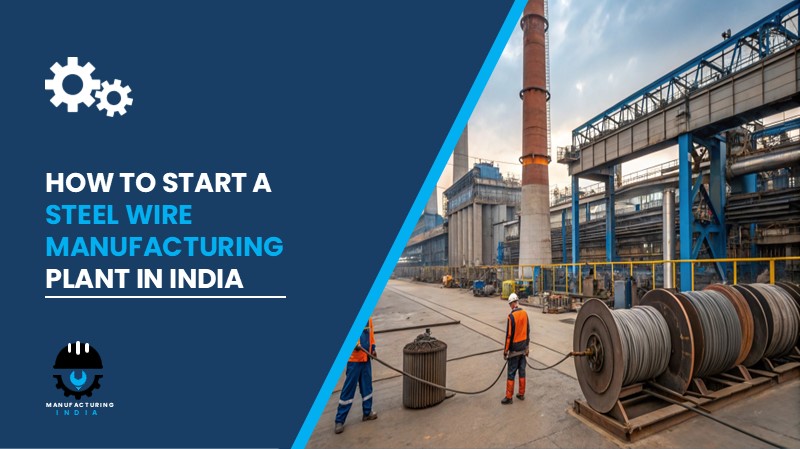
Setting up a steel wire manufacturing plant in India presents a compelling investment case driven by sustained demand from construction, automotive, infrastructure, mining, energy, agriculture, and general manufacturing sectors. The product is a fundamental input for concrete reinforcement, bridge cables, overhead power lines, fencing, springs, and industrial machinery — making it indispensable to the country’s infrastructure backbone. As urbanisation accelerates and India’s industrial base expands, demand for high-tensile, corrosion-resistant, and specialty alloy wire products rises steadily across both established and emerging end-use segments.
India’s unique advantages amplify this opportunity. The country offers cost-competitive land and labour, a deepening domestic supply chain for steel wire rod, and a growing network of industrial estates and SEZs in states such as Gujarat, Maharashtra, Uttar Pradesh, and Rajasthan. Government programmes including Make in India and the PLI scheme for automotive and engineering sectors indirectly stimulate demand for wire products used in reinforcement, cables, and structural applications. For investors seeking a scalable industrial venture with strong downstream linkages, India is a strategically sound location for this production.
India’s steel wire manufacturing opportunity is reinforced by policy tailwinds, cost-competitive operations, and robust demand from construction, automotive, and energy sectors. With gross profit margins ranging between 20–30% and capacity scalable from 50,000 to 150,000 MT annually, the investment demonstrates strong financial viability. The combination of infrastructure-driven demand and local supply chain preferences makes break-even achievable within a realistic operational horizon.
What is Steel Wire?
Steel wire is a versatile, slender metal strand produced by drawing steel rods through progressively smaller dies to reduce their diameter, resulting in high tensile strength and durability. Primarily composed of carbon, alloy, or stainless steel, it is engineered to be flexible — allowing it to be bent, twisted, or braided for diverse applications. It is crucial in construction for reinforcing concrete, in the automotive industry for cables and suspension components, and in manufacturing for fasteners, springs, and fencing. To enhance longevity and resist rust, the product is often coated or galvanized with zinc.
The production method relies on drawing, annealing, galvanizing, stranding, and cabling as primary steps in the steel wire manufacturing process. End-use industries served include construction, automotive, infrastructure, mining, energy, agriculture, and general manufacturing, with applications spanning concrete reinforcement, tire reinforcement, fencing, overhead conductors, springs, and mechanical cables.
Cost of Setting Up a Steel Wire Manufacturing Plant in India
The total investment required for a steel wire manufacturing plant depends on capacity, technology, site location, automation level, and regulatory compliance.
1. Capital Expenditure (CapEx)
Land and Site Development includes land registration, boundary development, internal roads, and drainage. Locating within an industrial estate or SEZ reduces acquisition costs and provides access to shared utilities.
Civil Works and Construction cover the manufacturing shed, raw material storage yard, finished goods warehouse, quality control laboratory, effluent treatment area, and administrative block.
Machinery and Equipment account for the largest single component of total capital expenditure. Key machinery required includes:
- Wire drawing machines
- Continuous annealing furnaces
- Galvanizing lines
- Stranding and bunching machines
- Tension levelers
- Spooling units
- Automated packaging systems
Other Capital Costs include the Effluent Treatment Plant (ETP), pre-operative and commissioning expenses, insurance, and applicable import duties on specialised equipment.
Request a Sample Report for In-Depth Market Insights: https://www.imarcgroup.com/steel-wire-manufacturing-plant-project-report/requestsample
2. Operational Expenditure (OpEx)
Raw Material Cost is the dominant driver, accounting for approximately 80–85% of total OpEx. The primary inputs are steel wire rod and drawing lubricants. Securing long-term supply contracts with reliable rod suppliers is critical to managing price volatility and ensuring production continuity.
Utility Cost forms the next significant component at 10–15% of OpEx. Electricity consumption is particularly high given the energy-intensive nature of the annealing and drawing operations. Water and steam requirements must also be factored in for galvanizing and heat treatment.
Other Operating Costs include transportation, packaging, salaries and wages, routine maintenance, depreciation, and applicable taxes. By the fifth year, total costs are projected to increase substantially due to inflation, market fluctuations, and potential rises in rod input prices.
3. Plant Capacity
The proposed facility is designed with an annual production capacity of 50,000–150,000 MT, enabling economies of scale while maintaining flexibility. Capacity can be customised per investor requirements, and profitability improves with higher utilisation rates.
4. Profit Margins and Financial Projections
The project demonstrates healthy profitability potential. Gross margins typically range 20–30%, with net margins projected at 8–15%. Financial projections cover NPV, IRR, payback period, and break-even analysis — providing a comprehensive view of ROI and long-term sustainability.
Why Set Up a Steel Wire Plant in India?
Crucial Industrial Backbone Demand. Steel wires are fundamental inputs for construction reinforcement, automotive systems, power transmission, fencing, fasteners, springs, cables, and industrial machinery — ensuring a broad and defensible demand base across sectors.
Residential Construction Growth. The residential construction sector expanded at 6.8% during FY2024–25 and is projected to reach USD 350 Billion by 2030. The production is a direct beneficiary, with concrete reinforcement, prestressed strands, and fencing demand rising from housing and commercial projects across Tier 1 and Tier 2 cities.
Infrastructure and Megatrend Alignment. Rapid urbanisation, infrastructure expansion, renewable energy installations, automotive lightweighting, and industrial automation are driving sustained demand for high-tensile specialty wire products. Electric vehicles and industrial equipment create multiple simultaneous demand vectors for a domestic steel wire manufacturing plant.
Policy and Regulatory Tailwinds. Government-led investments in roads, railways, housing, and transmission lines — including PLI schemes for automotive and engineering sectors — indirectly stimulate demand for the product across reinforcement, cables, and structural applications.
Active Industry Investment. In November 2025, United States Steel Corporation outlined its growth plan in partnership with Nippon Steel, targeting approximately USD 14 Billion of U.S. capital with USD 11 Billion to be invested by end of 2028 — signalling strong global confidence in the industry’s long-term outlook.
Local Supply Chain Preference. OEMs, EPC contractors, and infrastructure developers increasingly prefer dependable domestic suppliers to reduce lead times and ensure consistent mechanical properties — creating structural advantages for regional producers.
Manufacturing Process – Step by Step
The steel wire manufacturing process uses drawing, annealing, galvanizing, stranding, and cabling as primary production methods, involving multiple unit operations, material handling stages, and quality checks.
- Raw Material Receipt and Inspection: Steel wire rod is received, inspected for dimensional accuracy and surface quality, and staged for processing.
- Drawing: Rod is pulled through progressively smaller dies using drawing machines to reduce diameter and increase tensile strength.
- Annealing: Drawn product passes through continuous annealing furnaces to relieve internal stresses and restore ductility.
- Galvanizing: Product is passed through galvanizing lines to apply a zinc coating enhancing corrosion resistance.
- Stranding and Cabling: Individual strands are twisted using stranding and bunching machines to produce multi-strand cables and ropes.
- Tension Leveling and Spooling: Tension levelers straighten the product to dimensional tolerances; automated spooling units wind finished product onto reels for dispatch.
- Quality Testing and Packaging: Products are tested against BIS, ASTM, and ISO standards before packaging and dispatch to construction, automotive, energy, and agriculture customers.
Key Applications
The plant serves a broad range of industries across India’s industrial and infrastructure ecosystem:
- Automotive: Reinforcement in tires, control cables, seat structures, and suspension components.
- Construction: Prestressed concrete strands, bridge cables, fencing, and structural reinforcement.
- Energy and Utilities: Overhead power line strands, transmission cables, and support wires.
- Agriculture and Industrial: Baling wire, fencing wire, springs, and general-purpose fastening applications.
Leading Manufacturers
The global market is served by several multinational companies with extensive production capacities. Key players in the industry include:
- ArcelorMittal
- Bekaert
- Kiswire
- WireCo WorldGroup
- Usha Martin
Timeline to Start the Plant
- Feasibility study and project report preparation
- Land acquisition and site development
- Regulatory approvals and environmental clearances
- Factory licence and fire safety compliance
- Machinery procurement and installation
- Raw material supplier agreements and supply chain setup
- Trial production and quality testing
- Commercial production launch
Licences and Regulatory Requirements
Starting a steel wire manufacturing unit in India requires several approvals:
- Business registration (Proprietorship, LLP, or Pvt Ltd)
- Factory Licence under the Factories Act
- Environmental Clearance from State Pollution Control Board
- GST Registration
- Fire Safety NOC
- Hazardous and chemical compliance (applicable given drawing lubricants and galvanizing chemicals)
- Effluent Treatment Plant (ETP) operational clearance
- Occupational Health and Safety compliance
Key Challenges to Consider
High Capital Requirements. Machinery for drawing, annealing, galvanizing, and stranding represents the largest CapEx portion, requiring substantial upfront investment and careful financing to maintain working capital through the ramp-up phase.
Raw Material Price Volatility. Steel wire rod accounts for 80–85% of total operating expenses. Fluctuations in global steel prices can significantly affect unit economics, requiring proactive hedging or long-term supplier agreements.
Regulatory Compliance. Environmental clearances, ETP requirements, hazardous materials handling, and BIS or ASTM certification processes can extend pre-production timelines and add compliance costs.
Technology and Innovation Pressure. Advancements in coating methods and higher tensile strength formulations are driving product innovation globally. Domestic producers must invest in process upgrades to serve premium OEM customers.
Competition from Established Players. The presence of ArcelorMittal, Bekaert, Kiswire, WireCo WorldGroup, and Usha Martin means new entrants must differentiate on quality, lead time, or regional supply reliability.
Skilled Manpower. Operating drawing machines, galvanizing lines, and quality testing equipment requires technically trained personnel, making talent acquisition and retention a key operational priority.
Frequently Asked Questions
1. How much does it cost to set up this type of plant in India?
The total setup cost depends on capacity, technology, location, and automation. It covers land, civil works, machinery including drawing machines and galvanizing lines, and pre-operative expenses. A detailed CapEx and OpEx breakdown is available via the IMARC Group project report.
2. Is steel wire manufacturing profitable in India in 2026?
Yes. Gross margins typically range 20–30% and net margins 8–15%, supported by stable demand and growing domestic sourcing preference across construction, automotive, and energy end-users.
3. What machinery is required for a steel wire plant in India?
Key equipment includes drawing machines, continuous annealing furnaces, galvanizing lines, stranding and bunching machines, tension levelers, spooling units, and automated packaging systems.
4. What licences and approvals are required to start a steel wire plant in India?
Required approvals include business registration, Factory Licence, Environmental Clearance from the State Pollution Control Board, GST Registration, Fire Safety NOC, ETP clearance, hazardous materials compliance, and Occupational Health and Safety compliance.
5. What raw materials are needed for steel wire manufacturing?
The primary inputs are steel wire rod and drawing lubricants. Rod is the dominant cost component at 80–85% of total operational expenses.
6. What are the environmental compliance requirements for a steel wire plant in India?
Plants must obtain Environmental Clearance, operate a compliant ETP, manage drawing lubricants and galvanizing chemicals responsibly, and adhere to emission standards and effluent discharge norms.
7. What is the best location to set up a steel wire plant in India?
Ideal locations offer proximity to rod suppliers, reliable transport and utility infrastructure, industrial land within an SEZ or estate, and access to construction or automotive OEM clusters.
8. What is the break-even period for this type of plant in India?
The break-even period depends on capacity utilisation, pricing strategy, and cost management. Detailed payback period, NPV, and IRR projections are available in the IMARC Group project report.
9. What government incentives are available for manufacturers in India?
Manufacturers can access PLI scheme benefits for automotive and engineering sectors, SEZ tax holidays, state capital subsidies, and interest subsidies under central and state industrial promotion programmes.
Key Takeaways for Investors
A steel wire manufacturing plant in India represents a well-grounded industrial investment with broad exposure to high-growth sectors including construction, automotive, energy, infrastructure, mining, and agriculture. The financial structure is viable across a range of production capacities, with gross margins of 20–30% and net margins of 8–15% providing resilience against input cost fluctuations. The global market was valued at USD 120.76 Billion in 2025 and is projected to reach USD 204.02 Billion by 2034 at a CAGR of 6.0% — directly benefiting domestic producers serving India’s expanding infrastructure and manufacturing base. With policy support, a deepening local supply chain, and rising OEM preference for domestic sourcing, demand sustainability for quality wire production in India is structurally intact for the decade ahead.
About the Author