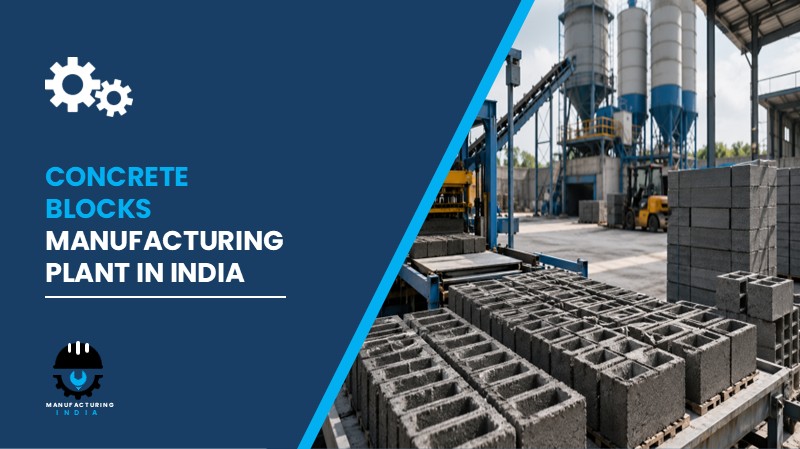
Setting up a concrete blocks manufacturing plant in India presents a compelling investment case at a time when the country’s construction sector is in one of the most sustained expansion phases in its history — driven by the government’s ambitious housing programmes, rapid urbanisation, smart city initiatives, industrial corridor development, and infrastructure investment that collectively constitute the most favourable environment for building materials manufacturers that India has ever offered. Concrete blocks — the precast building units manufactured by compacting a mixture of cement, aggregates, sand, and water into standardised moulds — are rapidly displacing traditional clay bricks as the preferred masonry material across India’s residential, commercial, and infrastructure construction activity, valued for their superior compressive strength, dimensional accuracy, fire resistance, thermal insulation properties, faster construction speed, and reduced mortar consumption. As India’s construction pipeline deepens and modernises, and as contractors and developers seek faster, more consistent, and more cost-effective walling solutions, the domestic requirement for machine-produced, quality-certified concrete blocks is growing into one of the country’s most commercially accessible and demand-stable building materials manufacturing investments.
India’s construction sector data confirms the exceptional scale and growth momentum of this opportunity. The residential construction sector in India expanded at 6.8% during FY2024–25 and is projected to reach USD 350 Billion by 2030 per industrial reports — a scale of expansion that will require enormous volumes of masonry walling material, with concrete blocks positioned to capture a rapidly growing share as the preference for standardised, machine-produced building products deepens across both organised developers and government housing programmes. The PM Awas Yojana (Urban and Gramin), Bharatmala highway infrastructure programme, industrial corridor projects, and smart city initiatives together constitute a government procurement machine for construction materials that provides a demand floor for concrete block producers across every state. The locational supply advantage of concrete blocks — due to transportation cost sensitivity, concrete blocks are typically produced near construction zones — creates strong opportunities for regional manufacturers with optimised logistics and proximity to active construction markets.
Investing in a concrete blocks manufacturing plant in India today aligns rapid urbanisation, government housing and infrastructure investment, the shift from clay bricks to standardised precast walling materials, and a global concrete blocks market growing from USD 10.17 Billion in 2025 to USD 13.85 Billion by 2034 at a CAGR of 3.49%. With gross profit margins of 30–40% and net profit margins of 12–20% at annual production capacities of 5–20 million blocks, the unit economics are commercially attractive, and the investment’s proximity-advantage business model supports reliable, long-term returns.
What are Concrete Blocks?
Concrete blocks are precast building units manufactured by compacting a mixture of cement, aggregates, sand, and water into standardised moulds. These blocks are produced in solid, hollow, and interlocking configurations to meet diverse structural and non-structural construction needs across residential, commercial, and infrastructure applications. Concrete blocks are valued for their high compressive strength, dimensional accuracy, fire resistance, and thermal insulation properties, delivering faster construction speed, reduced mortar consumption, and improved structural stability compared to traditional clay bricks.
Their uniform dimensions enable precise, consistent brickwork with minimal on-site cutting waste, supporting faster project timelines and reducing labour costs on large construction projects. Hollow block configurations provide embedded conduit pathways for electrical and plumbing installations and reduce masonry dead load on structural systems without compromising wall strength. The availability of fly ash, slag, and other supplementary cementitious material variants improves sustainability credentials and reduces cement consumption per block while maintaining strength requirements — a product innovation direction that aligns with green building standards gaining commercial traction in India’s organised real estate sector. Owing to their durability and cost efficiency, concrete blocks are widely used in load-bearing walls, partition walls, boundary walls, and paving applications across India’s entire construction value chain.
The primary manufacturing process covers batching, mixing, moulding, vibration compaction, curing, and stacking. End-use industries served include residential construction, commercial buildings, and infrastructure development. Applications span load-bearing walls, partition walls, retaining walls, boundary walls, and paving structures.
Cost of Setting Up a Concrete Blocks Manufacturing Plant in India
The cost of establishing a concrete blocks manufacturing plant in India depends on plant capacity in blocks per year, automation level from manual through semi-automatic to fully automatic block-making machines, product mix across solid, hollow, and interlocking block types, geographic location — particularly proximity to cement, aggregate, and sand supply and active construction market zones — and the BIS quality compliance requirements applicable to concrete blocks sold to residential, commercial, and infrastructure construction customers.
1. Capital Expenditure (CapEx)
Land and Site Development forms a foundational component of total capital investment, covering land acquisition charges, site registration, boundary development, hardstanding for green-area curing, drainage infrastructure, and site utilities. The location must offer easy access to key raw materials such as cement, sand, aggregate, and water. Proximity to target construction markets is a uniquely important site selection criterion for concrete blocks compared to most manufacturing investments — because blocks are heavy and bulky relative to their value, transportation costs rise rapidly with distance, creating a natural geographic market radius of typically 50–100 km for economically competitive supply. Sites near large active construction zones in state capital peripheral development areas, industrial corridors, or smart city project districts provide the most commercially advantaged operating environments. The site must have robust infrastructure including reliable heavy-load transportation, utilities, and waste management systems, and must comply with local zoning laws and environmental regulations.
Plant Layout Optimisation is critical for a concrete blocks facility. The layout must be optimised to enhance workflow efficiency, safety, and minimise material handling across the batching, mixing, moulding, curing, and dispatch sequence. Separate areas for cement, sand, and aggregate raw material storage with covered weather protection, the batching and mixing plant, block-making and vibration compaction operations, green-area curing racks, finished block stacking and storage yards, quality control testing area, and dispatch loading docks must be designated. Curing area — which requires significant open land for the multi-day curing period — is typically the largest space requirement in a concrete block plant layout.
Machinery and Equipment represent the largest single component of total CapEx for a concrete blocks manufacturing plant. Essential equipment includes:
- Batching plants
- Mixers
- Block moulding machines
- Vibrators
- Curing racks
- Cubers
- Pallet wrapping systems
Other Capital Costs include an effluent treatment plant (ETP) to minimise environmental impact and ensure compliance with standards for cement-contaminated process water, dust collection for cement and aggregate handling areas, pre-operative expenses, BIS certification costs, commissioning charges, and any import duties on fully automated block-making machines not available domestically at the required cycle speed and mould configuration.
Request a Sample Report for In-Depth Market Insights: https://www.imarcgroup.com/concrete-blocks-manufacturing-plant-project-report/requestsample
2. Operational Expenditure (OpEx)
Raw Material Cost is the overwhelmingly dominant operational expense, accounting for approximately 60–70% of total OpEx. The primary raw materials are cement, sand, aggregate, and water. Cement — as the binding agent consumed in the largest value quantities and the primary determinant of block strength and durability — drives the majority of raw material cost and is priced in correlation with domestic clinker production economics and coal costs. Coarse aggregate and sand are geographically sourced inputs whose procurement cost depends heavily on site proximity to quarries and river sand sources or manufactured sand (M-sand) producers. Water is consumed in both mixing and curing stages. Long-term contracts with reliable suppliers for cement and aggregate must be negotiated to stabilise pricing and ensure a steady supply, with M-sand increasingly adopted as a controlled-quality substitute for natural river sand where river sand availability is constrained.
Utility Cost is the second-largest OpEx component, representing approximately 10–15% of total operating expenses, covering electricity for batching plant motors, mixers, block-making machine hydraulic and vibration systems, conveyors, and general plant operations. Steam curing or accelerated curing systems, where installed for production volume optimisation, add an additional fuel or electricity utility requirement that improves throughput capacity at the expense of higher utility cost per block.
Other Operating Costs include transportation and distribution of finished blocks to construction project sites — which given blocks’ weight and volume typically involves owned or contracted tipper trucks operating within the economic radius — packaging and palletising costs, salaries and wages for plant operators and quality control staff, routine machinery maintenance including mould replacement and mixer lining upkeep, BIS certification and audit costs, depreciation on production equipment, and applicable taxes. By the fifth year, the total operational cost is expected to increase substantially due to factors such as inflation, market fluctuations, and potential rises in the cost of key materials. Additional factors, including supply chain disruptions, rising consumer demand, and shifts in the global economy, are expected to contribute to this increase.
3. Plant Capacity
The proposed manufacturing facility is designed with an annual production capacity ranging between 5 million and 20 million blocks, enabling economies of scale while maintaining operational flexibility across solid blocks, hollow blocks, and interlocking paving blocks for diverse construction application requirements. Plant capacity can be customised per investor requirements and scaled through additional block-making machines and expanded curing area as construction market demand and customer relationships develop. Profitability improves with higher capacity utilisation, making established supply relationships with large residential developers, government housing project contractors, or industrial construction companies a strategic commercial foundation from the outset.
4. Profit Margins and Financial Projections
The financial projections for a concrete blocks manufacturing plant demonstrate healthy profitability potential under normal operating conditions. Gross profit margins typically range between 30–40%, supported by stable demand and value-added applications across residential, commercial, and infrastructure construction sectors. Net profit margins are projected at 12–20% — commercially attractive returns that reflect the meaningful value-added production of standardised, quality-certified masonry units from bulk raw material inputs at scale. A comprehensive financial analysis covering NPV, IRR, payback period, and five-year projections is essential before committing capital, with break-even typically ranging from 4 to 8 years depending on scale, regulatory compliance costs, raw material pricing, and market demand.
Why Set Up a Concrete Blocks Manufacturing Plant in India?
Essential Construction Material with Constant Market Demand. Concrete blocks are fundamental components in modern construction due to their structural strength, fire resistance, and cost-effectiveness, making them indispensable for urban development and infrastructure expansion. As a necessity-category building material consumed in every residential, commercial, and infrastructure construction project, concrete blocks enjoy non-cyclical, structurally recurrent demand that provides commercial resilience across economic cycles unlike most manufacturing investment categories.
Residential Construction Sector at USD 350 Billion by 2030 Driving Masonry Demand. The residential construction sector in India expanded at 6.8% during FY2024–25 and is projected to reach USD 350 Billion by 2030. This sustained sectoral growth — driven by PM Awas Yojana housing targets, organised real estate development, and India’s continuing urbanisation — creates an enormous and growing masonry material demand that concrete block producers located near active construction zones can capture with significant logistical cost advantages over distant suppliers.
Megatrend Alignment with Urbanisation, Smart Cities, and Infrastructure Investment. Rapid urbanisation, smart city initiatives, affordable housing programs, and industrial corridor development are driving sustained demand for efficient masonry materials. Government investments in transportation infrastructure, industrial development, commercial real estate, and domestic building material production initiatives are indirectly strengthening demand for concrete blocks. Asia-Pacific — of which India is the most dynamically growing large economy — remains the dominant and fastest-growing region for concrete blocks, driven by large-scale residential projects and government-backed infrastructure initiatives.
Technological Advancement and Innovation Expanding Market. In September 2025, Cemex introduced its ReadyBlock Lite concrete blocks to the UK market, an ultra-lightweight concrete block with a density of 950 kg/m³ — further expanding its concrete solutions offering and demonstrating the active product innovation in lightweight, high-performance concrete block variants that are gaining commercial traction in premium construction segments. Technological advancements in automated block-making machines and curing techniques are improving production efficiency and product consistency, further enhancing profitability for organised manufacturers who invest in current-generation automated plant technology.
Localised Supply Advantage Creating Defensible Market Positioning. Due to transportation cost sensitivity, concrete blocks are typically produced near construction zones, creating strong opportunities for local manufacturers with optimised logistics. This proximity advantage is a commercially distinctive feature of concrete block manufacturing relative to most other building materials — it creates a natural geographic market protection that rewards locally positioned producers with cost advantages over distant competitors that no amount of production scale can fully overcome. Organised manufacturers with consistent quality, reliable delivery, and competitive logistics serve local construction markets with durable competitive advantages.
Policy Push for Standardised Construction Materials Accelerating Brick-to-Block Transition. The growing preference for factory-produced, standardised building materials is encouraging the shift from traditional clay bricks to concrete blocks due to better strength-to-weight ratio and construction efficiency. Government green building norms, BIS quality standards for masonry materials, and the preference of large organised developers for pre-certified, dimensionally accurate walling materials are collectively accelerating the market transition from unorganised clay brick supply to organised concrete block production that benefits scale-capable, quality-focused manufacturers.
Manufacturing Process — Step by Step
The concrete blocks manufacturing process uses batching, mixing, moulding, vibration compaction, curing, and stacking as the primary production method. Each stage requires controlled mix proportions, vibration energy management, and adequate curing to produce concrete blocks meeting the compressive strength, dimensional accuracy, and water absorption specifications required under IS 2185 for India’s residential, commercial, and infrastructure construction customers.
- Raw Material Receipt and Batching: Cement, coarse aggregate, fine aggregate (sand or M-sand), and water are received from certified suppliers, quality-checked for specification compliance, and batched in the specified mix proportions — typically determined by the target block compressive strength grade — using batching plants that weigh each ingredient to the required accuracy for consistent batch-to-batch product quality.
- Mixing: Batched dry ingredients are combined in mixers with the controlled water addition to produce a uniform, semi-dry concrete mix of the target consistency — typically zero-slump or near-zero-slump — appropriate for the block-making machine’s vibration compaction process. Mixing time and intensity are controlled to achieve full cement hydration and aggregate coating without introducing excess water that would compromise block strength.
- Moulding and Vibration Compaction: The prepared concrete mix is fed into block moulding machines where it fills the mould cavities for the specified block type — solid, hollow, or interlocking — and is compacted by vibrators that consolidate the mix, remove air voids, and achieve the target bulk density and dimensional accuracy in the moulded block. Vibration frequency, amplitude, and duration are controlled to maximise compaction without segregating the aggregate.
- Demoulding and Green-State Handling: Freshly moulded blocks are demolded from the block-making machine onto pallets and transferred to curing racks on wheeled curing cars, with careful handling to avoid damage to the green-state blocks before they develop handling strength through initial hydration.
- Curing: Demoulded blocks on curing racks are cured under controlled moisture conditions — either ambient water curing by spraying or mist humidification, or steam curing in enclosed chambers for accelerated strength development — for the specified curing period to achieve the target compressive strength required by the block grade being produced.
- Stacking and Quality Inspection: Cured blocks are inspected for dimensional accuracy, surface quality, and compressive strength sampling compliance against IS 2185 specifications, with blocks passing quality inspection stacked in uniform piles on pallets using cubers for efficient storage and transport loading.
- Pallet Wrapping and Dispatch: Finished pallet-stacked blocks are wrapped using pallet wrapping systems where specified for protected long-distance transport, then loaded onto trucks for dispatch to residential construction projects, commercial building sites, infrastructure contractors, and building materials dealers within the plant’s economic distribution radius.
Key Applications
Concrete blocks manufactured in India serve the complete spectrum of masonry walling and structural applications across India’s construction economy:
- Residential Construction: Load-bearing and non-load-bearing walls, foundations, and partition systems for apartments, individual houses, and housing society developments across India’s rapidly expanding residential construction pipeline.
- Commercial Buildings: Structural walls, facades, and fire-rated wall systems for office buildings, retail complexes, hotels, and commercial infrastructure across India’s expanding organised commercial real estate sector.
- Infrastructure Projects: Retaining walls, boundary walls, utility enclosures, and structural walling for highways, bridges, industrial parks, and government infrastructure projects across India’s public capital expenditure programmes.
- Landscaping and Hardscaping: Garden walls, fencing systems, and decorative architectural features for residential communities, institutional campuses, and commercial properties.
Leading Manufacturers
The global concrete blocks industry is served by a group of large multinational construction materials companies and domestic producers with extensive production capacities. Key players in the global market include:
- CRH plc
- CEMEX S.A.B. de C.V.
- Holcim Group
- Boral Limited
- Oldcastle Infrastructure
Timeline to Start the Plant
Establishing a concrete blocks manufacturing plant in India involves a structured multi-phase development sequence. Usually, the timeline can range from 12 to 24 months to start this type of plant, depending on factors like site development, machinery installation, environmental clearances, safety measures, and trial runs. Investors should plan for the following phases:
- Feasibility study and project report preparation
- Land acquisition and site development
- Regulatory approvals and environmental clearances
- Factory licence and fire safety compliance
- Machinery procurement and installation
- Raw material supplier agreements and supply chain setup
- Trial production and quality testing
- Commercial production launch
Licences and Regulatory Requirements
Starting a concrete blocks manufacturing unit in India requires several approvals spanning business registration, product quality certification, environmental, and industrial safety compliance domains:
- Business registration (Proprietorship, LLP, or Pvt Ltd)
- Factory Licence under the Factories Act
- Environmental Clearance from the State Pollution Control Board
- GST Registration
- Fire Safety NOC
- BIS licence under IS 2185 applicable to concrete masonry units where BIS certification is required for government project supply and organised construction sector procurement
- Mining-linked aggregate and sand procurement compliance under applicable state mineral and sand extraction regulations
- Effluent Treatment Plant (ETP) operational clearance to minimise environmental impact and ensure compliance with emission standards for cement-contaminated process water from mixing and curing operations
- Occupational Health and Safety compliance including cement dust exposure monitoring and prevention measures
Key Challenges to Consider
Cement Price Volatility and Raw Material Cost Concentration. Cement accounts for approximately 60–70% of total OpEx as the primary binder consumed in every block, with pricing tied to clinker production economics, coal and petcoke costs, and domestic cement industry supply-demand cycles that can move cement prices 15–25% within a year. Managing this cost exposure requires long-term procurement agreements with cement suppliers, efficient mix design optimisation to reduce cement content without compromising strength, and customer contract pricing that allows for cement price adjustments.
Transportation Cost Radius Limiting Market Geography. The transportation cost sensitivity of concrete blocks — heavy and bulky relative to their selling price — limits the economic distribution radius and therefore the addressable market geography of any individual plant. Locating the plant in a high-density construction activity zone is essential for achieving the capacity utilisation rates that support target profitability. Investors must conduct careful market demand assessment within the 50–100 km economic radius before committing to a site location.
Sand and Aggregate Supply and Regulatory Compliance. River sand procurement is subject to state government regulation, environmental restrictions, and availability constraints in many Indian states, creating supply chain complexity and cost variability for concrete block producers dependent on natural river sand. Building M-sand procurement relationships with established manufactured sand quarry operators in the region provides a compliant, consistent-quality alternative that removes regulatory supply chain risk.
BIS Certification and Quality Consistency for Organised Construction. Supplying concrete blocks to government housing projects, large residential developers, and commercial construction contractors typically requires BIS certification under IS 2185, which involves product testing at BIS-accredited laboratories, factory assessment, and ongoing surveillance. Maintaining consistent compressive strength and dimensional accuracy across production batches demands reliable batching accuracy, controlled mix water content, and systematic curing management — quality disciplines that require trained operators and calibrated equipment.
Competition in a Fragmented and Locally Contested Market. India’s concrete block manufacturing market is served by a combination of large automated plants operated by building materials companies, medium-scale regional producers, and small-scale semi-manual units — all competing for construction project supply within overlapping geographic radius zones. New entrants must differentiate through product quality consistency, delivery reliability, competitive pricing, and the customer service responsiveness that larger players may not provide to smaller construction contractors.
Skilled Manpower for Block-Making and Quality Operations. Maintaining consistent vibration compaction quality, mix proportions, and curing discipline across multi-shift production operations requires trained plant operators and quality control personnel — a workforce requiring ongoing investment in technical training and supervision to maintain the production consistency that OEM and government project specifications demand.
Frequently Asked Questions
1. How much does it cost to set up a concrete blocks manufacturing plant in India?
Capital requirements generally include land acquisition, construction, equipment procurement, installation, pre-operative expenses, and initial working capital. Equipment costs — for batching plants, mixers, block moulding machines, vibrators, curing racks, cubers, and pallet wrapping systems — represent a significant portion of capital expenditure. The total amount varies with capacity, automation level, and location. A detailed project report with full CapEx and OpEx breakdowns is available on request.
2. Is concrete blocks manufacturing profitable in India in 2026?
Yes. The project demonstrates gross profit margins of 30–40% and net profit margins of 12–20% under normal operating conditions, supported by India’s residential construction sector expanding at 6.8% in FY2024–25 toward USD 350 Billion by 2030, government housing and infrastructure programmes, and the ongoing shift from clay bricks to standardised concrete blocks across organised construction. The global market growing from USD 10.17 Billion in 2025 to USD 13.85 Billion by 2034 at a 3.49% CAGR confirms sustained commercial opportunity.
3. What machinery is required for a concrete blocks manufacturing plant in India?
Key machinery includes batching plants, mixers, block moulding machines, vibrators, curing racks, cubers, and pallet wrapping systems. Block moulding machines — ranging from manual through semi-automatic to fully automatic configurations — are the most production-critical equipment, determining throughput capacity, product consistency, and the range of block types and sizes the facility can produce.
4. What licences and approvals are required to start a concrete blocks plant in India?
Required approvals include business registration, a Factory Licence under the Factories Act, Environmental Clearance from the State Pollution Control Board, GST registration, a Fire Safety NOC, BIS licence under IS 2185 for organised construction project supply, aggregate and sand procurement compliance under state mineral regulations, ETP operational clearance, and Occupational Health and Safety compliance.
5. What raw materials are needed for concrete blocks manufacturing?
The primary raw materials are cement, sand, aggregate, and water. Cement accounts for approximately 60–70% of total operating expenses, making cement procurement strategy, mix design optimisation, and supplier relationship management the most critical cost management levers. Long-term contracts with reliable suppliers will help mitigate price volatility and ensure a consistent supply of materials.
6. What are the environmental compliance requirements for a concrete blocks plant in India?
The unit must obtain Environmental Clearance from the State Pollution Control Board, operate a certified ETP to minimise environmental impact and ensure compliance with emission standards for cement-contaminated process water, implement dust collection for cement and aggregate handling areas, comply with state mineral procurement regulations for sand and aggregate sourcing, and maintain monitoring systems for wastewater discharge in line with applicable state pollution control standards.
7. What is the best location to set up a concrete blocks plant in India?
Optimal locations offer proximity to active construction markets within 50–100 km economic distribution radius, reliable cement and aggregate supply, access to water for mixing and curing, heavy-load transportation infrastructure, and compliance-ready regulatory environments. Active construction zones near state capital peripheral developments, industrial corridors, smart city project districts, and government housing programme construction sites are among the most commercially advantaged options.
8. What is the break-even period for this type of plant in India?
Break-even in a concrete blocks manufacturing business typically ranges from 4 to 8 years, depending on scale, regulatory compliance costs, raw material pricing, and market demand. Efficient manufacturing, strong local distribution logistics, and export opportunities can help accelerate returns.
9. What government incentives are available for manufacturers in India?
Governments may offer incentives such as capital subsidies, tax exemptions, reduced utility tariffs, export benefits, or interest subsidies to promote manufacturing under various national or regional industrial policies. State-level building materials manufacturing incentives, MSME development schemes, and preferential procurement provisions for BIS-certified concrete blocks under government housing and infrastructure programmes provide direct and indirect financial support for this investment category.
Key Takeaways for Investors
A concrete blocks manufacturing plant in India represents one of the most commercially accessible, proximity-advantage-protected, and demand-stable building materials manufacturing investments available in the country’s construction sector — anchored by India’s residential construction sector growing at 6.8% in FY2024–25 toward USD 350 Billion by 2030, government housing and infrastructure programmes creating sustained public procurement demand, and the structural shift from unorganised clay brick to standardised factory-produced concrete masonry that is accelerating across India’s organised construction sector. The project demonstrates financial viability across annual production capacities of 5–20 million blocks, with gross profit margins of 30–40% and net profit margins of 12–20% confirming commercially attractive unit economics supported by the meaningful value-added production of specification-certified masonry units from bulk commodity raw material inputs at scale. The global concrete blocks market, valued at USD 10.17 Billion in 2025, is projected to reach USD 13.85 Billion by 2034 at a CAGR of 3.49%, with Asia-Pacific — led by India’s construction growth — remaining the dominant regional market. With Cemex’s September 2025 ReadyBlock Lite ultra-lightweight concrete block launch demonstrating ongoing product innovation, India’s massive government housing and infrastructure commitments sustaining institutional demand, and the proximity advantage of local production creating durable competitive positioning within each plant’s geographic market radius, demand sustainability for India-based concrete blocks manufacturing is structurally robust, policy-supported, and commercially compelling across the full investment horizon.
About the Author