Setting up a sintered bearing manufacturing plant in India represents a highly attractive investment proposition underpinned by robust and structurally growing demand from the automotive and transportation sector, the industrial machinery and equipment industry, the electrical appliances segment, and the consumer goods manufacturing space. As global vehicle production expands, factory automation deepens, and equipment makers increasingly favour compact, low-maintenance motion components over conventionally machined parts, sintered bearings occupy an increasingly important position across engine and drivetrain assemblies, industrial machines, household appliances, and small motors. This growth trajectory, combined with the powder metallurgy route’s comparatively moderate capital intensity and strong scope for product customisation, creates a highly favourable manufacturing environment for new entrants with efficient compaction, sintering, and quality systems.
What is Sintered Bearing?
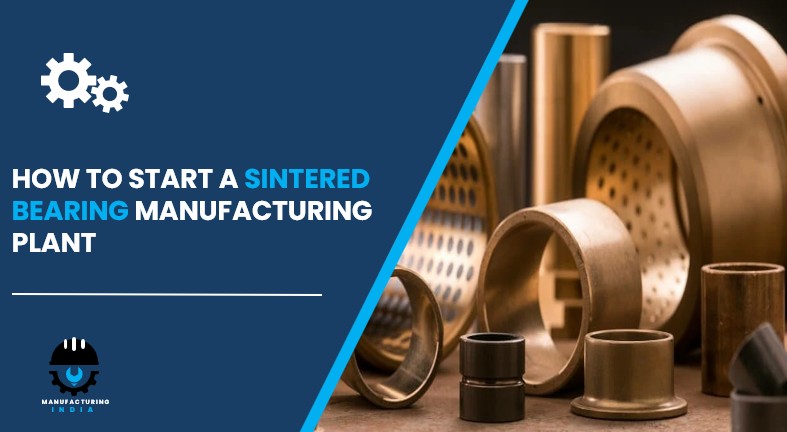
A sintered bearing is a self-lubricating, porous metal bearing produced through the powder metallurgy route from blends of iron, copper, graphite, alloying elements, and impregnated lubricants, and supplied ready to install for supporting rotating shafts with minimal need for additional machining. The porous internal structure retains lubricant within the bearing body itself, allowing it to deliver load-carrying capacity, frictional performance, and operating life comparable to conventionally machined bearings while substantially reducing installation and finishing time.
Sintered bearings are manufactured and sold across several principal types, including iron-based, bronze-based, oil-impregnated, self-lubricated, stainless steel, and specialty grades engineered for corrosion resistance or elevated-temperature service. Beyond their traditional use in supporting rotational shafts, these bearings are widely adopted for automated and semi-automated assembly across large-scale industrial machinery as well as compact household appliances and small motors, owing to their durability and ease of handling.
China alone is estimated to account for approximately 24-27% of the global sintered bearing market, reflecting its scale in both powder metallurgy component manufacturing and downstream automotive and appliance assembly. Demand for sintered bearings globally continues to be shaped by the push toward compact mechanical designs, expanding automation across manufacturing units, and the need for standardised, cost-efficient motion components across a wide range of industries.
Cost of Setting Up a Sintered Bearing Manufacturing Plant
The total capital investment required to establish a sintered bearing manufacturing plant is shaped by several key parameters: annual production capacity (typically ranging from 500 to 5,000 MT per annum), the degree of automation across powder mixing, compaction, and sintering sections, facility specification, raw material sourcing strategy, and applicable industrial and quality certification requirements. Below is a structured breakdown of the major cost components.
1. Capital Expenditure (CapEx)
Total capital investment in a sintered bearing manufacturing plant covers the following major heads:
Land and Site Development
This encompasses land acquisition or lease, site preparation, boundary development, and utilities connectivity. Site selection should prioritise proximity to metal powder and lubricant suppliers to ensure a steady, low-transport-cost input supply, along with strong road and rail logistics for inbound raw materials and outbound finished bearings. Access to reliable power and process gas infrastructure for sintering operations, availability of a trained workforce for plant operations and quality control, and compliance with industrial zoning regulations, factory safety norms, and effluent and emission compliance frameworks must be assessed from project initiation.
Civil Works and Construction
Building costs cover the main processing facility including the raw material storage and handling area, powder mixing and blending section, compaction press house, sintering furnace area, sizing and inspection section, packaging and dispatch infrastructure, quality control laboratory, administrative block, and utility infrastructure including power backup, protective atmosphere gas systems, cooling systems, and effluent treatment plant. Construction must comply with applicable factory act requirements and industrial safety norms for pressing and high-temperature sintering operations.
Machinery and Equipment
Machinery represents the single largest CapEx component. Key equipment required for a sintered bearing manufacturing plant includes:
- Raw Material Handling Systems: Storage silos, conveying equipment, and weighing and batching units for metal powders including copper, iron, tin, and graphite
- Powder Mixing and Blending Equipment: Mixers or blenders that homogenise metal powders with lubricants to achieve a consistent composition prior to compaction
- Compaction Presses: Mechanical or hydraulic presses that compress the blended powder into the required bearing shape (the green compact) under precisely controlled pressure
- Sintering Furnaces: Continuous or batch furnaces operating under a protective atmosphere of nitrogen and hydrogen that bond the compacted powder particles metallurgically, using sintering trays to convey components through the furnace
- Sizing and Calibration Equipment: Precision sizing presses that restore dimensional accuracy and surface finish to sintered components after the sintering shrinkage
- Oil Impregnation Systems: Vacuum impregnation units used to infuse porous bearing bodies with lubricating oil for self-lubricating, oil-impregnated bearing grades
- Quality Inspection Equipment: Dimensional measurement instruments, density testing equipment, and other analytical tools to verify compliance with load-bearing and tolerance specifications
- Automated Packaging Lines: Filling, labelling, and cartoning equipment for retail and bulk industrial packaging of finished bearings
- Material Handling and Warehousing: Conveyors, bins, and finished goods warehousing with organised stock management for raw powders and finished components
Other Capital Costs
These include pre-operative expenses, commissioning charges, import duties on specialised compaction and sintering equipment, staff training and competency development, initial raw material and consumable inventory for production commissioning, and quality management system establishment costs including ISO 9001:2015 certification.
Request a Sample Report for In-Depth Market Insights: https://www.imarcgroup.com/sintered-bearing-manufacturing-plant-project-report/requestsample
2. Operational Expenditure (OpEx)
Raw materials principally metal powders (copper, iron, tin, and graphite), lubricants for powder blending, sintering trays, and protective atmosphere gases such as nitrogen and hydrogen constitute the dominant operating cost, typically representing 45-60% of total OpEx. Utility costs, driven primarily by electricity consumption of compaction presses and sintering furnaces, account for 20-30% of OpEx. Labour, maintenance, quality control, packaging, transportation, depreciation, taxes, and overhead costs constitute the remainder of the operating cost base.
3. Plant Capacity
The proposed sintered bearing manufacturing facility is designed with an annual production capacity ranging between 500-5,000 MT, enabling economies of scale while maintaining operational flexibility. This capacity range supports a diversified product portfolio spanning iron-based, bronze-based, oil-impregnated, self-lubricated, stainless steel, and specialty bearing grades, serving the automotive and transportation industry, industrial machinery and equipment sector, electrical appliances industry, and consumer goods manufacturing segment.
4. Profit Margins and Financial Projections
The project demonstrates healthy profitability potential under normal operating conditions. Financial projections encompass capital investment, operating costs, capacity utilisation ramp-up schedule, product mix across bearing grades, and forward demand outlook underpinned by rising automotive production and industrial automation. A comprehensive feasibility analysis includes sensitivity analysis, Net Present Value (NPV), Internal Rate of Return (IRR), and Payback Period calculations. Gross profit margins for sintered bearing manufacturing typically range from 25-30%, supported by stable demand, value-added product customisation, and efficient raw material utilisation, with net profit margins of 10-20% achievable with disciplined cost management and optimal capacity utilisation.
Why Set Up a Sintered Bearing Manufacturing Plant?
Growing Demand for Compact Mechanical Systems
Equipment designers across automotive, industrial machinery, and consumer appliance segments increasingly favour compact, pre-finished components that support faster assembly with minimal on-site machining. Sintered bearings, supplied ready to install with consistent tolerances, are well aligned with this shift toward efficient, space-saving mechanical designs, supporting steady volume growth across a broad base of end-use industries.
Consistency and Quality Control Advantages
The powder metallurgy process allows precise control over material composition, enabling manufacturers to consistently deliver bearings with uniform load capacity, friction characteristics, and operating life across production batches. This consistency is particularly valued by original equipment manufacturers seeking to standardise motion components across large production runs.
Expanding Automotive and Industrial Sector Demand
The rising number of vehicles, industrial machines, and automated devices in use globally is driving sustained demand for standardised motion components such as sintered bearings. According to NITI Aayog’s vision for the Indian automotive sector, automotive component production is targeted to grow to USD 145 Billion, with exports tripling from USD 20 Billion to USD 60 Billion by 2030, illustrating the scale of downstream demand growth available to component manufacturers including sintered bearing producers.
Product Customisation Opportunities
Manufacturers are able to develop application-specific, performance-graded, and specialty bearing variants including corrosion-resistant and high-temperature grades tailored to the varied technical requirements of different customer segments, supporting differentiated product positioning and improved margin capture relative to commodity-grade output.
Scalable and Cost-Efficient Production
The powder metallurgy process underlying sintered bearing manufacturing requires comparatively moderate capital investment relative to many other precision component manufacturing routes, while supporting a scalable production model with efficient inventory management. This allows new entrants to commence operations at a moderate scale and expand capacity as order volumes and customer relationships develop.
Manufacturing Process Overview
The sintered bearing manufacturing operation transforms metal powders into finished, self-lubricating bearing components through a sequence of batching, mixing, compaction, sintering, sizing, and packaging operations. The key process stages are:
- Raw Material Weighing and Batching: Metal powders including copper, iron, tin, and graphite are precisely weighed and batched according to the target alloy composition for the bearing grade being produced.
- Powder Mixing and Homogenisation: Batched powders are blended with lubricants in mixing equipment to achieve a homogeneous mixture, ensuring uniform composition and flow characteristics ahead of compaction.
- Compaction: The homogenised powder blend is compressed under controlled pressure in mechanical or hydraulic presses to form a green compact with the approximate final bearing shape and dimensions.
- Sintering: Green compacts are conveyed through sintering furnaces on sintering trays under a protective atmosphere of nitrogen and hydrogen, where controlled heating metallurgically bonds the powder particles, forming a strong, porous bearing structure.
- Sizing and Calibration: Sintered components undergo a precision sizing operation to correct dimensional variation arising from sintering shrinkage, restoring tight tolerances and surface finish required for bearing fit and function.
- Oil Impregnation (where applicable): For oil-impregnated and self-lubricated grades, sized bearings are vacuum-impregnated with lubricating oil, which is retained within the porous bearing structure to provide continuous, maintenance-free lubrication in service.
- Quality Inspection: Finished bearings are tested for dimensional accuracy, density, and load-bearing performance to verify compliance with customer specifications and applicable industry standards before release for packaging.
- Packaging and Dispatch: Finished sintered bearings are packed and labelled for dispatch to automotive, industrial machinery, electrical appliance, and consumer goods customers, in retail packs or bulk industrial quantities as required.
Key Applications of Sintered Bearing
The sintered bearing market serves several major end-use segments across automotive, industrial, electrical, and consumer sectors:
- Automotive and Transportation Sector: Sintered bearings support engine, drivetrain, and auxiliary component assemblies, delivering consistent load stability, wear resistance, and operating performance across high-volume vehicle production programmes.
- Industrial Machinery and Equipment Sector: The speed of installation, simplicity of maintenance, and part-to-part homogeneity offered by sintered bearings are considered major advantages for industrial machine builders standardising motion components across product lines.
- Electrical Appliances Industry: Compact bearing systems and motion solutions produced through the sintering route are integrated into a wide range of consumer electrical appliances, supporting quiet, reliable operation in space-constrained designs.
- Consumer Goods Manufacturing Segment: The sintered bearing route allows equipment makers to achieve consistent product quality without extensive machining, supporting simplified assembly and reliable performance across mass-produced consumer goods.
Global Sintered Bearing Market Outlook
The sintered bearing market is mainly fuelled by increasing demand from the global automotive industry, rising automation requirements across manufacturing units, and the growing preference for compact machine designs in urban and semi-urban manufacturing hubs. According to NITI Aayog’s vision for India’s automotive sector, automotive component production is targeted to grow to USD 145 Billion by 2030, with exports tripling from USD 20 Billion to USD 60 Billion, underscoring the scale of downstream demand available to component suppliers. The market benefits from multiple structural demand drivers:
- Sustained demand from the global automobile industry for standardised, load-stable motion components across engine and drivetrain assemblies
- Rising automation across manufacturing units, increasing the need for consistent, low-maintenance bearing solutions
- Growing preference for compact machine designs across urban and semi-urban industrial hubs, favouring pre-finished components over heavily machined parts
- Expanding demand for energy-efficient devices and maintenance-free bearing solutions across industrial and consumer applications
- Continued reduction in assembly time achieved through the use of sintered bearings relative to conventionally machined alternatives
- Ongoing product innovation, including oil-impregnated, noiseless, and load-optimised bearing variants, broadening the addressable application base
- China’s substantial share of global production, estimated at 24-27%, reflecting the scale of powder metallurgy manufacturing capacity concentrated in the region
Leading manufacturers in the global sintered bearing industry include GKN, Lohmann, THN, AMES, and Technymon, serving end-use sectors including the automotive and transportation industry, industrial machinery and equipment sector, electrical appliances industry, and consumer goods manufacturing segment.
Latest Industry Developments
- May 2025: NTN commenced mass production of a resin mould insulated bearing developed for e-axle applications, designed to suppress electrical pitting through an insulating resin layer coating the outer diameter and width surfaces, enhancing durability and insulation performance for high-voltage electric vehicle applications.
- February 2025: NTN developed a new fluid dynamic bearing capable of both forward and reverse rotation, removing the need to confirm assembly direction and reducing manufacturing costs, while delivering improved quietness, lower vibration, and lower torque relative to conventional bearings, positioned for compact motors and actuators in appliance and automotive applications.
Licenses and Regulatory Requirements
Establishing a sintered bearing manufacturing unit requires a range of approvals and certifications, which may vary by country and jurisdiction, including:
- Business registration and company incorporation under applicable company law
- Factory License under applicable state Factories Act provisions for manufacturing operations
- Pollution Control Board Clearances Consent to Establish (CTE) and Consent to Operate (CTO) for manufacturing operations involving furnace emissions and effluent generation
- Explosive and hazardous gas storage compliance for protective atmosphere gases including hydrogen used in sintering operations
- ISO 9001:2015 Quality Management System Certification for quality management infrastructure compliance
- Weights and Measures (Legal Metrology) registration for packaged product labelling and net quantity declaration
- Export-Import Code (IEC) for international market access
- Trademark and Brand Registration for proprietary branded product launch
- Occupational Health and Safety management compliance (ISO 45001 / Factories Act provisions) for manufacturing worker safety, particularly around high-temperature furnace operations
Key Challenges to Consider
Raw Material Price Volatility
Metal powders including copper, iron, and tin, which together account for 45-60% of total operating costs, are subject to global commodity price cycles. Fluctuations in base metal prices can materially affect production costs and margins, requiring processors to manage procurement strategies and, where possible, secure long-term supply contracts to stabilise input costs.
Furnace and Process Safety
Sintering operations conducted under a protective atmosphere of nitrogen and hydrogen introduce fire and process safety considerations that must be managed through appropriately designed furnace systems, gas handling protocols, and worker safety training. Any lapse in gas handling or furnace maintenance increases both operating costs and safety exposure.
Dimensional Precision and Quality Consistency
Maintaining tight dimensional tolerances across the compaction, sintering, and sizing stages is critical to bearing performance, given the dimensional shrinkage that occurs during sintering. Achieving consistent quality across production batches requires disciplined process control, calibrated equipment, and rigorous incoming and in-process inspection.
Competition from Alternative Bearing Technologies
Sintered bearings compete with ball bearings, roller bearings, and other bushing technologies across various applications, with the choice of technology often depending on load, speed, and cost considerations specific to the end application. Processors must continue to demonstrate the cost and performance advantages of the sintered route relative to these alternatives to sustain market share.
Capital Intensity of Automation and Scale-Up
While entry-level sintered bearing production can be established at relatively moderate capital investment, achieving higher throughput through automated batching, compaction, and inspection systems represents a meaningful incremental capital commitment. New entrants must carefully evaluate the phasing of investment between manually operated production lines and fully automated, higher-capacity operations based on available capital and target markets.
Frequently Asked Questions (FAQs)
1. How much does it cost to set up a sintered bearing manufacturing plant?
The total investment depends on plant capacity (500-5,000 MT per annum), automation level, facility specification, location, and target market certifications. Costs cover land, civil construction (mixing and compaction section, sintering furnace area, sizing and inspection section, storage, quality laboratory, utilities), machinery (mixers, compaction presses, sintering furnaces, sizing presses, packaging lines), quality certifications, working capital, and regulatory compliance. A comprehensive feasibility study from IMARC Group provides detailed, capacity-specific cost estimates covering all CapEx and OpEx components.
2. Is sintered bearing manufacturing a profitable business in 2026?
Yes. Sustained demand from the automotive, industrial machinery, electrical appliances, and consumer goods sectors, combined with gross margins of 25-40% and net profit margins of 10-20%, make sintered bearing manufacturing financially attractive. Opportunities for product customisation across performance and specialty grades offer meaningful scope for margin enhancement above commodity-grade output.
3. What machinery and equipment are required for a sintered bearing manufacturing plant?
Key equipment includes raw material handling and weighing systems, powder mixers or blenders, compaction presses, sintering furnaces with sintering trays and protective atmosphere gas systems, sizing and calibration presses, oil impregnation systems for applicable grades, quality inspection equipment, and automated packaging lines for retail and bulk dispatch.
4. What licenses and approvals are required?
Required approvals include company registration, Factory License, Pollution Control Board clearances, hazardous gas storage compliance for protective atmosphere gases, and ISO 9001:2015 quality management system certification. Additional certifications such as ISO 45001 for occupational health and safety are advisable given the furnace-based nature of sintering operations.
5. How long does it take to commission a sintered bearing manufacturing plant?
Typically, 8-16 months from project initiation to commercial production launch, depending on project scale, facility construction timeline, equipment procurement lead times for compaction and sintering systems, and regulatory approval timelines, which should be initiated early in the project to avoid delays to commercial launch.
6. What are the key raw materials for sintered bearing manufacturing?
The primary raw materials are metal powders including copper, iron, tin, and graphite, combined with lubricants for powder blending. Additional key inputs include sintering trays used to convey components through the furnace, and protective atmosphere gases such as nitrogen and hydrogen required for the sintering process.
7. What is the break-even period for a sintered bearing manufacturing plant?
The break-even period generally depends on capacity utilisation ramp-up trajectory, product mix across bearing grades, raw material price stability, and customer offtake arrangements. Securing long-term supply agreements for metal powders and stable offtake arrangements with automotive and industrial equipment customers significantly improves revenue predictability and supports faster break-even achievement.
8. What are the main types of sintered bearings and their applications?
The principal types include iron-based, bronze-based, oil-impregnated, self-lubricated, stainless steel, and specialty bearings resistant to corrosion or suited to higher-temperature operation. These grades serve applications ranging from automotive engine and drivetrain components to industrial machinery, electrical appliances, and consumer goods, depending on the load, environment, and lubrication requirements of the specific application.
9. Who are the leading manufacturers in the global sintered bearing industry?
Leading manufacturers in the global sintered bearing industry include GKN, Lohmann, THN, AMES, and Technymon, serving end-use sectors such as the automotive and transportation industry, industrial machinery and equipment sector, electrical appliances industry, and consumer goods manufacturing segment.
10. How does sintered bearing manufacturing compare to conventional bearing machining in terms of setup?
Compared to conventionally machined bearing production, sintered bearing manufacturing via the powder metallurgy route requires relatively lower capital investment and enables near-net-shape production with minimal material waste and reduced machining time. The process instead requires investment in precision compaction and sintering infrastructure and disciplined process control to manage the dimensional shrinkage inherent to sintering, allowing processors experienced in metal forming to adapt existing technical capabilities with targeted investment in powder handling and furnace technology.
Key Takeaways for Investors
The sintered bearing manufacturing industry represents a structurally resilient and financially attractive investment opportunity positioned at the intersection of expanding global automotive production, deepening industrial automation, and rising demand for compact, low-maintenance motion components. Stable demand from automotive, industrial machinery, electrical appliances, and consumer goods channels provides resilience against single-segment demand volatility, while the scope for product customisation across performance and specialty bearing grades offers meaningful margin enhancement beyond commodity-grade output. The comparatively moderate capital intensity of the powder metallurgy route allows investors to phase capital deployment according to risk appetite and target market positioning, while ongoing innovation by established manufacturers in specialty applications such as electric vehicle e-axle components reflects strong confidence in the long-term growth and profitability of the category.
About the Author