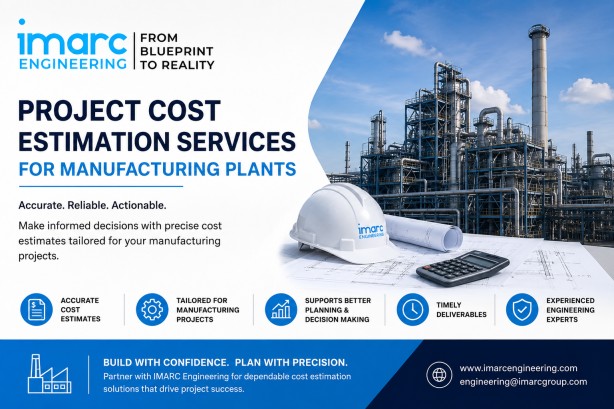
project cost estimation services for manufacturing plants
Manufacturing companies in India lose crores every year to one recurring problem: inaccurate project cost estimates. A plant expansion budgeted at ₹40 crore quietly balloons to ₹55 crore. A greenfield facility meant to break even in three years takes five. In nearly every case, the root cause traces back to the earliest stage of the project , a cost estimate built on incomplete data, outdated benchmarks, or optimistic assumptions rather than engineering rigor.
As India’s manufacturing sector scales under Make in India, PLI schemes, and rising domestic demand, capital projects are getting bigger and more complex. Multi-line production facilities, automated assembly units, and integrated processing plants all carry cost structures that simple per-square-foot estimates simply cannot capture. This guide explains why professional project cost estimation services for manufacturing plants matter, the mistakes manufacturers commonly make, and how a structured, engineering-led approach protects capital investment from planning through commissioning.
Why Project Cost Estimation Matters for Manufacturing Plants
1. It Determines Whether a Project Gets Funded
Banks, private equity investors, and internal boards all evaluate capital expenditure proposals against the credibility of the cost estimate. A poorly substantiated number raises red flags during due diligence and can delay or derail financing altogether.
2. It Sets the Baseline for Every Downstream Decision
Procurement budgets, vendor negotiations, contingency planning, and cash flow scheduling are all built on the initial estimate. If that number is wrong, every subsequent decision inherits the error.
3. It Protects Against Cost Overruns
Industry data consistently shows that manufacturing capital projects without formal estimation processes overrun budgets by 20-40%. A disciplined estimate, built with engineering detail rather than historical guesswork, significantly narrows that variance.
4. It Enables Realistic ROI and Payback Calculations
Investors and plant owners need confidence in payback period and return projections. Estimates that ignore utility tie-ins, statutory approvals, or commissioning costs produce ROI models that collapse under real-world conditions.
Industry Challenges and Common Selection Mistakes
Manufacturers evaluating cost estimation support often fall into predictable traps:
- Relying on Vendor Quotes Alone — Equipment vendor quotations rarely capture installation, civil work, utility integration, or commissioning costs, leading to underestimation by 25-35%.
- Using Outdated Per-Unit Benchmarks — Applying last year’s cost-per-square-foot figures to this year’s project ignores material price volatility and labor rate changes.
- Skipping Contingency Planning — Many in-house estimates omit contingency allowances for design changes, site conditions, or regulatory delays.
- Treating Estimation as a One-Time Exercise — Costs shift as design matures; estimates that aren’t revisited at each project stage become stale and misleading.
- Overlooking Indirect and Soft Costs — Statutory clearances, testing, commissioning, and project management fees are frequently excluded from headline numbers, distorting the true capital requirement.
Steps to Consider While Selecting a Cost Estimation Partner
Before engaging an estimation service provider, manufacturers should evaluate:
- Engineering Depth
- Does the team include process, mechanical, electrical, and civil engineers, or only cost accountants?
- Can they read and interpret P&IDs, layouts, and equipment specifications?
- Estimation Methodology
- Do they use recognized classes of estimate accuracy (Class 5 to Class 1, per AACE standards)?
- Is the approach bottom-up (detailed take-off) or purely parametric?
- Sector-Specific Cost Databases
- Do they maintain updated regional cost data for equipment, labor, and materials relevant to your industry?
- Track Record
- Have they delivered estimates for plants of comparable scale and process complexity?
- Post-Estimate Support
- Will they revisit and refine the estimate as design and procurement progress?
IMARC Engineering’s Cost Estimation Framework
IMARC Engineering applies a structured, six-stage methodology to deliver estimates manufacturers can rely on for financing, budgeting, and execution decisions.
Stage 1: Scope Definition and Data Collection
Gathering process flow diagrams, equipment lists, site conditions, and utility requirements to establish estimation boundaries.
Stage 2: Equipment and Material Cost Analysis
Building detailed equipment costs from vendor benchmarking, historical data, and current market rates, adjusted for specification and capacity.
Stage 3: Civil, Structural, and Utility Costing
Estimating building, foundation, piping, electrical, and utility tie-in costs using site-specific engineering assessments.
Stage 4: Labor, Installation, and Indirect Cost Assessment
Factoring in installation labor, project management, statutory approvals, testing, and commissioning expenses often missed in vendor-only quotes.
Stage 5: Contingency and Risk-Adjusted Estimation
Applying calculated contingency ranges based on project maturity, design risk, and market volatility rather than arbitrary percentages.
Stage 6: Validation and Reporting
Cross-checking the estimate against benchmark databases and delivering a structured report suitable for board approval, bank financing, or internal budgeting.
Discuss Your Manufacturing Project’s Cost Estimation Needs with IMARC Engineering – https://www.imarcengineering.com/contact?service=project-scheduling-and-cost-estimation
Cost Estimation Lifecycle
| Stage | Key Activities | IMARC’s Role | Business Outcome |
| Conceptual (Class 5) | Preliminary scope, rough order of magnitude | High-level parametric estimate | Early feasibility screening |
| Preliminary (Class 4) | Layout, major equipment list | Bottom-up equipment and civil costing | Budget-level financing estimate |
| Definitive (Class 3) | Detailed engineering drawings | Comprehensive line-item estimate | Board approval, funding sanction |
| Control (Class 2) | Procurement specifications finalized | Vendor-quote validation, cost tracking setup | Procurement and contract budgeting |
| Execution (Class 1) | Construction and installation | Cost monitoring, variance analysis | Cost control during project delivery |
Industry-Specific Cost Estimation Considerations
- Automotive and Auto Components — High capital intensity in automation and tooling requires precise costing of robotics, conveyors, and quality inspection systems.
- Pharmaceuticals — Cleanroom construction, HVAC validation, and GMP compliance add significant, easily underestimated cost layers.
- Chemicals and Process Industries — Piping, instrumentation, and safety systems dominate cost structures and demand detailed process engineering input.
- Food and Beverage — Hygienic design requirements and cold chain infrastructure carry cost implications distinct from general manufacturing.
- Electronics and Electricals — ESD-controlled environments and precision equipment installation require specialized cost benchmarking.
Business Outcomes of Accurate Cost Estimation
- Improved Financing Success Rates — Credible, engineering-backed estimates strengthen loan and investor proposals.
- Reduced Cost Overruns — Structured estimation typically narrows budget variance to within 10-15% of final project cost.
- Better Cash Flow Planning — Stage-wise estimates allow manufacturers to align capital deployment with project milestones.
- Stronger Vendor Negotiations — Independent cost benchmarks give procurement teams leverage during vendor discussions.
- Faster Decision-Making — Reliable numbers accelerate go/no-go decisions on expansion and modernization projects.
Project Cost Estimation Trends in 2026
- Digital Twin-Based Estimation — Manufacturers increasingly use digital models to simulate costs before physical construction begins.
- Real-Time Material Price Integration — Estimation tools now pull live steel, cement, and electronics component pricing to reduce estimate drift.
- Modular and Prefabricated Construction Costing — Growing adoption of modular plant components is reshaping traditional civil cost models.
- Sustainability-Linked Cost Factors — Energy efficiency and emissions compliance are becoming standard line items in capital estimates.
- AI-Assisted Benchmarking — Predictive analytics are being layered onto historical cost databases to improve estimate accuracy at early project stages.
Conclusion
Project cost estimation is not a formality to satisfy a board presentation — it is the financial backbone of every successful manufacturing plant project. Manufacturers that invest in engineering-led, stage-wise cost estimation consistently deliver projects closer to budget, secure financing more easily, and avoid the operational disruption that comes with mid-project cost surprises. As Indian manufacturing scales in complexity and capital intensity, the gap between rough estimates and precise, defensible numbers will only grow more consequential.
Frequently Asked Questions
1. What is the difference between a cost estimate and a budget?
A cost estimate is an engineering-based prediction of project cost at a given design maturity level, while a budget is the approved capital allocation derived from that estimate.
2. How accurate is a Class 3 (definitive) cost estimate?
Definitive estimates typically carry an accuracy range of -10% to +15%, sufficient for board approval and financing decisions.
3. Can cost estimates be revised after project approval?
Yes. Estimates should be refined at each project stage as design, procurement, and site conditions evolve.
4. What is typically missing from vendor-only cost quotes?
Installation labor, civil and utility tie-in costs, statutory approvals, testing, commissioning, and project management fees are frequently excluded.
5. How long does a detailed cost estimate take to prepare?
Depending on project scale and data availability, a definitive-level estimate typically takes 2-4 weeks to complete.
IMARC Engineering
Project Cost Estimation | Feasibility Studies | Capital Expenditure Planning | Manufacturing Consulting
📞 +91 120 433 0800
📧 sales@imarcengineering.com
📍 C–130, Sector 2, Noida, Uttar Pradesh 201301
About the Author