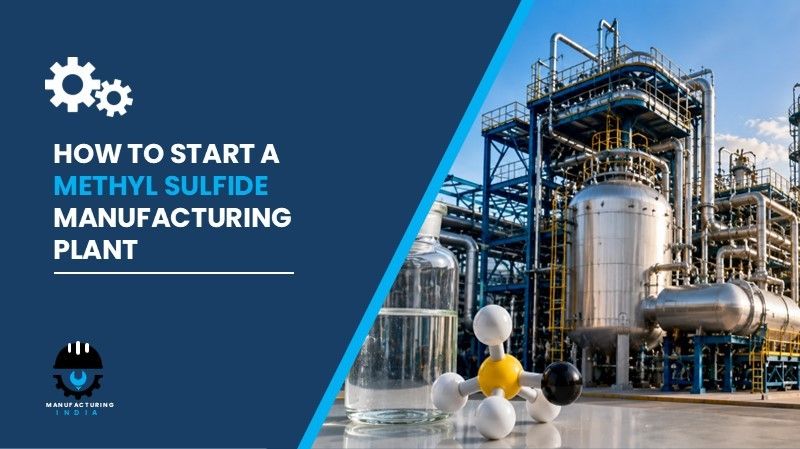
A methyl sulfide manufacturing plant setup in India presents a compelling investment case, driven by rising demand from the agrochemical sector, increasing use as an intermediate in specialty chemicals, and growing application in pharmaceutical synthesis. Methyl sulfide, also known as dimethyl sulfide (DMS), is a critical intermediate for sulfur-based fungicides, pesticides, and pharmaceutical active ingredients, making it essential to industries central to India’s economic growth.
India’s expanding chemical manufacturing base, growing infrastructure, and the government-backed Make in India initiative create a favorable environment for this plant. States with established chemical and petrochemical clusters, such as Gujarat and Maharashtra, offer proximity to raw material supply chains and downstream agrochemical and pharmaceutical producers, positioning India as a strategically sound location for methyl sulfide production.
With policy support through Make in India and PLI-linked downstream industries, cost-competitive access to methanol-based raw materials, and gross profit margins between 25-45%, this investment offers a financially viable and demand-backed opportunity with a realistic path to break-even.
What is Methyl Sulfide?
Methyl sulfide, also known as dimethyl sulfide (DMS), is a volatile organosulfur compound with the chemical formula (CH₃)₂S. It is a colorless liquid with a characteristic sulfurous odor and exhibits high volatility and flammability. It is sparingly soluble in water but readily soluble in organic solvents, making it suitable for chemical synthesis applications. Industrial-grade methyl sulfide is primarily used as an intermediate in agrochemicals, pharmaceuticals, flavors and fragrances, and sulfur-containing chemicals, with its reactivity and sulfur-donating capability making it a valuable building block across downstream chemical processes.
The manufacturing process relies on methylation, condensation, and purification as the primary production stages. End-use industries include agrochemicals, pharmaceuticals, petrochemicals, specialty chemicals, and materials science, with the compound also used in pesticide synthesis, pharmaceutical intermediates, catalyst ligands, solvent production, and polymer modification.
Cost of Setting Up a Methyl Sulfide Manufacturing Plant in India
This cost depends on capacity, technology, location, automation level, and regulatory compliance requirements.
1. Capital Expenditure (CapEx)
Capital expenditure begins with land and site development, covering land acquisition, registration, boundary development, and site preparation; investors may evaluate dedicated chemical zones or industrial estates offering ready infrastructure. Civil works cover the production shed, laboratory, storage areas, effluent treatment infrastructure, and the administrative block, forming a solid foundation for safe operations.
Machinery costs account for the largest share of total capital expenditure. Key machinery required includes:
- Chemical reactors
- Distillation columns
- Condensers
- Scrubbers
- Drying units
- Purification systems
- Storage tanks
- Automated filling stations
Other capital costs cover pre-operative expenses, commissioning, and infrastructure needed to meet safety and environmental standards for flammable, sulfur-based compounds.
Request a Sample Report for In-Depth Market Insights: https://www.imarcgroup.com/methyl-sulfide-manufacturing-plant-project-report/requestsample
2. Operational Expenditure (OpEx)
Raw material cost is the largest component of operating expenditure, with methanol, hydrogen sulfide, and natural gas/syngas accounting for approximately 55-75% of total OpEx. Long-term supplier contracts help mitigate price volatility and ensure a steady supply.
Utility costs, covering electricity, water, and steam, represent approximately 10-15% of OpEx. Other operating costs include transportation, packaging, salaries and wages, repairs and maintenance, depreciation, and taxes. By the fifth year, total operational cost is expected to rise substantially due to inflation, market fluctuations, raw material cost increases, supply chain disruptions, and rising demand.
3. Plant Capacity
The proposed facility is designed with an annual capacity ranging between 2,000 and 5,000 Metric Tonnes, enabling economies of scale while maintaining flexibility. Capacity can be customized based on investor requirements, and profitability generally improves with higher capacity utilization.
4. Profit Margins and Financial Projections
The project demonstrates healthy profitability potential under normal operating conditions. Gross profit margins typically range between 25-45%, while net profit margins range between 10-25%. Financial projections, including net present value (NPV), internal rate of return (IRR), and payback period, are developed based on realistic assumptions about capital investment, operating costs, capacity utilization, pricing trends, and demand outlook, giving a comprehensive view of long-term viability.
Why Set Up a Methyl Sulfide Plant in India?
Critical Chemical Intermediate: Methyl sulfide is a key building block in the synthesis of dimethyl sulfoxide (DMSO), dimethyl sulfone (DMSO₂), agrochemicals, pharmaceuticals, and specialty chemicals, giving it stable, essential demand across multiple downstream industries.
Moderate but Defensible Entry Barriers: Capital intensity is lower than petrochemicals, but production requires controlled reaction conditions, safety protocols, odor management, and consistent purity standards, favoring compliance-driven manufacturers.
Megatrend Alignment: Growth in pharmaceuticals, crop protection chemicals, specialty solvents, and electronic chemicals is driving demand for sulfur-based intermediates. India’s pharmaceutical industry is projected to grow at a CAGR of over 10% to reach USD 130 billion by 2030 (IBEF), reinforcing long-term volume growth.
Policy and Regulatory Tailwinds: Government initiatives promoting domestic chemical manufacturing, import substitution, and value-chain integration, including Make in India, chemical park development, and PLI-linked downstream industries, indirectly strengthen demand.
Local Supply Chain Preference: Downstream producers prefer reliable local suppliers to ensure quality, minimize logistics risks, manage price volatility of sulfur and methanol, and comply with environmental regulations, favoring compliant regional manufacturers.
Manufacturing Process – Step by Step
The methyl sulfide manufacturing process uses methylation, condensation, and purification as the primary production method. Production proceeds through the following stages:
- Raw Material Preparation: Methanol, hydrogen sulfide, and natural gas/syngas are received and prepared according to mass balance and raw material requirement specifications.
- Methylation Reaction: Raw materials are fed into chemical reactors, where controlled reaction conditions drive the methylation stage.
- Condensation: The reacted stream undergoes condensation, converting vapor-phase intermediates into liquid form.
- Distillation and Purification: Distillation columns, condensers, scrubbers, and purification systems refine the product to industrial-grade purity standards.
- Drying: Drying units remove residual moisture to stabilize the product.
- Quality Assurance and Technical Testing: Analytical instruments monitor concentration, purity, and stability, with documentation maintained for traceability and compliance.
- Storage: The finished product is held in dedicated storage tanks designed for flammable, sulfur-based compounds.
- Packaging and Dispatch: Automated filling stations package the product before dispatch to agrochemical, pharmaceutical, petrochemical, specialty chemical, and materials science end-use industries.
Key Applications
Methyl sulfide serves multiple downstream industries as a critical chemical intermediate.
- Chemical Manufacturing: Used as an intermediate for dimethyl sulfoxide (DMSO) and other sulfur-based chemicals.
- Agrochemicals: Serves as a raw material for pesticides and crop protection formulations.
- Pharmaceuticals: Functions as a chemical intermediate in drug synthesis.
- Flavors & Fragrances: Used in the production of specialty aroma compounds.
Leading Manufacturers
Leading manufacturers in the global methyl sulfide industry include several multinational companies with extensive capacities and diverse application portfolios:
- Arkema
- Chevron Phillips Chemical
- BASF
- Toray Industries
- Lanxess
- Merck KGaA
Timeline to Start the Plant
- Feasibility study and project report preparation
- Land acquisition and site development
- Regulatory approvals and environmental clearances
- Factory licence and fire safety compliance
- Machinery procurement and installation
- Raw material supplier agreements and supply chain setup
- Trial production and quality testing
- Commercial production launch
Licences and Regulatory Requirements
Starting this unit in India requires several approvals:
- Business registration (Proprietorship, LLP, or Pvt Ltd)
- Factory Licence under the Factories Act
- Environmental Clearance from State Pollution Control Board
- GST Registration
- Fire Safety NOC
- Hazardous/Chemical compliance for flammable sulfur-based compounds
- Effluent Treatment Plant (ETP) operational clearance
- Occupational Health and Safety compliance
Key Challenges to Consider
High Capital Requirements: Machinery such as chemical reactors, distillation columns, and purification systems forms a significant share of total capital expenditure, requiring substantial upfront investment.
Raw Material Price Volatility: Methanol, hydrogen sulfide, and natural gas/syngas prices can fluctuate, and since methanol alone accounts for 55-75% of OpEx, this directly affects profitability.
Regulatory Compliance: Safety protocols, environmental clearances, and effluent treatment requirements for flammable, odor-generating compounds demand ongoing compliance investment.
Technology and Process Control Pressure: Controlled reaction conditions, odor management, and consistent purity standards require continuous technical competence.
Competition: Established global players such as Arkema, BASF, Chevron Phillips Chemical, Toray Industries, Lanxess, and Merck KGaA compete across diverse portfolios.
Skilled Manpower: Operating reactors, distillation systems, and quality assurance processes requires a technically trained workforce familiar with hazardous chemical handling.
Frequently Asked Questions
1. How much does it cost to set up a methyl sulfide manufacturing plant in India?
Total cost depends on capacity, technology, location, and automation level, covering land and site development, civil works, machinery, and other capital costs. Detailed figures are available in the full project report.
2. Is methyl sulfide manufacturing profitable in India in 2026?
Yes, the plant shows healthy profitability potential, with gross profit margins between 25-45% and net profit margins between 10-25% under normal operating conditions.
3. What machinery is required for a methyl sulfide plant in India?
Key machinery includes chemical reactors, distillation columns, condensers, scrubbers, drying units, purification systems, storage tanks, and automated filling stations.
4. What licences and approvals are required to start a methyl sulfide plant in India?
Requirements include business registration, a Factory Licence, Environmental Clearance from the State Pollution Control Board, GST Registration, Fire Safety NOC, hazardous/chemical compliance, ETP operational clearance, and occupational health and safety compliance.
5. What raw materials are needed for methyl sulfide manufacturing?
The primary raw materials are methanol, hydrogen sulfide, and natural gas/syngas, with methanol accounting for the largest share of operating costs.
6. What are the environmental compliance requirements for a methyl sulfide plant in India?
The plant needs State Pollution Control Board clearance, an operational effluent treatment plant, and advanced monitoring systems to detect leaks or process deviations, given the product’s flammability and odor.
7. What is the best location to set up a methyl sulfide plant in India?
Locations with easy access to methanol, hydrogen sulfide, and natural gas/syngas, robust transportation and utility infrastructure, and proximity to target markets suit this plant best.
8. What is the break-even period for this type of plant in India?
The break-even period depends on capital investment, operating cost structure, and capacity utilization, and is assessed through payback period and net present value calculations in the project’s financial analysis.
9. What government incentives are available for manufacturers in India?
Initiatives such as Make in India, chemical park development, and PLI-linked downstream industries support domestic chemical manufacturing and indirectly strengthen demand for methyl sulfide as a core intermediate.
Key Takeaways for Investors
This manufacturing plant taps into stable demand from the agrochemical, pharmaceutical, petrochemical, and specialty chemical sectors, all of which rely on methyl sulfide as a critical intermediate. It demonstrates financial viability across its proposed capacity range of 2,000-5,000 Metric Tonnes annually, supported by gross margins of 25-45% and net margins of 10-25%. With the global dimethyl sulfide market valued at USD 150.85 Million in 2025 and projected to reach USD 265.88 Million by 2034 at a CAGR of 6.5%, alongside India’s pharmaceutical sector growing toward USD 130 billion by 2030, demand for this intermediate should remain resilient long term.
About the Author