
Introduction
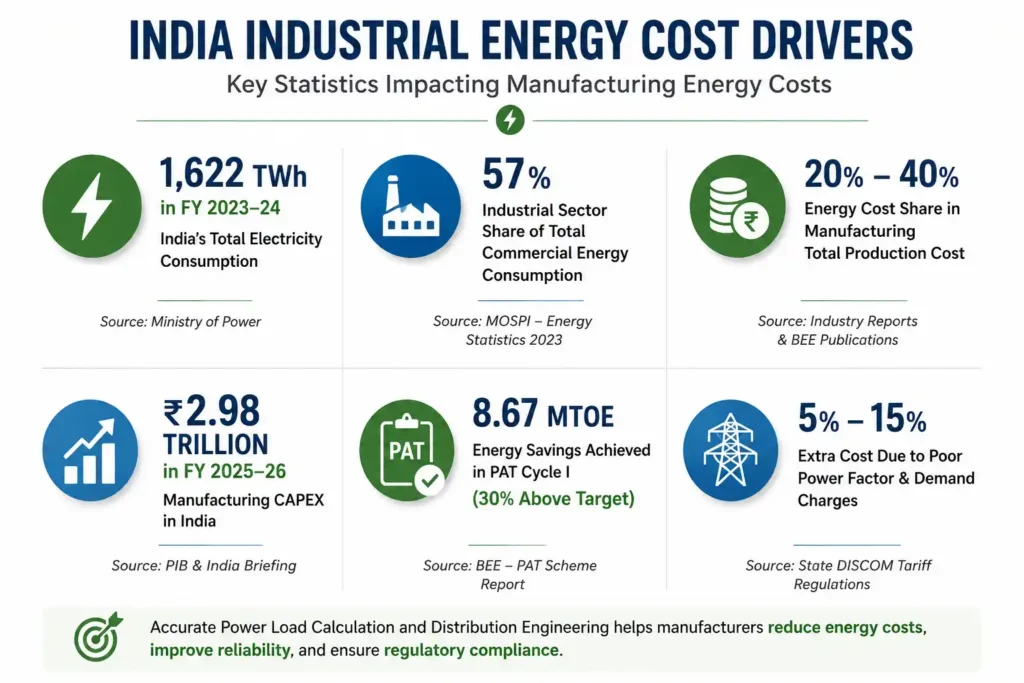
India’s industrial sector is the largest consumer of electricity in the country, accounting for approximately 57% of national commercial energy consumption per Energy Statistics published by MOSPI, and total electricity consumption reached 1,622 TWh in FY 2023–24, per the Ministry of Power. Within this total, energy-intensive manufacturing industries steel, cement, aluminium, chemicals, and textiles carry a disproportionate share of energy cost exposure, where electrical power frequently represents 20–40% of total production cost depending on the sector.
Power load calculation and distribution engineering is the technical discipline that determines how much electrical power a manufacturing facility actually requires, how that power is distributed across production systems, and where the losses, imbalances, and peak demand penalties are occurring that inflate the energy bill beyond what the production process genuinely needs. Done at the right stage during project planning, during capacity expansion, or during an existing facility’s operational review accurate load calculation directly reduces energy cost and prevents the infrastructure failures and production downtime that under-engineered electrical systems consistently generate.
Rising energy costs, stricter efficiency regulations, and expanding manufacturing capacity have made electrical system optimization a strategic priority. Understanding how power load calculation influences both operating costs and long-term infrastructure planning is the first step toward building a reliable and energy-efficient manufacturing facility.
“IMARC Engineering provides power load calculation, electrical distribution design, and energy audit services for industrial manufacturers across India. This article sets out the regulatory framework, the documented cost of unengineered electrical systems, and the structured technical interventions that reduce energy cost and improve production reliability.”
Why Power Load Calculation Matters More Than Ever for Indian Manufacturers
Several regulatory and operational factors are raising the cost of unengineered electrical systems in Indian manufacturing.
The Industrial Sector’s Energy Cost Exposure
India consumed 1,622 TWh of electricity in FY 2023–24, with an estimated 1,694 TWh in FY 2024–25, per the Ministry of Power (Wikipedia cross-referenced with MoP data). The industrial sector accounts for the largest share of this consumption. For manufacturers operating energy-intensive processes smelting, kilns, compressors, chilling systems, and continuous production lines electrical power cost is not a fixed overhead. It is a variable that responds directly to load profile management, power factor correction, and demand charge optimisation.
BEE’s PAT Scheme: Mandatory Energy Reduction Targets
The Bureau of Energy Efficiency (BEE), under the Ministry of Power, has launched eight cycles of its Perform, Achieve and Trade (PAT) scheme covering over 1,333 Designated Consumers (DCs) including thermal power plants, refineries, railways, and manufacturing sectors per BEE India Energy Scenario 2023–24. PAT Cycle I alone achieved energy savings of 8.67 MTOE against a target of 6.886 MTOE 30% above target equivalent to 31 million tonnes of CO2 reduction and monetary savings of ₹37,685 crore, which encouraged investment of ₹24,500 crore in energy efficiency infrastructure. BEE is expanding the PAT scheme to ten additional energy-intensive sectors including automobile, ceramic, chemicals, copper, dairy, glass, and tyre manufacturing increasing the population of manufacturers with mandatory specific energy consumption (SEC) reduction targets.
Energy Conservation Act, 2001 and Designated Consumer Obligations
Under the Energy Conservation Act, 2001, Designated Consumers (DCs) in specified energy-intensive sectors are required to appoint a certified Energy Manager, conduct energy audits at defined intervals, file annual energy consumption returns, and meet notified SEC reduction targets. Non-compliance carries financial penalties and for DCs that fail to meet PAT targets and cannot purchase sufficient ESCerts mandatory compliance corrective action. For manufacturers who are DCs or are approaching DC threshold energy consumption levels, engineering-grade power load analysis is a regulatory requirement, not a discretionary exercise.
Demand Charges and Power Factor Penalties
State electricity regulatory commissions in India apply demand charges on the maximum demand (in kVA or kW) recorded during a billing period, regardless of actual energy consumed. Facilities with poor power factor typically below 0.90 incur additional surcharges from DISCOMs that can add 5–15% to monthly electricity bills. Power factor below 0.85 triggers penalties at most state tariff schedules. Right-sized capacitor banks and load balancing, both outputs of accurate power load calculation, directly eliminate these charges.
Manufacturing CAPEX Growth Increasing Electrical Design Risk
Manufacturing CAPEX reached ₹2.98 trillion in FY 2025–26, up 21.6% year-on-year, per PIB and India Briefing. At this investment pace, electrical distribution systems are being designed and installed under compressed timelines. Under-calculated load estimates based on equipment name-plate ratings rather than actual operating load profiles result in oversized transformer and switchgear procurement that inflates project cost, or undersized infrastructure that trips under actual production load and causes production downtime.
These factors together create the operational and financial case for engineering-grade power load calculation at every stage of the facility lifecycle.
What Unengineered Electrical Systems Cost Manufacturing Operations
Most electrical system failures in manufacturing facilities are not random events. They are predictable consequences of load calculations made at project initiation that were based on incomplete data and never revised as the facility evolved.
The documented cost categories of unengineered or under-calculated electrical distribution:
- Oversized and under-utilised electrical infrastructure: Facilities designed for rated nameplate load rather than actual operating load profile consistently oversize transformers and switchgear adding 15–25% to procurement cost for equipment that operates at low utilisation, reducing energy efficiency further.
- Feeder and cable undersizing causing production downtime: Under-calculated feeders, switchboards, and cable sizing trip under actual production load, particularly during simultaneous start of multiple high-inrush motors a primary cause of unplanned production stoppages.
- Power factor penalties on monthly electricity bills: Power factor below 0.85 at state tariff schedule thresholds attracts surcharges of 5–15% on monthly electricity bills. Most Indian manufacturing facilities without active power factor correction operate below 0.90.
- Harmonic distortion and power quality degradation: Poor harmonic management from variable frequency drives (VFDs), rectifiers, and arc furnaces without harmonic filtering causes transformer overheating, neutral conductor overload, and metering inaccuracy none of which are visible without a power quality assessment.
- Outdated load documentation creating invisible risk: Single-line diagrams and load schedules that are not updated as production lines are added, modified, or reconfigured leave the facility operating on electrical infrastructure planned for a different load until a fault makes the discrepancy visible.
Each of these consequences has a defined engineering solution but the solution must be applied before the system design is frozen or, for existing facilities, before the cumulative cost of inefficiency and failure is accepted as normal operating loss.
Key Components of Power Load Calculation and Distribution Engineering
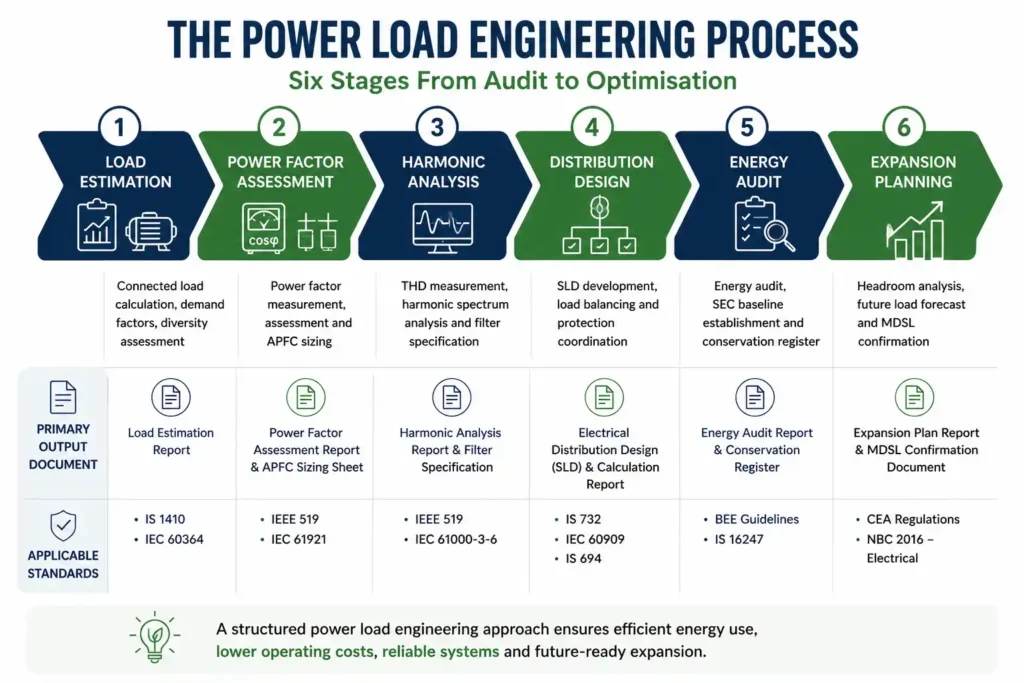
A credible electrical load engineering programme for an industrial facility addresses six interconnected technical areas.
1. Load Estimation and Demand Factor Analysis
- Calculate connected load from actual equipment duty cycles and simultaneous operation patterns not nameplate ratings applying demand and diversity factors per IS 3700
- Identify maximum demand and peak load periods to right-size transformer, switchgear, and feeder infrastructure to actual operating conditions
2. Power Factor Assessment and Correction
- Measure actual power factor at the main incomer and major load centres through metering or power quality audit
- Design and size automatic power factor correction (APFC) capacitor banks to maintain power factor above 0.95, directly eliminating DISCOM penalty surcharges
3. Harmonic Analysis and Power Quality Management
- Conduct harmonic spectrum analysis where VFDs, rectifiers, UPS systems, or arc furnaces are present in the load mix
- Specify harmonic filters or active compensators where total harmonic distortion (THD) exceeds IEEE 519 / IEC 61000-3 limits, preventing transformer overheating and metering inaccuracy
4. Distribution System Design and Protection Coordination
- Design single-line diagram, feeder schedules, cable selection, and voltage drop calculations per IS 732 and NBC 2016 Part 8
- Coordinate protection relay settings across HT and LT systems to ensure selective tripping so a local fault does not cause facility-wide production shutdown
5. Energy Audit and SEC Baseline Establishment
- Conduct BEE-format energy audit to establish specific energy consumption (SEC) baseline per unit of production the mandatory starting point for PAT scheme compliance
- Develop an energy conservation opportunity register quantifying reduction potential in the top five energy loads (motors, HVAC, compressed air, furnaces, lighting) with payback analysis
6. Load Growth Planning and Future Expansion Headroom
- Model electrical infrastructure requirements for planned capacity expansion confirming transformer, switchgear, and feeder headroom before capital equipment is finalised
- Confirm DISCOM maximum demand sanctioned load (MDSL) capacity and design spare bus section capacity to accommodate future additions without primary infrastructure replacement
How IMARC Engineering Delivers Power Load Calculation and Distribution Services
IMARC Engineering delivers power load calculation and electrical distribution engineering as a structured, documentation-based service from initial load schedule development through protection coordination, energy audit, and expansion planning.
- Load estimation and demand factor analysis: Developing load schedules from actual equipment operating profiles, duty cycles, and production shift patterns rather than nameplate ratings.
- Power factor and harmonic management: Measuring power factor at the incomer and load centres, sizing APFC capacitor banks, and specifying harmonic filters where non-linear loads are present.
- Distribution system design and protection engineering: Designing single-line diagrams, feeder schedules, protection relay coordination, and earthing systems per applicable IS codes and NBC 2016 Part 8.
- Energy audit and PAT compliance support: Conducting BEE-format energy audits to establish SEC baselines and develop energy conservation opportunity registers with payback analysis.
- Expansion headroom analysis: Modelling future electrical infrastructure requirements against planned capacity expansion and confirming DISCOM maximum demand sanctioned load headroom.
IMARC Engineering supports power load calculation and distribution engineering across chemicals, pharmaceuticals, metals, cement, food processing, electronics, and textiles sectors where energy cost as a percentage of production cost varies significantly and where BEE PAT scheme obligations are most likely to apply.
Contact IMARC Engineering’s team for power load calculation, electrical distribution design, and energy audit services.
https://www.imarcengineering.com/contact?service=utilities-planning-water-power-hvac-steam-services
Common Mistakes in Industrial Power Load Calculation and Distribution
- Calculating load from nameplate ratings without demand factors: Equipment nameplate kW multiplied by number of units gives connected load not demand load. Applying no demand factor to high-rated but rarely simultaneous loads oversizes infrastructure and understates energy efficiency potential.
- Ignoring power factor as load composition changes: Power factor correction sized for the original load configuration becomes under-compensated or over-compensated as load profile changes with production expansion both conditions generate cost and risk.
- Not updating protection coordination after load changes: Protection relay settings designed for the original switchgear configuration are rarely revised when load is added or reconfigured, creating the risk of non-selective tripping that shuts the entire facility on a local fault.
- Treating energy audits as compliance formalities: BEE energy audits required under the Energy Conservation Act are treated as compliance paperwork rather than engineering exercises producing no actionable conservation opportunity register and no SEC improvement plan.
- Not modelling electrical infrastructure headroom before expansion: Load growth modelling is not conducted before capacity expansion equipment is ordered resulting in transformer or switchgear upgrades that were not budgeted, or a grid connection agreement that cannot support the expanded maximum demand.
Conclusion
India’s industrial sector consumed 1,622 TWh of electricity in FY 2023–24, BEE’s PAT Cycle I delivered ₹37,685 crore in monetary savings and BEE is now expanding the scheme to ten additional sectors. With manufacturing CAPEX growing 21.6% year-on-year, engineering-grade power load calculation is both a compliance requirement for Designated Consumers and a capital efficiency imperative for every manufacturer investing in new or expanded production capacity.
Through load estimation, power factor management, harmonic analysis, distribution system design, energy auditing, and expansion headroom planning, IMARC Engineering helps manufacturers reduce energy cost, prevent downtime, and meet BEE PAT compliance obligations across India.
IMARC Engineering
Power Load Calculation | Electrical Distribution Design | Energy Audit | PAT Compliance | Power Factor Correction
Contact Us:
IMARC Engineering
Phone: +91-120-433-0800
Email: sales@imarcengineering.com
India: C-130, Sector 2, Noida, Uttar Pradesh 201301
LinkedIn: https://www.linkedin.com/showcase/imarc-engineering/
About the Author