Introduction
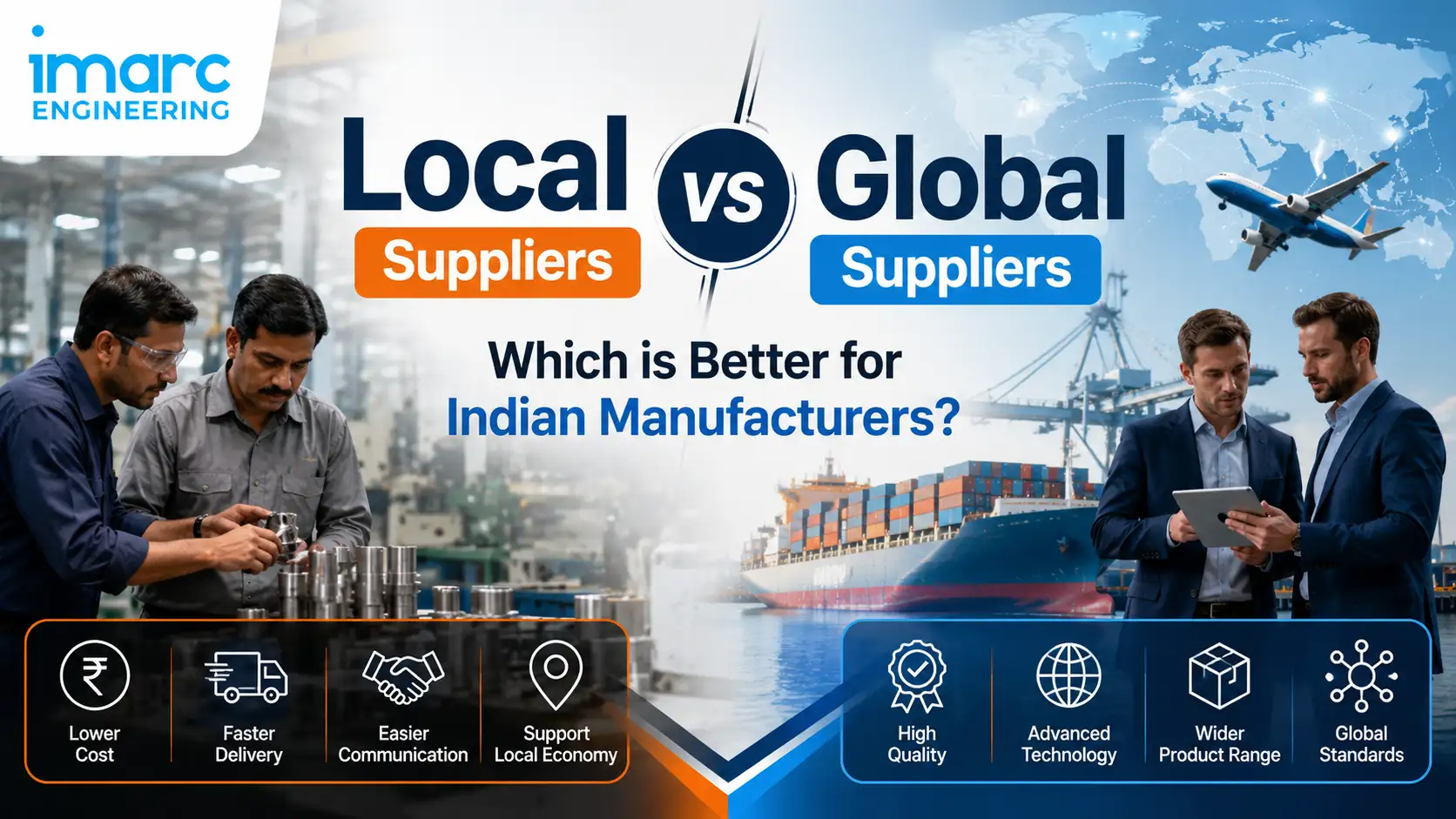
Every manufacturer sourcing raw materials, components, or equipment eventually faces the same question: should we source locally or buy from global suppliers? The answer is rarely straightforward. A sourcing strategy that works well for standard packaging materials may be completely unsuitable for specialty chemicals, precision machinery, or export-oriented production. Cost, quality, lead time, regulatory compliance, supply chain resilience, and long-term reliability all influence the decision, making supplier selection a strategic business choice rather than simply a procurement activity.
India’s supplier ecosystem includes more than 63 million MSMEs alongside large domestic enterprises and multinational manufacturers, offering a broad spectrum of capabilities across industries. At the same time, global suppliers continue to play an important role by providing advanced technologies, specialized materials, and internationally certified products that may not yet be available domestically. Rather than viewing local and global sourcing as competing approaches, successful manufacturers evaluate suppliers category by category, balancing capability, risk, cost, and operational requirements.
This guide examines the practical advantages and limitations of both sourcing models, compares them across key manufacturing sectors, highlights the risks associated with each approach, and outlines a structured framework for making informed supplier selection decisions.
The Case for Local Suppliers
Local sourcing has clear structural advantages that show up directly on the balance sheet and in day-to-day operations.
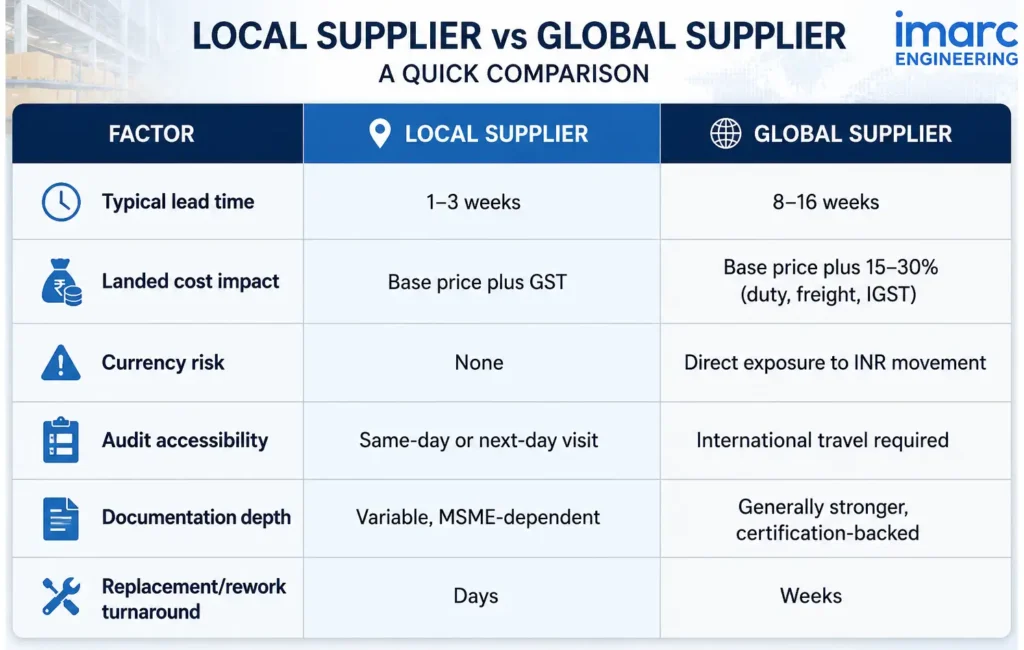
- Lead times for domestic raw materials and components typically run 1 to 3 weeks, against 6 to 12 weeks or longer for imported equivalents once shipping and customs clearance are factored in
- Landed cost avoids import duty, which for many industrial inputs ranges from 7.5% to 15%, plus IGST applicable on import value
- Communication happens in real time across time zones, which shortens the loop on specification changes, quality queries, and urgent replacements
- GST input credit is available on domestic purchases, improving working capital efficiency compared to import transactions
- Physical audits are logistically simple, since a facility visit is a same-day or next-day trip rather than an international one
The tradeoff is consistency. Many domestic MSME suppliers operate with limited quality documentation, and batch-to-batch variation between an approved sample and a production run is one of the most common issues IMARC Engineering encounters during supplier evaluations. Financial fragility is another real concern, since a single-source MSME vendor facing cash flow stress can disrupt an entire production schedule with little warning.
The Case for Global Suppliers
Global suppliers earn their place where domestic capability genuinely falls short, not as a default preference.
- Advanced process equipment, specialty chemical intermediates, and precision components in categories such as semiconductors, advanced pharma intermediates, and high-precision instrumentation are often only available from established international manufacturers
- Certification depth tends to be stronger, with many global suppliers already holding US FDA, EU GMP, or CE-marked credentials that support export-oriented manufacturing
- Production consistency across large multinational suppliers is typically tighter, since automated, high-volume manufacturing reduces batch variation
- Scale pricing can be competitive for high-volume orders, sometimes offsetting the cost of duties and freight over large order quantities
The tradeoffs are equally real. Landed cost includes freight, insurance, customs duty, and IGST, which together can add 15% to 30% to the base price depending on the category and country of origin. Lead times of 8 to 16 weeks are common for capital equipment, and any specification issue discovered after shipment can mean weeks of delay for replacement parts or rework. Currency exposure is another factor, since a weakening rupee directly inflates the cost of dollar or euro-denominated contracts signed months earlier.
Cost Comparison at a Glance
Sector-Wise: Where Each Option Actually Wins
Pharmaceuticals and nutraceuticals CDSCO-licensed domestic API and excipient manufacturers are well developed for standard pharmacopoeial-grade materials under IP, BP, and USP specifications. Global suppliers become necessary for specialty APIs, DMF-filed active ingredients required for US FDA or EU GMP regulated market exports, and certain high-purity excipients not yet produced domestically at scale.
Food processing FSSAI-licensed domestic suppliers cover the bulk of ingredients, additives, and packaging needs, and local sourcing is generally preferred here since freshness, shelf life, and transport time matter directly to product quality. Imported sourcing is largely limited to specific flavour compounds, functional additives, or packaging substrates not manufactured in India.
Chemicals and specialty chemicals Domestic suppliers handle most industrial chemicals and solvents, verified against PESO licensing and CPCB consent-to-operate requirements. Specialty and high-purity chemical intermediates, particularly those requiring REACH pre-registration for export-bound formulations, often still come from established global sources.
Industrial equipment and machinery This is where the local versus global question gets the most complicated. Standard utility equipment, basic material handling systems, and BIS-certified components are readily available domestically at 30% to 50% lower landed cost than imported equivalents. Precision process equipment, advanced automation systems, and certain instrumentation still frequently require global sourcing, particularly where CE marking or specific international performance benchmarks are contractually required.
Risk Factors That Cut Across Both Options
Sourcing risk does not disappear by choosing one side over the other, it just changes shape.
- Single-source dependency is a bigger risk with global suppliers given longer replacement lead times, but domestic MSME suppliers carry their own version of this risk through financial fragility and limited backup capacity
- Quality inconsistency between approved samples and production batches shows up in both pools, though it is more frequently flagged during domestic MSME audits due to less mature quality systems
- Regulatory compliance gaps need independent verification regardless of origin, since self-declared certifications, whether BIS, FSSAI, PESO, or CDSCO for domestic suppliers, or CE and international GMP for global ones, are sometimes expired, out of scope, or misrepresented
- Counterfeit or substituted materials remain a documented risk in categories such as chemical intermediates and packaging materials from both domestic and international sources without third-party testing verification
A Practical Decision Framework
Rather than treating this as an either-or choice, most well-run procurement functions apply a simple filter across four questions:
- Does a domestic supplier exist with the required technical specification and certification, verified rather than self-declared?
- What is the true landed cost difference once duty, freight, currency risk, and lead time carrying cost are included, not just the base quotation?
- How critical is this input to production continuity, and what does a supply disruption actually cost per day of downtime?
- Is there a credible multi-source strategy available, combining a primary domestic vendor with a qualified backup, whether domestic or global?
Applying this framework category by category, rather than defaulting to an entire supply chain being local or global, is generally what produces the best combination of cost, quality, and resilience.
Strengthen procurement with expert supplier evaluation services: https://www.imarcengineering.com/contact?service=supplier-identification-and-evaluation
Why the Blended Approach Usually Wins
Very few manufacturers in India run a purely local or purely global supply chain, and for good reason. A blended strategy typically looks like domestic sourcing for standard inputs, packaging, and utility equipment, paired with selective global sourcing for specialty materials, certified components, and process equipment not yet matched domestically. This structure preserves the cost and speed advantages of local sourcing while keeping access open to capability that genuinely does not exist in the domestic market yet.
The evaluation process matters more than the supplier’s location. Manufacturers that consistently build resilient supply chains assess suppliers on capability rather than geography, evaluating technical expertise, quality systems, regulatory compliance, financial stability, production capacity, lead-time reliability, and long-term performance before onboarding.
IMARC Engineering supports manufacturers across pharmaceuticals, chemicals, food processing, engineering products, and other industrial sectors by conducting structured supplier evaluations for both domestic and international vendors. The assessment framework examines technical capability, quality management systems, regulatory compliance, financial strength, production capacity, delivery reliability, and operational performance, supported by on-site supplier audits across India’s major manufacturing clusters to verify capabilities beyond documentation alone.
Conclusion
Local versus global is not a question with one right answer, it is a question that needs answering separately for every material and equipment category in a plant’s supply chain. Manufacturers who build their sourcing strategy around verified capability rather than geographic preference end up with supply chains that are both cost-efficient and resilient, with the flexibility to shift weight between domestic and international vendors as capability, currency, and regulatory conditions change over time.
Contact Us:
IMARC Engineering
Phone: +91-120-433-0800
Email: sales@imarcengineering.com
India: C-130, Sector 2, Noida, Uttar Pradesh 201301
LinkedIn: https://www.linkedin.com/showcase/imarc-engineering/
About the Author