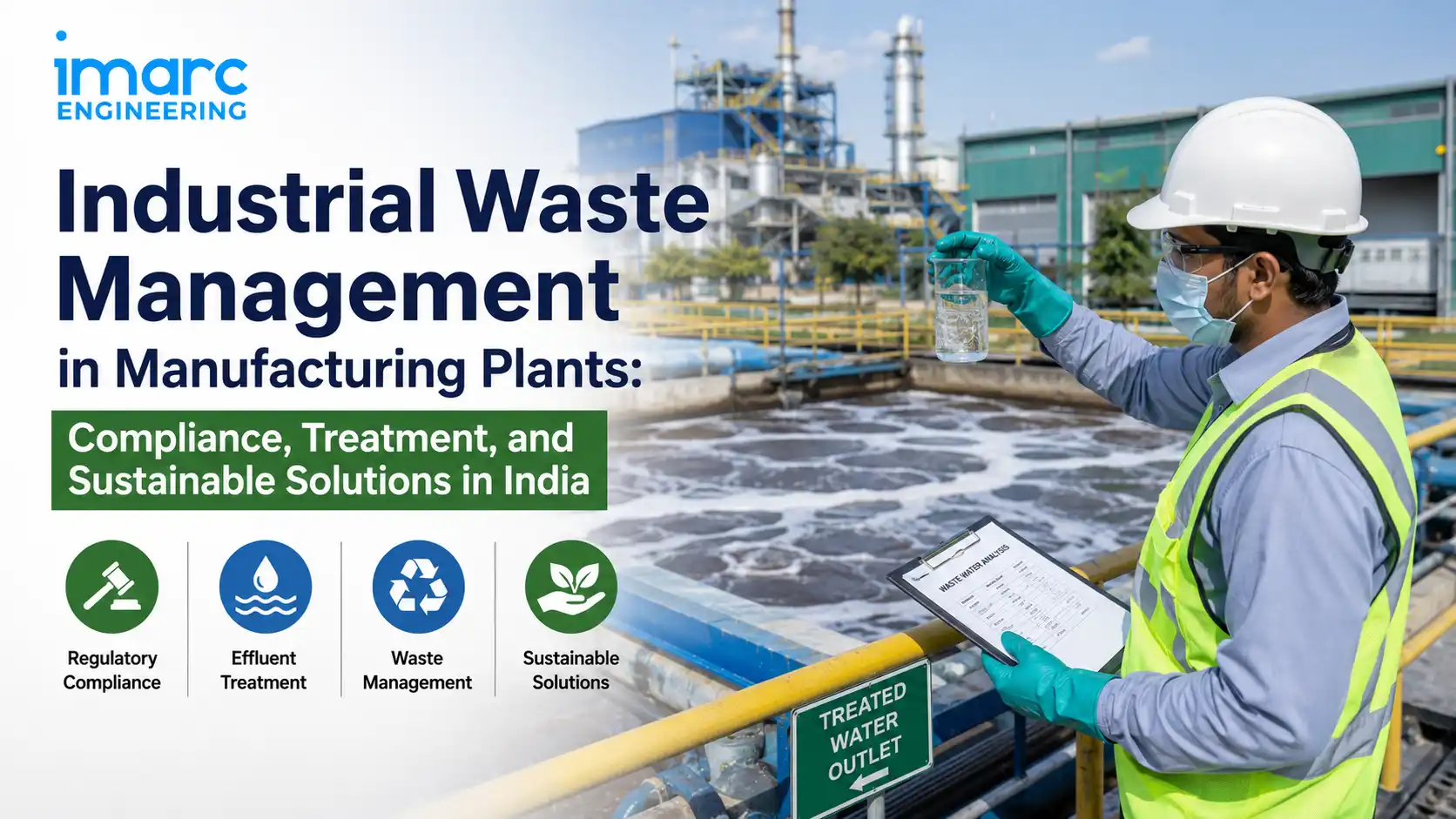
India’s manufacturing sector is generating waste faster than it can process it. As industrial output expands across pharmaceuticals, chemicals, textiles, automotive components, and food processing, the waste streams coming out of these plants are growing in both volume and complexity. Liquid effluent, hazardous sludge, plastic packaging, e-waste from process equipment, and air emissions from boilers and reactors all need dedicated handling systems, and each is governed by its own set of central and state rules. For most manufacturing facilities, this is no longer a background compliance task. It has become a core part of how a plant is designed, licensed, and kept running.
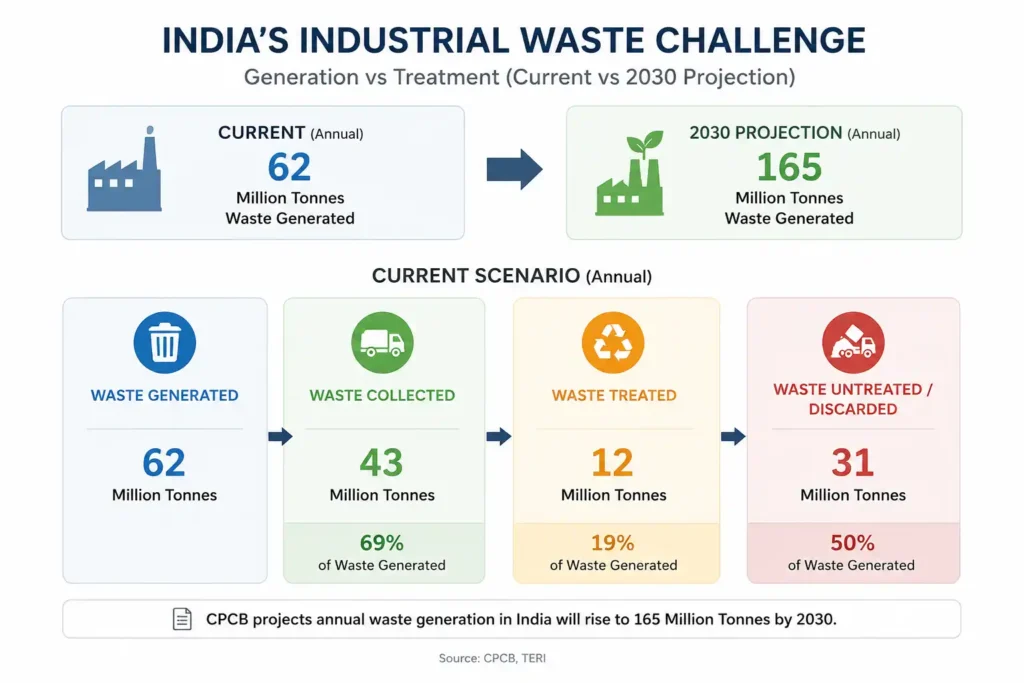
According to data compiled from CPCB and TERI sources, the country produces around 62 million tonnes of waste annually, broken down as follows:
- 7.9 million tonnes of hazardous waste
- 5.6 million tonnes of plastic waste
- 1.5 million tonnes of e-waste
- 0.17 million tonnes of biomedical waste
Of the total waste generated, only 43 million tonnes gets collected. Just 12 million tonnes is treated before disposal. The remaining 31 million tonnes ends up discarded in wasteyards without treatment. CPCB projects that annual waste generation in the country will climb to 165 million tonnes by 2030. For manufacturing facilities, these numbers translate directly into regulatory exposure. Consent to Operate renewals, environmental clearances, and CPCB inspections all hinge on how well a facility’s waste streams are characterised, treated, and documented.
Why Waste Management Has Become a Strategic Manufacturing Function
Industrial waste management is no longer limited to meeting environmental regulations. It directly affects plant approvals, operational continuity, production costs, ESG performance, and customer confidence. As manufacturing facilities become more complex, waste management systems must be integrated into plant design rather than added after production begins. This shift is encouraging manufacturers to treat waste management as an engineering discipline rather than simply a compliance requirement.
Industrial Waste Challenges Facing Indian Manufacturers
Manufacturing plants in pharmaceuticals, chemicals, textiles, food processing, and metal finishing sit at the center of India’s hazardous waste burden. Under the Hazardous Waste Management Rules 2016, generators must:
- Obtain authorisation from their state pollution control board
- Maintain generation and disposal records in Form 3
- Submit annual returns
- Store waste for a maximum of 90 days before sending it to an approved treatment, storage, and disposal facility (TSDF)
A facility that misses these deadlines or stores waste beyond the permitted window risks directions, penalties, or suspension of its Consent to Operate.
Plastic waste presents a parallel challenge for FMCG and packaging-heavy manufacturers. Per capita plastic waste generation in India rose from roughly 700 grams in 2016-17 to over 2.5 kilograms by 2020. That is close to a threefold increase in four years. Of the plastic waste generated nationally, only around 60 percent gets recycled. The remaining share, roughly 1.65 million tonnes, is landfilled, incinerated, or leaks into the environment each year. The Plastic Waste Management Rules 2016 place Extended Producer Responsibility obligations directly on manufacturers of packaged products. This requires registration with the state PCB and annual documentation of collection and recycling volumes against EPR targets.
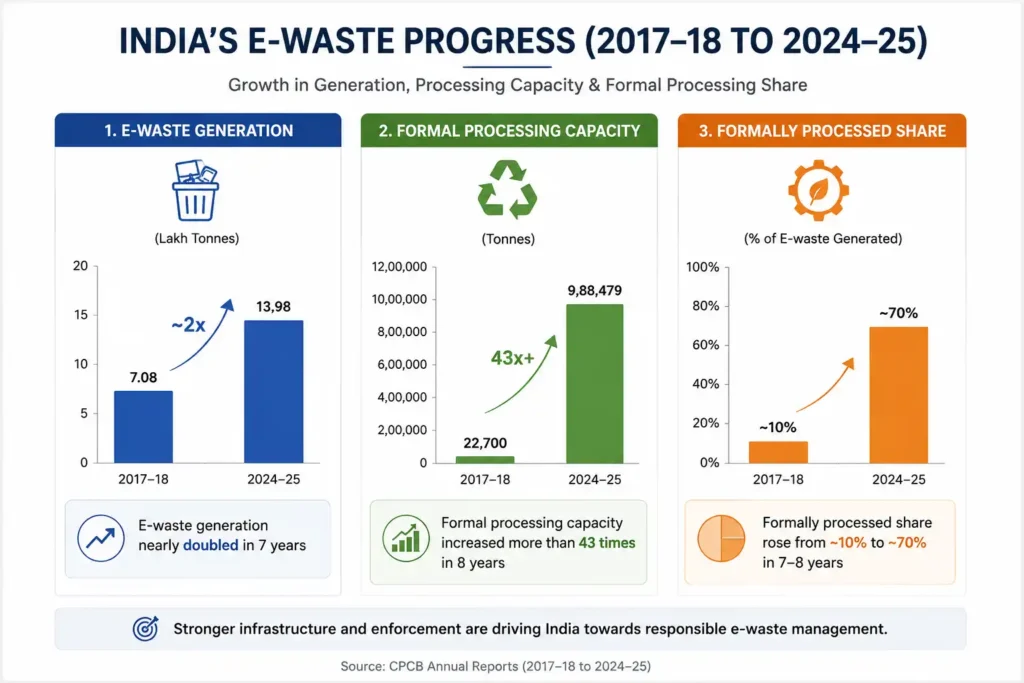
Electronic and electrical component manufacturers face a fast-moving compliance curve. CPCB data shows:
- E-waste generation nearly doubled from 7.08 lakh tonnes in 2017-18 to 13.98 lakh tonnes in 2024-25
- Collection and formal processing capacity expanded even faster, rising from 22,700 tonnes in 2016-17 to 9,88,479 tonnes in 2024-25, a more than 43-fold increase over eight years
- The formally processed share of generated e-waste climbed from around 10 percent to close to 70 percent over the same period, reflecting both stronger enforcement and the growth of authorised recycling infrastructure
Municipal-adjacent industrial zones add further pressure. National data puts total solid waste generation at 1,70,339 tonnes per day against processing capacity of only 91,511 tonnes per day. This means just 54 percent of generated waste is actually treated or processed across the country. Per capita solid waste generation has climbed from 98.79 grams per day to 123.45 grams per day over five years, and disposal infrastructure has not kept pace uniformly. A total of 1,244 sites have been identified nationally for sanitary landfill development. Of these, 669 have been constructed and 645 are currently operational, leaving a meaningful gap between identified need and built capacity in several states.
Why Sustainable Waste Management Systems Matter for Manufacturing Facilities
For a manufacturing facility, waste management is not a peripheral EHS function. It is a design input that determines whether a plant can legally operate, making well-planned industrial waste management solutions essential from the earliest stages of facility design. An effluent treatment plant sized without accounting for periodic cleaning-in-place discharges will be overloaded during changeovers. A hazardous waste storage yard built without reference to the facility’s liquid effluent strategy can create secondary contamination that triggers additional consent conditions. Air emission control systems for boilers, scrubbers, and solvent recovery units are equally governed by CPCB ambient air quality standards. Actual stack limits and fugitive dust allowances are specified in state PCB consent conditions rather than uniform national numbers.
Sustainable waste management planning for Indian manufacturing facilities generally spans four interconnected streams:
- Liquid effluent treatment: Primary treatment such as screening, equalisation, and pH correction, secondary biological treatment through activated sludge or moving bed biofilm reactors, and tertiary polishing through filtration and disinfection. Facilities in pharmaceutical, textile dyeing, distillery, and pulp and paper clusters notified by CPCB are additionally required to implement Zero Liquid Discharge, eliminating liquid effluent release entirely through membrane concentration, thermal evaporation, and crystallisation for salt recovery.
- Hazardous waste handling: Storage facilities must meet HWM Rules 2016 construction standards, with waste categorised across process-specific, concentration-based, and import-export schedules, and disposed of only through CPCB-approved TSDFs within the 90-day storage window.
- Solid and packaging waste: Segregation at source into hazardous and non-hazardous streams is mandatory, with non-hazardous waste routed to authorised recyclers, composting facilities, or approved landfill sites, and packaging waste tracked against EPR obligations under the Plastic Waste Management Rules.
- Air emissions: Boiler flue gases, chemical process exhaust, and solvent vapour streams each require distinct engineered controls, from bag filters and cyclones to wet scrubbers, thermal oxidisers, and vapour recovery systems, sized to the specific emission source rather than applied generically across a facility.
Common Gaps in Industrial Waste Management Planning
Several recurring gaps show up across Indian manufacturing facilities when waste systems are planned reactively rather than as part of facility engineering from the outset.
- Design based on assumed influent parameters: treatment systems get sized without an actual waste characterisation study measuring chemical oxygen demand, biological oxygen demand, suspended solids, pH, and heavy metal concentrations across all production scenarios. This mismatch typically produces either an undersized ETP that fails discharge norms or an oversized one carrying unnecessary capital cost.
- Siloed system design: liquid, solid, hazardous, and air emission systems are treated as separate design exercises handled by different specialists, which creates compliance gaps at the interfaces, such as hazardous sludge generated by an ETP that was never accounted for in the facility’s solid waste storage capacity.
- Vendor-driven technology selection: choices are made based on vendor promotion rather than technical evaluation. A membrane bioreactor proposed where conventional activated sludge with tertiary polishing would meet the same discharge standard represents avoidable capital cost without a corresponding compliance benefit.
- Designing to outdated standards: systems get built to regulatory standards that are already superseded by the time they are commissioned, given how frequently CPCB revises discharge limits, ZLD mandates, and hazardous waste classification schedules, and how often state PCBs layer additional consent conditions, including mandatory online effluent monitoring, on top of national standards.
Integrating Waste Management into Plant Design
For greenfield projects, waste stream mapping should begin at the process design stage using the process flow diagram, well before construction. This allows waste minimisation to be built into the production process itself rather than bolted on as end-of-pipe treatment. Site selection should factor in proximity to TSDF facilities, state-specific PCB constraints, and available infrastructure for ZLD residue disposal. For brownfield facilities, waste management upgrades usually need to be sequenced around production continuity, while closing gaps identified in prior CPCB or state PCB inspection observations.
Environmental clearance applications under the EIA Notification require a detailed waste management plan as a mandatory component of the submission to State and Central Expert Appraisal Committees. The technical credibility of that plan directly shapes both processing time and the conditions attached to the clearance. Getting the underlying engineering right, not just the paperwork, is what determines whether a facility passes its first CPCB inspection without additional directions.
How IMARC Engineering Supports Waste Management System Planning
IMARC Engineering designs integrated waste management systems for manufacturing facilities across pharmaceuticals, chemicals, food processing, FMCG, agrochemicals, medical devices, and industrial products, covering:
- Effluent treatment plant design
- Zero Liquid Discharge engineering
- Hazardous waste storage design under HWM Rules 2016
- Solid waste segregation frameworks
- Air emission control systems built to current CPCB and state PCB standards
The approach starts with waste characterisation studies that establish an accurate design basis. It moves through detailed engineering with complete P&ID documentation and equipment specifications. From there, it continues through construction conformance review, commissioning performance testing, and post-commissioning regulatory compliance support, including annual hazardous waste returns and consent renewal documentation.
Manufacturing facilities looking to build waste management systems that hold up against CPCB and state PCB scrutiny can review IMARC Engineering’s full waste management system planning services to understand how integrated planning reduces both compliance risk and long-term treatment cost.
Consult with Our Waste Management Engineering Specialists: https://www.imarcengineering.com/contact?service=waste-management-system-planning
Contact Us:
IMARC Engineering
Phone: +91-120-433-0800
Email: sales@imarcengineering.com
India: C-130, Sector 2, Noida, Uttar Pradesh 201301
LinkedIn: https://www.linkedin.com/showcase/imarc-engineering/
About the Author