Setting up a canned vegetables manufacturing plant in India presents a compelling investment case driven by the growing consumer preference for convenience, the rise in packaged food consumption, and the increasing demand for longer shelf-life produce. Canned vegetables – fresh vegetables preserved through a controlled canning and heat-processing sequence – provide a ready-to-eat option with a long shelf life, making them highly convenient for consumers, particularly in urban areas or regions with limited access to fresh produce. As India’s organised food retail sector deepens, its working-population expands, and its foodservice and hospitality industries scale, the domestic market for consistently processed, shelf-stable, and nutritionally preserved vegetables is structurally positioned for sustained long-term growth. Canned vegetables account for about 28.7% of the share in the global canned food market according to industry reports – a dominant position that confirms this as the largest and most commercially validated segment in the broader canned food investment landscape.
India’s structural advantages make this investment strategically sound. India’s food manufacturing market is expected to grow from USD 307 billion in 2023 to USD 700 billion in 2030 according to IBEF – a trajectory that directly expands the domestic processing, retail, and foodservice ecosystem demanding quality canned vegetable products across multiple distribution channels. Convenience continues to be a primary factor driving purchasing decisions, and India’s rapid urbanisation, changing lifestyles, and rising disposable incomes are accelerating adoption of packaged food formats across both metro and tier-2 consumer bases. Asia-Pacific and North America are the largest markets globally for canned vegetables – with Asia benefiting from rising disposable incomes and changing lifestyles, and North America leading in consumption through its well-established retail and foodservice networks – and India as Asia-Pacific’s fastest-growing food manufacturing nation is optimally positioned to serve both domestic and export demand from a single strategically located canned vegetables manufacturing plant in India.
India’s food manufacturing market expanding from USD 307 billion in 2023 to USD 700 billion in 2030 per IBEF, canned vegetables’ 28.7% share of the global canned food market, and the structural shift toward convenience and packaged food consumption make a canned vegetables manufacturing plant a financially sound, export-capable agro-food processing investment. With gross margins of 25–35% and net margins of 10–18% across a capacity of 15 million cans annually, the project delivers consistent returns aligned with India’s food processing value-addition agenda.
What are Canned Vegetables?
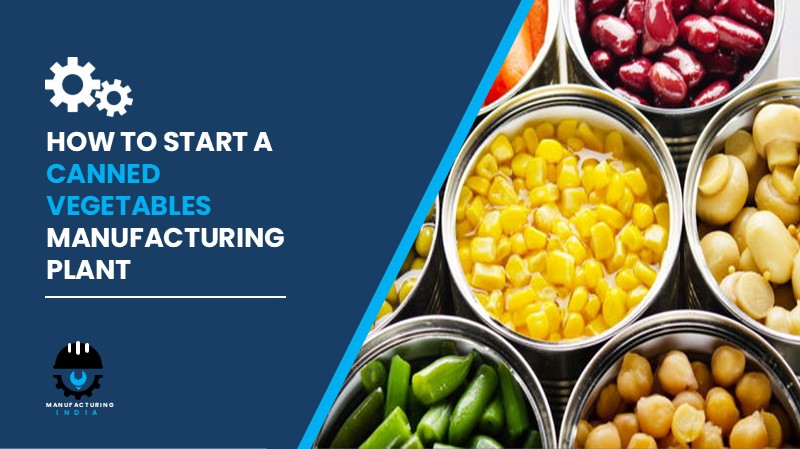
Canned vegetables are fresh vegetables that have been preserved through the canning process. The vegetables are washed, peeled (if necessary), cut, blanched, and packed into cans, followed by heat treatment to destroy harmful bacteria and enzymes – ensuring they remain safe for consumption over an extended period. The most common vegetables used for canning include beans, peas, corn, carrots, spinach, and mushrooms. Canned vegetables retain their nutritional content and provide a convenient, shelf-stable alternative to fresh produce, making them a popular choice for consumers seeking long shelf life – especially in regions with limited access to fresh produce.
The products align strongly with the growing demand for healthy, preservative-free canned options and the increasing consumer preference for clean labels and sustainable production processes. Their versatility across home consumption, ready-to-eat meals, salads, soups, and catering applications makes them one of the most broadly applicable and institutionally supported processed food categories globally – and in India, a natural fit for the country’s expanding urban household, modern retail, and institutional foodservice channels.
The primary production method is washing, peeling, cutting, blanching, canning, sealing, and heat processing – a multi-stage food manufacturing and thermal sterilisation process. End-use industries served include the food and beverage industry, retail, hospitality, and food processing.
Cost of Setting Up a Canned Vegetables Manufacturing Plant in India
The cost of establishing this facility depends on capacity, technology selection, plant location, degree of automation, and regulatory compliance requirements.
1. Capital Expenditure (CapEx)
Total capital investment for a canned vegetables manufacturing plant in India covers land acquisition, site preparation, civil construction, machinery, and pre-operative expenses. The cost of land and site development – including charges for land registration, boundary development, and other related expenses – forms a substantial part of the overall investment. This allocation ensures a solid foundation for safe and efficient plant operations. Investors can reduce land acquisition costs by locating the unit in a food processing zone, agro-industrial park, or Special Economic Zone (SEZ), which also provide shared utility infrastructure and potential state-level fiscal incentives aligned with India’s food processing manufacturing development agenda.
Civil works and construction cover the main washing, blanching, canning, and heat processing production building, cold raw material receiving and fresh vegetable storage areas, a finished goods warehouse, a quality control laboratory, and an administrative block. Given that canned vegetables manufacturing requires high-temperature retort sterilisation, steam and water systems, and food-grade processing environments, civil infrastructure must incorporate appropriate ventilation, steam distribution, food-safety compliant flooring, and wastewater management provisions.
Machinery costs account for the largest portion of total capital expenditure. Key machinery required includes:
- Washing stations
- Blanchers
- Peelers
- Cutters
- Canning lines
- Retorts for sterilisation
- Cooling tunnels
- Labelling machines
- Case packers
All machinery must be high-quality and corrosion-resistant, tailored for canned vegetables production, and must comply with industry standards for safety, efficiency, and reliability. Other capital costs include the effluent treatment plant (ETP), advanced process monitoring systems, pre-operative expenses, trial production costs, and commissioning charges.
Request a Sample Report for In-Depth Market Insights: https://www.imarcgroup.com/canned-vegetables-manufacturing-plant-project-report/requestsample
2. Operational Expenditure (OpEx)
The operating cost structure of a canned vegetables manufacturing plant is primarily driven by raw material consumption, particularly fresh vegetables including peas, carrots, and corn, which account for approximately 65–75% of total operating expenses (OpEx). Tinplate cans and lids, and brine/syrup, are the secondary raw material inputs. Securing long-term supply agreements with reliable fresh vegetable producers and minimising transportation costs by selecting nearby suppliers is essential for cost stability and production continuity. Long-term contracts should be negotiated to stabilise pricing and ensure a steady supply, and sustainability and supply chain risks must be assessed as part of the procurement strategy.
Utility costs – comprising electricity and steam for retorts, blanchers, and cooling tunnels, as well as water – account for 10–15% of total OpEx. Other ongoing operating costs include transportation, packaging, salaries and wages, depreciation, taxes, equipment repairs and maintenance, and other miscellaneous expenses.
In the first year of operations, the operating cost for the canned vegetables manufacturing plant is projected to be significant, covering raw materials, utilities, depreciation, taxes, packing, transportation, and repairs and maintenance. By the fifth year, the total operational cost is expected to increase substantially due to factors such as inflation, market fluctuations, and potential rises in the cost of key materials. Additional factors, including supply chain disruptions, rising consumer demand, and shifts in the global economy, are expected to contribute to this increase.
3. Plant Capacity
The proposed manufacturing facility is designed with an annual production capacity of 15 million cans, enabling economies of scale while maintaining operational flexibility. Capacity can be customised per investor requirements based on target retail, foodservice, institutional, or export market segments, available capital, and degree of automation. Profitability improves materially with higher capacity utilisation, making domestic supply agreements with organised retail chains, institutional catering operators, and ready-to-eat food manufacturers – alongside export relationships with international grocery and foodservice buyers – a commercial priority from the commissioning stage.
4. Profit Margins and Financial Projections
The project demonstrates healthy profitability potential under normal operating conditions. Gross profit margins typically range between 25–35%, supported by stable demand and value-added applications. Net profit margins range between 10–18%. A comprehensive financial model covering NPV (net present value), IRR (internal rate of return), payback period, liquidity analysis, uncertainty analysis, sensitivity analysis, and a full five-year profit and loss account provides investors with a rigorous analytical framework for assessing financial viability and long-term sustainability across different capacity and pricing scenarios.
Why Set Up a Canned Vegetables Plant in India?
Convenience Factor Driving Structural Demand. Canned vegetables provide a ready-to-eat option with long shelf life, making them highly convenient for consumers – particularly in urban areas or regions with limited access to fresh produce. The growing preference for packaged foods, especially due to busy lifestyles, has propelled demand for canned vegetables, making it a lucrative market for investment. This demand driver is structural, not cyclical, as India’s urbanisation continues to increase the share of working professionals and nuclear families that prioritise meal convenience over fresh produce preparation.
Dominant Market Position in the Canned Food Segment. Canned vegetables account for about 28.7% of the share in the global canned food market – the largest individual product segment in the broader canned foods category. This dominant share position confirms consistent and deep consumer and institutional demand across developed and developing markets, making canned vegetables manufacturing a commercially validated and volume-supported category investment.
India’s Expanding Food Manufacturing Market. India’s food manufacturing market is expected to grow from USD 307 billion in 2023 to USD 700 billion in 2030 according to IBEF – a trajectory that directly expands the domestic processing, retail, and institutional procurement ecosystem for canned vegetable products. Asia-Pacific and North America are the largest markets globally, with Asia benefiting from rising disposable incomes and changing lifestyles, positioning India as a growth engine within the Asia-Pacific canned vegetables demand curve.
Health and Sustainability Trends Aligning with Clean-Label Demand. The growing demand for healthy, preservative-free canned options is aligning with the increasing consumer preference for clean labels and sustainable production processes. Canned vegetables – which retain their nutritional content through heat processing without artificial preservatives – align naturally with India’s growing health-aware consumer segment that seeks convenient, nutritionally dense food products.
Moderate Entry Barriers Supporting Viable Market Entry. While capital is required for plant setup – including specialised canning and heat processing equipment such as retorts, blanchers, and canning lines – the technology involved in canning vegetables is relatively standardised, making entry into the market feasible with careful planning. This moderate barrier profile enables well-capitalised and FSSAI-compliant domestic investors to establish commercially competitive operations without requiring proprietary technology development.
Active Global Industry Developments Confirming Category Investment Momentum. In November 2023, B&G Foods Inc. announced that it had sold its Green Giant U.S. shelf-stable vegetable product line to Seneca Foods Corporation – with B&G retaining ownership of the Green Giant trademarks and licensing the Green Giant brand name to Seneca Foods, confirming active portfolio rationalisation and specialisation investment in canned vegetable production capacity among established global players. In September 2023, Conagra Brands Canada unveiled new state-of-the-art upgrades to its tomato processing plant in Dresden, Ontario – a multi-million-dollar investment representing Conagra Brands Canada’s commitment to meeting consumers where it matters most with high-quality, local food made in Canada. These industry actions confirm that global canned vegetable producers are actively investing in production capacity and brand-focused distribution, validating long-term commercial confidence in the category.
Manufacturing Process – Step by Step
The canned vegetables manufacturing process uses washing, peeling, cutting, blanching, canning, sealing, and heat processing as the primary production method. Each stage is precision-controlled to ensure vegetable quality, microbiological safety, and full compliance with the food safety and shelf-life standards required by retail, hospitality, food processing, and institutional customers.
- Raw Material Receipt and Inspection: Fresh vegetables – including peas, carrots, corn, beans, spinach, and mushrooms – tinplate cans and lids, and brine/syrup are received at the facility and subjected to incoming quality checks for freshness, microbiological compliance, size specification, and grade before entering the processing line.
- Washing: Fresh vegetables pass through washing stations where high-pressure water washing removes surface soil, agrochemical residues, and foreign matter – the critical first cleaning stage that protects food safety and product quality throughout downstream processing.
- Peeling and Cutting: Washed vegetables are passed through peelers and cutters to remove outer skins where required and to reduce vegetables to the required size, shape, and piece specification for the target product format – diced carrots, whole peas, cut corn kernels, sliced mushrooms, or other specified geometries.
- Blanching: Cut vegetables are processed through blanchers under controlled time and temperature conditions – typically using steam or hot water – to deactivate enzymes that would otherwise cause colour deterioration and nutritional loss during storage, and to partially soften texture for improved canning fill performance.
- Canning: Blanched vegetables are filled into tinplate cans through automated canning lines to the specified fill weight and headspace. Brine or syrup – formulated to the required salt concentration or sugar level for the target product – is added to each can to complete the filling operation.
- Sealing: Filled cans are hermetically sealed with lids using double-seaming equipment on the canning lines, producing an airtight seal that is essential for the sterility and long shelf life of the finished canned product.
- Retort Sterilisation: Sealed cans are loaded into retorts for sterilisation under controlled temperature, pressure, and time conditions calibrated to achieve the required sterility assurance level (F₀ value) for the target vegetable product – destroying harmful bacteria and enzymes while preserving the nutritional content and eating quality of the canned vegetables.
- Cooling: Sterilised cans are passed through cooling tunnels to reduce product temperature rapidly to ambient conditions – preventing overcooking and maintaining the texture, colour, and nutritional quality of the canned vegetables within specification.
- Quality Inspection: Finished canned vegetables are evaluated for seam integrity, can pressure, appearance, and analytical quality compliance – including incubation testing for commercial sterility verification – before release for labelling and dispatch.
- Labelling and Case Packing: Approved cans are labelled with product specification, nutritional information, FSSAI compliance markings, and traceability data using labelling machines, then packed into retail cases using case packers for dispatch to end-use customers across the food and beverage industry, retail, hospitality, and food processing sectors.
Key Applications
The canned vegetables manufacturing plant serves a diverse and commercially significant range of end-use sectors across India’s food and foodservice economy.
- Food Processing: Cleaning, blanching, and preparation of vegetables prior to canning – supplying processed vegetable intermediates to ready-meal, soup, and sauce manufacturers who use canned vegetables as convenient, consistent, and shelf-stable ingredient inputs.
- Canning and Packaging: Filling, sealing, and thermal processing of canned vegetables for retail, institutional, and export distribution channels – the core manufacturing operation covering the full spectrum from single-serve retail cans to bulk foodservice containers.
- Quality Control: Inspection, sorting, and safety assurance throughout production – ensuring FSSAI and HACCP compliance across all production batches and maintaining traceability documentation for domestic and export market access.
- Storage and Distribution: Warehousing, labelling, and transportation of finished canned products across organised retail supermarkets, hypermarkets, online grocery platforms, hospitality procurement channels, and export distribution networks.
- Home Consumption and Ready-to-Eat Meals: Direct retail supply to household consumers seeking long shelf-life vegetable convenience products for use in salads, soups, stir-fries, and quick-preparation meal occasions.
- Catering and Institutional Foodservice: Supply to hotel banqueting operations, hospital catering, airline meal production, and institutional food service providers requiring consistent, safe, and bulk-pack vegetable supplies that simplify kitchen operations and inventory management.
Leading Manufacturers
The global canned vegetables industry is served by several established multinational manufacturers with extensive production capacities and diverse application portfolios. Key players operating in this market include:
- Del Monte Foods
- Nestlé
- B&G Foods
- Green Giant
- ConAgra Foods
All of these manufacturers serve end-use sectors including the food and beverage industry, retail, hospitality, and food processing – the same markets that a domestic Indian canned vegetables manufacturing plant can target across domestic retail, institutional foodservice, and export distribution channels.
Timeline to Start the Plant
Investors should plan for a structured pre-production and commissioning phase covering the following key stages:
- Feasibility study and project report preparation
- Land acquisition and site development
- Regulatory approvals and environmental clearances
- Factory licence and fire safety compliance
- Machinery procurement and installation
- Raw material supplier agreements and supply chain setup
- Trial production and quality testing
- Commercial production launch
Licences and Regulatory Requirements
Starting a canned vegetables manufacturing unit in India requires several approvals:
- Business registration (Proprietorship, LLP, or Private Limited Company)
- Factory Licence under the Factories Act
- Environmental Clearance from the State Pollution Control Board
- GST Registration
- Fire Safety NOC
- FSSAI (Food Safety and Standards Authority of India) food business operator licence for thermally processed canned food products
- Effluent Treatment Plant (ETP) operational clearance
- Occupational Health and Safety compliance
Key Challenges to Consider
High Capital Requirements. Establishing a fully equipped canned vegetables manufacturing plant – with washing stations, blanchers, peelers, cutters, canning lines, retorts for sterilisation, cooling tunnels, labelling machines, and case packers – at the 15 million can annual capacity range requires significant upfront capital investment. Access to food processing PLI scheme incentives, MSME credit-linked schemes, and Pradhan Mantri Kisan Sampada Yojana grants for food processing can help bridge funding requirements.
Raw Material Price Volatility and Perishability. Fresh vegetables – peas, carrots, and corn – accounting for 65–75% of total OpEx, are perishable agricultural commodities subject to significant seasonal price fluctuations, crop year harvest variability, and post-harvest spoilage risks. Long-term procurement contracts with reliable vegetable growers, harvest-season forward purchasing strategies, and strategic plant location in proximity to major vegetable growing regions are the primary risk mitigation measures for managing this dominant cost driver.
Regulatory Compliance. Canned vegetables are thermally processed foods subject to detailed FSSAI compliance obligations including retort process validation, commercial sterility testing, labelling regulations, and lot traceability requirements. Advanced monitoring systems must be installed throughout the retort sterilisation process, and effluent treatment systems must manage the high-BOD wastewater generated by vegetable washing and blanching operations. Maintaining continuous regulatory compliance and documentation adds materially to ongoing operational overhead.
Competition from Established Global Players. Established multinational manufacturers – Del Monte Foods, Nestlé, B&G Foods, Green Giant, and ConAgra Foods – set high benchmarks for product quality, food safety certification, brand recognition, and distribution reach. Indian manufacturers must compete through locally sourced Indian vegetable varieties, FSSAI-certified production, competitive pricing in the domestic retail and institutional foodservice segments, and the ability to serve export markets with consistent, traceable, and internationally certified canned products.
Supply Chain Complexity and Seasonality. Fresh vegetable availability and pricing are highly seasonal, requiring careful harvest procurement planning, cold chain logistics from farm to factory, and scheduling of production runs aligned with seasonal crop availability. Managing this procurement complexity while maintaining consistent year-round production schedules is one of the most operationally demanding challenges for domestic canned vegetables manufacturers.
Skilled Manpower. Operating washing stations, blanchers, retorts, canning lines, and quality inspection systems in a food-grade manufacturing environment while maintaining FSSAI HACCP compliance documentation requires trained food processing technicians, retort operation specialists, and quality assurance personnel. Recruiting, training, and retaining qualified production and quality staff is a recurring operational challenge in India’s food processing sector.
Frequently Asked Questions
1. How much does it cost to set up a canned vegetables manufacturing plant in India?
Total setup cost depends on plant capacity, location, machinery selection, and automation level. Key cost components include land and site development, food-grade civil construction with steam and wastewater management provisions, machinery (washing stations, blanchers, peelers, cutters, canning lines, retorts for sterilisation, cooling tunnels, labelling machines, case packers), and pre-operative expenses. A detailed feasibility study is recommended to generate accurate project-specific cost estimates.
2. Is canned vegetables manufacturing profitable in India in 2026?
Yes. The project delivers healthy financial performance, with gross margins of 25–35% and net profit margins of 10–18% under normal operating conditions. Canned vegetables account for 28.7% of the global canned food market per industry reports, and India’s food manufacturing market is expected to grow from USD 307 billion in 2023 to USD 700 billion in 2030 per IBEF – providing a strong and expanding domestic and export demand foundation.
3. What machinery is required for a canned vegetables manufacturing plant in India?
Essential equipment includes washing stations, blanchers, peelers, cutters, canning lines, retorts for sterilisation, cooling tunnels, labelling machines, and case packers.
4. What licences and approvals are required to start a canned vegetables manufacturing plant in India?
Required approvals include business registration, Factory Licence, Environmental Clearance from the State Pollution Control Board, GST Registration, Fire Safety NOC, an FSSAI food business operator licence for thermally processed canned food products, ETP operational clearance, and Occupational Health and Safety compliance.
5. What raw materials are needed for canned vegetables manufacturing?
The primary raw materials are fresh vegetables – particularly peas, carrots, and corn – tinplate cans and lids, and brine/syrup. Fresh vegetables are the dominant cost driver, accounting for 65–75% of total operating expenses, and must be sourced from reliable growers meeting the freshness, size, and grade specification requirements of the target canned product.
6. What are the environmental compliance requirements for a canned vegetables manufacturing plant in India?
The facility must obtain Environmental Clearance from the State Pollution Control Board, operate an approved ETP for high-BOD vegetable processing wastewater management, and install advanced monitoring systems to detect deviations in the retort sterilisation process. Effluent treatment systems are necessary to minimise environmental impact and ensure compliance with emission standards applicable to food processing operations. FSSAI traceability and quality documentation must be maintained throughout operations.
7. What is the best location to set up a canned vegetables manufacturing plant in India?
The location must offer easy access to key raw materials such as fresh vegetables – peas, carrots, corn – while proximity to target domestic retail and institutional markets minimises distribution costs. The site must have robust infrastructure including reliable transportation, utilities, and waste management systems. States with strong vegetable production bases – including Punjab, Haryana, Uttar Pradesh, Maharashtra, and Karnataka – combined with access to food processing industrial infrastructure and export port connectivity are the strongest location candidates.
8. What is the break-even period for this type of plant in India?
The break-even period depends on plant capacity, total capital investment, product selling price across retail and institutional segments, and capacity utilisation rate. A comprehensive financial analysis covering NPV, IRR, payback period, and uncertainty and sensitivity analysis is the most reliable method for generating project-specific break-even timelines.
9. What government incentives are available for manufacturers in India?
Canned vegetables manufacturers in India can access the Production Linked Incentive (PLI) scheme for food processing, Pradhan Mantri Kisan Sampada Yojana (PMKSY) grants for integrated cold chain and food processing infrastructure, MSME credit-linked capital subsidy schemes, and export promotion incentives for processed vegetable products administered by APEDA under the Ministry of Commerce. Governments may also offer capital subsidies, tax exemptions, and interest subsidies under national or regional agro-processing development policies.
Key Takeaways for Investors
A canned vegetables manufacturing plant in India offers a well-grounded agro-food processing investment opportunity anchored by growing demand across the food and beverage industry, retail, hospitality, and food processing sectors – all of which require consistently processed, nutritionally preserved, and shelf-stable canned vegetable products for home consumption, ready-to-eat meals, salads, soups, and catering applications. The project is financially viable at the 15 million can annual capacity, with gross margins of 25–35% and net margins of 10–18% providing a consistent return framework supported by India’s rapidly expanding food manufacturing market. Canned vegetables account for 28.7% of the global canned food market per industry reports – the dominant segment position that confirms deep and diversified institutional and consumer demand. India’s food manufacturing market is expected to grow from USD 307 billion in 2023 to USD 700 billion in 2030 per IBEF, and Asia-Pacific’s position as one of the two largest global canned vegetables markets confirms that India – with its vast vegetable growing base and rapidly scaling food retail infrastructure – is optimally positioned for canned vegetables manufacturing investment. With B&G Foods’ November 2023 Green Giant divestiture to Seneca Foods and Conagra Brands Canada’s September 2023 multi-million-dollar tomato processing plant upgrade confirming active category investment globally, the long-term demand sustainability for domestically produced canned vegetables in India is structurally sound across all investment planning horizons.
About the Author