An aluminum bottle manufacturing plant setup in India presents a compelling investment case as demand accelerates across the beverage sector, food and liquid nutrition processing, pharmaceutical and cosmetic industry, retail, and e-commerce distribution. This packaging format is increasingly favoured for packaged water, juices, energy drinks, alcoholic beverages, and liquid supplements, driven by rising demand for eco-friendly and reusable packaging and the growing shift away from single-use plastics. As global brands prioritise sustainable, recyclable packaging, such a facility is positioned to serve both domestic consumption and export-oriented liquid product categories.
India’s expanding urbanisation, organised retail growth, and the Make in India initiative create favourable conditions for new packaging capacity, with manufacturing hubs across Gujarat and Maharashtra offering strong industrial infrastructure, port access, and aluminum processing ecosystems. Combined with a large, growing packaged beverage market, India offers a strategically sound base for this production, aimed at both domestic supply and export.
This investment offers a well-rounded opportunity, supported by rising demand from the beverage, food, cosmetic, and pharmaceutical sectors, cost-competitive manufacturing conditions, and healthy projected gross margins of 30-40%. With capacity that can be scaled from 50 to 100 million units annually and clear regulatory pathways, the unit presents a financially viable, demand-backed proposition for investors.
What is an Aluminum Bottle?
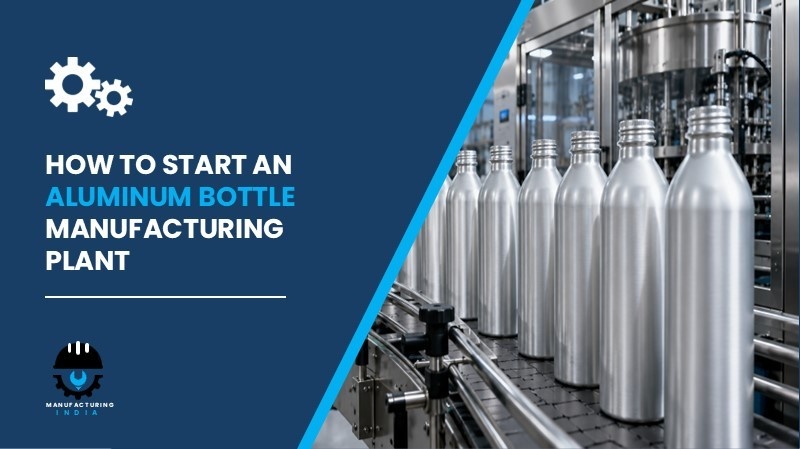
These are lightweight, durable, and fully recyclable containers widely used for beverages, liquid foods, and other consumables. Produced from aluminum sheets or coils, production for this aluminum bottle manufacturing plant relies on extrusion or blow-forming, trimming and necking, coating, printing and labeling, capping or sealing, quality inspection, and packaging to transform raw aluminum into finished containers. The product offers superior protection, helps maintain freshness, and extends shelf life, while supporting sustainability through recyclability and reusability.
The container is increasingly preferred in the beverage industry for water, juices, energy drinks, alcoholic beverages, and nutritional supplements, and it also serves the food, cosmetic, and pharmaceutical sectors owing to its hygienic and protective qualities.
Cost of Setting Up an Aluminum Bottle Manufacturing Plant in India
The cost of setting up an aluminum bottle manufacturing plant depends on capacity, technology, automation level, site location, and regulatory compliance requirements.
1. Capital Expenditure (CapEx)
Capital expenditure for this aluminum bottle manufacturing plant is anchored by land and site development costs, which cover acquisition, registration, and boundary development, ideally within an industrial estate or SEZ that offers infrastructure and compliance advantages. Civil works and construction costs follow, covering the manufacturing shed, quality control lab, storage areas, and the administrative block.
Machinery represents the largest share of capital investment for the unit. Key machinery required includes:
- Extrusion or blow-forming machines
- Trimming machines
- Coating machines
- Printing machines
- Capping machines
- Conveyors
- Packaging machines
Other capital costs cover effluent treatment plant installation, pre-operative expenses, commissioning costs, and any applicable import duties. The exact rupee-value breakdown across these four cost heads is gated behind IMARC’s sample report, where the figures currently appear as placeholder values pending a formal data request.
Request a Sample Report for In-Depth Market Insights: https://www.imarcgroup.com/aluminum-bottle-manufacturing-plant-project-report/requestsample
2. Operational Expenditure (OpEx)
Raw material cost dominates the operating expense structure, with aluminum slugs accounting for approximately 65-75% of total OpEx, making long-term supplier contracts important for mitigating price volatility. Utility cost, covering electricity, water, and steam, contributes a further 10-15% of OpEx.
Other operating costs include transportation, packaging, salaries and wages, maintenance, depreciation, and taxes; the specific rupee-value contribution of each is similarly gated behind the sample report. By the fifth year of operations, total operational cost is projected to rise substantially due to inflation, market fluctuations, supply chain disruptions, and rising input costs.
3. Plant Capacity
The proposed facility is designed with an annual production capacity ranging between 50 and 100 million units, enabling economies of scale while maintaining operational flexibility. Capacity can be customized based on investor requirements and target markets, and profitability generally improves with higher utilisation.
4. Profit Margins and Financial Projections
The project demonstrates healthy profitability potential under normal operating conditions. Gross profit margins typically range between 30-40%, while net profit margins range between 12-18%, supported by stable demand and value-added applications. Detailed NPV, IRR, and payback period calculations, developed from capital investment, operating costs, and capacity utilisation, are available through the full sample report.
Why Set Up an Aluminum Bottle Plant in India?
Rising Consumer Preference for Eco-Friendly Packaging: Aluminum containers are replacing single-use plastic bottles as brands and consumers prioritise sustainability. According to Shorr’s 2025 Sustainable Packaging Consumer Report, 90% of customers prioritise brands using sustainable packaging, 54% have intentionally bought such products in the last six months, and 43% would pay more for them.
Growth of the Packaged Beverage Sector: The rapidly increasing packaged beverage sector, consisting of water, juices, energy drinks, and alcoholic beverages, continues to court manufacturers of durable, lightweight, and eco-friendly containers, directly supporting demand for this facility’s output.
Lightweight and Durable Product Profile: These containers offer convenience in transportation, handling, and storage compared to alternative packaging formats, making them attractive to distributors and retailers operating across large geographies.
Reusable and Recyclable Format: Output from the plant supports environmental regulations and green initiatives, aligning with the ban on single-use plastics and enforcement of strict environmental guidelines that are promoting the use of aluminum packaging.
Active Industry Investment: Brand-level investment in this packaging category is accelerating: in November 2025, Smol launched a 500 mL container made from recycled aluminum for its home care range, and in April 2025, Saint James Iced Tea launched a 100% recyclable aluminum-based container for its ready-to-drink iced tea products.
Product Diversification and Scalable Production: The facility supports diversification across multiple sizes, finishes, coatings, and printed designs, alongside a scalable production model that allows gradual capacity expansion with manageable capital outlay.
Aluminum Bottle Manufacturing Process – Step by Step
The aluminum bottle manufacturing process uses extrusion or blow-forming as the primary production method, supported by several finishing and quality stages.
- Raw Material Sourcing: Aluminum sheets, coils, and slugs are procured as the primary input.
- Extrusion or Blow-Forming: The slug is shaped into the bottle form.
- Trimming and Necking: The formed unit is trimmed, and the neck is shaped for capping compatibility.
- Coating: A protective coating is applied for durability.
- Printing and Labeling: Branding and labeling are applied through printing.
- Capping or Sealing: Units are fitted with caps or sealing mechanisms.
- Quality Inspection: Each unit is inspected for safety and performance.
- Packaging and Dispatch: Finished output is packaged and dispatched to end-use industries.
Key Applications
Output from this aluminum bottle manufacturing plant serves a diverse set of industries spanning beverages, food, cosmetics, pharmaceuticals, and retail distribution.
- Beverage Industry: Water, juices, energy drinks, alcoholic beverages, and nutritional supplements.
- Food and Liquid Nutritional Products: Sauces, liquid foods, and meal supplements.
- Cosmetics and Pharmaceuticals: Lotions, tonics, syrups, and other liquid products.
- Retail and E-commerce: Lightweight, durable, eco-friendly packaging for direct consumer sales.
Leading Manufacturers
The global industry is served by several multinational companies with extensive production capacities and diverse application portfolios. Key players include:
- Ball Corporation
- CCL Industries Inc.
- Trivium Packaging
- O.Berk Company
- Tournaire Group
Timeline to Start the Plant
- Feasibility study and project report preparation
- Land acquisition and site development
- Regulatory approvals and environmental clearances
- Factory licence and fire safety compliance
- Machinery procurement and installation
- Raw material supplier agreements and supply chain setup
- Trial production and quality testing
- Commercial production launch
Licences and Regulatory Requirements
Starting this manufacturing unit in India requires several approvals:
- Business registration (Proprietorship, LLP, or Pvt Ltd)
- Factory Licence under the Factories Act
- Environmental Clearance from State Pollution Control Board
- GST Registration
- Fire Safety NOC
- Effluent Treatment Plant (ETP) operational clearance
- Occupational Health and Safety compliance
Key Challenges to Consider
High Capital Requirements: For an aluminum bottle manufacturing plant, machinery costs, including extrusion/blow-forming, trimming, coating, printing, capping, and packaging equipment, represent a significant share of total capital expenditure.
Raw Material Price Volatility: Aluminum slugs account for 65-75% of operating expenses, making the facility sensitive to fluctuations in aluminum pricing and supply availability.
Regulatory Compliance: The unit must navigate environmental clearances, effluent treatment requirements, and factory licensing before production begins.
Competition from Established Players: Ball Corporation, CCL Industries Inc., Trivium Packaging, O.Berk Company, and Tournaire Group represent established global competition.
Skilled Manpower: Operating extrusion/blow-forming, coating, and printing machinery requires trained technical staff.
Site Selection and Supply Chain Access: The site must offer easy access to aluminum slug suppliers, proximity to target markets, and robust transportation infrastructure.
Frequently Asked Questions
1. How much does it cost to set up an aluminum bottle manufacturing plant in India?
Total capital investment depends on capacity, technology, automation, and location, covering land, civil works, machinery, and other capital costs; detailed figures are in the full sample report.
2. Is aluminum bottle manufacturing profitable in India in 2026?
Yes, with gross profit margins of 30-40% and net profit margins of 12-18% under normal operating conditions, supported by rising demand across the beverage, food, cosmetic, and pharmaceutical sectors.
3. What machinery is required for an aluminum bottle plant in India?
Extrusion or blow-forming machines, trimming machines, coating machines, printing machines, capping machines, conveyors, and packaging machines.
4. What licences and approvals are required to start an aluminum bottle plant in India?
Business registration, a Factory Licence under the Factories Act, Environmental Clearance from the State Pollution Control Board, GST Registration, Fire Safety NOC, ETP operational clearance, and Occupational Health and Safety compliance.
5. What raw materials are needed for aluminum bottle manufacturing?
Aluminum slugs, sourced from aluminum sheets or coils, which account for approximately 65-75% of total operating expenses.
6. What are the environmental compliance requirements for an aluminum bottle plant in India?
Environmental Clearance from the State Pollution Control Board and an operational Effluent Treatment Plant (ETP) to manage waste and emissions.
7. What is the best location to set up an aluminum bottle plant in India?
Locations with easy access to aluminum slug suppliers, proximity to target markets, robust infrastructure, and compliance with zoning and environmental regulations, with industrial estates and SEZs offering added advantages.
8. What is the break-even period for this type of plant in India?
It depends on capacity utilisation, pricing trends, and cost structure; detailed payback period and NPV calculations are provided in the full financial analysis.
9. What government incentives are available for manufacturers in India?
The project can benefit from India’s push toward sustainable manufacturing under initiatives such as Make in India, alongside regulatory support tied to the ban on single-use plastics.
Key Takeaways for Investors
This investment opportunity is well positioned to capture demand from the beverage sector, food and liquid nutrition processing, pharmaceutical and cosmetic industry, and retail and e-commerce distribution, all of which are shifting toward sustainable, recyclable packaging. The project demonstrates financial viability across its proposed 50-100 million unit annual capacity range, with gross margins of 30-40% and net margins of 12-18% supporting a scalable investment case. With the global market for this product valued at USD 10.77 Billion in 2025 and projected to reach USD 18.87 Billion by 2034 at a CAGR of 6.4%, demand for this facility’s output is set to remain on a sustained growth trajectory, reinforced by continued brand-level investment in eco-friendly packaging formats.
About the Author