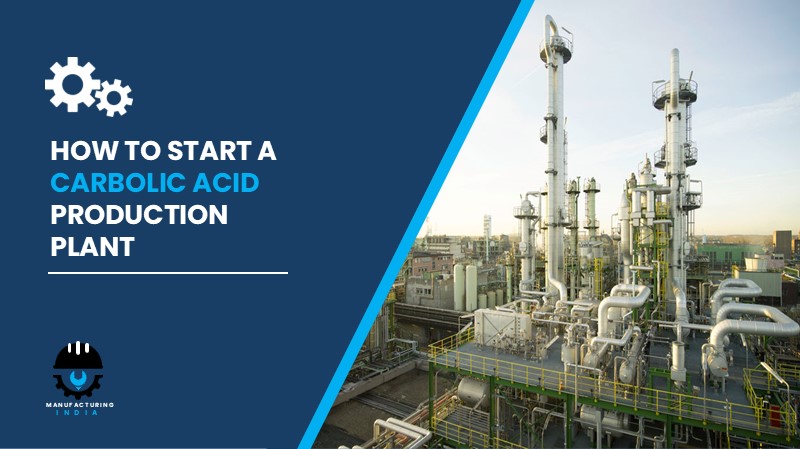
Setting up a carbolic acid production plant in India presents a compelling investment case driven by increasing demand from the phenolic resins, pharmaceuticals, disinfectants, agrochemicals, dyes, plastics, and specialty chemical industries. Carbolic acid – commercially known as phenol (C₆H₅OH) – is an essential aromatic chemical used as a key intermediate in the manufacture of bisphenol A, phenolic resins, caprolactam, alkyl phenols, and numerous pharmaceutical products. As India’s chemical industry expands rapidly and its downstream industries in automotive, construction, electronics, and pharmaceuticals scale to serve both domestic and global demand, the need for domestically produced, high-purity carbolic acid is growing at a pace that strongly favours new domestic production capacity investment.
India’s structural advantages make this investment strategically compelling. According to the India Brand Equity Foundation (IBEF), the Indian chemical industry was valued at approximately USD 250 billion in 2024 and is projected to reach USD 300 billion by 2028 and USD 1 trillion by 2040. India is also the sixth-largest chemical producer globally and the third-largest in Asia, contributing around 7% to the country’s GDP. This scale and growth trajectory confirm that the domestic demand base for industrial chemical intermediates like carbolic acid is structurally expanding – and that new capacity investment is well-timed relative to the country’s chemical industry growth cycle. The global carbolic acid market was valued at USD 25.30 billion in 2025 and is expected to reach USD 35.20 billion by 2034 at a CAGR of 3.7% from 2026 to 2034 according to IMARC Group estimates – positioning a domestic carbolic acid production plant in India within one of the most commercially important aromatic chemical categories in the global chemicals sector.
India’s chemical industry growing from USD 250 billion in 2024 toward USD 1 trillion by 2040 per IBEF, the global carbolic acid market expanding from USD 25.30 billion in 2025 to USD 35.20 billion by 2034, and rising demand from phenolic resins, bisphenol A, pharmaceuticals, and specialty chemicals make a carbolic acid production plant a financially sound and commercially well-supported investment. With gross margins of 18–25% and net margins of 10–16% across a capacity of 60,000 MT annually, the project delivers consistent returns anchored by India’s chemical industry megatrend.
What is Carbolic Acid?
Carbolic acid, commercially known as phenol, is an aromatic organic compound with the chemical formula C₆H₅OH. It is a colorless to pale pink crystalline solid or liquid (above its melting point) with a characteristic sweet, medicinal odor. Commercially, carbolic acid is primarily manufactured through the cumene process, in which benzene reacts with propylene to form cumene, followed by oxidation to cumene hydroperoxide and acid-catalyzed cleavage to produce phenol and acetone as co-products. The crude phenol is subsequently purified through distillation, quality tested, and packaged.
Commercial production emphasises high product purity, efficient process integration, safe handling of hazardous chemicals, and compliance with environmental, occupational safety, and product quality standards. Carbolic acid serves as one of the most important feedstocks for producing resins, plastics, fibres, pharmaceuticals, and specialty chemicals – a versatility that ensures multi-sector demand across the chemicals, plastics, pharmaceuticals, automotive, construction, electronics, agrochemicals, and healthcare industries.
The primary production method is the cumene process involving alkylation of benzene with propylene, oxidation to cumene hydroperoxide, acid cleavage, purification, fractional distillation, quality testing, and packaging – a multi-stage precision chemical production process. End-use industries served include chemicals, plastics, pharmaceuticals, automotive, construction, electronics, agrochemicals, and healthcare.
Cost of Setting Up a Carbolic Acid Production Plant in India
The cost of establishing this facility depends on capacity, technology selection, plant location, degree of automation, and regulatory compliance requirements.
1. Capital Expenditure (CapEx)
Total capital investment for a carbolic acid production plant in India covers land acquisition, site preparation, civil construction, process machinery, and pre-operative expenses. The cost of land and site development – including charges for land registration, boundary development, and other related expenses – forms a substantial part of the overall investment. This allocation ensures a solid foundation for safe and efficient plant operations. Investors can reduce land acquisition costs by locating the unit in a Chemical Zone, PCPIR (Petroleum, Chemicals and Petrochemicals Investment Region) cluster, or Special Economic Zone (SEZ), which also provide shared utility infrastructure and potential state-level fiscal incentives aligned with India’s specialty chemical production agenda.
Civil works and construction encompass the main alkylation, oxidation, cleavage, and distillation production building, raw material storage areas for cumene and air (oxygen), a quality control laboratory, a finished goods warehouse, and an administrative block. Given that carbolic acid production involves high-pressure oxidation reactions and handling of flammable and corrosive chemical intermediates, civil and structural infrastructure must incorporate explosion-proof construction, appropriate secondary containment, comprehensive ventilation, and emergency response infrastructure throughout the facility.
Machinery costs account for the largest portion of total capital expenditure. Key machinery required includes:
- Benzene and propylene storage tanks
- Alkylation reactors
- Oxidation reactors
- Cleavage reactors
- Heat exchangers
- Condensers
- Fractional distillation columns
- Separation vessels
- Storage tanks
- Quality control instruments
- Filling and packaging systems
- Vapor recovery units
- Wastewater treatment facilities
- Automated process control systems
All machinery must be high-quality and corrosion-resistant, tailored for carbolic acid production, and must comply with industry standards for safety, efficiency, and reliability. Other capital costs include the effluent treatment plant (ETP), advanced process monitoring systems, pre-operative expenses, trial production costs, and commissioning charges.
Request a Sample Report for In-Depth Market Insights: https://www.imarcgroup.com/carbolic-acid-production-plant-project-report/requestsample
2. Operational Expenditure (OpEx)
The operating cost structure of a carbolic acid production plant is primarily driven by raw material consumption, particularly cumene and air (oxygen), which accounts for approximately 60–70% of total operating expenses (OpEx). Securing long-term supply agreements with reliable cumene producers and minimising transportation costs by selecting nearby suppliers is essential for cost stability and production continuity. Sustainability and supply chain risks must be assessed, and long-term contracts should be negotiated to stabilise pricing and ensure a steady supply.
Utility costs – comprising electricity, water, and steam consumed throughout alkylation, oxidation, cleavage, and distillation operations – account for 8–12% of total OpEx. Other ongoing operating costs include transportation, packaging, salaries and wages, depreciation, taxes, equipment repairs and maintenance, and other miscellaneous expenses.
In the first year of operations, the operating cost for the carbolic acid production plant is projected to be significant, covering raw materials, utilities, depreciation, taxes, packing, transportation, and repairs and maintenance. By the fifth year, the total operational cost is expected to increase substantially due to factors such as inflation, market fluctuations, and potential rises in the cost of key materials. Additional factors, including supply chain disruptions, rising consumer demand, and shifts in the global economy, are expected to contribute to this increase.
3. Plant Capacity
The proposed production facility is designed with an annual production capacity of 60,000 MT, enabling economies of scale while maintaining operational flexibility. Capacity can be customised per investor requirements based on target phenolic resins, bisphenol A, pharmaceutical, or specialty chemical market segments, available capital, and chosen process technology. Profitability improves materially with higher capacity utilisation, making domestic supply agreements with phenolic resin manufacturers, bisphenol A producers, pharmaceutical intermediates companies, and specialty chemical formulators a commercial priority from the commissioning stage.
4. Profit Margins and Financial Projections
The project demonstrates healthy profitability potential under normal operating conditions. Gross profit margins typically range between 18–25%, supported by stable demand and value-added applications. Net profit margins range between 10–16%. A comprehensive financial model covering NPV (net present value), IRR (internal rate of return), payback period, liquidity analysis, uncertainty analysis, sensitivity analysis, and a full five-year profit and loss account provides investors with a rigorous analytical framework for assessing financial viability and long-term sustainability across different capacity and pricing scenarios.
Why Set Up a Carbolic Acid Production Plant in India?
Growing Demand for Engineering Plastics Driving Bisphenol A Consumption. Increasing consumption of polycarbonate plastics and epoxy resins is driving demand for phenol-derived bisphenol A – one of the largest single downstream application streams for carbolic acid globally. India’s rapidly expanding electronics, automotive, and construction sectors are all significant consumers of polycarbonate and epoxy resin products, creating a large and structurally growing domestic procurement base for carbolic acid as a key bisphenol A feedstock.
Expansion of Construction and Automotive Industries Supporting Phenolic Resin Demand. Rising production of laminates, insulation materials, adhesives, coatings, and composite materials is supporting phenolic resin consumption. Phenolic resins – produced from carbolic acid – are essential materials in plywood, laminates, foundry binders, friction materials, and industrial adhesives. India’s expanding construction activity and its growing automotive component production base provide consistent and structurally growing procurement volumes for carbolic acid across both sectors.
India’s Chemical Industry Megatrend Creating Structural Demand. According to IBEF, the Indian chemical industry was valued at approximately USD 250 billion in 2024 and is projected to reach USD 300 billion by 2028 and USD 1 trillion by 2040. India is the sixth-largest chemical producer globally and the third-largest in Asia, contributing around 7% to the country’s GDP. This scale of domestic chemical industry expansion directly creates growing demand for carbolic acid as a key aromatic intermediate across specialty chemical, pharmaceutical, agrochemical, and plastics production value chains.
Increasing Pharmaceutical and Specialty Chemical Production. Growing demand for disinfectants, pharmaceutical intermediates, and specialty aromatic chemicals continues to strengthen market growth. Carbolic acid is utilised in the production of pharmaceutical intermediates, antiseptics, disinfectants, and medical formulations – a high-value application segment aligned with India’s rapidly growing pharmaceutical export and domestic healthcare sectors. The synthesis of alkyl phenols, dyes, pesticides, surfactants, antioxidants, and plasticisers further diversifies the domestic demand base for carbolic acid.
Established Commercial Production Technology. The cumene process offers high production efficiency, integrated acetone co-production, and reliable large-scale production – a commercially proven production technology with well-understood process engineering and extensive global operating experience. This technological maturity reduces execution risk for new plant investors and enables competitive benchmarking of process performance against established global producers.
High-Value Industrial Chemical Intermediate with Multi-Sector Demand Resilience. Carbolic acid serves as one of the most important feedstocks for producing resins, plastics, fibres, pharmaceuticals, and specialty chemicals – a breadth of end-use applications that ensures diversified and resilient revenue streams for domestic producers, reducing dependency on any single industrial sector and providing financial resilience across the plant’s operating lifetime.
Production Process – Step by Step
The carbolic acid production process uses the cumene process involving alkylation of benzene with propylene, oxidation to cumene hydroperoxide, acid cleavage, purification, fractional distillation, quality testing, and packaging as the primary production method. Each stage is precision-controlled to ensure product purity, process safety, and full compliance with the chemical quality and environmental standards required by chemicals, plastics, pharmaceuticals, automotive, construction, electronics, agrochemicals, and healthcare customers.
- Raw Material Receipt and Inspection: Cumene and air (oxygen) are received at the facility and subjected to incoming quality checks for purity, specification compliance, and moisture content before entering the process flow.
- Alkylation of Benzene with Propylene: Benzene and propylene are combined in alkylation reactors under controlled temperature, pressure, and acid catalyst conditions to produce cumene (isopropylbenzene) – the primary intermediate for carbolic acid production via the cumene process.
- Oxidation to Cumene Hydroperoxide: Cumene is oxidised in oxidation reactors by controlled air (oxygen) feed under mild temperature and pressure conditions, producing cumene hydroperoxide (CHP) – the key reactive intermediate in the phenol synthesis route.
- Acid Cleavage: Cumene hydroperoxide is subjected to acid-catalyzed cleavage in cleavage reactors, converting CHP into phenol (carbolic acid) and acetone as co-products – the core reaction of the cumene process that determines both product yield and acetone co-product quality.
- Separation and Crude Purification: The cleavage reaction products – phenol, acetone, unreacted cumene, and by-products – are separated using separation vessels and heat exchangers to produce crude phenol and acetone streams for downstream distillation purification.
- Fractional Distillation: Crude phenol is processed through fractional distillation columns under controlled reflux ratios and pressure profiles to remove acetone, cumene, residual by-products, and high-boiling impurities – producing commercial-grade purified carbolic acid meeting the required purity specification for the target application grade.
- Vapor Recovery and Emissions Control: Volatile organic compound vapours from the separation and distillation stages are captured and recovered through vapor recovery units to minimise atmospheric emissions and ensure compliance with applicable VOC emission standards.
- Quality Testing: Purified carbolic acid is analytically tested using quality control instruments for purity, colour, water content, crystallisation point, and application-specific performance parameters before release for filling and packaging.
- Filling, Packaging, and Dispatch: Approved carbolic acid is filled into drums, ISO tanks, or bulk containers using filling and packaging systems, and dispatched to end-use customers across chemicals, plastics, pharmaceuticals, automotive, construction, electronics, agrochemicals, and healthcare sectors.
Key Applications
The carbolic acid production plant serves a diverse and commercially critical range of industries and applications across India’s chemical and industrial economy.
- Phenolic Resins: Widely used in the production of phenolic resins for plywood, laminates, insulation materials, friction materials, foundry binders, and industrial adhesives – the largest single volume application for carbolic acid in India’s construction and automotive sectors.
- Bisphenol A Production: Serves as the primary raw material for production bisphenol A, which is subsequently used in polycarbonate plastics and epoxy resins for electronics, automotive, and construction applications.
- Caprolactam Production: Utilised in the production of caprolactam, an important intermediate for production nylon 6 fibres and engineering plastics across India’s textile and automotive components industries.
- Pharmaceuticals and Disinfectants: Utilised in the production of pharmaceutical intermediates, antiseptics, disinfectants, and medical formulations – a high-specification segment requiring consistently high-purity carbolic acid.
- Specialty Chemicals: Applied in the synthesis of alkyl phenols, dyes, pesticides, surfactants, antioxidants, plasticisers, and numerous specialty chemical products – a diversified multi-sector application base that provides revenue resilience for domestic producers.
Leading Manufacturers
The global carbolic acid industry is served by several established multinational producers with extensive production capacities and diverse application portfolios. Key players operating in this market include:
- INEOS Phenol
- Shell
- CEPSA
- Mitsui Chemicals
All of these producers serve end-use sectors including chemicals, plastics, pharmaceuticals, automotive, construction, electronics, agrochemicals, and healthcare – the same markets that a domestic Indian carbolic acid production plant can target as local demand accelerates across India’s chemical industry expansion trajectory.
Timeline to Start the Plant
Investors should plan for a structured pre-production and commissioning phase covering the following key stages:
- Feasibility study and project report preparation
- Land acquisition and site development
- Regulatory approvals and environmental clearances
- Factory licence and fire safety compliance
- Machinery procurement and installation
- Raw material supplier agreements and supply chain setup
- Trial production and quality testing
- Commercial production launch
Licences and Regulatory Requirements
Starting a carbolic acid production unit in India requires several approvals:
- Business registration (Proprietorship, LLP, or Private Limited Company)
- Factory Licence under the Factories Act
- Environmental Clearance from the State Pollution Control Board
- GST Registration
- Fire Safety NOC
- Hazardous chemical compliance for storage and handling of cumene, phenol, and process intermediates under the Manufacture, Storage and Import of Hazardous Chemical Rules
- Effluent Treatment Plant (ETP) operational clearance
- Occupational Health and Safety compliance
Key Challenges to Consider
High Capital Requirements. Establishing a fully equipped carbolic acid production plant – with alkylation reactors, oxidation reactors, cleavage reactors, fractional distillation columns, separation vessels, heat exchangers, vapor recovery units, wastewater treatment facilities, and automated process control systems – at the 60,000 MT annual capacity scale requires very significant upfront capital investment. Access to chemical sector term financing, PCPIR cluster infrastructure support, and state government chemical production investment incentives can help manage this requirement.
Raw Material Price Volatility. Cumene – accounting for 60–70% of total OpEx – is directly linked to global benzene and propylene price cycles, which are in turn driven by crude oil and naphtha feedstock markets. Price fluctuations in these upstream commodities can materially compress operating margins without proactive hedging strategies and long-term supply contracts with reliable domestic or international cumene producers.
Regulatory Compliance. Carbolic acid production involves high-pressure oxidation reactions and handling of flammable, corrosive, and toxic chemical intermediates including cumene, cumene hydroperoxide, and phenol. Advanced monitoring systems must be installed throughout the facility to detect leaks or process deviations. Compliance obligations under India’s Hazardous Chemicals Rules are extensive, covering safety audits, emergency response plans, process hazard analyses, and ongoing ETP monitoring. Dedicated environmental, health, and safety management resources are non-negotiable operational requirements.
Technology Integration and Process Optimisation. The cumene process involves multiple high-pressure reaction stages, complex separation trains, and tight product purity specifications that require sophisticated process control systems and experienced chemical engineers. Achieving consistent product purity, maximising cumene conversion, and managing the acetone co-product value chain efficiently are ongoing operational challenges that require continuous process optimisation investment.
Competition from Established Global Producers. Established multinational producers – including INEOS Phenol, Shell, CEPSA, and Mitsui Chemicals – hold dominant positions in global carbolic acid supply and set high benchmarks for product purity, process reliability, and pricing. Indian manufacturers must compete through domestic supply security, lower landed cost versus imports, and the ability to serve India-specific downstream customer requirements with consistent, specification-compliant product.
Skilled Manpower. Operating alkylation reactors, oxidation reactors, cleavage reactors, and fractional distillation columns in a high-pressure, hazardous chemical process environment requires certified chemical process engineers, process control technicians, and quality assurance specialists with specific aromatic chemicals production experience. Recruiting, training, and retaining qualified technical personnel is a recurring operational challenge in India’s chemical production sector.
Frequently Asked Questions
1. How much does it cost to set up a carbolic acid production plant in India?
Total setup cost depends on plant capacity, location, technology selection, and automation level. Key cost components include land and site development, hazardous-rated civil construction, process machinery (benzene and propylene storage tanks, alkylation reactors, oxidation reactors, cleavage reactors, heat exchangers, condensers, fractional distillation columns, separation vessels, storage tanks, quality control instruments, filling and packaging systems, vapor recovery units, wastewater treatment facilities, and automated process control systems), and pre-operative expenses. A detailed feasibility study is recommended to generate accurate project-specific cost estimates.
2. Is carbolic acid production profitable in India in 2026?
Yes. The project delivers healthy financial performance, with gross margins of 18–25% and net profit margins of 10–16% under normal operating conditions. The global carbolic acid market was valued at USD 25.30 billion in 2025 and is projected to reach USD 35.20 billion by 2034 at a CAGR of 3.7% according to IMARC Group, with India’s chemical industry valued at approximately USD 250 billion in 2024 and projected to reach USD 1 trillion by 2040 per IBEF providing a structurally expanding domestic demand base.
3. What machinery is required for a carbolic acid production plant in India?
Essential equipment includes benzene and propylene storage tanks, alkylation reactors, oxidation reactors, cleavage reactors, heat exchangers, condensers, fractional distillation columns, separation vessels, storage tanks, quality control instruments, filling and packaging systems, vapor recovery units, wastewater treatment facilities, and automated process control systems.
4. What licences and approvals are required to start a carbolic acid production plant in India?
Required approvals include business registration, Factory Licence, Environmental Clearance from the State Pollution Control Board, GST Registration, Fire Safety NOC, hazardous chemical compliance for cumene, phenol, and process intermediates under the Hazardous Chemicals Rules, ETP operational clearance, and Occupational Health and Safety compliance.
5. What raw materials are needed for carbolic acid production?
The primary raw materials are cumene and air (oxygen). Cumene is the dominant cost driver, accounting for 60–70% of total operating expenses, and must be sourced from suppliers meeting the purity and specification requirements of the cumene oxidation process.
6. What are the environmental compliance requirements for a carbolic acid production plant in India?
The facility must obtain Environmental Clearance from the State Pollution Control Board, operate an approved ETP with wastewater treatment facilities for phenolic effluent, and install vapor recovery units to capture VOC emissions. Advanced monitoring systems must be installed to detect leaks or process deviations, and regular effluent monitoring, stack emission reporting, and safety audit documentation are mandatory throughout operations.
7. What is the best location to set up a carbolic acid production plant in India?
The location must offer easy access to key raw materials such as cumene and air (oxygen), while proximity to target markets minimises distribution costs. The site must have robust infrastructure including reliable transportation, utilities, and waste management systems. PCPIR clusters in Gujarat, Andhra Pradesh, Odisha, and Rajasthan – which offer petrochemical supply chain infrastructure, chemical zone fiscal incentives, and industrial utility support – are the strongest candidates for carbolic acid plant location.
8. What is the break-even period for this type of plant in India?
The break-even period depends on plant capacity, total capital investment, product selling price, and capacity utilisation rate. A comprehensive financial analysis covering NPV, IRR, payback period, and uncertainty and sensitivity analysis is the most reliable method for generating project-specific break-even timelines.
9. What government incentives are available for manufacturers in India?
Carbolic acid manufacturers in India can access PLI scheme incentives for chemicals and specialty materials, MSME credit-linked capital subsidy schemes, state government investment promotion subsidies within Chemical and PCPIR Zone locations, and export promotion incentives under schemes administered by the Ministry of Commerce. Governments may also offer capital subsidies, tax exemptions, reduced utility tariffs, and interest subsidies to promote specialty chemical production under national or regional industrial development policies.
Key Takeaways for Investors
A carbolic acid production plant in India offers a well-grounded investment opportunity anchored by growing demand across phenolic resins, bisphenol A production, caprolactam production, pharmaceuticals and disinfectants, and specialty chemicals – all of which depend on carbolic acid as a critical, multi-application aromatic chemical intermediate. The project is financially viable at the 60,000 MT annual production scale, with gross margins of 18–25% and net margins of 10–16% providing a consistent return framework for investors in the specialty chemicals sector. According to IMARC Group estimates, the global carbolic acid market is set to grow from USD 25.30 billion in 2025 to USD 35.20 billion by 2034 at a CAGR of 3.7%, and India’s chemical industry – valued at USD 250 billion in 2024 and projected by IBEF to reach USD 1 trillion by 2040 – as the sixth-largest chemical producer globally and the third-largest in Asia, contributing around 7% to GDP, confirms the structural depth of domestic demand for industrial chemical intermediates of which carbolic acid is among the most commercially central. With continued expansion of petrochemical capacity and specialty chemical production creating favourable opportunities for carbolic acid producers during the forecast period, the long-term demand sustainability for domestically produced carbolic acid in India is structurally sound across all investment planning horizons.
About the Author