Setting up a colored glass manufacturing plant in India presents a compelling investment case driven by the rise in consumer preference for visually appealing products, surging demand across architecture and construction, art and décor, automotive finishing, lighting systems, and food and beverage packaging. Colored glass – a specialised type of glass imbued with vibrant hues by adding metallic oxides, metal salts, or mineral impurities to the molten raw materials during manufacturing – provides UV protection, heat control, privacy enhancement, and visual appeal that make it an important value-added industrial material across modern construction, interior design, automotive, and consumer goods applications. India’s rapidly expanding residential and commercial construction sector, its growing focus on green buildings and smart city infrastructure, and its rising luxury interior design and premium packaging industries are creating a broad and structurally sound demand base for domestically manufactured colored glass products.
India’s structural advantages make this investment strategically compelling. The residential construction sector in India expanded at 6.8% during FY2024–25 and is projected to reach USD 350 billion by 2030 as per industry reports – a growth trajectory that is directly boosting demand for colored glass in architectural cladding and facades, interior decorative panels, and energy-efficient building elements. The Government of India’s initiatives promoting green buildings, urban infrastructure development, energy-efficient construction, and domestic manufacturing indirectly stimulate demand for specialty glass, decorative glass panels, and industrial glass applications. Builders, interior designers, and industrial buyers increasingly prefer reliable local suppliers to reduce delivery time, manage transportation risks, and maintain consistent colour and quality specifications – creating commercial opportunities for regional colored glass producers that are structurally reinforced by India’s infrastructure growth cycle. The global colored glass market was valued at USD 3.98 billion in 2025 and is expected to reach USD 7.19 billion by 2034 at a CAGR of 6.8% from 2026 to 2034 according to IMARC Group estimates.
India’s residential construction sector growing toward USD 350 billion by 2030, the global colored glass market expanding from USD 3.98 billion in 2025 to USD 7.19 billion by 2034 at a CAGR of 6.8%, and rising demand across architecture, art and décor, automotive, and premium packaging make a colored glass manufacturing plant a financially sound and structurally well-supported industrial investment. With gross margins of 30–40% and net margins of 15–22% across a capacity of 10,000–30,000 MT annually, the project delivers strong returns aligned with India’s construction and design megatrends.
What is Colored Glass?
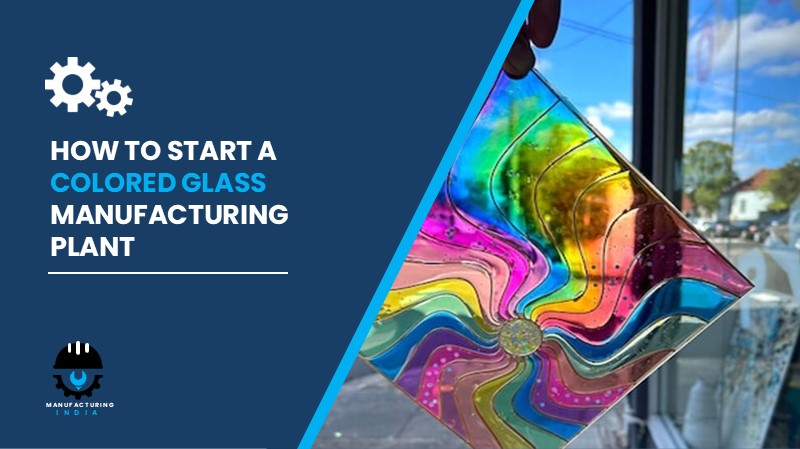
Colored glass is a specialised type of glass imbued with vibrant hues by adding metallic oxides, metal salts, or mineral impurities to the molten raw materials during manufacturing. While standard glass is clear, these additives alter the light absorption properties, resulting in colours ranging from cobalt blues and copper greens to gold-infused ruby reds. Historically used for stained glass windows in cathedrals, modern applications include decorative arts, bottles for UV protection, and architectural elements.
Techniques for producing colored glass include pot metal – where colour is distributed throughout the glass body – and flashed glass – where a thin coloured layer is bonded to a clear glass substrate – blending functional, industrial, and artistic purposes. The product provides UV protection, heat control, privacy enhancement, and visual appeal, making it an important value-added industrial product across architecture, interior design, automotive, lighting, and packaging applications. The rapid expansion of modern architecture, smart city projects, luxury interior design, automotive styling, and energy-efficient building materials is driving stable demand for colored glass products.
The primary production method is batching, melting, coloring, and annealing – a multi-stage high-temperature glass manufacturing process. End-use industries served include architecture and construction, art and décor, automotive, lighting, consumer goods, and food and beverage packaging.
Cost of Setting Up a Colored Glass Manufacturing Plant in India
The cost of establishing this facility depends on capacity, technology selection, plant location, degree of automation, and regulatory compliance requirements.
1. Capital Expenditure (CapEx)
Total capital investment for a colored glass manufacturing plant in India covers land acquisition, site preparation, civil construction, machinery, and pre-operative expenses. The cost of land and site development – including charges for land registration, boundary development, and other related expenses – forms a substantial part of the overall investment. This allocation ensures a solid foundation for safe and efficient plant operations. Investors can reduce land acquisition costs by locating the unit in an industrial estate, construction materials cluster, or Special Economic Zone (SEZ), which also provide shared utility infrastructure and potential state-level fiscal incentives aligned with India’s construction materials manufacturing agenda.
Civil works and construction cover the main batch house, melting furnace, forming, and annealing production building, raw material storage areas for silica sand, soda ash, limestone, and metal oxides, a quality control laboratory, a finished goods warehouse, and an administrative block. Given that colored glass manufacturing involves high-temperature glass melting furnaces operating continuously, civil infrastructure must incorporate appropriate heat-resistant structural elements, refractory-lined furnace bases, comprehensive ventilation, and fire safety provisions throughout the facility.
Machinery costs account for the largest portion of total capital expenditure. Key machinery required includes:
- Batch houses
- Mixing systems
- Melting furnaces
- Forming machines
- Annealing lehrs
- Tempering units
- Coloring additives dosing systems
- Packaging lines
All machinery must be high-quality and corrosion-resistant, tailored for colored glass production, and must comply with industry standards for safety, efficiency, and reliability. Other capital costs include the effluent treatment plant (ETP), advanced process monitoring systems, pre-operative expenses, trial production costs, and commissioning charges.
Request a Sample Report for In-Depth Market Insights: https://www.imarcgroup.com/colored-glass-manufacturing-plant-project-report/requestsample
2. Operational Expenditure (OpEx)
The operating cost structure of a colored glass manufacturing plant is primarily driven by raw material consumption, particularly silica sand, which accounts for approximately 50–60% of total operating expenses (OpEx). Soda ash, limestone, and metal oxides for coloring are the secondary raw material inputs. Securing long-term supply agreements with reliable silica sand, soda ash, and metal oxide producers is essential for cost stability and production continuity. Minimising transportation costs by selecting nearby suppliers is essential, and long-term contracts should be negotiated to stabilise pricing and ensure a steady supply.
Utility costs – comprising electricity and fuel consumed by melting furnaces, forming machines, annealing lehrs, and tempering units, as well as water – account for 25–30% of total OpEx – among the highest utility cost proportions in any manufacturing category, reflecting the enormous and continuous energy demands of high-temperature glass melting operations running at furnace temperatures exceeding 1,400°C. Securing reliable and cost-competitive electricity and natural gas or alternative fuel supply is therefore a critical site selection and operating cost management criterion. Other ongoing operating costs include transportation, packaging, salaries and wages, depreciation, taxes, equipment repairs and maintenance, and other miscellaneous expenses.
In the first year of operations, the operating cost for the colored glass manufacturing plant is projected to be significant, covering raw materials, utilities, depreciation, taxes, packing, transportation, and repairs and maintenance. By the fifth year, the total operational cost is expected to increase substantially due to factors such as inflation, market fluctuations, and potential rises in the cost of key materials.
3. Plant Capacity
The proposed manufacturing facility is designed with an annual production capacity ranging between 10,000 and 30,000 MT, enabling economies of scale while maintaining operational flexibility. Capacity can be customised per investor requirements based on target architectural, automotive, art and décor, or packaging market segments, available capital, and chosen glass forming technology. Profitability improves materially with higher capacity utilisation, making domestic supply agreements with construction developers, interior fit-out contractors, automotive OEMs, and premium packaging companies a commercial priority from the commissioning stage.
4. Profit Margins and Financial Projections
The project demonstrates healthy profitability potential under normal operating conditions. Gross profit margins typically range between 30–40%, supported by stable demand and value-added applications. Net profit margins range between 15–22%. A comprehensive financial model covering NPV (net present value), IRR (internal rate of return), payback period, liquidity analysis, uncertainty analysis, sensitivity analysis, and a full five-year profit and loss account provides investors with a rigorous analytical framework for assessing financial viability and long-term sustainability across different capacity and pricing scenarios.
Why Set Up a Colored Glass Manufacturing Plant in India?
Aesthetic and Functional Construction Material Driving Multi-Sector Demand. Colored glass is a key material for architectural design, interior decoration, automotive finishing, lighting systems, and consumer products – providing UV protection, heat control, privacy enhancement, and visual appeal. The residential construction sector in India expanded at 6.8% during FY2024–25 and is projected to reach USD 350 billion by 2030 – a scale of growth that is directly fuelling demand for decorative and functional colored glass across new residential buildings, commercial complexes, and premium interior fit-out projects.
Megatrend Alignment with Modern Architecture and Smart City Development. The rapid expansion of modern architecture, smart city projects, luxury interior design, automotive styling, and energy-efficient building materials is driving stable demand for colored glass products. India’s smart city programme, National Infrastructure Pipeline investments, and the surge in commercial real estate development create a large and government-backed institutional procurement base for architectural cladding and facades, decorative glass panels, and specialty building glass products.
Growing Automotive Sector Expanding Application Scope. In the automotive sector, colored glass is increasingly utilised for windows, windshields, and mirrors, offering both style and UV protection. India’s expanding automotive manufacturing base – spanning passenger vehicles, electric vehicles, and commercial vehicles – provides a consistent and growing procurement channel for automotive-grade colored glass.
Energy-Efficient Building Materials Driving Green Construction Adoption. The use of colored glass in architecture, particularly in energy-efficient buildings, is growing due to its aesthetic appeal and ability to regulate light transmission. India’s increasing focus on sustainable construction and the adoption of green building materials – supported by BEE standards and GRIHA/LEED certification requirements – is directly stimulating specification of energy-efficient colored glass in commercial, hospitality, and institutional construction projects.
Localisation and Supply Chain Reliability Creating Market Preference. Builders, interior designers, and industrial buyers increasingly prefer reliable local suppliers to reduce delivery time, manage transportation risks, and maintain consistent colour and quality specifications – creating significant commercial opportunities for regional colored glass producers.
Latest Industry Development Confirming Global Investment Momentum. In January 2025, Vitro Architectural Glass declared that it had initiated a significant investment plan to expand its Wichita Falls, Texas, location to allow for the annual production of up to 25 million patterned solar glass lites upon completion. A USD 67.6 million investment tax credit allocation from the Internal Revenue Service (IRS) will enable this investment.
Manufacturing Process – Step by Step
The colored glass manufacturing process uses batching, melting, coloring, and annealing as the primary production method. Each stage is precision-controlled to ensure colour consistency, optical quality, dimensional accuracy, and full compliance with the performance and safety standards required by architectural, automotive, art and décor, and packaging customers.
- Raw Material Receipt and Inspection: Silica sand, soda ash, limestone, and metal oxides for coloring are received at the facility and subjected to incoming quality checks for purity, particle size, moisture content, and chemical composition before entering the batch house.
- Batching and Mixing: Raw materials are precisely weighed and combined in batch houses and mixing systems according to the specific glass formulation – including the type and quantity of metal oxides required to achieve the target colour. Cullet (recycled glass) is also typically incorporated to improve melt efficiency.
- Melting: The batch mixture is fed into high-temperature melting furnaces operating continuously at temperatures exceeding 1,400°C. Coloring additives dosing systems introduce precise quantities of metallic oxides – such as cobalt for blue, chromium or copper for green, or gold chloride for ruby red.
- Refining and Homogenisation: The molten glass is refined in the furnace to remove bubbles, seeds, and compositional inhomogeneities that would impair optical quality.
- Forming: Refined molten glass is fed to forming machines where it is shaped into the required product form – flat glass sheets via the float process, blown or pressed glass articles, or cast glass elements.
- Annealing: Formed glass products are passed through annealing lehrs where controlled, slow cooling relieves internal thermal stresses, producing dimensionally stable glass with the required mechanical strength and optical flatness.
- Tempering (where applicable): For safety glass applications, annealed glass is processed through tempering units that rapidly heat and quench the glass to develop a compression surface layer that dramatically increases breakage resistance.
- Quality Inspection: Finished colored glass products are inspected for colour consistency, optical quality, dimensional compliance, surface defects, and mechanical performance before release for packaging.
- Packaging and Dispatch: Approved colored glass is packed using packaging lines with appropriate edge protection, interleavers, and crating and dispatched to end-use customers across architecture and construction, art and décor, automotive, lighting, consumer goods, and food and beverage packaging sectors.
Key Applications
The colored glass manufacturing plant serves a diverse and commercially significant range of end-use sectors across India’s construction, automotive, and consumer economy.
- Architectural Design: Stained glass windows, decorative facades, interior panels, cladding, and privacy screens – the largest volume architectural application segment driven by India’s expanding commercial and premium residential construction pipeline.
- Art and Craft Production: Colored glass artworks, ornaments, and mosaic elements for the domestic art market, interior design studios, and the growing decorative arts export segment.
- Furniture and Lighting: Decorative glass tabletops, lampshades, chandelier components, and luxury furniture glass elements – a premium segment aligned with India’s expanding organised home furnishings and luxury lighting retail market.
- Automotive and Transportation: Colored glass accents, tinted windows, windshield tinting, display covers, and protective glass elements for automotive OEMs.
- Consumer Goods and Home Décor: Colored glass tableware, decorative bowls, vases, and home accessories serving India’s growing organised home décor and lifestyle retail channels.
- Food and Beverage Packaging: Colored glass bottles – particularly amber and green glass providing UV protection for beverages, pharmaceuticals, and specialty food products.
Leading Manufacturers
The global colored glass industry is served by several established multinational manufacturers with extensive production capacities and diverse application portfolios. Key players operating in this market include:
- Saint-Gobain
- AGC Inc.
- NSG Group
- Schott AG
- Barovier & Toso
All of these manufacturers serve end-use sectors including architecture and construction, art and décor, automotive, lighting, consumer goods, and food and beverage packaging – the same markets that a domestic Indian colored glass manufacturing plant can target at competitive landed cost advantage over imported product.
Timeline to Start the Plant
Investors should plan for a structured pre-production and commissioning phase covering the following key stages:
- Feasibility study and project report preparation
- Land acquisition and site development
- Regulatory approvals and environmental clearances
- Factory licence and fire safety compliance
- Machinery procurement and installation
- Raw material supplier agreements and supply chain setup
- Trial production and quality testing
- Commercial production launch
Licences and Regulatory Requirements
Starting a colored glass manufacturing unit in India requires several approvals:
- Business registration (Proprietorship, LLP, or Private Limited Company)
- Factory Licence under the Factories Act
- Environmental Clearance from the State Pollution Control Board
- GST Registration
- Fire Safety NOC
- Hazardous material compliance for storage and handling of metal oxides and coloring additives
- Effluent Treatment Plant (ETP) operational clearance
- Occupational Health and Safety compliance
Key Challenges to Consider
High Capital Requirements. Establishing a fully equipped colored glass manufacturing plant – with batch houses, mixing systems, high-temperature melting furnaces, forming machines, annealing lehrs, tempering units, coloring additives dosing systems, and packaging lines – at the 10,000–30,000 MT annual capacity range requires significant upfront capital investment.
Extremely High Utility Cost Intensity. Utilities – at 25–30% of total OpEx – represent by far the most elevated cost component in colored glass manufacturing, driven by the enormous and continuous electricity and fuel demands of melting furnaces operating at above 1,400°C around the clock. Securing reliable and cost-competitive electricity and fuel supply is the single most critical site selection criterion.
Colour Consistency and Technical Complexity. Producing consistent colour across production batches requires precise control of metal oxide dosing, furnace temperature uniformity, and glass homogeneity. Strict optical standards, colour tolerance specifications, and breakage resistance requirements create technical barriers that favour experienced manufacturers.
Regulatory Compliance. Colored glass manufacturing involves handling metal oxide colorants – including compounds of cobalt, chromium, copper, and lead-based oxides – that are subject to hazardous material handling regulations. Advanced monitoring systems must be installed to detect process deviations, and effluent treatment systems are mandatory.
Competition from Established Global Players. Established multinational manufacturers – Saint-Gobain, AGC Inc., NSG Group, and Schott AG – set high benchmarks for colour consistency, optical quality, product certification, and technical service. Indian manufacturers must compete through localisation advantages, rapid delivery of custom colour specifications, and competitive pricing.
Skilled Manpower. Operating high-temperature melting furnaces, forming machines, annealing lehrs, and quality control systems in a continuous glass manufacturing environment requires certified glass technologists, furnace operators, and quality assurance specialists.
Frequently Asked Questions
1. How much does it cost to set up a colored glass manufacturing plant in India?
Total setup cost depends on plant capacity, location, technology selection, and automation level. Key cost components include land and site development, heat-resistant civil construction, machinery (batch houses, mixing systems, melting furnaces, forming machines, annealing lehrs, tempering units, coloring additives dosing systems, packaging lines), and pre-operative expenses. A detailed feasibility study is recommended to generate accurate project-specific cost estimates.
2. Is colored glass manufacturing profitable in India in 2026?
Yes. The project delivers healthy financial performance, with gross margins of 30–40% and net profit margins of 15–22% under normal operating conditions. The global colored glass market was valued at USD 3.98 billion in 2025 and is projected to reach USD 7.19 billion by 2034 at a CAGR of 6.8% according to IMARC Group, with India’s residential construction sector expanding at 6.8% in FY2024–25 and projected to reach USD 350 billion by 2030.
3. What machinery is required for a colored glass manufacturing plant in India?
Essential equipment includes batch houses, mixing systems, melting furnaces, forming machines, annealing lehrs, tempering units, coloring additives dosing systems, and packaging lines.
4. What licences and approvals are required to start a colored glass manufacturing plant in India?
Required approvals include business registration, Factory Licence, Environmental Clearance from the State Pollution Control Board, GST Registration, Fire Safety NOC, hazardous material compliance for metal oxide colorants, ETP operational clearance, and Occupational Health and Safety compliance.
5. What raw materials are needed for colored glass manufacturing?
The primary raw materials are silica sand, soda ash, limestone, and metal oxides for coloring. Silica sand is the dominant cost driver, accounting for 50–60% of total operating expenses.
6. What are the environmental compliance requirements for a colored glass manufacturing plant in India?
The facility must obtain Environmental Clearance from the State Pollution Control Board, operate an approved ETP, and install advanced monitoring systems. Stack emission monitoring for furnace gases and hazardous waste documentation for metal oxide colorant handling are mandatory throughout operations.
7. What is the best location to set up a colored glass manufacturing plant in India?
The location must offer easy access to key raw materials – silica sand, soda ash, limestone, and metal oxides – while proximity to target markets minimises distribution costs. States with silica sand deposits and strong construction industry demand – including Rajasthan, Gujarat, Maharashtra, and Andhra Pradesh – are strong location candidates.
8. What is the break-even period for this type of plant in India?
The break-even period depends on plant capacity, total capital investment, product selling price across architectural, automotive, and decorative segments, and capacity utilisation rate. A comprehensive financial analysis covering NPV, IRR, payback period, and uncertainty and sensitivity analysis is the most reliable method.
9. What government incentives are available for manufacturers in India?
Colored glass manufacturers in India can access MSME credit-linked capital subsidy schemes, state government investment promotion subsidies in construction materials and industrial estate clusters, and export promotion incentives under schemes administered by the Ministry of Commerce. PLI scheme incentives for glass and specialty materials manufacturing are available to qualifying domestic producers.
Key Takeaways for Investors
A colored glass manufacturing plant in India offers a well-grounded investment opportunity anchored by growing demand across architecture and construction, art and décor, automotive, lighting, consumer goods, and food and beverage packaging – all of which are expanding as India’s construction sector targets USD 350 billion by 2030. The project is financially viable across the 10,000–30,000 MT annual capacity range, with gross margins of 30–40% and net margins of 15–22% providing a strong return framework. According to IMARC Group estimates, the global colored glass market is set to grow from USD 3.98 billion in 2025 to USD 7.19 billion by 2034 at a CAGR of 6.8% – driven by the megatrend alignment of modern architecture, smart city development, luxury interior design, automotive styling, and energy-efficient building materials that all favour colored glass specification. With Vitro Architectural Glass’s January 2025 announcement of a USD 67.6 million IRS tax credit-backed expansion confirming global commercial confidence in specialty glass manufacturing investment, the long-term demand sustainability for domestically produced colored glass is structurally sound across all investment planning horizons.
About the Author