Introduction
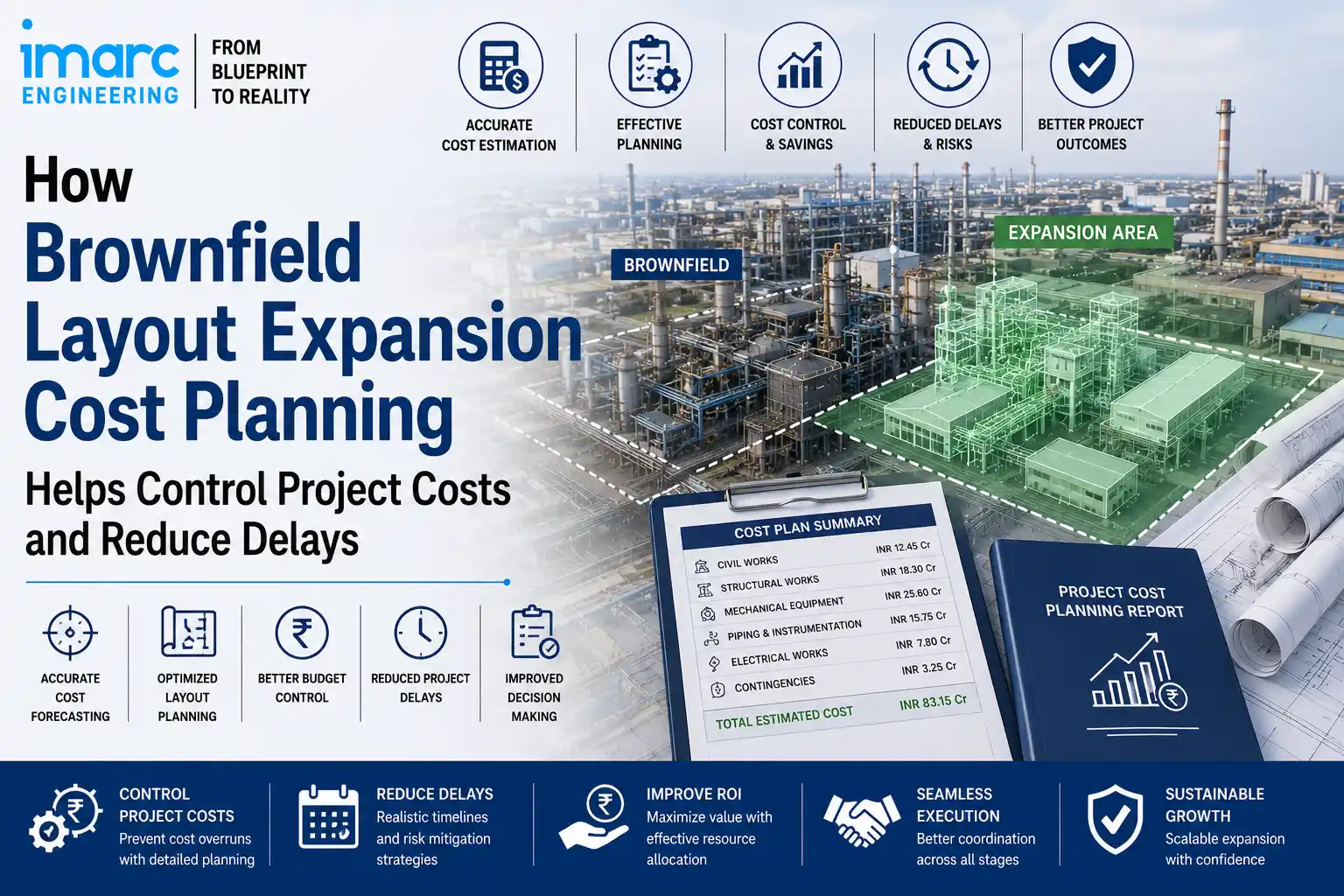
Brownfield expansion is often the preferred strategy for manufacturers seeking to increase production capacity while leveraging existing infrastructure, utilities, and operational assets. Although it can reduce capital investment and shorten project timelines compared to greenfield development, hidden site constraints, undersized utilities, ageing infrastructure, and overlooked regulatory requirements can quickly turn a seemingly straightforward expansion into a costly project with significant schedule overruns.
Without structured cost planning, the very advantages that make brownfield projects attractive—existing infrastructure, established connectivity, and operational continuity—can become the primary sources of change orders, construction delays, and budget escalation once execution begins.
IMARC Engineering supports manufacturers, exporters, and industrial operators across India through its Brownfield Project Management services, helping organisations assess existing facilities, validate engineering constraints, prepare realistic cost estimates, and develop execution-ready expansion strategies. This article explains why brownfield expansion cost planning is critical, where projects typically lose control of budgets and schedules, and how manufacturers can establish a structured planning framework that improves cost certainty before construction begins.
Why Brownfield Layout Expansion Cost Planning Is Critical for Indian Manufacturers
India’s own infrastructure project data shows how quickly cost and schedule control can slip without structured planning — and brownfield facility expansions carry the same categories of risk within a smaller footprint.
The Scale of Cost and Time Overruns in India
As of May 2026, MoSPI’s PAIMANA system was tracking 1,987 central sector infrastructure projects worth ₹150 crore and above, with a cumulative cost overrun of approximately ₹5.4 lakh crore against an original combined cost of ₹37.09 lakh crore — an overrun of roughly 14.6 percent.
Even among these closely monitored projects, only 817 (41 percent) had crossed 80 percent physical progress, and just 280 (14 percent) had crossed 80 percent financial completion — evidence that scale and monitoring alone do not prevent cost and schedule slippage.
Brownfield Sites Carry Hidden Planning Risk
DPIIT and Invest India’s India Industrial Land Bank maps more than 4,500 industrial parks across 5.06 lakh hectares nationwide, of which only 1.12 lakh hectares is currently available for industrial allotment — reflecting how much manufacturing capacity growth in India increasingly depends on expanding existing sites rather than acquiring new land.
Brownfield sites often contain undocumented structural, utility, and infrastructure constraints, including aging foundations, undersized utility headroom, and layouts never designed for new equipment. These issues often remain hidden until detailed engineering begins unless identified through structured due diligence.
Approval Timelines Remain a Major Cost Driver
Category A environmental clearances continue to take 6 to 24 months from a complete application in most cases as of 2026, directly affecting how realistically an expansion budget and schedule can be set at the sanction stage.
The National Single Window System has processed over 11.56 lakh applications and granted more than 8.29 lakh approvals to date, streamlining discovery of requirements — but expansion-specific approvals such as factory licence amendments and Consent to Establish revisions still require direct engagement with state authorities.
Why Leading Manufacturers Are Choosing Modernization Over Expansion
Brownfield expansion has become the preferred strategy for many manufacturers looking to increase production capacity without the time and cost involved in developing a new facility. However, successful modernization requires careful layout planning, realistic cost estimation, and effective project execution. Watch the video below to understand why leading manufacturers in India are increasingly choosing modernization over expansion and how strategic planning supports long-term operational efficiency.
Investment Momentum Raises the Stakes
Production Linked Incentive schemes across 14 sectors carry a combined outlay of ₹1.97 lakh crore, with actual investment of more than ₹1.88 lakh crore recorded as of June 2025 — much of it channelled into capacity expansion at existing manufacturing sites.
As investment in brownfield manufacturing projects continues to grow, the financial consequences of poor cost planning become increasingly significant for manufacturers expanding existing facilities.
Taken together, this data makes one point clear: brownfield layout expansion cost planning is not a formality before construction — it is the mechanism that keeps a project’s budget and schedule credible from sanction to commissioning.
Why Poor Cost Planning Turns Brownfield Expansion Into a Liability
Most brownfield cost overruns follow a familiar pattern: the initial estimate is built on assumed site conditions and approval timelines, rather than verified ones.
The most common business risks arising from inadequate brownfield cost planning include:
- Undiscovered structural constraints: Foundations, floor loading, or column spacing that cannot support the planned expansion without costly reinforcement.
- Utility headroom shortfalls: Power, water, or effluent capacity that looks sufficient on paper but requires upgrades once the expanded load is modelled.
- Production disruption costs: Construction sequencing that collides with ongoing operations, resulting in downtime costs that were never budgeted.
- Underestimated approval timelines: Treating environmental, consent, and licence amendments as quick formalities rather than multi-month dependencies.
- Contractor claims and change orders: Ambiguous scope definitions at the brownfield interface, where new construction meets an existing structure, are a leading source of disputes.
- Financing cost overrun: Schedule slippage extends the drawdown period on project financing, increasing the effective cost of capital for the expansion.
A structured cost planning process replaces these assumptions with verified data before the budget is locked and construction begins.
Key Components of Brownfield Layout Expansion Cost Planning
A successful Brownfield Layout Expansion Cost Planning framework is built around six interconnected components. Skipping any one of them tends to resurface later as an unplanned cost or delay.
1. Site & Structural Due Diligence
- Structural assessment of existing foundations, columns, and floor loading against the proposed expansion
- Subsurface investigation to identify buried utilities, contamination, or soil conditions not visible in existing drawings
- As-built verification against original construction drawings, which are frequently outdated or incomplete
2. Utility Capacity & Tie-In Assessment
- Power load study confirming transformer, DG, and distribution capacity for the expanded facility
- Water, compressed air, steam, and effluent treatment capacity assessed against the expanded process load
- Identification of tie-in points and any shutdown windows required to connect new utility runs
3. Layout & Phasing Plan
- Construction sequencing designed around continued operation of unaffected production areas
- Material and equipment movement routes planned to avoid conflict with ongoing logistics
- Defined phase-wise handover milestones tied to the production schedule, not just the construction schedule
4. Regulatory & Approval Mapping
- Consolidated list of approvals triggered by the expansion — environmental, consent, factory licence, fire NOC, and building plan revisions
- Realistic timeline built against current 2026 processing ranges rather than best-case assumptions
- Clarity on which approvals route through the National Single Window System and which require direct state engagement
5. Contingency & Escalation Budgeting
- Defined contingency percentage for structural, utility, and design-change risk specific to brownfield conditions
- Material and labour escalation built into the budget based on the anticipated project duration
- Clear governance on how contingency is drawn down and reported against the original sanction
6. Vendor and Contractor Cost Benchmarking
- Market-tested rates for civil, structural, MEP, and specialised trade packages before budget sanction
- Scope boundaries clearly defined at the interface between new construction and the existing facility
- Reference cost data drawn from comparable brownfield projects, not greenfield benchmarks
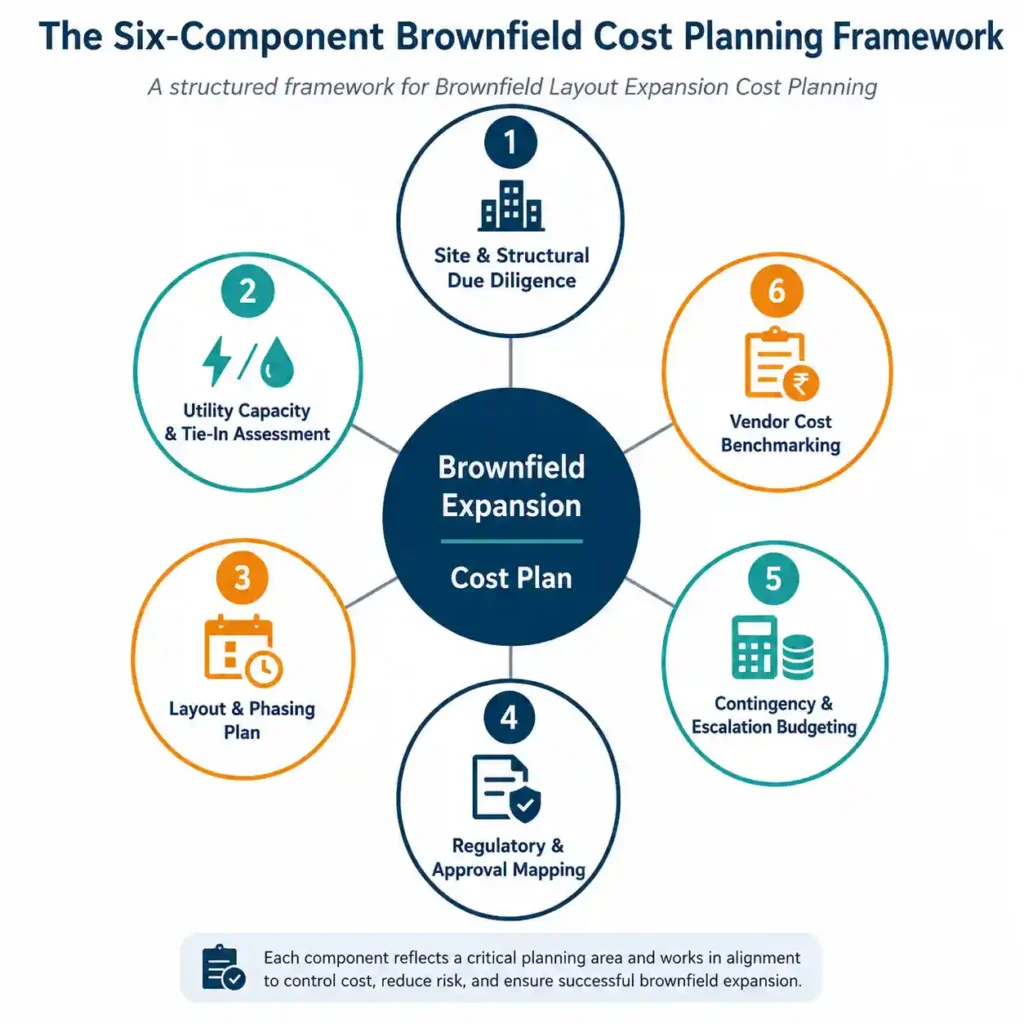
Figure 2 — The six components a brownfield layout expansion cost plan must cover, from due diligence through to contractor benchmarking
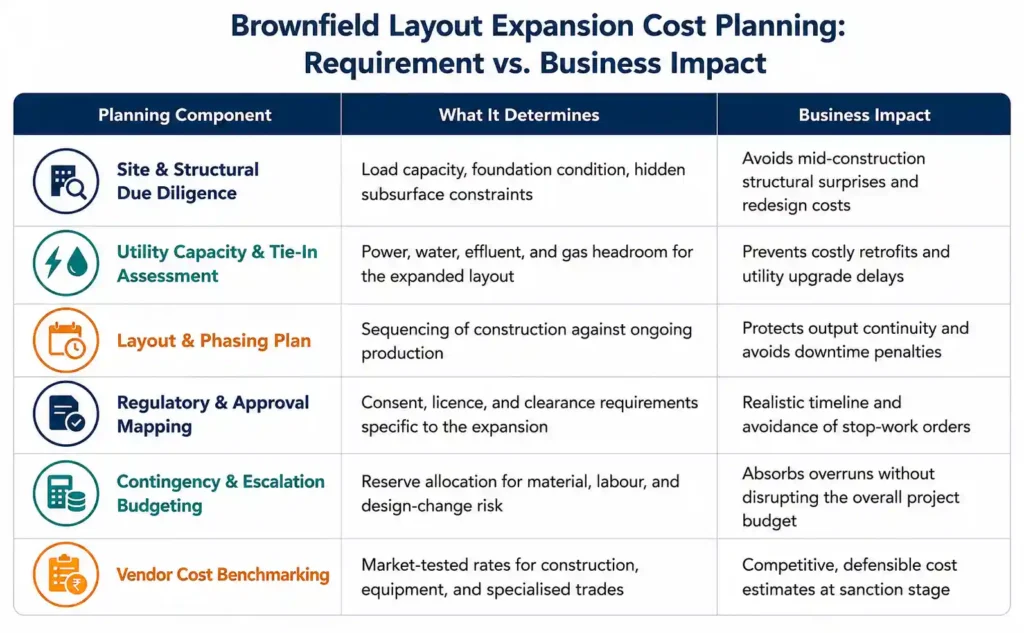
Brownfield Layout Expansion Cost Planning: Requirement vs. Business Impact
The table below summarises what each planning component determines, and its consequence for project cost and schedule control.
How IMARC Engineering Supports Brownfield Layout Expansion Cost Planning
IMARC Engineering’s Brownfield Layout Expansion Cost Planning approach is built around verified site data — replacing assumption-based estimates with engineering-backed cost and schedule inputs.
- Site & structural due diligence: Assessing existing structural capacity, utility infrastructure, and as-built conditions against the proposed expansion.
- Layout & phasing design: Sequencing construction to protect ongoing production while meeting the expansion timeline.
- Regulatory approval mapping: Consolidating every consent, licence, and clearance triggered by the expansion into a single realistic timeline.
- Cost estimation & benchmarking: Building sanction-stage estimates through CAPEX & OPEX Planning Support, using current, market-tested vendor and contractor rates to improve budgeting accuracy and long-term cost control.
- Contingency and risk modelling: Structuring contingency and escalation allowances specific to brownfield site risk rather than generic project norms.
- Project governance support: Providing budget tracking frameworks that flag deviations early, before they compound into major overruns.
IMARC Engineering supports brownfield layout expansion cost planning across pharmaceuticals, food and beverage, chemicals, automotive components, and industrial manufacturing sectors — where existing facility constraints differ significantly by industry and site.
Speak with IMARC Engineering’s specialists to develop a Brownfield Layout Expansion Cost Planning strategy tailored to your facility: https://www.imarcengineering.com/contact?service=brownfield-project-management
Common Mistakes in Brownfield Layout Expansion Cost Planning
- Estimating from drawings alone: Relying on original construction drawings without on-site structural and utility verification.
- Ignoring production continuity costs: Treating construction phasing as purely a contractor’s schedule issue rather than a cost variable in its own right.
- Underbudgeting for approvals: Assuming environmental and consent approvals will clear faster than the current 6–24 month range for Category A clearances.
- Flat contingency percentages: Applying the same contingency used for greenfield projects, without adjusting for brownfield-specific structural and utility risk.
- Vague interface scope: Leaving the boundary between new and existing construction poorly defined, a common source of contractor claims.
- No mid-project cost governance: Tracking budget only at project close, rather than flagging deviations while corrective action is still possible.
Conclusion
Brownfield expansion offers real advantages — existing infrastructure, faster market access, and lower land acquisition risk — but only when the cost plan reflects actual site conditions rather than assumed ones.
Structural due diligence, utility assessment, phasing design, regulatory mapping, contingency budgeting, and vendor benchmarking together determine whether a brownfield expansion stays within its sanctioned budget and schedule.
Through structured Brownfield Layout Expansion Cost Planning, IMARC Engineering helps manufacturers develop realistic project budgets, minimise execution risk, and improve cost certainty from project sanction through commissioning.
IMARC Engineering
Brownfield Expansion Advisory | Cost Planning | Layout & Feasibility Studies | Project Risk Assessment
Contact Us:
IMARC Engineering
Phone: +91-120-433-0800
|Email: sales@imarcengineering.com
India: C-130, Sector 2, Noida, Uttar Pradesh 201301
LinkedIn: https://www.linkedin.com/showcase/imarc-engineering/
About the Author