Manufacturing plants routinely lose recoverable warranty value simply because equipment records live in scattered spreadsheets, vendor emails, and paper files instead of a single structured system. When a critical asset fails, plant teams often cannot confirm warranty status fast enough to file a claim before the coverage window closes. Building a formal equipment warranty register is one of the most cost-effective ways to protect capital investment, reduce unplanned repair spend, and give maintenance and project teams a single source of truth across the equipment lifecycle. For plant heads, EPCM commissioning teams, and reliability engineers alike, the register is a working tool that determines whether a breakdown becomes a covered repair or an unbudgeted expense.
This guide outlines a practical, step-by-step approach to designing and operating an equipment warranty register for manufacturing plants.
Why an Equipment Warranty Register Matters
Industrial equipment failure remains the single largest driver of unplanned downtime, accounting for roughly 42% of all unscheduled stoppages across manufacturing operations, with the average large plant losing tens of millions of dollars annually when a line sits idle (Gitnux, 2026). For Indian manufacturers, the stakes are rising further as private capital expenditure accelerates. Manufacturing already accounts for more than half of total corporate capex in FY 2025-26, backed by PLI-linked investment exceeding ₹2.16 lakh crore as of December 2025 (India Briefing, 2026). Every new machine, utility system, and process line added under this investment wave carries a warranty period that, if untracked, quietly expires unused.
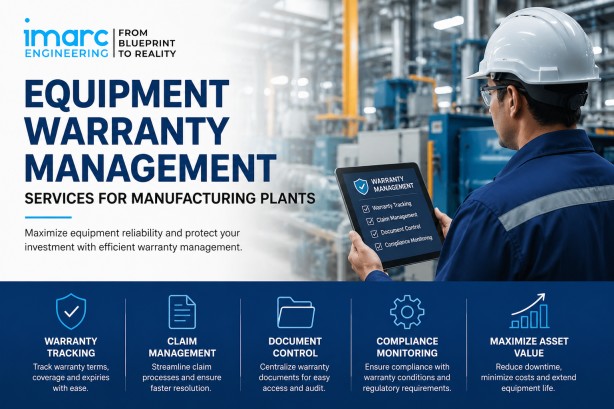
This is where equipment warranty management services for manufacturing plants become a critical control mechanism rather than an administrative task. By systematically capturing warranty terms, vendor obligations, service timelines, and claim conditions in a centralized register, manufacturers can ensure that every eligible repair, replacement, or service intervention is claimed within the valid period.
The Hidden Cost of Poor Warranty Documentation
Without a structured register, plants typically discover a warranty has lapsed only after a breakdown occurs, forcing them to absorb repair costs the OEM should have covered. Fleet-based warranty tracking data shows that organizations without systematic tracking commonly leave 12% to 18% of eligible repairs unclaimed each year, translating into tens of thousands of dollars in written-off recoverable costs even for a mid-sized asset base (FleetRabbit, 2026). The most common reasons claims get rejected include:
- Incomplete or missing installation and commissioning documentation
- Inability to prove the equipment was maintained per OEM-recommended intervals
- Claims filed after the OEM’s notification window has closed
- Mismatched serial numbers, invoices, or failure descriptions across departments
Manufacturers increasingly require proof of consistent preventive maintenance before honoring a claim, which means a plant’s maintenance history and its warranty documentation are no longer separate workflows; they must be linked (FleetRabbit, 2026). This shift matters even more given the broader cost of downtime itself: two-thirds of manufacturing plants globally experience at least one unplanned stoppage every month, with the average incident lasting around four hours and forcing teams to make immediate repair-versus-claim decisions under pressure (TeamSense, 2026). A register that cannot be consulted in minutes, rather than hours, effectively forces the plant to choose reactive repair over warranty recovery by default.
How to Build an Equipment Warranty Register: Step-by-Step Framework
Step 1: Centralize Equipment and Vendor Data at Handover
Warranty tracking starts at commissioning, not after installation is forgotten. EPC/EPCM teams should hand over a structured equipment master list at project closeout, capturing OEM name, model and serial number, purchase order reference, commissioning date, warranty start and end date, and the responsible vendor contact. Gaps at this stage are the leading cause of untraceable warranty claims later in the asset’s life.
Step 2: Standardize the Register Fields
A consistent data structure prevents information loss as equipment moves between departments. At minimum, each register entry should include:
- Asset ID and location (plant, line, unit)
- Warranty type (standard, extended, parts-only, labor-included)
- Coverage terms and exclusions
- Claim filing window and required documentation checklist
- Assigned owner (maintenance engineer or asset manager)
Step 3: Link Preventive Maintenance to Warranty Compliance
Since OEMs increasingly deny claims citing inadequate maintenance evidence, the register should be tied directly to the plant’s preventive maintenance schedule. Every service performed on warrantied equipment should be logged with the date, technician, parts used, and reference to the applicable warranty terms, creating an audit trail that supports rather than undermines a future claim.
Step 4: Set Alert Systems for Expiry and Claim Windows
Manual tracking fails at scale once a plant carries hundreds of warrantied assets. Automated alerts, triggered 90, 60, and 30 days before expiry, give maintenance managers time to schedule pre-expiry inspections and catch latent defects while coverage is still active, rather than discovering a failure after the window closes.
Step 5: Digitize with CMMS or EAM Integration
Spreadsheets do not scale well beyond a handful of assets and offer no audit trail. Enterprise asset management adoption in India reflects this shift: the domestic asset management market was valued at USD 83.9 billion in 2025 and is projected to grow at a 36.86% CAGR through 2034, driven by industrial automation and IoT-enabled tracking
Integrating the warranty register into a CMMS or EAM platform allows automatic cross-referencing between maintenance logs, purchase records, and claim documentation, reducing the manual reconciliation burden on plant teams. Globally, the computerized maintenance management systems market is projected to reach USD 2.4 billion in 2026, with growth increasingly tied to whether enterprises can produce traceable work orders and auditable maintenance histories rather than simply logging maintenance activity; a warranty register built on the same digital backbone benefits directly from this traceability.
Step 6: Audit and Reconcile Quarterly
A warranty register degrades in accuracy without periodic review. Quarterly audits should reconcile the register against actual maintenance logs, flag assets nearing expiry, and confirm vendor contact details remain current, particularly important where multiple EPCM contractors and OEMs are involved across a single project.
Learn How India’s Manufacturing Location Impacts Project Success
Choosing the right state for a manufacturing facility affects much more than land costs. Industrial policies, logistics infrastructure, skilled workforce availability, utility reliability, and state-level incentives all influence long-term operational performance and project returns. For manufacturers planning greenfield or expansion projects, understanding these regional differences is essential before making investment decisions. To explore how leading industrial states compare across infrastructure, incentives, connectivity, and business environment, watch our YouTube video, “Which State is Best for Manufacturing in India?” It provides practical insights to help investors, project owners, and manufacturers evaluate the best location for their next facility and make informed, data-driven expansion decisions.
Industry-Specific Considerations
- Pharma manufacturing: Warranty documentation must align with equipment qualification records (IQ/OQ/PQ) required under CDSCO and Schedule M compliance frameworks
- Food processing: Hygienic equipment often carries shorter warranty windows tied to sanitation cycle counts, requiring tighter monitoring
- Chemical and process industries: Corrosive operating environments accelerate wear, making documented maintenance evidence critical to sustaining claim eligibility
- EPC/EPCM handovers: Multi-vendor projects need warranty traceability built into the commissioning documentation package, not added retroactively
Business Outcomes of a Well-Maintained Warranty Register
- Faster claim filing and higher approval rates through complete documentation
- Reduced unplanned repair costs by catching defects within the coverage period
- Improved audit readiness for regulated sectors during inspections
- Clear accountability across maintenance, procurement, and project teams
- Better lifecycle visibility supporting future capital planning decisions
Emerging Trends in Equipment Warranty Management (2025-2026)
- Compliance-driven digitization: Regulated sectors are tightening documentation requirements around inspections and equipment certification, pushing plants toward CMMS platforms that generate audit-ready maintenance histories by default (Future Market Insights, 2026)
- AI-assisted claim validation: Warranty management platforms are increasingly using AI and IoT sensor data to flag supplier-attributable failures automatically, improving recovery rates without adding administrative headcount (Cognitive Market Research, 2026)
- Multi-site governance: Enterprises operating hundreds of facilities are standardizing asset taxonomies and warranty fields centrally, rather than leaving each plant to define its own tracking format
- Capex-linked urgency: With India’s manufacturing capex cycle accelerating under PLI-linked investment, more plants are treating warranty governance as a first-year commissioning deliverable rather than a later retrofit
How IMARC Engineering Can Help
IMARC Engineering supports manufacturing plants and EPC/EPCM teams in building structured equipment warranty registers as part of broader asset management and commissioning support services. From standardizing handover documentation during project closeout to integrating warranty tracking with preventive maintenance schedules, our team helps plants protect capital investment and reduce the risk of lapsed or denied claims. As India’s manufacturing capex cycle accelerates, disciplined warranty governance is becoming a core operational safeguard rather than an administrative afterthought, and plants that build this discipline early stand to protect significantly more of their equipment investment over the asset lifecycle.
Consult With An Expert: https://www.imarcengineering.com/contact?service=warranty-and-amc-coordination
Contact Us:
IMARC Engineering
Phone: +91-120-433-0800
Email: sales@imarcengineering.com
India: C-130, Sector 2, Noida, Uttar Pradesh 201301
LinkedIn: https://www.linkedin.com/showcase/imarc-engineering/
About the Author