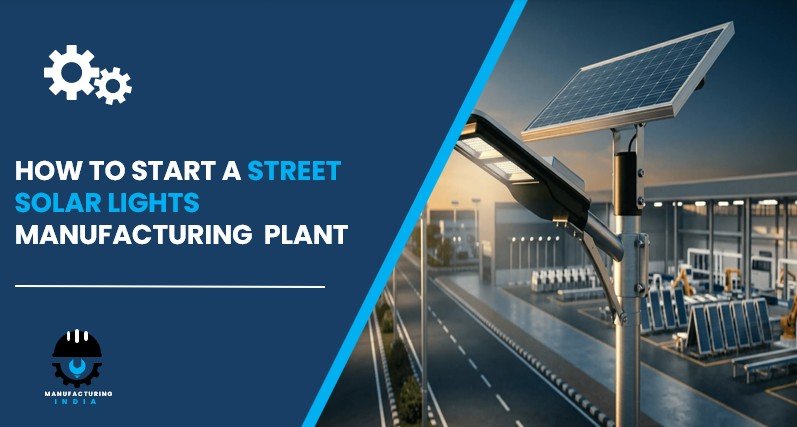
Setting up a street solar lights manufacturing plant in India represents a highly attractive investment proposition underpinned by robust and structurally growing demand for sustainable urban infrastructure, government initiatives promoting renewable energy adoption, and the accelerating global shift toward energy-efficient outdoor lighting solutions. As cities worldwide pursue smart infrastructure upgrades and carbon reduction targets, street solar lights, valued for their off-grid operation, low maintenance requirements, and long-term cost savings, occupy an increasingly important position across municipal lighting, park and garden lighting, and public infrastructure applications. This growth trajectory, combined with continuous advances in solar panel efficiency, LED technology, and battery storage, creates a highly favourable manufacturing environment for new entrants with efficient assembly, testing, and quality systems.
What is a Street Solar Light?
Street solar lights are outdoor lighting solutions powered by solar energy, offering a sustainable, off-grid alternative to conventional street lighting systems. These lights harness solar panels to capture sunlight during the day, storing it in rechargeable batteries to power LEDs at night. They are equipped with smart technologies such as motion sensors and dusk-to-dawn functionality to optimise energy usage. Street solar lights are environmentally friendly, cost-effective, and largely maintenance-free, making them an ideal choice for streets, parks, parking lots, and other public areas where traditional electrical connections are difficult or costly to implement.
The India street solar lights market was valued at USD 1.22 Billion in 2025 and is expected to reach USD 4.04 Billion by 2034, exhibiting a CAGR of 14.21% from 2026 to 2034, supported by rising government investment in renewable energy infrastructure, growing smart city initiatives, and increasing demand for energy-efficient public lighting.
Cost of Setting Up a Street Solar Lights Manufacturing Plant
The total capital investment required to establish a street solar lights manufacturing plant is shaped by several key parameters: annual production capacity (typically ranging from 50,000 to 200,000 units), the level of vertical integration across solar panel assembly, battery pack assembly, and light fixture manufacturing, the degree of automation across SMT assembly, welding, and testing sections, facility specification, raw material sourcing strategy, and applicable regulatory and quality certification requirements. Below is a structured breakdown of the major cost components.
1. Capital Expenditure (CapEx)
Total capital investment in a street solar lights manufacturing plant covers the following major heads:
Land and Site Development
This encompasses land acquisition or lease, site preparation, boundary development, and utilities connectivity. Site selection should prioritise proximity to key raw material suppliers of solar panel, LED fixture, battery, pole, and controller components to ensure a steady, low-transport-cost supply chain. Access to reliable power infrastructure, strong road and rail logistics for inbound components and outbound finished lights, availability of skilled electronics assembly workforce, and proximity to target municipal and infrastructure markets are critical site selection criteria. Compliance with industrial zoning regulations, electrical safety standards, and environmental clearance requirements must be assessed from project initiation.
Civil Works and Construction
Building costs cover the main manufacturing facility including the SMT (Surface-Mount Technology) assembly line area, battery pack assembly and spot-welding section, aluminium pole extrusion and cutting area, LED fixture assembly line, testing and calibration laboratory, weatherproofing and ingress protection (IP) test chambers, final assembly and packaging stations, quality control laboratory, administrative block, and utility infrastructure including power backup, compressed air systems, and effluent and waste management systems. Construction must comply with applicable factory act requirements, electrical safety norms, and fire safety regulations relevant to battery handling and storage areas.
Machinery and Equipment
Machinery represents a significant CapEx component. Key equipment required for a street solar lights manufacturing plant includes:
- SMT (Surface-Mount Technology) Assembly Lines: Automated pick-and-place, reflow soldering, and inspection systems for assembling printed circuit boards used in charge controllers and sensor modules
- Battery Pack Spot-Welding Machines: Precision spot-welding systems for assembling and connecting battery cells into finished battery packs used in solar light units
- LED Testing and Calibration Systems: Equipment for testing LED module brightness, colour temperature, and electrical performance to ensure consistent light output and compliance with photometric standards
- Aluminium Extrusion and Cutting Machinery: Equipment for extruding, cutting, and finishing aluminium poles and light-fixture housings used in street solar light assemblies
- Photometric Goniometers: Instruments for analysing the light distribution pattern of finished fixtures to verify compliance with street lighting illumination standards
- Weatherproofing and Ingress Protection (IP) Test Chambers: Environmental chambers for testing dust and water resistance ratings of finished light fixtures under outdoor operating conditions
- Final Assembly and Packaging Stations: Conveyorised assembly lines for integrating solar panels, batteries, LED fixtures, poles, and controllers into finished units, along with automated packaging and cartoning systems
- Material Handling and Warehousing: Conveyors, racking systems, and finished goods warehousing with FIFO stock management for raw components and completed units
Other Capital Costs
These include pre-operative expenses, commissioning charges, import duties on specialised assembly and testing equipment, staff training and competency development, initial raw material and consumable inventory for production commissioning, and regulatory compliance setup including electrical safety certification and quality management system establishment costs.
Request a Sample Report for In-Depth Market Insights: https://www.imarcgroup.com/street-solar-lights-manufacturing-plant-project-report/requestsample
Capital Expenditure Breakdown:
· Gross Profit: 30-40%
· Net Profit: 12-20%
2. Operational Expenditure (OpEx)
Raw materials, principally solar panel, LED fixture, battery, pole, and controller, constitute the dominant operating cost, accounting for approximately 70-80% of total OpEx. Utility costs, driven primarily by electricity consumption of SMT assembly, welding, and testing equipment, account for 5-10% of OpEx. Labour, maintenance, quality control, packaging, transportation, depreciation, taxes, and overhead costs constitute the remainder of the operating cost base.
Operational Expenditure Breakdown:
- Raw Material Cost: 70-80%
- Utility Cost: 5-10%
3. Plant Capacity
The proposed street solar lights manufacturing facility is designed with an annual production capacity ranging between 50,000-200,000 units, enabling economies of scale while maintaining operational flexibility. This capacity range supports a diversified product portfolio spanning standard street solar lights, decorative and smart networked variants, serving municipal infrastructure projects, government tenders, and private commercial and residential lighting customers.
4. Profit Margins and Financial Projections
The project demonstrates healthy profitability potential under normal operating conditions. Financial projections encompass capital investment, operating costs, capacity utilisation ramp-up schedule, product mix between standard and smart/decorative variants, and forward demand outlook underpinned by government renewable energy initiatives and smart city infrastructure spending. A comprehensive feasibility analysis includes sensitivity analysis, Net Present Value (NPV), Internal Rate of Return (IRR), and Payback Period calculations. Gross profit margins for street solar lights manufacturing typically range from 30-40%, supported by stable demand and value-added applications. Net profit margins of 12-20% are achievable with disciplined cost management and optimal capacity utilisation.
Why Set Up a Street Solar Lights Manufacturing Plant?
Sustainable Urban Development
Street solar lights are integral to the development of smart cities, aligning with global sustainability trends and helping cities reduce carbon emissions by decreasing reliance on grid electricity for public lighting infrastructure.
Government and Policy Support
Increasing government incentives, subsidies, and mandates to adopt renewable energy solutions in urban infrastructure are creating favourable conditions for the growth of the street solar lights market. As per the Ministry of New and Renewable Energy, India added a record 44.5 GW of renewable energy capacity in 2025, reflecting continued policy momentum toward renewable-powered public infrastructure.
Low Maintenance and Energy Efficiency
Solar-powered street lights offer a long-term solution for municipalities looking to reduce energy costs, as they require minimal maintenance and are highly energy-efficient compared to grid-connected lighting systems.
Technological Advancements
Innovations in solar panel technology, LED efficiency, and battery storage are enhancing the performance and affordability of street solar lights, making them an increasingly competitive alternative to traditional street lighting systems.
Expanding Smart and Networked Lighting Demand
Growth in smart city initiatives incorporating intelligent lighting systems with motion sensors, remote monitoring, and centralised control is driving demand for networked street solar lights that offer better energy management and reduced operational costs for municipal operators.
Scalable and Modular Manufacturing Operations
The street solar lights value chain, spanning solar panel assembly, battery integration, and light fixture assembly, allows processors to begin operations at a moderate scale and expand capacity or add integrated component manufacturing as volumes grow. This phased investment approach allows new entrants to manage capital deployment while building operational and technical expertise.
Manufacturing Process Overview
The street solar lights manufacturing operation transforms raw components including solar panels, LED fixtures, batteries, poles, and controllers into finished, field-ready lighting units through a sequence of assembly, integration, and testing operations. The key process stages are:
- Raw Material Reception and Inspection: Incoming solar panels, LED fixtures, batteries, poles, and controllers received from suppliers are inspected and verified for quality parameters and specification compliance prior to production release
- Solar Panel Preparation: Solar panels are tested for output efficiency and inspected for physical defects before being mounted onto light fixture assemblies
- Battery Pack Assembly: Battery cells are assembled into packs using precision spot-welding, followed by protection circuit integration and capacity testing to ensure reliable energy storage performance
- Controller and Circuit Assembly: Charge controller and sensor circuit boards are assembled on SMT lines using automated pick-and-place and reflow soldering, followed by functional testing of dusk-to-dawn and motion-sensing functionality
- LED Fixture Assembly: LED modules are integrated into weatherproof housings, with electrical connections tested for consistent light output and colour temperature
- Pole Fabrication: Aluminium or galvanised steel poles are extruded, cut, and finished to required specifications for mounting solar panels and light fixtures
- Final Integration and Assembly: Solar panel, battery pack, controller, LED fixture, and pole components are integrated into a complete street solar light unit on the final assembly line
- Weatherproofing and IP Testing: Assembled units undergo ingress protection (IP) testing in weatherproofing test chambers to verify dust and water resistance ratings under simulated outdoor conditions
- Photometric Testing: Finished units are tested using photometric goniometers to verify light distribution patterns comply with street lighting illumination standards
- Quality Control: Finished units are tested for battery performance, LED output, sensor functionality, and overall durability to verify compliance with applicable quality and safety standards before release for packaging
- Packaging and Dispatch: Finished street solar lights are packed for dispatch to municipal infrastructure projects, government tenders, and commercial and residential customers
Key Applications of Street Solar Lights
The street solar lights market serves several major end-use segments across urban infrastructure, public services, and networked lighting applications:
- Solar Street Lighting Systems: Internal wiring for LED modules, controllers, and battery connections used in standard street and roadway lighting installations
- Energy Storage and Power Management: Battery cables, grounding straps, and charge controller interconnections used to manage solar energy storage and power distribution within light units
- Outdoor Infrastructure Installations: Flexible grounding straps, bonding jumpers, and weather-resistant electrical connectors used in parks, parking lots, and pathway lighting installations
- Smart and Networked Lighting: Communication cables for monitoring systems, sensors, and remote control units used in smart city and centrally managed street lighting networks
Street Solar Lights Industry Outlook 2026
The market for street solar lights is steadily growing, driven by the push toward renewable energy adoption and the shift toward sustainable, energy-efficient lighting solutions. As per the Ministry of New and Renewable Energy, India added a record 44.5 GW of renewable energy capacity in 2025. Urbanisation, the growing emphasis on reducing carbon footprints, and government initiatives for clean energy are the primary drivers of market expansion. With the increasing need for off-grid lighting in both urban and rural areas, street solar lights are becoming an essential part of public infrastructure. In regions such as Asia-Pacific and Latin America, growth in urban development and government focus on sustainable cities is expected to fuel demand for solar-powered lighting solutions. Additionally, the trend toward smart city initiatives, which incorporate intelligent lighting systems for better energy management and reduced operational costs, further supports the adoption of street solar lights.
The India street solar lights market was valued at USD 1.22 Billion in 2025. According to IMARC Group estimates, the market is expected to reach USD 4.04 Billion by 2034, exhibiting a CAGR of 14.21% from 2026 to 2034. Leading manufacturers in the global street solar lights industry include several multinational companies with extensive production capacities and diverse application portfolios, including SOKOYO Solar Group, Signify (Philips), Urja Global Ltd., Su-Kam Power Systems Ltd., and Omega Solar, all serving end-use sectors such as urban infrastructure, public services, street lighting, park and garden lighting, and municipal lighting solutions.
Latest Industry Developments
- September 2025: Signify introduced two new products, the Signify SunStay Pro gen2 and SunStay Pro gen2 mini, highlighting the company’s advances in solar and modular streetlighting. The new introductions reflect Signify’s commitment to high-quality sustainable products, connected systems, and services engineered for optimal performance.
- March 2025: Inlux Solar completed the deployment of 100 units of ATHENA Solar Decorative Street Lights in Sierra Leone. The project features 8.5-metre cast aluminium poles, 80W high-brightness LED luminaires, and 40Ah/25.6V LiFePO4 battery systems, delivering reliable and visually appealing lighting for local communities.
Licenses and Regulatory Requirements
Establishing a street solar lights manufacturing unit requires a range of approvals and certifications, which may vary by country and jurisdiction, including:
- Business registration and company incorporation under applicable company law
- Factory License under applicable state Factories Act provisions for manufacturing operations
- BIS (Bureau of Indian Standards) certification for LED luminaires and solar photovoltaic modules under applicable standards
- Electrical safety certification for finished lighting and battery products
- Ingress Protection (IP) rating certification for weatherproofing compliance
- Pollution Control Board Clearances Consent to Establish (CTE) and Consent to Operate (CTO) for manufacturing operations
- ISO 9001:2015 Quality Management System Certification for quality management infrastructure compliance
- Battery Waste Management compliance under applicable hazardous and battery waste rules
- Weights and Measures (Legal Metrology) registration for packaged product labelling
- Export-Import Code (IEC) for international market access
- Trademark and Brand Registration for proprietary branded product launch
- Occupational Health and Safety management compliance (ISO 45001 / Factories Act provisions) for manufacturing worker safety
Key Challenges to Consider
Raw Material Supply Consistency and Component Quality
Solar panel, which accounts for a substantial share of total operating costs, is subject to global supply chain dynamics and price volatility. Inconsistent component supply or quality variation in solar panels, batteries, or LED fixtures can materially affect product performance, durability, and warranty exposure. Securing long-term supply arrangements with reliable component suppliers is a critical operational priority.
Battery Technology and Safety Management
Battery pack assembly introduces safety and quality control requirements that must be managed through rigorous testing protocols, protection circuit design, and compliance with battery safety regulations. Any lapse in battery quality control increases warranty and safety exposure, requiring continuous investment in testing infrastructure and quality assurance.
Price Competition from Grid-Connected Alternatives
Street solar light demand and pricing are influenced by the relative cost of grid-connected conventional street lighting, which is subject to regional electricity tariffs and government infrastructure budgets. Periods of subsidised grid electricity or budget constraints in target markets can affect adoption rates, requiring manufacturers to demonstrate long-term total-cost-of-ownership advantages.
Tender-Based Demand and Government Procurement Cycles
A meaningful share of demand originates from municipal and government infrastructure tenders, which can be subject to procurement cycles, budget approvals, and policy changes. Diversifying into private commercial and residential lighting channels can help mitigate dependence on government procurement timelines.
Quality Certification and Compliance Maintenance
Maintaining BIS certification, electrical safety approvals, and IP rating certifications requires ongoing investment in testing laboratory infrastructure and process monitoring. Producing units that consistently meet photometric, durability, and weatherproofing specifications across all production batches requires disciplined process control, as any compliance lapse can disrupt market access and damage brand reputation.
Frequently Asked Questions (FAQs)
1. How much does it cost to set up a street solar lights manufacturing plant?
The total investment depends on plant capacity (50,000-200,000 units per annum), the level of vertical integration across solar panel, battery, and fixture assembly, automation level, facility specification, location, and target market certifications. Costs cover land, civil construction (SMT assembly area, battery assembly section, pole fabrication area, testing laboratory, utilities), machinery (SMT lines, spot-welding machines, LED testing systems, extrusion machinery, test chambers, packaging lines), quality certifications, working capital, and regulatory compliance. A comprehensive feasibility study from IMARC Group provides detailed, capacity-specific cost estimates covering all CapEx and OpEx components.
2. Is street solar lights manufacturing a profitable business in 2026?
Yes. Sustained demand from government renewable energy initiatives, smart city infrastructure spending, and growing focus on energy-efficient public lighting, combined with gross margins of 30-40% and net profit margins of 12-20%, make street solar lights manufacturing financially attractive.
3. What machinery and equipment are required for a street solar lights manufacturing plant?
Key equipment includes SMT (Surface-Mount Technology) assembly lines, battery pack spot-welding machines, LED testing and calibration systems, aluminium extrusion and cutting machinery, photometric goniometers for light distribution analysis, weatherproofing and ingress protection (IP) test chambers, and final assembly and packaging stations.
4. What licenses and approvals are required?
Required approvals include company registration, Factory License, BIS certification for LED luminaires and solar modules, electrical safety certification, IP rating certification, Pollution Control Board clearances, and ISO 9001:2015 quality management system certification.
5. How long does it take to commission a street solar lights manufacturing plant?
Typically, 12-18 months from project initiation to commercial production launch, depending on project scale, facility construction timeline, equipment procurement lead times, and regulatory approval and certification timelines, which should be initiated early in the project to avoid delays to commercial launch.
6. What are the key raw materials for street solar lights manufacturing?
The primary raw materials are solar panel, LED fixture, battery, pole, and controller components. Other key inputs include electrical connectors, wiring harnesses, and weatherproof housings, along with packaging materials for finished unit dispatch.
7. What is the break-even period for a street solar lights manufacturing plant?
The break-even period generally depends on capacity utilisation ramp-up trajectory, the product mix between standard and smart/decorative variants, raw material supply consistency, and offtake arrangements with municipal and commercial customers. Securing long-term supply agreements with component suppliers and stable offtake arrangements with government and private customers significantly improves revenue predictability and supports faster break-even achievement.
8. What are the main types of street solar lights and their applications?
The principal types include standard integrated street solar lights, split-type solar lights with separate battery and panel units, and smart/networked solar lights equipped with remote monitoring and control functionality. These serve applications across roadway lighting, park and garden lighting, parking area lighting, and pathway lighting in both urban and rural environments.
9. What government incentives are available for street solar lights manufacturers?
Manufacturers may benefit from renewable energy sector incentive schemes, state-level industrial investment incentives and capital subsidies, infrastructure support under smart city and rural electrification schemes, and export promotion benefits for solar lighting products. Continued government investment in renewable energy capacity, such as India’s addition of 44.5 GW of renewable energy capacity in 2025, also supports favourable demand conditions for manufacturers.
10. How does street solar lights manufacturing compare to conventional street lighting manufacturing in terms of setup?
Compared to conventional grid-connected street lighting manufacturing, street solar lights manufacturing requires additional investment in solar panel handling, battery pack assembly, and weatherproofing test infrastructure, but benefits from strong policy tailwinds and government procurement demand. The core LED fixture and pole fabrication technology is broadly similar to conventional lighting manufacturing, allowing manufacturers with experience in outdoor lighting production to adapt existing technical capabilities with targeted investment in solar and battery integration infrastructure.
Key Takeaways for Investors
The street solar lights manufacturing industry represents a structurally resilient and financially attractive investment opportunity positioned at the intersection of accelerating renewable energy adoption, expanding smart city infrastructure spending, and growing global focus on sustainable urban development. Stable demand from municipal infrastructure, government tenders, and private commercial and residential customers provides resilience against single-segment demand volatility, while continued technological advancement in solar, LED, and battery storage technology supports improving product performance and affordability. India’s addition of a record 44.5 GW of renewable energy capacity in 2025 and the India street solar lights market’s projected growth from USD 1.22 Billion in 2025 to USD 4.04 Billion by 2034 at a CAGR of 14.21% underscore the strength of the underlying demand outlook. The scalable nature of the value chain, from component assembly to fully integrated manufacturing, allows investors to phase capital deployment according to risk appetite and target market positioning, while continued investment by established lighting players in expanding solar streetlighting product lines reflects strong confidence in the long-term growth and profitability of the category.
About the Author