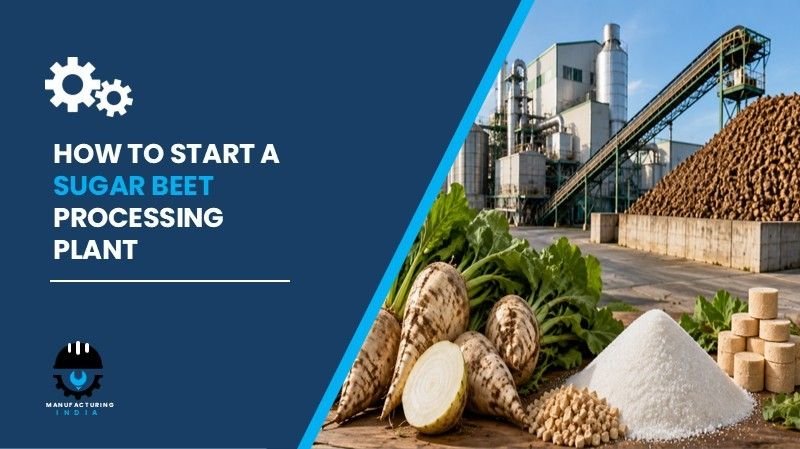
A sugar beet processing plant setup in India presents a compelling investment case for entrepreneurs looking to enter the sweetener and agro-processing space. Refined sugar produced from this root crop serves demand across food processing, agriculture, bioenergy, animal feed manufacturing, pharmaceutical, and beverage production, positioning this venture at the intersection of India’s growing packaged food sector and its expanding bio-based economy. It is the second-largest source of global sugar production, contributing an estimated 20-30% of the world’s sugar supply, which underlines the strategic relevance of building processing capacity in a large consuming market like India.
India’s rapid urbanisation, expanding food processing infrastructure, and the Make in India initiative make the country a strategically sound base for this kind of production. States with strong agro-processing ecosystems and access to reliable power, water, and logistics networks are well suited to host such a facility, and the broader thrust toward domestic manufacturing gives investors confidence that regulatory and infrastructure support will continue to improve. Such a facility can tap into rising packaged food consumption while also serving adjacent industries through valuable by-products such as molasses and beet pulp.
This investment combines policy support under Make in India, cost-competitive production economics, and steady demand from food, beverage, and bioenergy sectors. With gross profit margins typically in the 20-30% range and net profit margins of 8-15%, the venture presents a financially viable proposition for investors evaluating break-even timelines against India’s growing sweetener and agro-processing demand.
What is Sugar Beet?
This root crop (Beta vulgaris) is a biennial plant grown for its large, white taproot, which holds a high concentration of sucrose. Cultivated primarily in temperate climates, this root crop is distinct from sugarcane, thriving in cooler regions and requiring specific soil nutrients. The plant consists of a rosette of leaves and a conic root weighing between 0.5-1 kg, containing 15-20% sugar. Beyond sugar extraction, the crop is highly versatile, with pulp and molasses often used for animal feed, and foliage used for silage or green manure.
A sugar beet processing plant relies on washing, slicing, diffusion, purification, evaporation, and crystallization as its core process. This process converts raw beet roots into refined sugar along with valuable by-products. The end-use industries served by this processing chain include food processing, agriculture, bioenergy, animal feed manufacturing, pharmaceutical, and beverage production, reflecting the wide commercial reach of a single processing facility.
Cost of Setting Up a Sugar Beet Processing Plant in India
The cost of setting up this facility depends on capacity, technology, location, automation level, and regulatory compliance requirements.
1. Capital Expenditure (CapEx)
Land and site development form a foundational part of the capital outlay, and investors can evaluate options within industrial estates or special economic zones to benefit from existing infrastructure and streamlined approvals. Civil works and construction cover the processing shed, quality control laboratory, raw material and finished goods storage, and the administrative block, all of which must be designed to support continuous production flow.
Key machinery required includes:
- Beet washers
- Slicers
- Diffusion towers
- Purification systems
- Evaporators
- Crystallizers
- Centrifuges
- Dryers
- Packaging machines
Other capital costs include effluent treatment plant installation, pre-operative expenses, commissioning costs, and applicable import duties on specialised equipment sourced from overseas suppliers.
Request a Sample Report for In-Depth Market Insights: https://www.imarcgroup.com/sugar-beet-processing-plant-project-report/requestsample
2. Operational Expenditure (OpEx)
Raw material cost is the single largest component of ongoing operating expenses for a sugar beet processing plant, with sugar beets, lime, and carbon dioxide together accounting for approximately 75-85% of total OpEx. Given this weighting, investors are advised to negotiate long-term supplier contracts to stabilise pricing and secure a consistent supply of beets, particularly given the seasonal nature of the crop.
Utility costs, covering electricity, water, and steam, account for approximately 10-15% of operating expenses and represent the second-largest cost category, reflecting the energy-intensive nature of diffusion, evaporation, and crystallization stages. Other operating costs include transportation, packaging, salaries and wages, repairs and maintenance, depreciation, and taxes. Total operational cost is projected to increase substantially by the fifth year of operations due to inflation, market fluctuations, and rising costs of key raw materials, alongside supply chain disruptions and shifts in global demand.
3. Plant Capacity
The proposed processing facility is designed with an annual production capacity ranging between 100,000-500,000 MT, enabling economies of scale while maintaining operational flexibility. Capacity can be customized based on investor requirements and target market size, and profitability generally improves with higher capacity utilisation as fixed costs are spread across greater output volumes.
4. Profit Margins and Financial Projections
Financial projections for a sugar beet processing plant are developed around capital investment, operating costs, capacity utilisation, pricing trends, and demand outlook, with net present value (NPV), internal rate of return (IRR), and payback period forming the core evaluation metrics. Gross profit margins typically range between 20-30%, supported by stable demand and value-added applications, while net profit margins fall between 8-15%. These figures indicate healthy profitability potential under normal operating conditions.
Why Set Up a Sugar Beet Plant in India?
Strong Global Sugar Demand: Sugar remains one of the most widely consumed food ingredients worldwide. A sugar beet processing plant enables consistent production of refined sugar, supporting demand from food processing, confectionery, and beverage industries both domestically and internationally.
Rising Indian Food and Beverage Consumption: According to FICCI, the Indian food and beverage packaged industry is expected to grow from USD 33.7 Billion in 2023 to USD 46.3 Billion in 2028. Growing consumption of bakery items, confectionery, dairy products, and packaged foods continues to support underlying demand for refined sugar.
Multiple Revenue Streams from By-products: Besides sugar, a processing plant generates valuable by-products such as molasses, beet pulp, and lime residues, which are utilized in biofuel production, animal nutrition, and agricultural soil conditioning, adding diversified revenue beyond the core product.
Integration with the Bio-Based Economy: Sugar beet processing supports bio-based industries through fermentation substrates used in ethanol, organic acids, and bio-chemical production, contributing to the growth of renewable and sustainable industrial processes that align with India’s biofuel policy direction.
Agricultural Value Addition: Processing facilities enhance the economic value of this root crop by converting raw agricultural produce into high-value industrial and food ingredients, supporting rural economies and agricultural supply chains in beet-growing regions.
Efficient Resource Utilization: Modern facilities utilize integrated energy recovery systems, waste heat utilization, and by-product valorization, improving operational efficiency and sustainability, a factor increasingly valued by investors and regulators alike.
Sugar Beet Processing – Step by Step
The sugar beet processing plant uses washing, slicing, diffusion, purification, evaporation, and crystallization as the primary production method.
- Raw Beet Reception and Cleaning: Incoming sugar beets are received and washed using beet washers to remove soil and debris before processing begins.
- Slicing: Cleaned beets are cut into thin strips called cossettes using slicers to maximise surface area for sugar extraction.
- Diffusion: Sliced beets pass through diffusion towers and diffusers, where hot water extracts sucrose to produce raw juice, supported by juice heaters.
- Juice Purification: Raw juice is treated in clarifiers and carbonation tanks, with filtration systems removing impurities from the extracted juice.
- Evaporation and Concentration: Purified juice is concentrated using multiple-effect evaporators, reducing water content and preparing the syrup for crystallization.
- Crystallization: Concentrated syrup is processed in vacuum pans and crystallizers to form sugar crystals.
- Centrifugation, Drying and Cooling: Crystallized sugar is separated using centrifugals, then processed through sugar dryers and coolers.
- Packaging and Dispatch: Finished sugar is packed using automated packaging systems and dispatched to food processing, agriculture, bioenergy, animal feed manufacturing, pharmaceutical, and beverage industries.
Key Applications
A sugar beet processing plant serves a wide range of end-use industries through its core product and by-products.
- Sugar Extraction: Diffusers, juice heaters, and evaporators are used in raw juice processing to extract sucrose from beet roots.
- Juice Purification: Clarifiers, carbonation tanks, and filtration systems remove impurities from extracted juice.
- Evaporation & Crystallization: Multiple-effect evaporators, vacuum pans, and crystallizers concentrate sugar and form crystals.
- Drying & Packaging: Centrifugals, sugar dryers, coolers, and automated packaging systems prepare the finished product for distribution.
Leading Manufacturers
Leading processors in the global beet processing industry include several multinational companies with extensive production capacities and diverse application portfolios:
- Tereos Group
- Nordzucker AG
- Pfeifer & Langen GmbH & Co. KG
- British Sugar plc
- Cosun Beet Company
These companies serve end-use sectors including food processing, agriculture, bioenergy, animal feed manufacturing, pharmaceutical, and beverage production.
Timeline to Start the Plant
- Feasibility study and project report preparation
- Land acquisition and site development
- Regulatory approvals and environmental clearances
- Factory licence and fire safety compliance
- Machinery procurement and installation
- Raw material supplier agreements and supply chain setup
- Trial production and quality testing
- Commercial production launch
Licences and Regulatory Requirements
Starting a sugar beet processing unit in India requires several approvals:
- Business registration (Proprietorship, LLP, or Pvt Ltd)
- Factory Licence under the Factories Act
- Environmental Clearance from State Pollution Control Board
- GST Registration
- Fire Safety NOC
- Effluent Treatment Plant (ETP) operational clearance
- Occupational Health and Safety compliance
Key Challenges to Consider
High Capital Requirements: Machinery costs, including beet washers, slicers, diffusion towers, and evaporators, account for the largest share of capital expenditure, making upfront investment a significant barrier for new entrants.
Raw Material Price Volatility: Sugar beets, lime, and carbon dioxide together make up 75-85% of operating expenses, so fluctuations in beet availability or pricing directly affect plant profitability.
Regulatory Compliance: Environmental clearances, effluent treatment requirements, and factory licensing add procedural complexity and time to the setup process.
Competition: Established global processors such as Tereos Group, Nordzucker AG, and British Sugar plc set a high benchmark on scale, technology, and cost efficiency that new entrants must account for.
Skilled Manpower: Operating diffusion, purification, and crystallization systems requires trained technical staff, and building this workforce can be a constraint in emerging processing regions.
Supply Chain Coordination: Long-term contracts with reliable raw material suppliers are essential to mitigate seasonal price volatility and ensure a steady, uninterrupted supply of beets.
Frequently Asked Questions
1. How much does it cost to set up a sugar beet processing plant in India?
Cost depends on plant capacity, technology, automation level, and location, covering land, civil works, machinery, and other capital costs.
2. Is sugar beet processing profitable in India in 2026?
Yes, the plant demonstrates healthy profitability potential, with gross profit margins of 20-30% and net profit margins of 8-15% under normal operating conditions.
3. What machinery is required for a sugar beet plant in India?
Key machinery includes beet washers, slicers, diffusion towers, purification systems, evaporators, crystallizers, centrifuges, dryers, and packaging machines.
4. What licences and approvals are required to start a sugar beet plant in India?
Requirements include business registration, factory licence, environmental clearance, GST registration, fire safety NOC, ETP clearance, and occupational health and safety compliance.
5. What raw materials are needed for sugar beet processing?
The primary raw materials are sugar beets, lime, and carbon dioxide, which together account for the largest share of operating costs.
6. What are the environmental compliance requirements for a sugar beet plant in India?
Plants require environmental clearance from the State Pollution Control Board and an operational effluent treatment plant to manage processing waste.
7. What is the best location to set up a sugar beet plant in India?
Site selection should prioritise proximity to raw material sources, reliable infrastructure, transportation access, and compliance with local zoning and environmental regulations.
8. What is the break-even period for this type of plant in India?
Break-even depends on capacity utilisation, pricing trends, and cost structure, and is assessed as part of the detailed financial and payback period analysis for the project.
9. What government incentives are available for manufacturers in India?
Broader initiatives such as Make in India support domestic processing capacity, though investors should confirm scheme-specific incentives applicable to their state and sector.
Key Takeaways for Investors
This venture taps into steady demand from food processing, agriculture, bioenergy, animal feed manufacturing, pharmaceutical, and beverage production sectors, supported by India’s growing packaged food industry, which FICCI expects to grow from USD 33.7 Billion in 2023 to USD 46.3 Billion in 2028. The facility demonstrates financial viability across its 100,000-500,000 MT capacity range, with gross margins of 20-30% and net margins of 8-15% under normal operating conditions. Globally, this market was valued at 45.57 Million Tons in 2025 and is projected to reach 52.06 Million Tons by 2034, growing at a CAGR of 1.5%. With sustained demand for refined sugar and expanding applications for by-products in biofuel and animal nutrition, this investment represents a durable, diversified opportunity for the Indian market.
About the Author