Key takeaways
- Industrial safety data compiled by IndustriALL recorded over 240 workplace accidents across India’s manufacturing, mining, and energy sectors in 2024, resulting in more than 400 fatalities and over 850 serious injuries, and these figures are widely understood to undercount the true toll given weak reporting in the informal sector.
- Workplace accidents and occupational illnesses create significant direct and indirect economic costs through lost productivity, medical expenditure, absenteeism and production disruption.
- Government inspection data shows factory inspection coverage stayed below 40% even in hazardous process facilities as of 2023, meaning a majority of high-risk sites go uninspected in any given year, which places a disproportionate share of the compliance burden on internal EHS systems.
- The Employees’ State Insurance Corporation settled 185,634 permanent disablement claims in a single month, May 2026, a scale that reflects both the frequency of workplace injury and the limits of current prevention efforts.
- Mandatory external safety audits are required every two years for highly hazardous factories under most state factory rules, with internal assessments required annually, yet many plants treat these as compliance checkboxes rather than as a basis for updating training content.
- Sector-specific data shows the risk is not evenly distributed. The chemical and pharmaceutical sector alone accounted for over 110 major workplace accidents and more than 220 fatalities in a recent 12-month tracking period, underscoring why generic, one-size-fits-all safety training consistently underperforms sector-specific programs.
Introduction
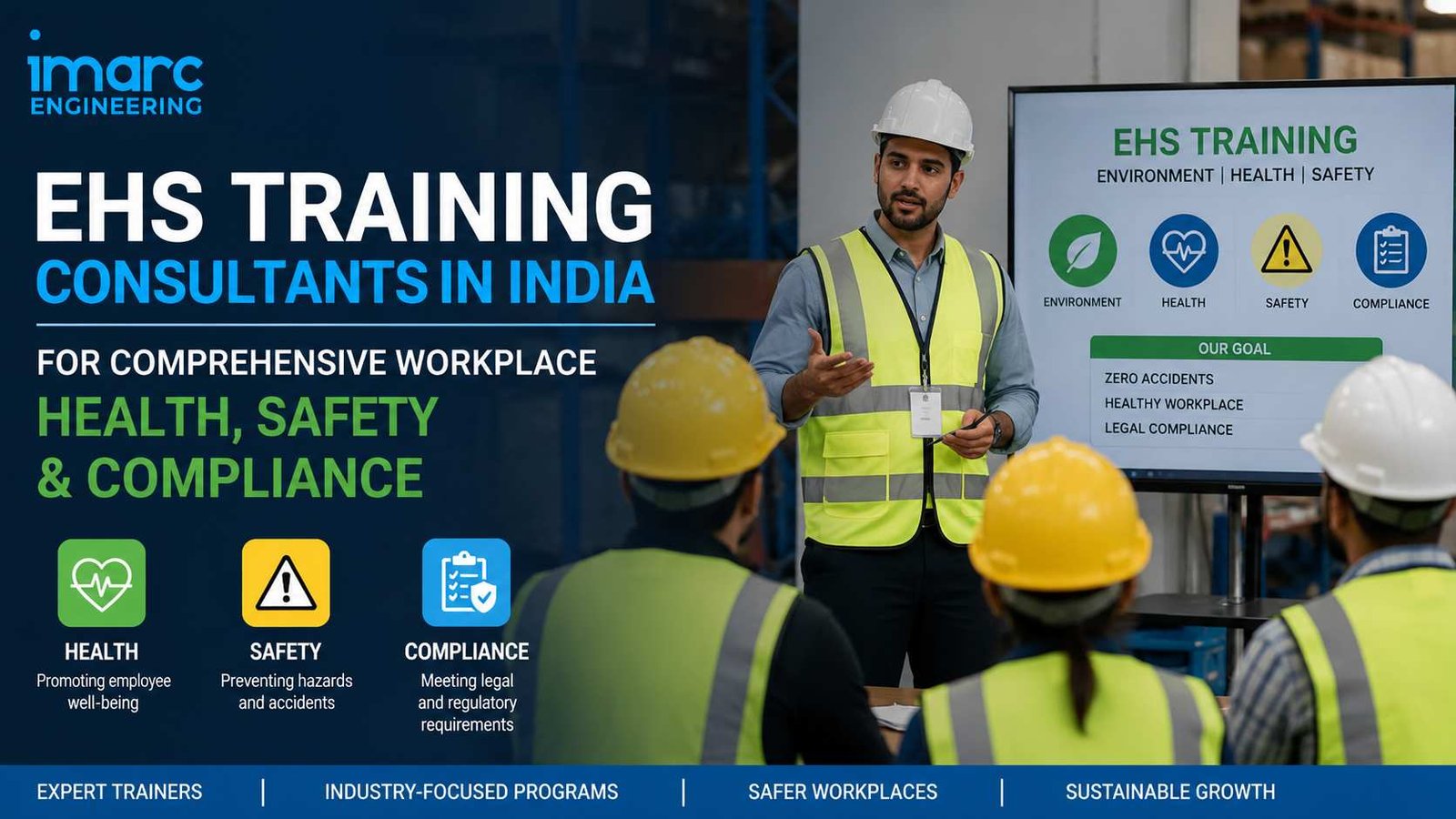
India’s workplace safety numbers are difficult to read past. Hundreds of fatalities and thousands of serious injuries are recorded across manufacturing, mining, and energy every year, and government data confirms that inspection coverage of hazardous facilities remains well below where it needs to be to catch every risk proactively. In that environment, internal training and compliance systems carry more of the actual prevention burden than regulation alone provides, which is why specialized EHS Training Consultants in India have become a core part of how serious manufacturers manage workplace risk, not an optional add-on to a compliance checklist.
This guide covers the scale of the problem current data reveals, what a properly structured EHS training program actually involves, and where most in-house programs fall short.
The Scale of India’s Workplace Safety Challenge
The numbers behind India’s industrial safety record are stark enough to reframe EHS training from a compliance requirement into an operational necessity. IndustriALL’s tracking recorded over 240 workplace accidents across manufacturing, mining, and energy in 2024 alone, resulting in more than 400 fatalities and over 850 serious injuries, figures widely acknowledged as an undercount given how much of India’s workforce sits in the informal sector, outside any official reporting system.
The economic dimension is just as significant. India’s Economic Survey 2024-25 estimates GDP loss from occupational accidents and illnesses at 4-14% for India specifically, a wide range but one that, at either end, represents several lakh crore rupees in lost productivity every year, cost that falls disproportionately on the employers and workers directly involved in preventable incidents.
Why Regulatory Inspection Alone Isn’t Enough
Government inspection data adds important context to why internal training systems matter as much as they do. Directorate General, Factory Advice Service and Labour Institutes figures show inspection coverage stayed below 40% even in hazardous process factories as of 2023, meaning most high-risk facilities operate for extended periods without external verification of their safety practices. The Employees’ State Insurance Corporation settled 185,634 permanent disablement claims in May 2026 alone, a single-month figure that underlines how much injury volume is still moving through the system despite decades of regulation.
Mandatory safety audits, generally required every two years externally and annually through internal assessment for highly hazardous factories, exist precisely to close some of this gap. But an audit only catches what it is designed to check. A properly structured training program is what determines whether workers actually apply safe practice on the days between audits, which is most of the calendar.
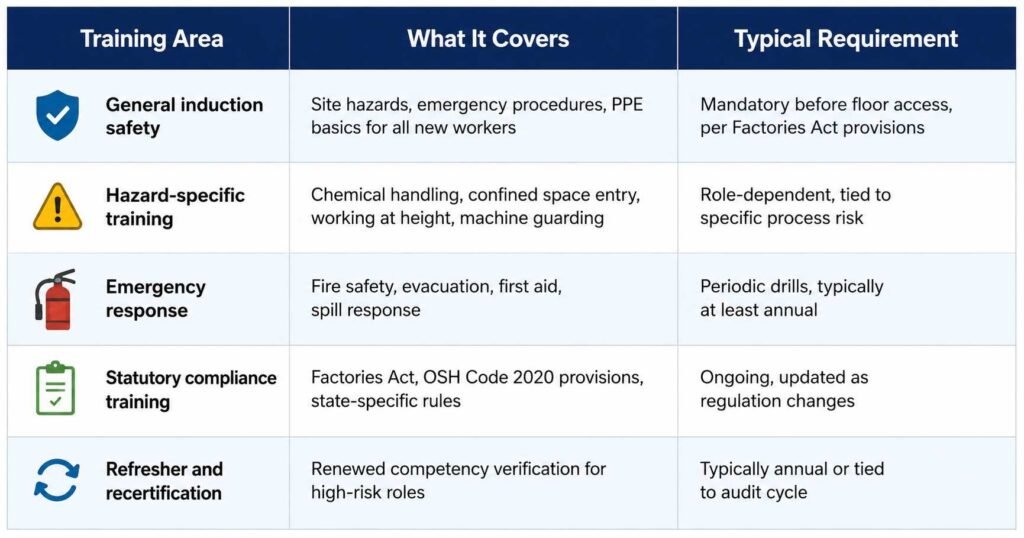
What Comprehensive EHS Training Covers
Effective EHS training spans several distinct categories, and a program that only covers general induction safety leaves meaningful gaps in role-specific and hazard-specific risk areas.
How a Structured EHS Training Program Is Built
A properly built training program follows a defined sequence, starting from actual site risk rather than a generic template applied across every facility regardless of process or hazard profile.
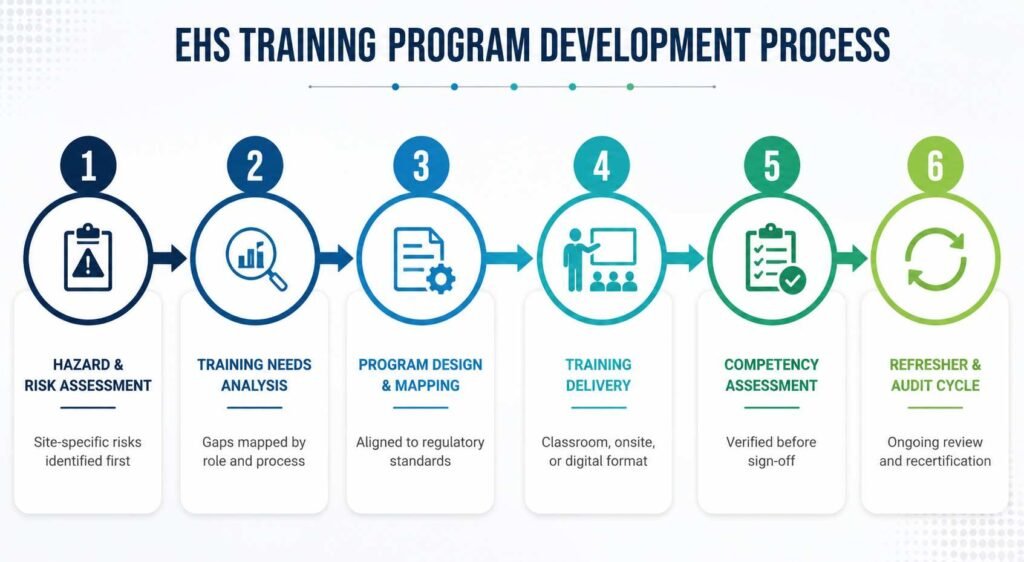
- Hazard and risk assessment: Site-specific hazards are identified first, since a training program built without this step tends to cover generic risks while missing the ones actually present on the floor.
- Training needs analysis: Gaps are mapped by role and process, so machine operators, chemical handlers, and general staff each receive training matched to their actual exposure.
- Program design and mapping: Content is built and mapped against applicable regulatory standards, Factories Act provisions, OSH Code 2020, and relevant state rules, so compliance and practical safety training are addressed together, not separately.
- Training delivery: Programs are delivered in the format that fits the workforce and site, classroom-based, on-site practical sessions, or digital modules for distributed teams.
- Competency assessment: Understanding is verified before sign-off, rather than treating attendance alone as proof of competency.
- Refresher and audit cycle: Training is reviewed and renewed on a recurring cycle, typically aligned with the mandatory audit schedule, so content stays current as processes, equipment, or regulation change.
Where Most In-House EHS Programs Fall Short
- Generic content applied uniformly across roles, rather than differentiated by actual hazard exposure, which leaves high-risk roles undertrained on the specific dangers they face.
- Training treated as a one-time induction requirement rather than a recurring cycle tied to audits and process changes.
- Attendance recorded as the measure of completion, without a competency check confirming workers actually retained and can apply the training.
- Sector-specific risk overlooked in favor of general safety content, despite data showing certain sectors, chemical and pharmaceutical manufacturing among them, carry meaningfully higher accident rates than others.
Consult IMARC Engineering for Expert EHS Training Support: https://www.imarcengineering.com/contact?service=ehs-training
How IMARC Engineering Supports EHS Training in India
- Site-specific risk assessment first: Every training program starts with an on-site hazard and risk assessment, not a generic template, so content reflects the actual processes and exposures at that facility.
- Regulatory alignment built in: Programs are mapped directly against Factories Act provisions, OSH Code 2020, and relevant state-specific requirements, so training and compliance documentation are developed together.
- Role-differentiated content: Machine operators, chemical handlers, and general staff receive training scoped to their actual risk exposure, not a single uniform induction module.
- Flexible delivery formats: Training is delivered through classroom sessions, on-site practical drills, or digital modules, depending on workforce size and site distribution.
- Verified competency, not just attendance: Assessment confirms workers can actually apply what they were trained on, before program sign-off.
- Structured refresher cycles: Training renewal is aligned with mandatory audit schedules, so programs stay current rather than lapsing between compliance checkpoints.
For detailed insights on EHS Training, read IMARC Engineering’s guide on how EHS training in India helps manufacturers reduce workplace risks and strengthen safety compliance: https://www.imarcengineering.com/blog/ehs-training-india-manufacturers-workplace-safety-compliance
Final thoughts
The data on India’s workplace safety record makes the case for structured EHS training clearly enough on its own: hundreds of fatalities, thousands of serious injuries, and inspection coverage that leaves most hazardous facilities unchecked in any given year. Closing that gap is not primarily a regulatory problem to wait out. It is an internal training and compliance discipline that manufacturers control directly, and the ones investing in it properly are consistently the ones keeping their people safer between the audits that current inspection capacity cannot run often enough on its own.
Contact Us:
IMARC Engineering
Phone: +91-120-433-0800
Email: sales@imarcengineering.com
India: C-130, Sector 2, Noida, Uttar Pradesh 201301
LinkedIn: https://www.linkedin.com/showcase/imarc-engineering/
About the Author