Introduction
Standard Operating Procedures (SOPs) are one of the simplest operational controls a manufacturing plant can put in place — yet they are often treated as a documentation formality.
When SOPs are weak, incomplete or poorly followed, process variation can increase: different shifts may run the same process differently, training may depend on individual experience, quality issues can recur, audits may expose documentation gaps, and safety-critical steps may depend on habit rather than a defined method.
IMARC Engineering supports manufacturers with Standard Operating Procedure (SOP) Development and operational readiness advisory across India. This article explains why manufacturing plants need effective Standard Operating Procedures, what makes an SOP effective in practice, and how well-designed procedures can support quality, safety and operational consistency.
Why SOPs Matter in India’s Manufacturing Environment
India’s manufacturing sector continues to expand, supported by domestic investment, policy initiatives and new production capacity. As manufacturers add capacity, introduce new equipment, increase shifts and onboard larger workforces, maintaining consistent operating practices becomes increasingly important.
- Manufacturing growth is estimated at around 7% at constant prices in FY 2025-26 (MoSPI First Advance Estimates).
- FDI into manufacturing rose 18% in FY 2024-25 to US$19.04 billion (Ministry of Commerce & Industry / DPIIT).
- PLI cumulative investment has exceeded ₹2.16 lakh crore, with cumulative production and sales surpassing ₹20.41 lakh crore as of December 2025 (PIB).
- Logistics costs have improved to an estimated 7.97% of GDP (DPIIT-NCAER study).
As plants scale, add shifts, onboard new workers and face more customer or regulatory audits, informal “known methods” stop being enough. Effective SOPs become the baseline for repeatable operations across people, shifts and sites.
What Effective Standard Operating Procedures Actually Are
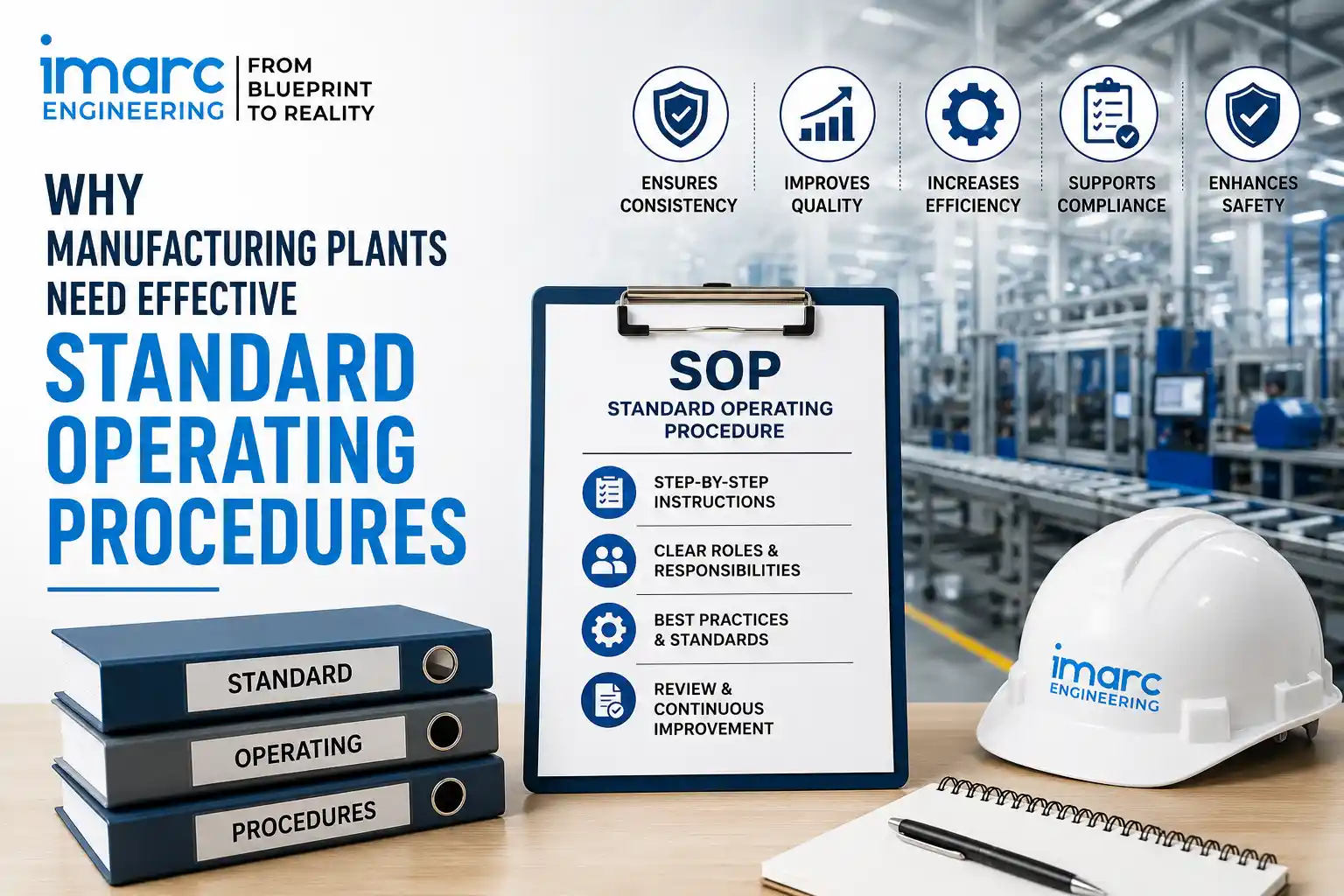
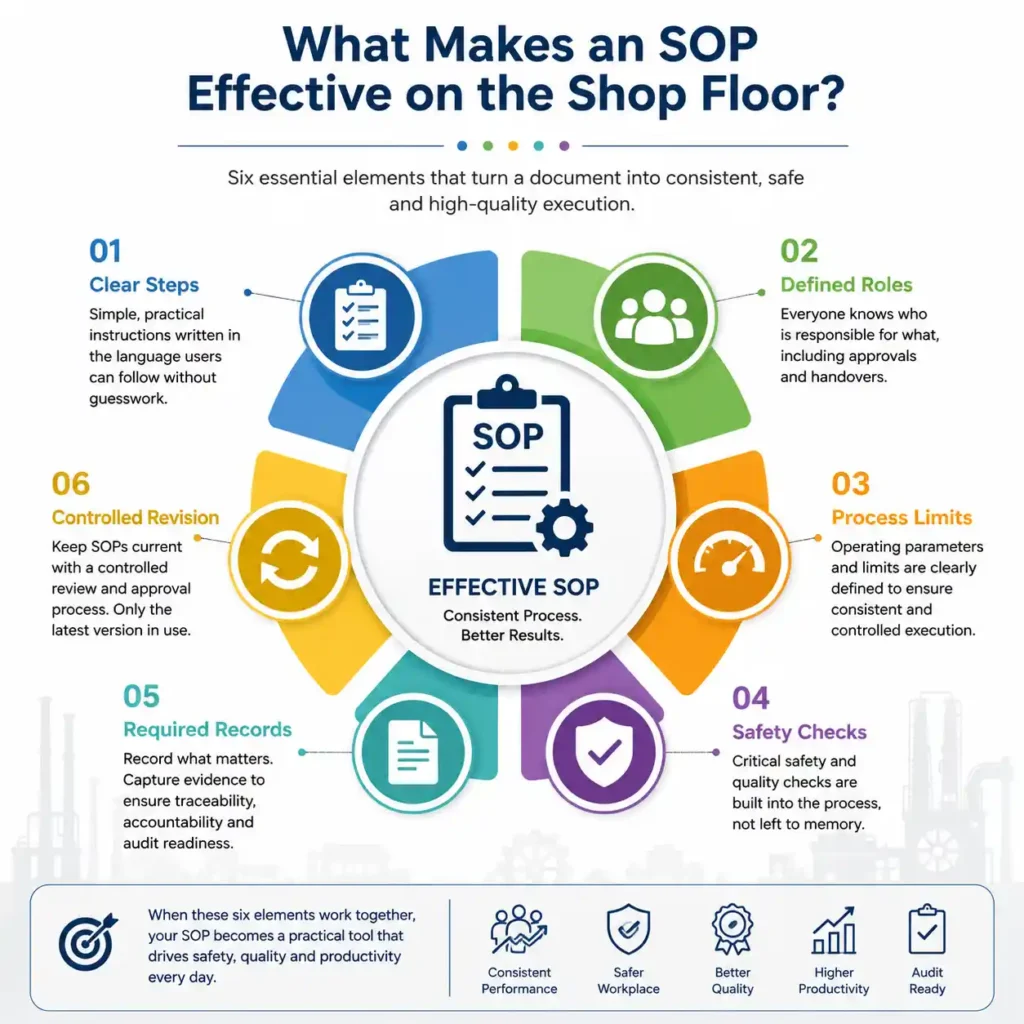
An effective SOP is a clear, controlled instruction that explains how a critical task must be performed, who is responsible, what inputs, operating requirements and applicable limits or reference documents apply, which checks are required, and what records must be maintained.
It is not a generic policy statement. It should define:
- Purpose and scope of the task
- Roles and responsibilities
- Step sequence in practical language
- Operating parameters and limits
- Safety and quality checkpoints
- Records to be completed
- What to do when the process goes outside limits
If the SOP cannot guide a trained operator through consistent execution, it is not yet effective.
Why Manufacturing Plants Need Effective SOPs
1. Consistency across shifts and people
Without shared methods, each experienced operator carries a private version of the process. SOPs convert tribal knowledge into plant standards.
2. Faster and safer training
New employees learn faster when instructions are structured. Training against SOPs also creates better competency evidence for audits.
3. Reduced process variation
Quality problems often come from small uncontrolled differences in setup, sequence or checks. SOPs narrow those differences.
4. Stronger audit and customer confidence
Auditors and customers look for alignment between written methods and actual practice. Effective Well-controlled SOPs help demonstrate that alignment.
5. Better safety control
Critical safety steps must not depend on memory. SOPs can incorporate mandatory precautions and required safety checks into routine work.
6. Cleaner improvement and change control
When the current method is defined, improvements can be tested and updated deliberately instead of spreading as informal workarounds.
7. Operational resilience
Absences, shift changes and scale-up are less disruptive when the method lives in the system, not only in a few skilled people.
Where SOP Systems Typically Fail
Common system-level failures include:
- No defined ownership for SOP review and revision
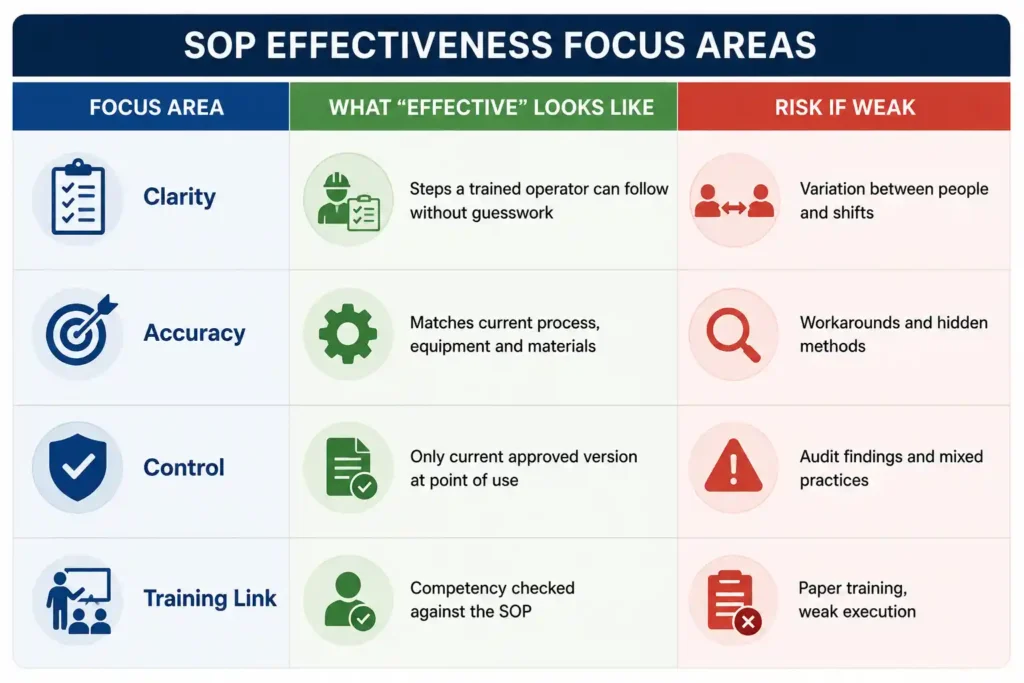
- Multiple uncontrolled versions available at the point of use
- Procedures disconnected from actual shop-floor workflows
- No defined trigger for review after process or equipment changes
- Training records maintained without linking them to competency
- An audit-driven documentation culture in which procedures receive attention only before inspections
These failures create a dangerous illusion of control: documents exist, but operations remain dependent on individual experience.
What Good SOP Management Looks Like
Effective plants treat SOPs as living operational tools.
They typically:
- Prioritise SOPs for quality-critical, safety-critical and high-variation tasks first.
- Write steps in practical language, with clear operating requirements, limits and checks.
- Validate procedures with the people who perform and supervise the work.
- Review, approve and control SOPs so only the current authorised version is available at the point of use.
- Train employees and assess competency against the SOP, rather than recording attendance alone.
- Review and update SOPs after process changes, incidents, audit findings and improvement initiatives.
- Verify during routine supervision that actual shop-floor practices align with approved procedures.
An SOP system works when supervisors can walk the floor and see the written method in action.
How to Measure SOP Effectiveness on the Shop Floor
SOP effectiveness should not be measured by the number of documents a plant has. It should be assessed by whether employees can consistently follow the defined method and whether the procedure helps control operational risk.
Useful indicators include:
- Reduction in repeat process deviations
- Fewer quality issues linked to procedural variation
- Training and competency gaps identified during assessment
- Audit observations related to procedure adherence
- Timeliness of SOP revisions after process changes
- Supervisor verification of actual practice against the approved procedure
These indicators help manufacturers determine whether SOPs are functioning as operational controls or simply existing as controlled documents.
SOP Effectiveness Focus Areas at a Glance\
How IMARC Engineering Supports SOP Development and Operational Discipline
IMARC Engineering supports manufacturers in developing and strengthening Standard Operating Procedures that reflect actual plant processes, responsibilities, quality requirements and operational controls.
- Process and workflow mapping before SOP development
- Development and structuring of plant-specific SOPs and work instructions
- Alignment of procedures with actual shop-floor practices
- SOP review, revision and document-control inputs
- Support for training, operational readiness and audit preparation
- Advisory across pharmaceuticals, food and beverage, chemicals, auto components, electronics, FMCG and discrete manufacturing
Contact IMARC Engineering’s team for operational readiness and process discipline support across India: https://www.imarcengineering.com/contact?service=standard-operating-procedure-development
Common Mistakes When Implementing SOPs
Common implementation mistakes include:
- Copying generic templates without adapting them to plant-specific processes and limits
- Writing instructions in language that operators find difficult to follow
- Excluding operators and supervisors from procedure validation
- Failing to verify SOP adherence during routine shop-floor supervision
- Measuring success by the number of SOPs completed rather than operational outcomes
- Treating procedure updates as administrative work instead of part of process change control
Conclusion
Manufacturing plants need effective Standard Operating Procedures because defined methods help support consistent quality, safer execution and repeatable operations across people and shifts.
As manufacturing operations in India expand, clear, current and consistently followed SOPs can help standardise processes, train employees, manage operational changes and demonstrate process control during audits. In contrast, reliance on informal or person-dependent methods can increase the risk of process variation, training gaps, recurring deviations and inconsistent execution.
Through process alignment and operational readiness support, IMARC Engineering helps manufacturers turn Standard Operating Procedures into practical shop-floor control, not just controlled documents.
Contact Us:
IMARC Engineering
Phone: +91-120-433-0800
Email: sales@imarcengineering.com
India: C-130, Sector 2, Noida, Uttar Pradesh 201301
LinkedIn: https://www.linkedin.com/showcase/imarc-engineering/
About the Author