Introduction
Most industrial project teams don’t start out looking for Regulatory Approval and Licensing Services. They start out stuck. A plant layout is ready, equipment is being finalised, and someone asks a simple question no one can answer with confidence: which approvals does this project actually need, and from whom?
This confusion is more common than it should be. Project teams often don’t know which approvals apply to their specific plant, which authority handles each requirement, at what stage in the project an approval must be obtained, what technical documents each application needs, or whether an approval the company already holds still covers a proposed expansion or process change.
Left unresolved, these gaps show up later as approval delays, repeated queries from authorities, documentation rework, last-minute engineering changes, construction and commissioning delays, and compliance costs that were never budgeted.
This is where structured regulatory approval and licensing support becomes useful — not as a paperwork formality, but as a way to build a clear, project-specific approval roadmap before decisions get locked in.
Why Do Industrial Projects Face Regulatory Approval Problems?
Project-specific requirements. Every plant’s approval list depends on its location, industry, capacity, raw materials and environmental footprint. Applying a generic checklist from a similar-looking project often misses what actually applies.
Multiple authorities. A single project can involve the State Pollution Control Board, the factories/labour department, the fire department, the local municipal or development authority, and sometimes a sector regulator — each with its own forms, timelines and documentation format.
Scope changes after planning. When capacity, product mix or process technology changes after the initial approval assessment, the earlier applicability review may no longer hold, but teams often don’t revisit it.
Engineering-document mismatch. Application forms ask for effluent volumes, emission sources, layout details and utility data that must match the engineering package. When engineering and regulatory documentation are prepared separately, numbers don’t align, triggering queries.
Late planning. Approvals are frequently treated as a downstream, administrative task rather than a parallel workstream, so applicability is assessed only after key design decisions are already frozen.
Greenfield vs brownfield differences. A new site needs a fresh approval baseline; an operating plant carries existing consents that may or may not cover a modification — a distinction teams often overlook.
Incomplete documentation. Missing site plans, process flow diagrams or water/effluent balances are among the most common reasons applications get sent back for clarification.
What Happens When Regulatory Approval Planning Is Done Too Late?
When approval planning starts late, the effects ripple across the entire project:
- Construction schedules get disrupted by pending clearances
- Repeated resubmissions and clarification cycles consume weeks or months
- Equipment or layout may need redesign to meet conditions discovered late
- Unbudgeted compliance costs appear (pollution control equipment, safety systems)
- Procurement gets delayed pending final approved drawings
- Commissioning is pushed back, delaying revenue
- Operations may face restrictions if conditional approvals aren’t fully closed
- Leadership time gets diverted from execution to firefighting approvals
- In some cases, non-compliance creates legal and regulatory exposure
What Should Companies Check Before Starting Regulatory Approval Work?
Before engaging any regulatory process, it helps to have clarity on:
- Project location and state/jurisdiction
- Industry sector and product being manufactured
- Production capacity
- Raw materials and fuel used
- Water requirement and effluent generation
- Emission sources
- Hazardous materials handled or stored
- Scope of buildings and plant area
- Workforce size
- Whether the project is greenfield or brownfield
- Existing approvals held (for brownfield projects)
- Nature of proposed modifications
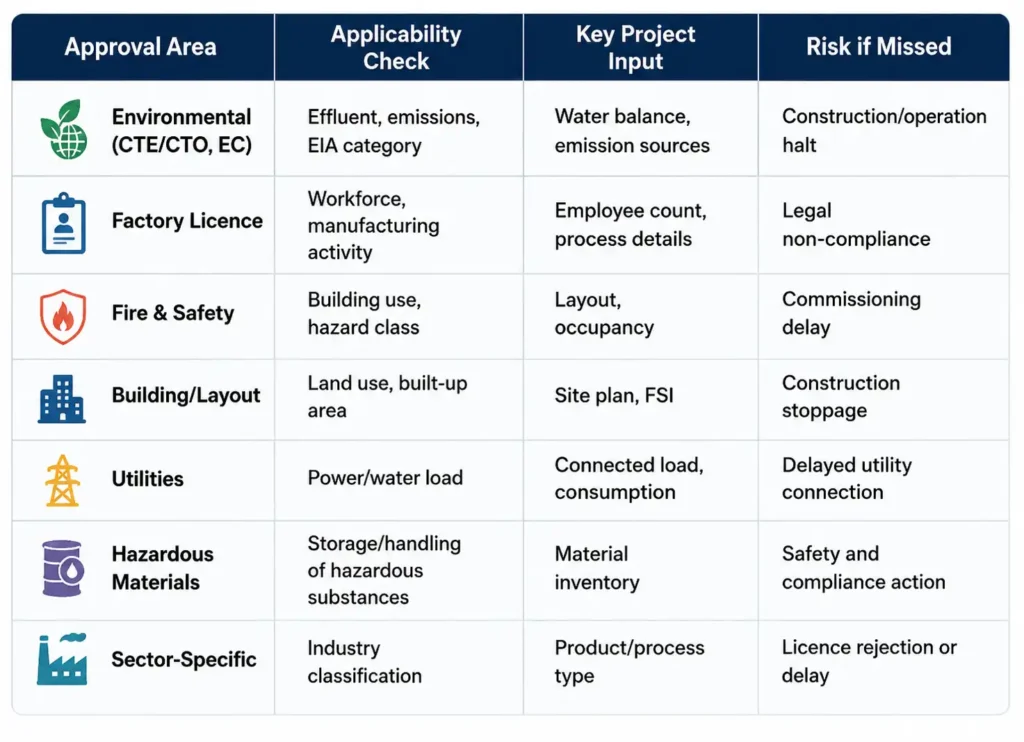
These inputs help determine which approval categories may realistically apply — requirements vary by location, industry, capacity, process and environmental impact, so no two projects should be assumed to need the same list.
What Regulatory Approvals and Licences May Apply to an Industrial Project?
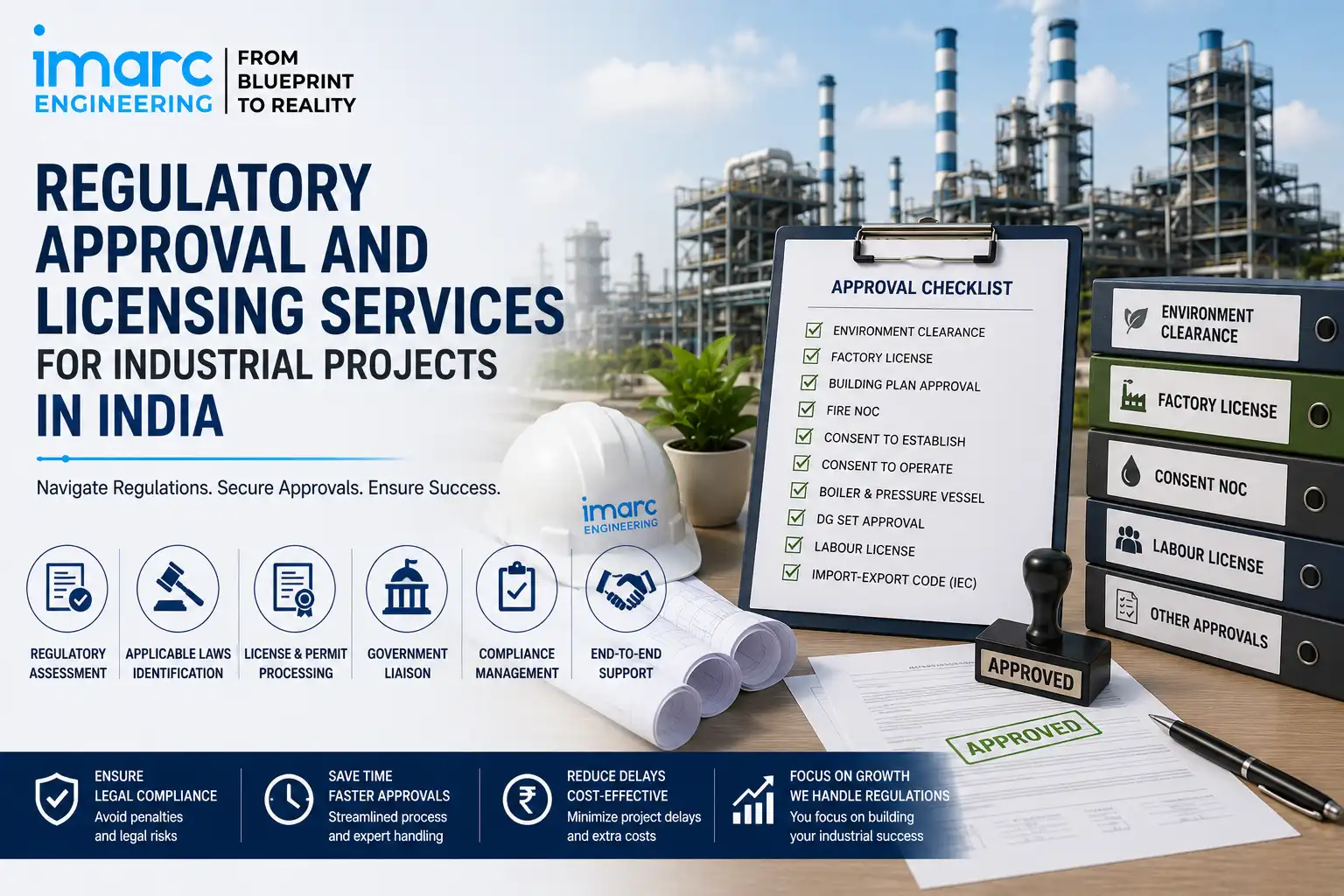
Depending on project scope, the following categories may apply:
- Environmental approvals and consents — Consent to Establish and Consent to Operate under the Water (Prevention and Control of Pollution) Act, 1974 and the Air (Prevention and Control of Pollution) Act, 1981, granted by the respective State Pollution Control Board; Environmental Clearance under the EIA Notification, 2006 (MoEFCC), where applicable
- Factory-related approvals — factory registration, licence and related requirements under the applicable state factory and occupational-safety framework
- Fire and safety approvals — Fire NOC from the state fire department
- Building/layout permissions — approvals from the local municipal body or industrial development authority
- Utility-related permissions — power, water and other utility connection approvals
- Hazardous material-related requirements — where applicable, under the Hazardous and Other Wastes (Management and Transboundary Movement) Rules
- Boiler/pressure-system approvals — where boilers or pressure vessels are used
- Sector-specific licences, where the industry falls under a specialised regulator
This is not a universal checklist; applicability must be assessed case by case.
Industrial projects in India may require environmental consents, factory-related approvals, fire and safety approvals, building permissions, utility approvals, hazardous-material permissions, boiler/pressure-system approvals and sector-specific licences. The exact requirements depend on the project’s location, industry, capacity, process and environmental impact.
Greenfield vs Brownfield: Why Approval Complexity Differs
Greenfield projects start from a clean slate — new site, new infrastructure, and a fresh environmental and utility baseline. Every approval must be obtained from scratch, but scope is at least well defined from day one.
Brownfield projects are more layered. They carry existing approvals, existing capacity limits, and existing infrastructure, onto which a capacity increase, new product line or process modification is being added. This requires reviewing existing environmental conditions, utility interfaces, and shutdown constraints — and existing approvals should never be assumed to automatically cover a major change without reassessment.
How Experts Identify the Applicable Regulatory Approvals
A structured assessment starts with the project’s technical basis, location, industry, capacity, raw materials, utilities and environmental profile. These inputs are used to determine the approval categories that may apply, identify the relevant authorities and establish the sequence in which approvals should be addressed.
The process also checks documentation requirements, existing approvals for brownfield projects, engineering-regulatory data consistency and conditions that must be satisfied before construction, commissioning or operation.
This approach works because regulatory requirements are closely tied to engineering, environmental systems, utilities, project schedules and operational scope — not treated as a standalone paperwork exercise.
Regulatory Approval Roadmap for an Industrial Project
Project Concept → Applicability Assessment → Approval Mapping → Engineering & Documentation → Submission → Authority Review → Clarification/Compliance → Approval → Construction/Installation → Pre-Commissioning Requirements → Operational Compliance
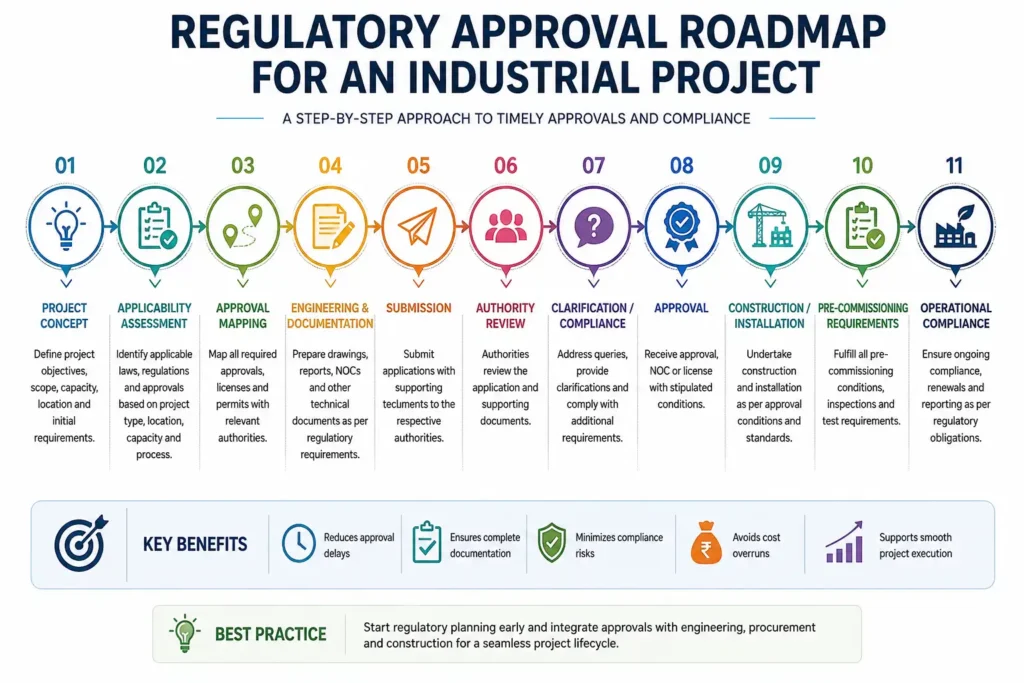
Start regulatory planning before project decisions are frozen.
What Documents Are Typically Required for Regulatory Approvals?
Common categories include: project profile, land/site documents, site and layout plans, process flow diagrams, manufacturing process details, capacity information, equipment details, raw-material information, water balance, fuel/energy details, emission and effluent data, waste information, pollution-control system details, fire and safety information, utility details, company/legal documents, and — for brownfield projects — existing approval documents. Exact documentation depends on the specific approval and authority involved.
How Regulatory Approval Planning Should Align With Engineering
Approval requirements are directly linked to process design, equipment selection, utility design, environmental systems, building/layout, fire and safety systems, and the overall project schedule. When engineering is frozen first and regulatory requirements are discovered afterwards, the result is avoidable rework — redesigned layouts, added pollution-control equipment, or revised utility sizing. Coordinating both tracks early reduces this risk considerably.
How Regulatory Approval Experts Help Reduce Project Risk
Expert support typically covers applicable-approval identification, an approval roadmap and matrix, documentation readiness, engineering-regulatory coordination, greenfield planning, brownfield assessment, compliance-gap identification, approval sequencing, project-schedule alignment, clarification management, and tracking of approval conditions.
The real value isn’t submitting applications — it’s reducing the risk of discovering regulatory requirements after engineering, procurement or construction decisions have already been locked in.
When Should a Company Seek Regulatory Approval Support?
It’s worth engaging support when a company is: setting up a new manufacturing plant, expanding an existing plant, planning a brownfield modification, increasing capacity, introducing a new product or production line, changing a process or fuel source, increasing environmental load, dealing with multiple overlapping approvals, already facing approval delays, or needing to reassess whether existing approvals cover a planned change.
How IMARC Engineering Supports Regulatory Approval and Licensing
This is where IMARC Engineering fits in — not as a substitute for statutory authorities, but as engineering-led regulatory support that connects approval requirements with actual plant design and project execution.
IMARC Engineering helps project teams assess applicable approvals, establish an approval roadmap, prepare documentation inputs, coordinate regulatory requirements with engineering, review brownfield approval implications and align regulatory activities with the project schedule. Its approach considers how plant layout, process design, utilities, environmental systems and equipment specifications can affect regulatory requirements and compliance obligations.
The objective is straightforward: help project teams understand what applies to their specific plant and address regulatory requirements early, before they become construction, commissioning or operational problems.
Planning a new industrial plant, expansion or brownfield modification? Learn how to align regulatory approvals with your project scope, engineering and execution timeline: https://www.imarcengineering.com/contact?service=regulatory-approval-and-licensing
Common Regulatory Approval Mistakes
- Starting approval work too late in the project
- Relying on a generic, non-project-specific checklist
- Not defining project scope clearly before assessment
- Mismatched data between engineering and application documents
- Assuming existing approvals automatically cover expansions
- Ignoring brownfield-specific regulatory implications
- Unclear ownership of documentation within the project team
- Poor tracking of submission and clarification status
- Missing renewal or condition-compliance deadlines
- Treating regulatory work as separate from the project schedule
Regulatory Approval Checklist for Industrial Projects
Before Design: Define project scope · Confirm location · Identify potential approval categories · Map relevant authorities
During Engineering: Confirm capacity · Align process data · Verify environmental inputs · Align drawings and utility information
Before Submission: Cross-check documents · Verify technical information · Check data consistency · Review authority-specific requirements
Before Commissioning: Confirm all required approvals are in hand · Review approval conditions · Close pending compliance items
Conclusion
Regulatory approval problems in industrial projects rarely stem from a lack of effort — they stem from starting late, using generic assumptions, and treating approvals as separate from engineering. Requirements are project-specific, tied to location, capacity, process and environmental impact, and they need to be planned alongside design decisions, not after them. Structured regulatory approval planning helps project teams build a clear roadmap early, reducing the chance of discovering critical requirements once construction is already underway. That is the practical value of engineering-led regulatory support — clarity before commitment, not paperwork after the fact.
FAQs
What regulatory approvals are required for an industrial project in India? It depends on the project’s location, industry, capacity and environmental impact. Common categories include environmental consents, factory licence, fire NOC, building approval and utility permissions, but the exact list varies by project.
Why do industrial projects face regulatory approval delays? Delays usually result from late planning, generic checklists, mismatched engineering and application data, and unclear documentation ownership.
How can companies identify which licences apply to their plant? By assessing project-specific inputs — location, capacity, process, raw materials, effluent and emissions — against applicable central and state regulations, ideally with expert support.
When should regulatory approval planning begin? As early as the project concept stage, alongside preliminary engineering, so approval requirements can inform design rather than follow it.
Do brownfield projects require a fresh regulatory assessment? Yes. Existing approvals should not be assumed to automatically cover capacity increases, process changes or product modifications.
Can changes in plant capacity affect existing approvals? Yes. Capacity or process changes can shift environmental load and pollution category, which may require fresh or amended consents.
What documents are usually required for industrial approvals? Typically project profile, site/layout plans, process flow diagrams, capacity and equipment details, water and effluent balances, and company documents — exact requirements vary by approval and authority.
When should a company hire regulatory approval experts? When starting a new plant, expansion or brownfield modification, or when facing delays, multiple overlapping approvals, or uncertainty about whether existing approvals still apply.
About the Author