Setting up a coconut milk manufacturing plant in India represents an attractive investment opportunity underpinned by robust, structurally growing demand from health-conscious and vegan consumers, the expanding plant-based dairy alternative category, and the broader food and beverage processing industry. As lactose-intolerance awareness spreads, plant-based diets gain mainstream traction, and consumer appetite for clean-label, dairy-free ingredients grows, coconut milk available in ready-to-drink, culinary, and value-added forms occupies an increasingly important position across household retail, food processing, and hospitality and catering (HoReCa) applications. This growth trajectory, combined with abundant raw material availability across coconut-growing regions and moderate but defensible entry barriers, creates a favourable manufacturing environment for new entrants with efficient extraction, processing, and quality systems.
What is Coconut Milk?
Coconut milk is a rich, opaque, milky-white liquid extracted from the grated pulp of mature brown coconuts. Unlike coconut water, which occurs naturally inside young coconuts, coconut milk is a processed product made by combining grated coconut meat with hot water and straining the resulting mixture. It is a staple ingredient across Southeast Asian, Caribbean, and Indian cuisines, valued for its high oil content and creamy, nutty character.
Coconut milk is generally produced in thick and thin varieties depending on how many times the grated pulp is pressed, with thick cream containing up to around 50% fat and thin milk carrying a lower fat concentration. Beyond traditional cooking in curries, soups, and desserts, coconut milk is widely used as a plant-based, vegan, and lactose-free substitute for dairy milk, and it is a source of lauric acid alongside its naturally high saturated fat and calorie content.
The global coconut milk market was valued at approximately USD 3.20 Billion in 2025 and is projected to reach USD 10.41 Billion by 2034, reflecting a CAGR of 14.0% from 2026 to 2034, supported by the rising popularity of plant-based diets and expanding use of coconut milk across beverages, desserts, and packaged foods.
Cost of Setting Up a Coconut Milk Manufacturing Plant
The total capital investment required to establish a coconut milk manufacturing plant is shaped by several key parameters: annual production capacity (typically ranging from 150,000 to 300,000 litres per annum), the level of processing technology and automation adopted, facility specification, raw material sourcing strategy, and applicable regulatory and food safety compliance requirements. Below is a structured breakdown of the major cost components.
1. Capital Expenditure (CapEx)
Total capital investment in a coconut milk manufacturing plant covers the following major heads:
Land and Site Development
This encompasses land acquisition or lease, site preparation, boundary development, and utilities connectivity. Site selection should prioritise proximity to fresh coconut supply sources and to water of suitable quality, along with access to target markets to minimise distribution costs. Reliable transportation infrastructure, utilities, and waste management systems, together with compliance with local zoning laws and environmental regulations, are critical site selection criteria that should be assessed from project initiation.
Civil Works and Construction
Building costs cover the main processing facility including raw material reception and storage, dehusking and deshelling areas, grating and extraction sections, filtration and homogenisation areas, pasteurisation and sterilisation zones, cold storage and cooling infrastructure, automated packaging and dispatch areas, quality control laboratory, administrative block, and utility infrastructure including boiler house, power backup, and effluent treatment systems. Construction must comply with applicable factory act requirements and food safety manufacturing standards.
Machinery and Equipment
Machinery represents a significant share of total CapEx. Key equipment required for a coconut milk manufacturing plant includes:
- Dehusking and Deshelling Machines: Equipment to remove the outer husk and hard shell from mature coconuts prior to processing
- Paring and Washing Units: Systems to remove the brown testa layer from the coconut kernel and clean the pared meat before grinding
- Pulverisers and Grating Machines: Equipment that shreds or grates the coconut kernel into fine pulp to maximise surface area for milk extraction
- Milk Extractors and Screw Presses: Systems that press hot water through the grated pulp to extract coconut milk, typically in successive pressings to yield thick and thin milk fractions
- Filtration Systems: Equipment to remove fibre and particulate matter from extracted coconut milk prior to further processing
- Homogenisers: High-pressure equipment that breaks down fat globules to produce a stable, uniform emulsion and prevent cream separation during storage
- Pasteurisation and Sterilisation Systems: Thermal processing equipment, including UHT and retort systems where aseptic or shelf-stable products are required, to eliminate micro-organisms and extend shelf life
- Mixing Tanks and Cooling Units: Jacketed tanks and cooling systems for blending, standardising, and rapidly cooling processed coconut milk before packaging
- Filling and Sealing Machines: Automated lines for filling coconut milk into cartons, cans, pouches, or bottles under hygienic or aseptic conditions
- Quality Control Laboratory Equipment: Instruments for testing fat content, total solids, microbial load, and other parameters to verify compliance with food safety and quality standards
- Material Handling and Warehousing: Conveyors, storage systems for raw coconuts and packaging materials, and finished goods warehousing with FIFO stock management
Other Capital Costs
These include pre-operative expenses, commissioning charges, import duties on specialised processing equipment, staff training and competency development, initial raw material and packaging inventory for production commissioning, and regulatory compliance setup including food safety licensing and quality management system establishment costs.
Request a Sample Report for In-Depth Market Insights: https://www.imarcgroup.com/coconut-milk-manufacturing-plant-project-report/requestsample
2. Operational Expenditure (OpEx)
Raw materials principally fresh coconuts, along with water and other processing inputs, constitute the dominant operating cost, typically representing 70–80% of total OpEx. Utility costs, driven primarily by thermal processing, electricity consumption of extraction and homogenisation equipment, and cold storage operations, account for 10–15% of OpEx. Labour, maintenance, quality control, packaging, transportation, depreciation, taxes, and overhead costs constitute the remainder of the operating cost base.
3. Plant Capacity
The proposed coconut milk manufacturing facility is designed with an annual production capacity ranging between 150,000–300,000 litres, enabling economies of scale while maintaining operational flexibility. This capacity range supports a diversified product portfolio spanning ready-to-drink coconut milk, culinary-grade coconut milk, and value-added formulations, serving household retail, food processing, and hospitality and catering channels.
4. Profit Margins and Financial Projections
The project demonstrates healthy profitability potential under normal operating conditions. Financial projections encompass capital investment, operating costs, capacity utilisation ramp-up schedule, product mix, and forward demand outlook underpinned by the rising plant-based dairy alternative trend. A comprehensive feasibility analysis includes sensitivity analysis, Net Present Value (NPV), Internal Rate of Return (IRR), and Payback Period calculations. Gross profit margins for coconut milk manufacturing typically range from 30–40%, supported by stable demand and value-added applications. Net profit margins of 15–22% are achievable with disciplined cost management and optimal capacity utilisation.
Why Set Up a Coconut Milk Manufacturing Plant?
Rising Demand for Plant-Based Dairy Alternatives
Increasing consumer focus on lactose-free, vegan, and clean-label diets is driving sustained demand for coconut milk as a core dairy-alternative ingredient. As health-conscious consumers increasingly seek out plant-based beverages and ingredients, coconut milk is transitioning from a specialty ethnic-cuisine ingredient toward a mainstream household and foodservice staple, supporting steady volume growth across retail and beverage channels.
Essential and Diversified Food & Beverage Ingredient
Coconut milk serves as a core ingredient across culinary preparations, dairy-alternative beverages, confectionery, bakery products, ready-to-eat foods, and sauces, positioning it as a staple component in both traditional cuisines and modern plant-based food systems. This diversified application base provides resilience against single-segment demand volatility.
Moderate but Defensible Entry Barriers
While coconut milk manufacturing is not as capital intensive as highly processed food industries, consistent quality standards, hygienic processing, shelf-life stabilisation, aseptic packaging, and food safety certifications create meaningful barriers that favour disciplined manufacturers with strong quality control and operational reliability.
Megatrend Alignment
The global rise of plant-based diets, lactose intolerance awareness, vegan lifestyles, and clean-label food products is accelerating demand for coconut-based dairy alternatives, with consumption expanding rapidly across beverage, bakery, health food, and ready-meal categories, as well as in cosmetic and personal care applications owing to coconut milk’s moisturising and nourishing properties.
Policy and Agro-Processing Support
Government initiatives supporting food processing, value-added agricultural products, export promotion, and rural agro-industries including food processing incentives and cold-chain infrastructure development indirectly encourage the expansion of coconut milk manufacturing capacity.
Supply Chain Localisation and Farmer Linkages
Food brands and processors increasingly prefer locally processed coconut products to reduce logistics costs, maintain freshness, and ensure traceable sourcing, creating opportunities for regional coconut milk manufacturers with strong farmer linkages and efficient processing systems.
Manufacturing Process Overview
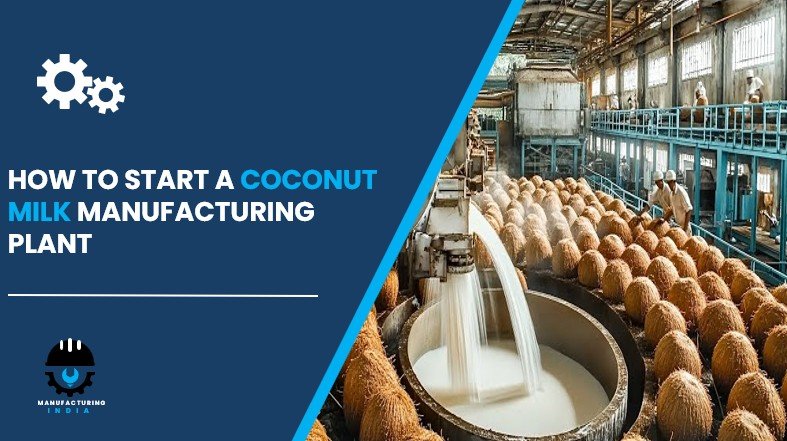
The coconut milk manufacturing operation transforms fresh mature coconuts into a stable, packaged liquid product through a sequence of mechanical extraction, processing, and packaging operations. The key process stages are:
- Selection and Cleaning: Fresh, mature coconuts are selected and cleaned to remove dirt and foreign matter before processing begins.
- Dehusking and Deshelling: The outer husk and hard shell are mechanically removed to expose the coconut kernel.
- Paring and Washing: The brown testa layer is pared away from the kernel, and the pared meat is washed to remove residual debris.
- Grating and Grinding: The cleaned kernel is grated or ground into fine pulp to maximise the surface area available for milk extraction.
- Extraction and Pressing: Hot water is combined with the grated pulp and pressed through screw presses or expellers to extract coconut milk, with successive pressings yielding thick and thin milk fractions.
- Filtration: Extracted coconut milk is filtered to remove residual fibre and particulate matter.
- Homogenisation: The filtered milk is homogenised under high pressure to break down fat globules, producing a stable, uniform emulsion that resists cream separation.
- Pasteurisation and Sterilisation: Homogenised coconut milk undergoes thermal treatment, including UHT or retort processing where shelf-stable products are required, to eliminate micro-organisms and extend shelf life.
- Cooling: Processed coconut milk is rapidly cooled prior to packaging to preserve product quality.
- Filling, Sealing, and Packaging: Coconut milk is filled into cartons, cans, pouches, or bottles under hygienic or aseptic conditions, followed by quality inspection, storage, and distribution.
Key Applications of Coconut Milk
The coconut milk market serves several major end-use segments across food processing, foodservice, and retail sectors:
- Food & Beverage Industry: Coconut milk is used as a dairy alternative in beverages, desserts, sauces, and ready-to-eat products, serving the growing plant-based and vegan product categories.
- Household Consumption: Consumers use coconut milk in daily cooking for curries, soups, smoothies, and traditional dishes across a wide range of culinary traditions.
- Food Processing Industry: Coconut milk serves as an ingredient in packaged foods, bakery products, confectionery, and instant mixes.
- Hospitality and Catering (HoReCa): Restaurants, hotels, and catering services use coconut milk extensively for diverse culinary preparations.
- Cosmetic and Personal Care Applications: Coconut milk’s moisturising and nourishing properties support its use in personal care formulations, providing an additional value-added revenue stream for manufacturers.
Global Coconut Milk Market Outlook
The coconut milk market is experiencing steady growth driven by rising demand for plant-based dairy alternatives, particularly among health-conscious and vegan consumers. As dairy-free diets gain popularity, coconut milk has gained traction as a versatile ingredient across beverages, desserts, and savoury dishes. The market benefits from several structural demand drivers:
- Rising consumer preference for plant-based, lactose-free, and clean-label dairy alternatives across urban populations globally
- Growing vegan and flexitarian lifestyles supporting broader adoption of coconut-based beverages and ingredients
- Expanding use of coconut milk in the cosmetic and personal care sectors, owing to its moisturising and nourishing properties
- Continued innovation in product offerings, including flavoured and functional coconut milk variants, expanding the category’s consumer base
- Growth in packaged foods, bakery, and confectionery sectors creating sustained industrial demand for coconut milk as an ingredient
- Government support for food processing, agro-industries, and export promotion in major coconut-producing regions
Leading manufacturers in the global coconut milk industry include Sambu Group, Axelum Resources Corp., McCormick & Company, Danone S.A., and Thai Coconut Public Company Limited, serving end-use sectors including food and beverage, dairy alternatives, bakery and confectionery, ready-to-drink beverages, frozen desserts, and cosmetics.
Latest Industry Developments
- March 2026: Vita Coco Company expanded its Vita Coco Treats range with a new Frosted Lemonade flavour, combining a tart lemon profile with a coconut finish, reflecting continued product innovation and flavour diversification within the coconut-based beverage category.
Licenses and Regulatory Requirements
Establishing a coconut milk manufacturing unit requires a range of approvals and certifications, which may vary by country and jurisdiction, including:
- Business registration and company incorporation under applicable company law
- Factory License under applicable state Factories Act provisions for manufacturing operations
- Food Safety and Standards Authority License for manufacturing and sale of coconut milk products
- BIS (Bureau of Indian Standards) or equivalent quality certification, where applicable, for packaged food products
- Environmental clearances and Pollution Control Board Consent to Establish (CTE) and Consent to Operate (CTO) for manufacturing operations
- Fire safety certifications and Occupational Health and Safety management compliance for manufacturing worker safety
- ISO 22000 / HACCP Food Safety Management System Certification for food safety infrastructure compliance
- Weights and Measures (Legal Metrology) registration for packaged commodity labelling and net quantity declaration
- Export-Import Code (IEC) for international market access
- Trademark and Brand Registration for proprietary branded product launch
Key Challenges to Consider
Raw Material Supply Consistency
Fresh coconuts, which account for 70–80% of total operating costs, are an agricultural commodity subject to seasonal availability, weather-related supply fluctuations, and regional concentration of cultivation. Inconsistent raw material supply can materially affect capacity utilisation and cost predictability. Securing long-term supply arrangements with coconut growers and cooperatives located in close proximity to the processing facility is a critical operational priority.
Shelf-Life Stabilisation and Cold Chain Management
Coconut milk is highly perishable in its fresh form and requires effective pasteurisation, sterilisation, or aseptic processing along with reliable cold chain infrastructure to achieve commercially viable shelf life. Any lapse in thermal processing efficiency or cold chain integrity increases spoilage risk and creates food safety exposure. Continuous investment in processing equipment maintenance and quality assurance is a non-negotiable operational requirement.
Price Volatility and Substitution Competition
Coconut milk demand and pricing are influenced by the relative pricing and availability of substitute plant-based milks such as almond, soy, and oat milk, which are subject to their own commodity price cycles and consumer preference shifts. Periods of aggressive pricing by substitute products can compress coconut milk demand, requiring processors to manage cost structures and product differentiation to maintain margins.
Quality Certification and Food Safety Compliance Maintenance
Maintaining food safety licensing, quality certifications, and food safety management system certifications requires ongoing investment in quality laboratory infrastructure, process monitoring, and surveillance audit preparedness. Producing coconut milk that consistently meets fat content, total solids, and microbial safety specifications across all production batches requires disciplined process control, as any food safety compliance lapse can disrupt market access and damage brand reputation.
Capital Intensity of Aseptic and UHT Processing
While basic pasteurised coconut milk production can be established at moderate capital investment, aseptic and UHT processing capable of producing shelf-stable, ambient-distribution products represents a substantial incremental capital commitment. New entrants must carefully evaluate the phasing of investment between chilled, short-shelf-life production and fully aseptic operations, based on available capital, target markets, and distribution strategy.
Frequently Asked Questions (FAQs)
1. How much does it cost to set up a coconut milk manufacturing plant?
The total investment depends on plant capacity (150,000–300,000 litres per annum), the level of processing technology and automation, facility specification, location, and target market certifications. Costs cover land, civil construction (processing, cold storage, quality laboratory, utilities), machinery (extraction, homogenisation, pasteurisation or UHT systems, packaging lines), quality certifications, working capital, and regulatory compliance. A comprehensive feasibility study from IMARC Group provides detailed, capacity-specific cost estimates covering all CapEx and OpEx components.
2. Is coconut milk manufacturing a profitable business in 2026?
Yes. Sustained demand from health-conscious and vegan consumers, the expanding plant-based dairy alternative category, and the broader food and beverage industry combined with gross margins of 30–40% and net profit margins of 15–22% make coconut milk manufacturing financially attractive, with profitability improving alongside capacity expansion and higher capacity utilisation.
3. What machinery and equipment are required for a coconut milk manufacturing plant?
Key equipment includes dehusking and deshelling machines, paring and washing units, pulverisers or grating machines, milk extractors or screw presses, filtration systems, homogenisers, pasteurisation and sterilisation systems, mixing and cooling tanks, filling and sealing machines, and quality control laboratory equipment.
4. What licenses and approvals are required?
Required approvals typically include business registration, environmental clearances, Factory License, food safety licensing for manufacturing and sale of coconut milk, quality certifications where applicable, Pollution Control Board clearances, fire safety certifications, and ISO 22000/HACCP food safety management system certification. Local, state, and national regulations may apply depending on the location.
5. How long does it take to commission a coconut milk manufacturing plant?
Typically, 12–24 months from project initiation to commercial production launch, depending on project scale, facility construction timeline, equipment procurement lead times, environmental clearances, safety measures, and trial runs.
6. What are the key raw materials for coconut milk manufacturing?
The primary raw material is the kernel of mature coconuts. Additional inputs depending on the desired product can include water, sugar, stabilisers such as emulsifiers, and flavourings.
7. What is the break-even period for a coconut milk manufacturing plant?
The break-even period generally ranges from 3 to 6 years, depending on capacity utilisation ramp-up, regulatory compliance costs, raw material pricing, and market demand. Efficient manufacturing and export opportunities can help accelerate returns.
8. What are the main product forms of coconut milk and their applications?
The principal forms are thick coconut milk or cream, containing up to around 50% fat and used in curries, desserts, and premium culinary applications, and thin coconut milk, with a lower fat concentration used in soups, beverages, and general cooking. Both forms serve household retail, food processing, and hospitality applications.
9. What government incentives are available for coconut milk processors?
Processors may benefit from food processing sector incentive schemes, capital subsidies, tax exemptions, reduced utility tariffs, export promotion benefits, and interest subsidies offered under various national or regional industrial policies supporting agro-processing units.
10. How does coconut milk manufacturing compare to other plant-based milk processing in terms of setup?
Compared to other plant-based milks such as almond, soy, or oat milk, coconut milk processing benefits from a raw material that requires less pre-treatment such as soaking, but is more dependent on regional cultivation zones and seasonal supply. The extraction and homogenisation technology employed is broadly similar to other plant-based milk processing, allowing processors with experience in one category to adapt existing technical capabilities to coconut milk with targeted investment in dehusking and deshelling infrastructure.
Key Takeaways for Investors
The coconut milk manufacturing industry represents a structurally attractive investment opportunity positioned at the intersection of rising global adoption of plant-based diets, expanding food and beverage applications, and the broader dairy-alternative megatrend. Stable demand from household retail, food processing, and hospitality and catering channels provides resilience against single-segment demand volatility, while moderate but defensible entry barriers reward manufacturers with strong quality control and food safety discipline. Continued product innovation, including flavoured and functional variants, and growing use of coconut milk beyond food into cosmetics and personal care, broaden the addressable market for new entrants. The scalable nature of the value chain allows investors to phase capital deployment between chilled short-shelf-life production and fully aseptic, ambient-distribution operations according to risk appetite and target market positioning.
About the Author