Regulatory Compliance Plant Checklist
Every manufacturing project reaches a moment that feels like the finish line: the equipment is installed, utilities are running, and the production line is ready to start. But mechanical completion and legal readiness are two different things. A plant can be fully built and still not be permitted to manufacture and sell a single unit , because an approval is pending, a consent hasn’t been granted, or a certification window has quietly closed during construction.
This gap between the plant works and “the plant is allowed to operate” is where most commissioning delays actually happen. It’s rarely a construction problem , it’s a compliance problem that nobody flagged early enough. This article walks through what commissioning-stage regulatory readiness actually looks like and how Regulatory Compliance Services : a practical way to answer the question every plant owner eventually has to face , can we legally start production, and can we prove it if someone asks?
Two Different Finish Lines
Projects are usually tracked against one timeline: design, procurement, construction, installation, testing, commissioning. Regulatory readiness runs on a separate, parallel timeline that project schedules often don’t account for.
The distinction matters because:
- Construction delays are visible and escalate immediately.
- Compliance gaps are invisible until an inspector, auditor, or certification body flags them , often after the plant is ready to run.
- A missing approval doesn’t slow the project down gradually. It stops it completely, on a specific date, with no partial credit for how close you are.
Treating regulatory work as something that happens alongside construction, rather than after it, is the single biggest factor separating smooth plant startups from stalled ones.
What Ready to Operate Actually Requires
Rather than listing every regulation, it’s more useful to group readiness into questions a plant owner should be able to answer with certainty before startup.
1. Is the facility itself authorized to exist and operate?
This covers factory registration, approved building plans, land use permissions, and whether what was actually built matches what was approved on paper. A common and costly mistake: layout changes made during construction , an extra storage area, a relocated utility room, an added mezzanine , that were never reflected in the approved factory plan. On paper, the facility approved and the facility built are no longer the same building.
It also covers worker-related statutory requirements, electrical installation approvals, and equipment-specific certifications , boilers, pressure vessels, lifting equipment , wherever the process involves them. None of these should be assumed complete just because the equipment is running; each carries its own sign-off.
2. Is the environmental footprint accounted for?
This is usually the most consequential category, because it directly controls whether production , including trial runs , can legally begin. Two approvals matter most: Consent to Establish, obtained before construction begins, and Consent to Operate is generally required before regular operation, while the permissibility and conditions for trial production should be confirmed with the relevant State Pollution Control Board and project-specific consent conditions..
The mistake that catches teams off guard almost every time: assuming production can start while the operating consent is “still being finalized.” Trial batches without the right consent can create exposure before a single commercial unit ships. Beyond the consent itself, the underlying question is whether the approved process still matches the actual one , changes in capacity, product mix, fuel source, or raw materials during construction can shift a plant’s pollution profile enough to require a fresh look at what was originally cleared.
3. Is waste handling designed in, not improvised later?
Every production process generates some form of waste , hazardous, packaging, wastewater, e-waste, or otherwise, depending on the industry. Before commissioning, the plant should already have identified waste streams, designated and labelled storage for each, and authorized disposal vendors with whatever tracking system applies. This is far easier to get right when it’s part of the facility design than when it’s bolted on after an audit finds a gap.
4. Can the product itself be legally sold?
A compliant factory doesn’t automatically mean a sellable product. Depending on the industry, the product itself may need independent certification , quality marks for engineering and industrial goods, manufacturing licenses and GMP readiness for pharmaceuticals, food safety licensing for processed food, or device-specific approvals for medical products. These requirements run on their own timelines and inspection cycles, separate from the factory’s approvals, and cover the underlying process , facility hygiene, material flow, validation, documentation , not just the license number itself.
5. Are the safety systems tested, not just installed?
Fire protection, electrical safety, and pressure-system compliance are frequently treated as installation checklists rather than functional ones. A hydrant system that’s plumbed in but never pressure-tested isn’t compliant , it’s incomplete. The useful discipline is a four-step chain: Installed → Tested → Verified → Documented. Skipping any link leaves the system unproven, regardless of whether it’s technically present. The same logic extends to instrumentation , sensors, flow meters, weighing systems , where the real question isn’t whether the instrument exists, but whether its calibration is current at the moment production begins.
6. Can every claim be backed up with paperwork?
This is the category that gets overlooked most often, because it isn’t a physical thing to inspect , it’s a filing cabinet (or shared drive) of evidence. Licenses, test certificates, calibration records, qualification and validation reports, and inspection sign-offs all need to exist in an organized, retrievable form. A plant that’s fully compliant but can’t produce the paperwork to prove it is, functionally, in the same position as one that isn’t compliant at all.
Where Projects Actually Lose Time
A few patterns show up repeatedly:
- Compliance work starts too late , regulatory scoping begins once construction is nearly finished, instead of during design, when changes are still cheap to make.
- Design happens in isolation from compliance requirements , layouts and equipment selection get finalized before anyone checks them against approvals already in hand.
- One approval gets mistaken for full coverage , environmental clearance, factory license, and product certification are separate tracks that all need to close independently.
- Mid-construction changes go unreported , a capacity increase or added product line can quietly invalidate the basis on which an earlier approval was granted.
- Certificates get treated as the finish line, when they’re really just evidence that operational controls exist , the controls themselves are what matter day to day.
- Upcoming requirements get missed , certification rules are periodically updated for categories that were previously unregulated, so a plant checked once at project start can fall out of step by the time it finishes.
Greenfield vs. Expansion: Different Risk Profiles
New plants have an advantage: compliance requirements can be built into the design from day one, rather than retrofitted later. The risk is sequencing , starting approvals too late relative to construction, so the plant is mechanically ready long before it’s legally ready.
Expansions and upgrades to existing facilities carry a different risk. The existing approval was granted for a specific capacity, product mix, and pollution load , any material change can shift the facility outside those boundaries, sometimes without anyone realizing it until an inspection. Checking regulatory impact before finalizing engineering changes is far cheaper than discovering a gap after equipment is already installed.
A Practical Way to Check Readiness
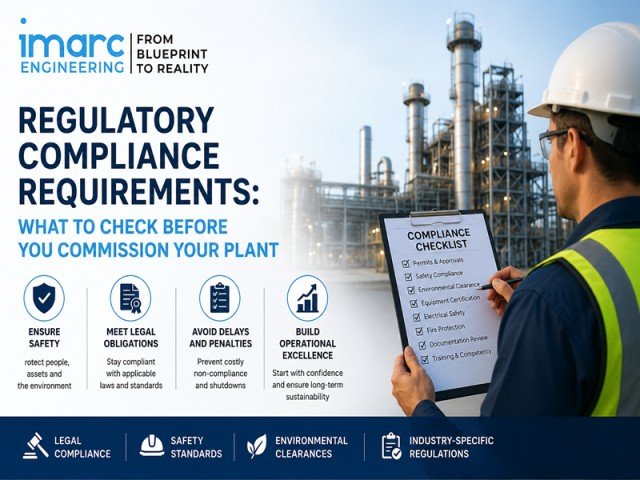
Rather than a long checklist, five questions cover most of what matters: Is the facility legally authorized, with approvals matching the as-built plant? Is the environmental footprint cleared , consents, waste, and pollution controls addressed for the process actually being run? Is the product legally marketable under whatever certification applies? Are safety systems tested end-to-end, not just installed? And can every answer above be demonstrated with a certificate, report, or record on file?
If the honest answer to any of these is “not yet,” that’s a signal to hold commissioning , or at least commercial production , until the gap closes, rather than treating it as something to catch up on later.
How IMARC Engineering Can Help
IMARC Engineering works with manufacturing teams to close exactly this gap between “technically built” and “legally ready to run.” That includes:
- Reviewing a facility against its approved layout, licenses, and permits to catch mismatches before an inspector does
- Mapping which approvals, consents, and certifications actually apply to a specific plant, product, and location
- Running pre-commissioning compliance assessments that flag critical, major, and minor gaps with clear ownership and deadlines
- Coordinating environmental, fire-safety, and product certification requirements alongside construction, not after it
- Organizing the documentation and evidence trail needed to demonstrate compliance when it’s asked for
- Supporting both greenfield projects and brownfield expansions, from design-stage planning through pre-commissioning review
The goal: by the time construction wraps up, regulatory readiness should already be a solved problem, not a new one.
Speak With An Expert: https://www.imarcengineering.com/contact?service=regulatory-compliance-services
Conclusion
A finished plant and a plant that’s legally allowed to produce are not the same milestone, and confusing the two is one of the most expensive mistakes in manufacturing project execution. The fix isn’t more paperwork at the end , it’s asking the readiness questions earlier, running them alongside construction rather than after it, and being able to prove compliance with documentation, not intention. Plants that treat regulatory readiness as a design input, not an afterthought, are the ones that start production on the day they planned to.
Contact Us:
IMARC Engineering
Phone: +91-120-433-0800
Email: sales@imarcengineering.com
India: C-130, Sector 2, Noida, Uttar Pradesh 201301
LinkedIn: https://www.linkedin.com/showcase/imarc-engineering/
About the Author