Pilot Plant Setup, Scale-Up
A process that performs well at laboratory or bench scale does not automatically behave the same way at commercial scale. Heat transfer, mixing efficiency, residence time, raw-material variability, and equipment limitations can change significantly as a process moves toward commercial production. This gap between laboratory performance and commercial-scale behaviour is one of the key reasons manufacturers use pilot plants.
For manufacturers evaluating a new product, process route, or capacity expansion, the real question is rarely “should we build a pilot plant?” It’s usually: what specific technical and commercial uncertainties do we need to resolve before committing capital to a full-scale facility?
This article covers what pilot plant consulting involves, when it’s genuinely needed, what gets evaluated during a trial, and how the resulting data feeds into commercial plant design.
What Pilot Plant Consulting Actually Covers
Pilot plant consulting is not simply building a smaller factory. It’s an engineering exercise designed to generate the data a company needs to make an informed, lower-risk decision about full-scale manufacturing.
A well-run pilot plant design and engineering programme typically moves through these stages:
- Defining the objective – what the pilot needs to prove: feasibility, product quality consistency, throughput potential, or safety behaviour
- Process and pilot design – flow diagrams, material and energy balances, and an operating envelope
- Equipment and technology selection – equipment and configurations that generate scale-up-relevant data, not just equipment that fits a small footprint
- Utility and infrastructure planning – sizing power, steam, compressed air, water, and effluent systems for the trial
- Installation and commissioning – running the pilot as an integrated process, not a collection of standalone equipment
- Trial execution and performance evaluation – running the process and systematically capturing data
- Scale-up translation – converting pilot results into commercial design inputs
Each stage builds on the last. If the pilot objective isn’t defined clearly at the outset, the resulting trials can generate data that doesn’t answer the commercial or engineering questions the business actually needs to resolve.
When a Manufacturing Project Actually Needs a Pilot Plant
Not every project requires one. A pilot plant makes sense when there’s genuine technical or commercial uncertainty that lab-scale data can’t resolve. Common triggers include:
- Introducing a new product or formulation not yet produced beyond the lab
- Adopting a new or unfamiliar process technology
- Switching to a different raw material or feedstock with variable quality
- Modifying an existing process significantly (new catalyst, reaction pathway, or separation method)
- Expanding capacity into a throughput range the process has never been tested at
- Commercializing R&D output for the first time
If none of these apply ,for instance, a well-established process being replicated at a known scale . A pilot plant may add cost without adding much decision-relevant information. The appropriate pilot scale should be determined by the uncertainties that need resolving, not by a fixed percentage of commercial capacity. Good pilot plant engineering consulting means being honest about when a pilot isn’t necessary, not just when it is.
What Gets Evaluated During a Pilot Trial
The value of a pilot trial comes down to what gets measured and how well that data translates to commercial conditions. Typical parameters include:
| Parameter | What It Tells the Manufacturer |
| Yield | Overall process productivity |
| Throughput | Realistic commercial capacity potential |
| Cycle time | Production scheduling implications |
| Product quality consistency | Process reproducibility |
| Temperature and pressure profiles | Heat-transfer and equipment behaviour |
| Energy and water consumption | Utility sizing and operating-cost basis |
| Raw-material variability response | Process robustness |
| Waste and effluent generation | Environmental infrastructure requirements |
| Equipment performance and downtime | Reliability and commercial equipment selection |
| Mass balance closure and material losses | Process efficiency and yield accuracy |
| Process variability across runs | Scale-up risk and control requirements |
Collecting this data without a clear plan for how it will be used is a common weak point in pilot projects. The evaluation stage should be designed around the specific decisions the commercial plant design will depend on , not treated as a generic data-logging exercise.
Pilot Plant vs Lab Scale vs Commercial Plant
- Lab scale proves the chemistry or process concept works under controlled, small-volume conditions.
- Pilot scale helps establish how the process behaves once engineering effects such as heat transfer, mixing, material handling, and equipment constraints become more significant.
- Commercial scale is the full production facility, designed using process-development knowledge, scale-up analysis, pilot data where applicable, and other validated engineering assumptions.
Skipping pilot-scale evaluation can increase scale-up uncertainty when important engineering effects haven’t been adequately characterized at laboratory scale. That doesn’t mean every project needs a pilot stage , but where meaningful uncertainty exists, skipping it usually means carrying that uncertainty into the commercial investment decision instead.
Pilot Evaluation Is Not the Same as Process Validation
This distinction matters, particularly for regulated industries like pharmaceuticals and food processing.
- Pilot plant evaluation asks: can this process work reliably at an intermediate scale, and what does the commercial facility need to look like?
- Process validation asks: does the defined manufacturing process consistently produce output that meets predetermined specifications?
A pilot plant is not automatically a validation facility, and pilot data doesn’t by itself guarantee regulatory approval. For applicable pharmaceutical products, pilot-scale studies can be an important part of a broader process development and validation strategy , but requirements depend on the product, process, and applicable regulations, and shouldn’t be assumed identical across all cases.
Where Pilot Plants Matter Most Across Industries
- Pharmaceuticals & Life Sciences , process development, scale-up, technology transfer, and API/intermediate manufacturing
- Chemicals & Specialty Chemicals , reaction engineering, mixing, heat/mass transfer, separation, and solvent recovery
- Food & Beverage , thermal processing, drying, fermentation, and applicable food-safety standards
- Agrochemicals , formulation, raw-material variability, recovery, and effluent handling
- Advanced Materials & Energy , coating, slurry preparation, mixing, drying, and throughput scale-up
- Industrial Manufacturing , new production processes, surface treatments, and automation changes
Regulatory and Safety Considerations in India
There’s no single, universal pilot-plant approval framework that applies across every industry in India. What applies depends on the process, raw materials, hazardous substances involved, plant location, production capacity, utilities, and waste streams ,and may involve environmental approvals, pollution-control consents, factory and occupational-safety requirements, hazardous-process controls, or product-specific regulations.
Rather than assuming one framework fits every project, the more reliable approach is a regulatory applicability assessment specific to the process, materials and location ,done before finalizing the pilot plant design, not after.
From Pilot Results to Commercial Plant Design
The real value of a pilot programme shows up after the trial ends. A programme that produces a successful batch but no usable engineering data has only partially done its job. Translated correctly, pilot data and deliverables typically feed into:
- Equipment scale-up factors and commercial equipment specifications
- Utility load estimates and sizing basis for the full-scale facility
- Process design basis, including instrumentation and control requirements
- Preliminary plant layout, CAPEX, and OPEX inputs
- Process safety considerations and the defined operating envelope
- Critical process parameters needing tight control at commercial scale
- Technology-transfer documentation for the operations team
Depending on scope, an engagement may also produce a feasibility assessment, trial protocols, and a performance evaluation report , a clear answer to what the engagement is actually expected to deliver, rather than a vague description of “support.”
How IMARC Engineering Can Help
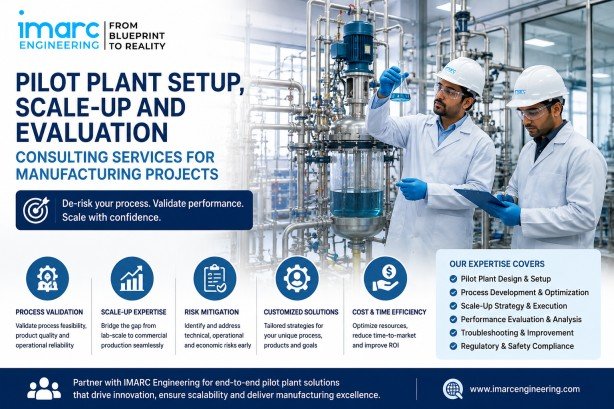
IMARC Engineering supports manufacturing companies through the full pilot-to-commercial journey ,not just the pilot build itself. This includes:
- Defining pilot objectives and the technical uncertainties that need resolving
- Process design, material/energy balance development, and pilot plant design suited to generating scale-up-relevant data
- Utility and infrastructure planning connecting pilot requirements with future commercial-scale needs
- Installation supervision and commissioning support to get the pilot operating as an integrated system
- Structured trial planning and performance evaluation tied to specific commercial-scale decisions
- Translating pilot outcomes into commercial equipment sizing, utility load basis, and process design inputs
- Regulatory applicability assessment specific to the process, industry, and location
Speak With An Expert: https://www.imarcengineering.com/contact?service=pilot-plant-setup-and-evaluation
Conclusion
A pilot plant should not be treated as simply a smaller version of the eventual manufacturing facility. Its value lies in generating reliable process and engineering data that reduces uncertainty around equipment selection, utilities, operating conditions, process economics, and commercial-scale design. The right pilot strategy starts by defining the decisions the programme needs to support, then connects pilot design, trial planning, performance evaluation, and scale-up analysis into a single engineering workflow ,turning the pilot stage into a practical decision-support step between process development and full-scale manufacturing investment.
Contact Us:
IMARC Engineering
Phone: +91-120-433-0800
Email: sales@imarcengineering.com
India: C-130, Sector 2, Noida, Uttar Pradesh 201301
LinkedIn: https://www.linkedin.com/showcase/imarc-engineering/
About the Author