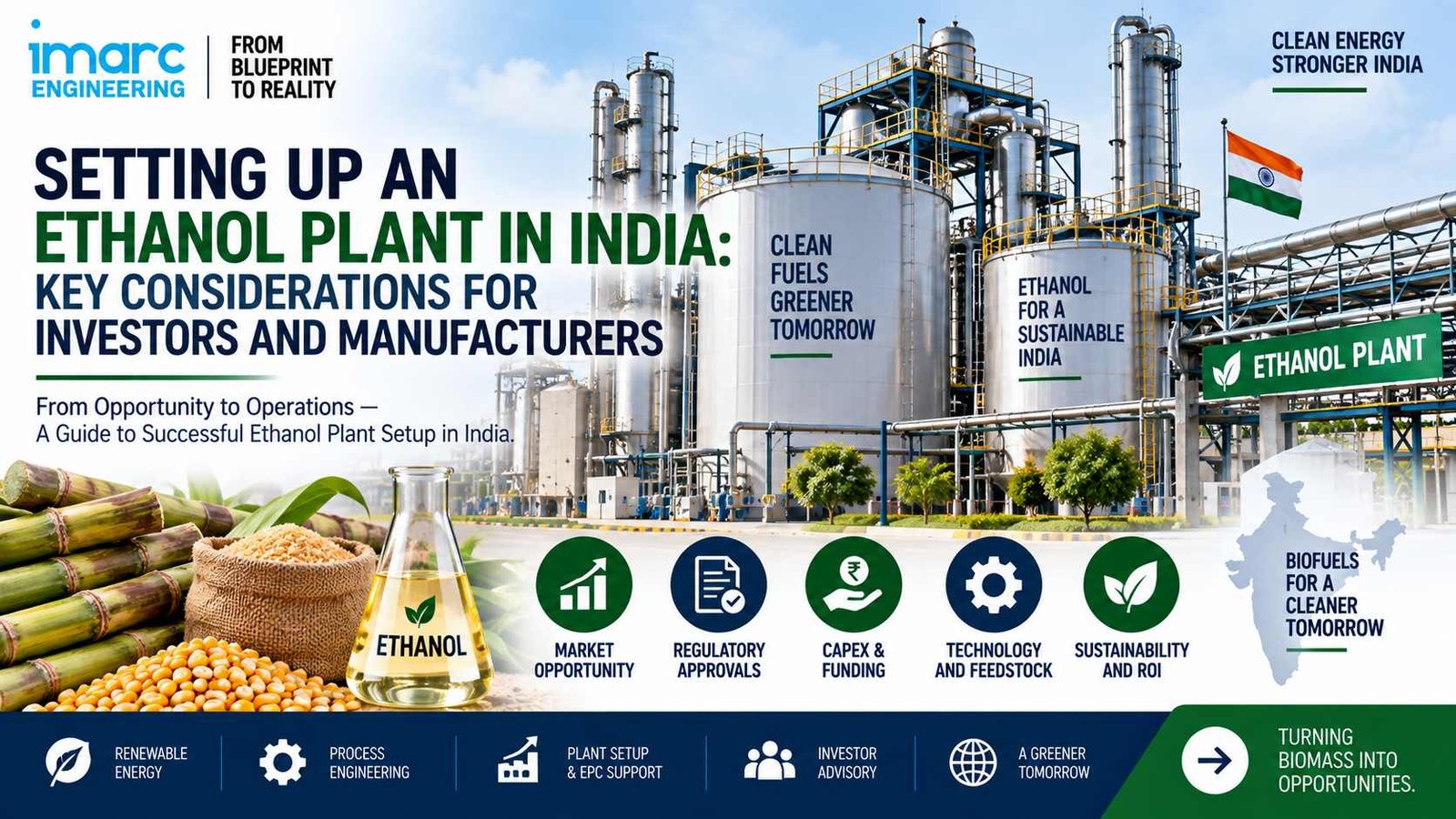
India’s ethanol sector has moved from a policy ambition to a fast-scaling industrial reality, and the questions investors ask before committing capital have grown sharper as a result. A stronger blending mandate, wider feedstock eligibility and rising distillery capacity have created genuine opportunity, but they have also raised the bar for project planning.
Setting up an ethanol plant in India is no longer only a question of choosing between 1G and 2G technology. It is a coordinated engineering, commercial and regulatory exercise spanning feedstock security, site selection, utilities design, environmental compliance, capacity planning and commercial structuring, any one of which can determine whether a project reaches commissioning on schedule.
This article sets out the practical factors that shape a viable ethanol plant setup in India, from feedstock and machinery to approvals and investment planning.
India’s Current Ethanol Landscape
Under the Ethanol Blended Petrol (EBP) Programme, the Government of India advanced its blending target from 2030 to Ethanol Supply Year (ESY) 2025-26, and public sector oil marketing companies achieved 20% blending in petrol during ESY 2025-26, five years ahead of schedule, according to the Press Information Bureau (PIB)
- Blending rose from under 1.5% in 2013-14 to 20% in 2025-26
- Production capacity expanded to approximately 2,000 crore litres by 2026, from around 421 crore litres in 2014
- No government decision has been taken, as of the latest official statements, to raise the target beyond 20%
This confirms a large, functioning market for an ethanol production plant in India, but it does not by itself guarantee offtake, pricing or approval outcomes for any individual project.
Choosing the Right Feedstock and Production Route
Feedstock choice is one of the key decisions shaping downstream requirements for a 1G or 2G ethanol plant, influencing plant location, utility load, process design and environmental management requirements.
- 1G ethanol is produced from sugarcane juice, molasses (B-heavy or C-heavy) or grains such as maize, broken rice and surplus rice, using established fermentation and distillation technology
- 2G ethanol uses agricultural residues and cellulosic biomass such as rice straw, wheat straw and bagasse, requiring pretreatment and enzymatic hydrolysis that 1G plants do not need
- Sugarcane and molasses-based routes depend on crushing-season supply and mill co-location; grain-based routes offer more year-round flexibility but compete with food and feed demand
- 2G feedstock availability depends heavily on regional crop-residue collection logistics and aggregation infrastructure
Reliable feedstock availability, not just theoretical regional supply, should be validated through supplier agreements, seasonal variation analysis and realistic logistics planning before a technology or capacity decision is finalised.
Selecting the Right Location for an Ethanol Plant
Location decisions for an ethanol plant carry more weight than in many other manufacturing sectors because feedstock bulk, water demand and effluent management are all site-dependent.
- Proximity to feedstock sources, reducing transport cost and spoilage risk
- Road and rail connectivity for inbound feedstock and outbound dispatch
- Assured water and power availability, and fuel access for steam generation
- Land suitable for effluent treatment, storage and future expansion
- Distance from ecologically sensitive zones and applicable siting norms
A structured location study that weighs these factors against multiple candidate sites, rather than defaulting to available land, is where IMARC Engineering’s Location Analysis & Site Selection service is typically engaged, since site errors are costly to correct once construction begins.
Capacity and Technology Planning
Plant capacity should be derived from validated feedstock availability and realistic utilisation assumptions, not from equipment supplier catalogues or aspirational production targets.
- Assess feedstock supply across a full crop or procurement cycle, not peak-season figures alone
- Model utilisation realistically, allowing for maintenance, feedstock variability and startup ramp-up
- Size storage for both incoming feedstock and finished ethanol to smooth supply and dispatch variability
- Build in space and utility headroom for future expansion
Technology selection should follow the same discipline: energy efficiency, reliability, automation, vendor track record and scale-up capability matter more than headline throughput claims, and should be evaluated against the specific feedstock and capacity chosen.
Key Equipment and Plant Infrastructure
An ethanol manufacturing plant integrates several interdependent systems, and gaps in any one of them constrain the whole facility.
- Feedstock receiving, handling and preparation
- Fermentation vessels and associated cooling
- Distillation and rectification columns, plus molecular sieve dehydration
- Heat exchangers, boilers and steam distribution
- Cooling towers and process cooling systems
- Storage tanks for feedstock, in-process material and finished ethanol
- Process pumps, electrical distribution and automation — the ethanol plant machinery matched to feedstock and capacity
These systems must be engineered together, since undersized utilities or storage frequently become the actual constraint on output, even when core equipment is correctly specified.
Utilities, Water and Energy Planning
Utility systems are among the most underestimated ethanol plant requirements at the concept stage, yet they materially affect both CAPEX and ongoing operating cost.
- Water supply, treatment and recycling for fermentation, cooling and cleaning demand
- Power supply with backup for continuous operations
- Steam generation and distribution for distillation and dehydration
- Cooling water and compressed air for instrumentation and process control
- Wastewater treatment integrated with, not added after, process design
- Redundancy in critical utilities to avoid production interruption
Utilities planning is best treated as an integrated engineering exercise alongside process design, which is the basis of IMARC Engineering’s Utilities Planning service for industrial projects.
Environmental Management and Regulatory Requirements
Ethanol production generates high-strength effluent, and environmental planning should begin early rather than being treated as a later-stage formality.
- Spent wash and effluent management appropriate to feedstock used
- Water recycling and reuse to reduce fresh-water dependence
- Zero Liquid Discharge (ZLD) systems, set out in CPCB’s charter for molasses-based distilleries, which may apply depending on feedstock, location and state norms
- Air emissions control, waste management and environmental monitoring appropriate to plant scale
Depending on project characteristics, location and applicable regulations, ethanol plant approvals can involve Consent to Establish and Consent to Operate from the State Pollution Control Board, Environmental Clearance where applicable, and other permissions under the Water Act and Air Act. Requirements vary by state and scale, so they should be mapped for the specific project rather than assumed from general practice.
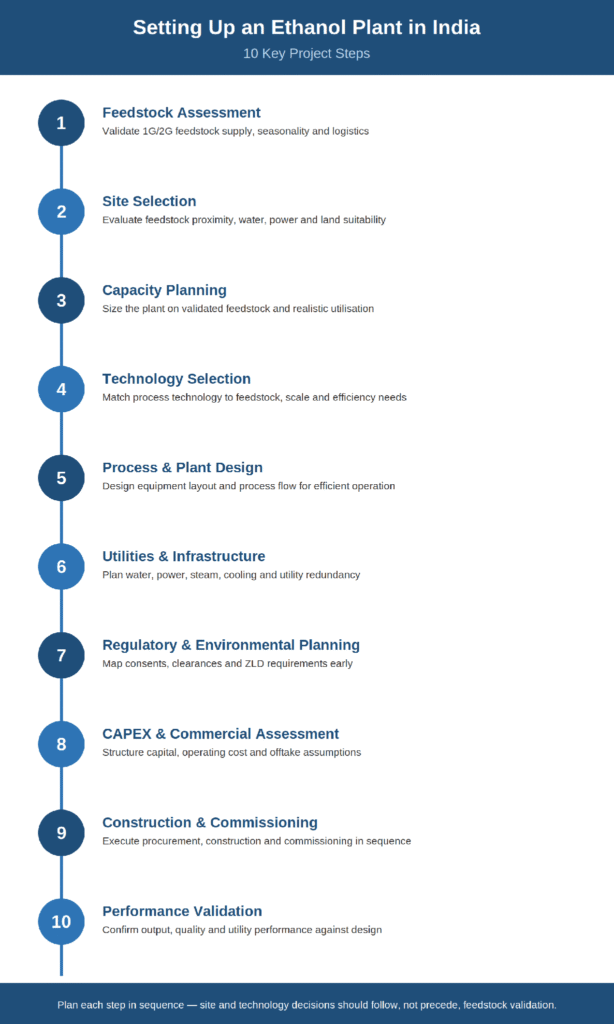
Setting Up an Ethanol Plant in India: 10 Key Project Steps
CAPEX, OPEX and Commercial Planning
Specific project-cost, ROI or payback figures are not meaningful outside a defined feedstock, capacity, technology and location, so credible ethanol plant investment planning focuses on the components that drive them.
CAPEX considerations: land and civil works, process equipment, utilities infrastructure, storage, effluent treatment and ZLD where required, electrical and automation, and engineering, installation and commissioning.
OPEX considerations: feedstock procurement and its seasonal variability, energy and steam, water and chemicals, labour and maintenance, logistics, and waste and effluent management.
Commercial planning should also address offtake arrangements with oil marketing companies, working capital across the procurement cycle, and realistic assumptions rather than best-case projections. IMARC Engineering’s CAPEX/OPEX Planning Support service is built around this kind of component-level cost structuring.
Practical Project Execution Roadmap
A disciplined sequence, beginning with an ethanol plant feasibility study, reduces rework and approval delays:
Feasibility assessment → Feedstock study → Site selection → Technology selection → Process and plant design → Utilities and environmental planning → Regulatory approvals → CAPEX/commercial assessment → Procurement → Construction → Commissioning → Performance validation
Executing these stages out of order, most commonly finalising a site or technology before the feedstock and regulatory assessment, is one of the most frequent sources of project delay.
Common Mistakes When Setting Up an Ethanol Plant
- Selecting a site before completing a feedstock availability study
- Choosing technology primarily on quoted price rather than reliability and fit
- Underestimating utility loads, particularly water and steam
- Treating environmental and ZLD planning as a late-stage formality
- Using optimistic utilisation assumptions unsupported by feedstock data
- Overlooking feedstock and product logistics costs in project economics
- Assuming government schemes, subsidies or offtake support apply automatically to every project
How IMARC Engineering Supports Ethanol Plant Projects
IMARC Engineering supports ethanol plant investors and manufacturers across the technical and regulatory areas that determine project viability:
- Location Analysis & Site Selection for feedstock-aligned sites
- Plant Layout & Process Flow Design for efficient process flow
- Utilities Planning for water, power, steam and cooling
- CAPEX/OPEX Planning Support for component-level cost structuring
- Regulatory Compliance support for consents and clearances
- Turnkey Project Management for coordinated ethanol plant project management
- Technical Due Diligence for investors evaluating proposals
This support is advisory and technical; it does not guarantee approvals, outcomes or returns, which depend on project-specific factors and the decisions of the relevant authorities.
Talk to IMARC Engineering about your ethanol plant project requirements and get practical support for planning and execution: https://www.imarcengineering.com/contact-us
Conclusion
Setting up an ethanol plant in India involves interdependent decisions across feedstock, location, technology, utilities, environmental compliance and commercial structuring. None can be finalised in isolation without risking rework, delay or cost overrun later in the project. A project that sequences feasibility, feedstock validation, site selection, design and regulatory planning in the right order, with realistic assumptions at each stage, is better positioned to reach commissioning without avoidable setbacks.
For investors and manufacturers evaluating an ethanol plant project in India, IMARC Engineering can support the feasibility, site selection, utilities, cost planning and regulatory compliance work needed to plan the project on a sound technical and commercial footing. Contact IMARC Engineering to discuss your ethanol plant project requirements.
Contact Us:
IMARC Engineering
Phone: +91-120-433-0800
Email: sales@imarcengineering.com
India: C-130, Sector 2, Noida, Uttar Pradesh 201301
LinkedIn: https://www.linkedin.com/showcase/imarc-engineering/
About the Author