Supplier Qualification in Manufacturing
Most procurement teams eventually face the same question. A critical component is running well with one approved supplier, and someone asks whether that is too risky. The usual answer is “qualify three suppliers.” That number sounds sensible, but no standard requires it, and following it blindly can waste money or create false comfort.
The better question is how many qualified and realistically usable sources you need to keep a critical component available if your primary supplier fails. The right number depends on supply risk, switching time, qualification requirements, capacity, and supplier independence. This guide explains how to assess these factors and determine the appropriate sourcing strategy for your own manufacturing plant.
A Practical Starting Point
For many critical components, one primary supplier plus at least one qualified alternative is a sensible starting point for supplier sourcing for critical components. Where disruption consequences are severe and the market allows it, two active suppliers may provide stronger resilience. Three or more may be justified when capacity, geographic or market concentration adds risk. The correct number still depends on recovery time, qualification burden, supplier independence and the cost of failure.
There Is No Universal Supplier Count
ISO 9001 does not prescribe a fixed number of suppliers. Its supplier controls centre on evaluating and monitoring external providers and applying risk-based thinking to quality and supply decisions. IATF 16949 is more specific for automotive: supplier monitoring covers conformity, disruptions at the receiving plant and delivery performance. NIST supply-chain risk guidance also highlights the importance of understanding dependencies beyond the direct supplier, including relationships further upstream.
A practical principle follows: the right number is the smallest supplier base that provides acceptable continuity and competitive tension without unnecessary qualification effort.
Single, Dual and Multiple Sourcing Compared
Single qualified source
Reasonable when real alternatives do not exist, tooling is supplier-specific or switching is extremely difficult. Single sourcing is not poor procurement; unmanaged single-source dependency is.
- Reduce exposure through safety stock, contractual commitments and contingency plans.
Primary supplier plus qualified backup
- One supplier receives most of the volume.
- A second remains qualified and commercially ready.
- Suits critical components where alternatives exist and switching takes time.
Dual active sourcing
Both suppliers deliver regularly, for example in a 70:30 split, so the second stays familiar with your part and keeps proving its capacity. ASCM recommends considering at least two active suppliers for critical components, with backups where appropriate. That is a resilience strategy, not a universal requirement.
Three or more sources
Justified by high volumes, severe disruption impact, volatile demand or regional diversification. Each additional supplier brings another audit, quality agreement, inspection routine and relationship to manage.
Effective Redundancy Matters More Than Supplier Count
A supplier counts towards resilience only if it is:
- technically qualified and commercially viable;
- able to supply your required volume at the required quality;
- able to deliver within an acceptable lead time;
- sufficiently independent from the primary source.
Two names on an approved vendor list do not necessarily equal two usable sources.
Ten Factors That Should Decide Your Supplier Count
- Consequence of failure: What happens if delivery stops for 30 days? Line stoppage, penalties or recalls strengthen the case for redundancy.
- Switching time: How long would it take to qualify, validate, tool and ramp up an alternative? Compare that with your inventory cover and the maximum downtime your plant can tolerate.
- Inventory cover: How long can production continue if the primary supplier stops shipping? Ten days of stock and ten months of stock call for very different strategies.
- Replaceability: How many suppliers can genuinely make this part to your specification?
- Qualification burden: Samples, tooling, process validation, audits and customer approval all take time and money.
- Capacity: Can a backup absorb your demand while serving its other customers?
- Geography: Do suppliers share the same region, port or logistics corridor?
- Upstream dependency: Do candidates rely on the same raw-material producer or sub-supplier?
- Regulatory load: Regulated sectors need documented, risk-based qualification for each added supplier.
- Total cost: Compare qualification and maintenance cost against the cost of supply failure.
Two Suppliers Are Not Always Two Independent Sources
Three suppliers in the same industrial cluster may share a port, power grid and raw-material source. Two component makers may also buy from one upstream supplier. That is supplier diversification without risk diversification.
Measure independence at the relevant tier, not only Tier 1. NIST recommends mapping Tier 2 and Tier 3 relationships to expose hidden concentration.
View Related Insight: https://www.imarcengineering.com/blog/how-strategic-sourcing-helps-manufacturers-in-india
Capacity, Minimum Orders and Allocation
Imagine Supplier A runs at 80 percent utilisation and Supplier B at 90 percent. You have two suppliers on paper but almost no usable redundancy. Ask whether the backup can absorb your volume. Check also whether its minimum order quantity is commercially practical, and whether your business is large enough to be prioritised when shortages force the supplier to allocate output to its largest customers.
Qualified Backup Versus Active Supplier
A qualified backup has passed technical, quality and commercial evaluation but may receive little volume. After three years without orders, its equipment, available capacity, sub-suppliers, certifications, processes or commercial terms may have changed.
Schedule periodic revalidation and performance reviews, consistent with ISO’s emphasis on monitoring and re-evaluating suppliers.
Worked Example: A Custom Machined Housing
A plant buys a custom housing from one supplier. A stoppage costs ₹20 lakh per day. Management estimates a 10 percent annual chance of a ten-day disruption.
- Expected annual exposure: ₹20 lakh × 10 days × 10% = ₹20 lakh
- Second-supplier qualification: ₹8 lakh initially, ₹2 lakh yearly
This exposure is a starting point for the business case. If qualification and maintenance cost substantially less than the disruption exposure avoided, a second supplier may be economically attractive. Inventory, insurance, contractual recovery, price premiums and likely disruption length should also be weighed. All figures are illustrative.
Measure Recovery Time, Not Just Supplier Count
Ask how long your organisation would need to receive conforming material if the primary supplier failed today. No generic industry timeframe answers this; it depends on the backup’s status:
- Qualified backup with spare capacity: potentially the fastest recovery.
- Qualified backup needing ramp-up: depends on capacity and production readiness.
- Capable but unqualified supplier: validation can materially extend recovery.
- New supplier needing tooling: recovery may be substantially longer.
Compare your own recovery time with your inventory cover.
A Simple Way to Choose Your Sourcing Model
Rate each component low, medium or high on production impact, replacement availability, qualification time, supplier-market size and switching cost. Then match the result:
- Low risk: one qualified supplier with monitoring may suffice.
- Medium risk: primary supplier plus qualified backup.
- High risk: dual active sourcing or several qualified sources.
- Extreme risk: multiple sources plus inventory and contingency planning.
This is a practical framework, not a regulatory rule.
When to Qualify a Second or Third Supplier
- Switching would take longer than your inventory cover.
- A single failure would stop production or breach customer commitments.
- The current supplier is near capacity, or you plan expansion.
- The supplier’s financial or geographic risk is rising.
- Alternatives exist and qualification cost is modest relative to exposure.
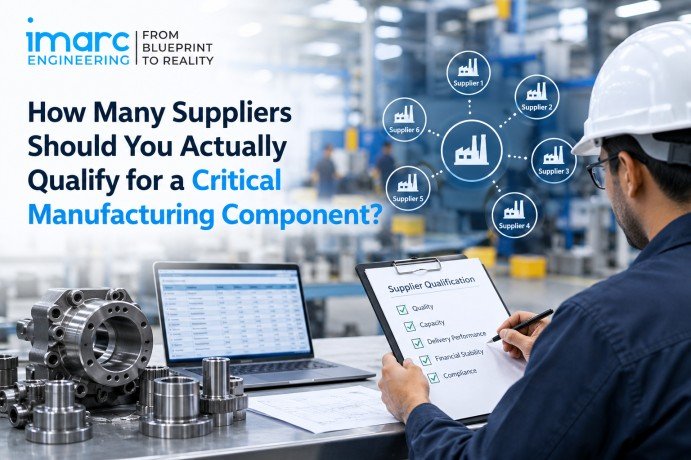
What to Evaluate Before Approving a Backup
- Technical: specification compliance, process capability, tolerances, testing facilities.
- Quality: QMS certification, rejection history, traceability, change control.
- Capacity: current utilisation, bottleneck equipment, expansion ability.
- Commercial: unit cost, minimum order quantity, tooling cost, price escalation.
- Risk: sub-supplier dependency, financial stability, continuity planning.
Illustrative Supplier Qualification Funnel
Qualification should narrow gradually. An illustrative path for a critical component:
- Potential suppliers identified: 15–20
- Initial screening: 8–10
- Technically capable: 4–6
- Commercially viable: 3–4
- Fully qualified: 2–3
- Active suppliers: 1–2
The starting pool should reflect market availability, component complexity and supplier concentration. These numbers are not a recommended industry ratio.
How Sector Changes the Answer
- Pharmaceuticals: the FDA expects risk-based qualification of critical or high-risk materials, so fewer, deeply qualified suppliers with strong quality controls are common.
- Automotive: IATF requirements make delivery and disruption performance central, so dual sourcing or contingency plans often suit demanding customers.
- Electronics: obsolescence and concentrated upstream supply can increase the value of qualified alternatives.
- Chemicals: specialised specifications and process compatibility can limit technically acceptable suppliers.
- General industrial: standardised specifications may allow more flexibility.
Common Mistakes to Avoid
- Treating an approved vendor list entry as ready capacity.
- Ignoring shared upstream dependencies.
- Comparing qualification cost only with unit price.
- Approving a backup once and never reviewing it.
- Qualifying suppliers without testing production volumes.
- Assuming a standard requires three suppliers.
How IMARC Engineering Can Help
Manufacturers often hold supplier names but lack confidence that those suppliers can meet the required specification, quality, capacity, delivery and commercial conditions. IMARC Engineering closes that gap. Our team identifies and maps suppliers, screens them technically and commercially, and supports supplier assessment and qualification, so your decision rests on verified capability rather than claims. Whether planning a new plant, expanding capacity or reducing single-source dependency, we help you build a resilient supplier base. Speak to us about your critical components.
Speak With An Expert: https://www.imarcengineering.com/contact?service=sourcing
Conclusion
There is no universal number of suppliers for a critical component. The right answer depends on failure impact, switching time, inventory cover, capacity, supplier independence and qualification effort. Aim for enough effectively redundant, qualified sources to remove single points of failure, and no more than your team can manage well. Measure recovery time, test backup capacity and review readiness regularly. The objective is not maximum supplier count; it is resilient, qualified and commercially viable sourcing.
Contact Us:
IMARC Engineering
Phone: +91-120-433-0800
Email: sales@imarcengineering.com
India: C-130, Sector 2, Noida, Uttar Pradesh 201301
LinkedIn: https://www.linkedin.com/showcase/imarc-engineering/
About the Author