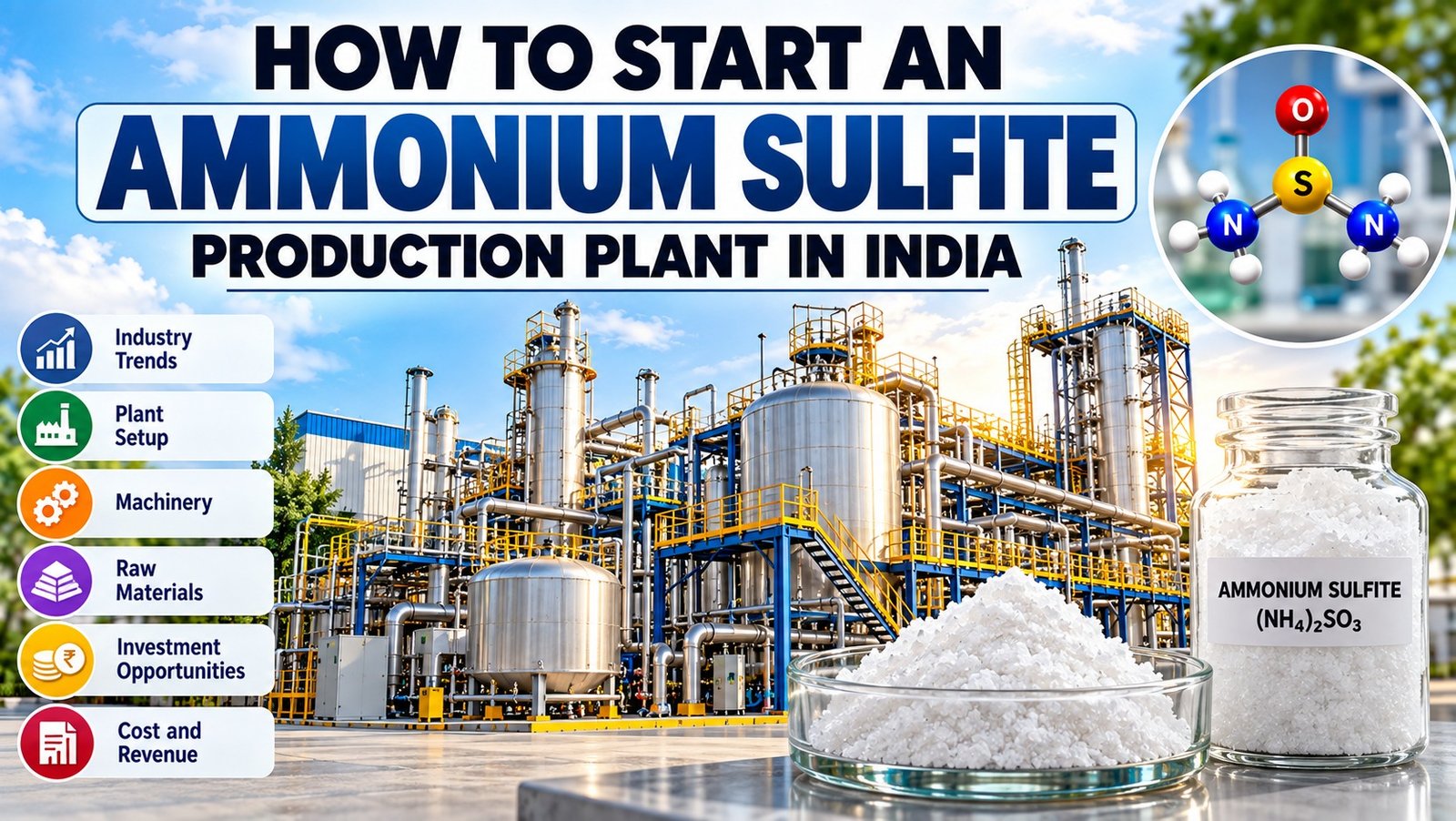
Setting up an ammonium sulfite production plant in India presents a compelling investment case, driven by demand from the pulp & paper, water treatment, chemical manufacturing, textile processing, food processing, and environmental management industries. Rising environmental regulations on industrial emissions and wastewater discharge are encouraging wider adoption of sulfite-based treatment chemicals, particularly in power generation, chemicals, and heavy manufacturing, making ammonium sulfite an increasingly important industrial intermediate for India’s economy.
India’s urbanisation trends, expanding industrial infrastructure, and the government’s Make in India initiative have positioned states such as Gujarat and Maharashtra as attractive hubs for chemical production. With Asia-Pacific already accounting for over 40.0% of the global ammonium sulfite market share, India is well placed within this regional demand base, making the country a strategically sound location for an ammonium sulfite production plant.
An ammonium sulfite production plant in India benefits from strong regional demand, policy support for domestic chemical production, and consistent end-use across water treatment, pulp & paper, and chemical processing sectors. With gross margins typically ranging between 22-30% and net margins of 12-18%, the investment case is reinforced by Asia-Pacific’s dominant market share and a scalable, break-even-viable production model.
What is Ammonium Sulfite?
Ammonium sulfite is an inorganic salt with the chemical formula (NH₄)₂SO₃. This odorless, colorless to yellowish crystalline solid acts as a strong reducing agent, and its unique chemical properties make it highly versatile across multiple industries. In cosmetics, it is widely utilized as an active ingredient in hair waving and permanent straightening solutions. In photography, it functions as a preservative and reducing agent to maintain developing chemicals. The food industry employs it to create caramel coloring, while various manufacturing sectors use it to produce specialty dyes and metal lubricants.
Ammonium sulfite is produced through absorption of sulfur dioxide in aqueous ammonia, followed by reaction control, concentration, filtration, and packaging. An ammonium sulfite production plant primarily serves the pulp & paper, water treatment, chemical manufacturing, textile processing, food processing, and environmental management industries.
Cost of Setting Up an Ammonium Sulfite Production Plant in India
The cost of setting up an ammonium sulfite production plant in India depends on capacity, technology, location, automation, and regulatory compliance.
1. Capital Expenditure (CapEx)
Land and site development form a foundational part of the investment, with options including industrial estates and SEZs that offer supporting infrastructure for an ammonium sulfite production plant. Costs here typically cover land registration, boundary development, and related site preparation. Civil works and construction costs follow, covering the production shed, quality control lab, raw material and finished goods storage, and the administrative block, all planned with future expansion in mind.
Machinery represents the largest share of capital expenditure, and high-quality, corrosion-resistant equipment is essential given the handling of ammonia and sulfur dioxide. Key machinery required includes:
- Ammonia storage tanks
- Sulfur dioxide handling systems
- Absorption reactors
- Mixing vessels
- Filtration units
- Concentration systems
- Storage tanks
- Emission control systems
- Packaging machines
Other capital costs include pre-operative expenses, commissioning costs, and installation charges associated with bringing the plant to operational readiness.
Request a Sample Report for In-Depth Market Insights: https://www.imarcgroup.com/ammonium-sulfite-manufacturing-plant-project-report/requestsample
2. Operational Expenditure (OpEx)
Raw material cost is the single largest component of OpEx for an ammonium sulfite production plant, accounting for approximately 55-65% of total operating expenses, driven primarily by ammonia consumption. Core raw materials include ammonia, sulfur dioxide, and water. Securing long-term supplier contracts for ammonia and sulfur dioxide helps stabilize pricing and ensures a consistent raw material supply.
Utility costs – covering electricity, water, and steam – account for 7-11% of OpEx. Other operating costs include transportation, packaging, salaries and wages, depreciation, taxes, and repairs and maintenance. By the fifth year of operations, total operational costs are projected to increase substantially due to inflation, market fluctuations, supply chain disruptions, and rising global demand.
3. Plant Capacity
The proposed ammonium sulfite production plant is designed around an annual production capacity of 8,000 MT, which enables economies of scale while maintaining operational flexibility. Capacity can be customized to individual investor requirements, and profitability generally improves as capacity utilisation increases.
4. Profit Margins and Financial Projections
Financial projections for an ammonium sulfite production plant are built on realistic assumptions covering capital investment, operating costs, capacity utilisation, pricing trends, and demand outlook, and typically include liquidity analysis, profitability analysis, payback period, net present value (NPV), and internal rate of return (IRR). Gross profit margins for an ammonium sulfite production plant generally range between 22-30%, while net profit margins range between 12-18%, supported by stable demand and value-added applications.
Why Set Up an Ammonium Sulfite Plant in India?
Important Industrial Chemical Intermediate: Ammonium sulfite is widely used in water treatment, flue gas desulfurization systems, chemical processing, pulp & paper operations, and specialty chemical synthesis, positioning it as a valuable industrial reagent across multiple process industries relevant to India’s expanding production base.
Dominant Regional Demand Base: Asia-Pacific accounts for over 40.0% of the global ammonium sulfite market share, placing an India-based ammonium sulfite production plant within the world’s largest consuming region.
Alignment with Environmental and Industrial Trends: Growing emphasis on emission control, wastewater treatment, industrial process optimization, and sustainable production practices is supporting demand for sulfur-based treatment chemicals, including ammonium sulfite, across various industrial sectors.
Policy and Environmental Compliance Support: Stricter environmental regulations governing air emissions, industrial effluents, and resource efficiency are encouraging investments in treatment chemicals and pollution-control technologies, indirectly supporting demand for ammonium sulfite-based solutions.
Moderate but Justifiable Entry Barriers: Production requires controlled handling of ammonia and sulfur dioxide, process safety management, corrosion-resistant equipment, and compliance with environmental regulations – requirements that favor experienced producers with strong technical capabilities and limit undisciplined competition.
Localization and Supply Chain Reliability: Industrial consumers increasingly prefer dependable regional suppliers capable of ensuring consistent product quality, regulatory compliance, timely deliveries, and stable pricing, creating opportunities for producers with efficient operations and secure raw material sourcing strategies.
Production Process – Step by Step
The ammonium sulfite production process uses absorption of sulfur dioxide in aqueous ammonia as the primary production method.
- Sulfur Dioxide Absorption: Sulfur dioxide gas is absorbed into aqueous ammonia using absorption reactors.
- Reaction Control: The reaction between sulfur dioxide and ammonia is closely controlled to achieve the desired ammonium sulfite formulation.
- Mixing: The reacted solution is processed through mixing vessels to ensure uniform composition.
- Concentration: The solution is passed through concentration systems to achieve the required product strength.
- Filtration: Filtration units remove impurities and solid residues from the concentrated product.
- Emission Control: Emission control systems manage process off-gases to ensure compliance with environmental standards.
- Storage: The finished product is held in storage tanks prior to packaging.
- Packaging and Dispatch: The ammonium sulfite is packaged using dedicated packaging machines and dispatched to pulp & paper, water treatment, chemical manufacturing, textile processing, food processing, and environmental management end users.
Key Applications
Ammonium sulfite serves a range of industrial applications centered on its properties as a reducing agent and chemical intermediate.
- Fertilizers: Used as a source of nitrogen and sulfur in liquid fertilizer formulations.
- Water Treatment: Applied for oxygen scavenging and dechlorination in industrial water systems.
- Chemical Processing: Functions as a reducing agent and intermediate in sulfite-based chemical synthesis.
- Pulp & Paper: Used as a chemical additive for pulping, bleaching, and process water treatment.
Leading Producers
Leading producers in the global ammonium sulfite industry include several multinational companies with extensive production capacities and diverse application portfolios.
- Shandong Tiantai Chemical Co., Ltd.
- Shouguang Luke Chemical Co., Ltd.
- Guangzhou Tinci Materials Technology Co., Ltd.
Timeline to Start the Plant
- Feasibility study and project report preparation
- Land acquisition and site development
- Regulatory approvals and environmental clearances
- Factory licence and fire safety compliance
- Machinery procurement and installation
- Raw material supplier agreements and supply chain setup
- Trial production and quality testing
- Commercial production launch
Licences and Regulatory Requirements
Starting an ammonium sulfite production unit in India requires several approvals:
- Business registration (Proprietorship, LLP, or Pvt Ltd)
- Factory Licence under the Factories Act
- Environmental Clearance from State Pollution Control Board
- GST Registration
- Fire Safety NOC
- Hazardous/Chemical compliance (given the handling of ammonia and sulfur dioxide)
- Effluent Treatment Plant (ETP) operational clearance
- Occupational Health and Safety compliance
Key Challenges to Consider
High Capital Requirements: Land acquisition, construction, corrosion-resistant equipment procurement, installation, and initial working capital together demand significant upfront investment for an ammonium sulfite production plant.
Raw Material Price Volatility: Ammonia, sulfur dioxide, and water are subject to price fluctuations, making long-term supplier contracts important for cost stability.
Regulatory Compliance: Controlled handling of ammonia and sulfur dioxide requires process safety management and strict adherence to environmental and emission-control regulations.
Technology or Innovation Pressure: Producers are expected to focus on high-purity grades, stable aqueous solutions, and customized formulations to meet evolving end-user requirements.
Competition: Established players such as Shandong Tiantai Chemical Co., Ltd., Shouguang Luke Chemical Co., Ltd., and Guangzhou Tinci Materials Technology Co., Ltd. represent significant competition in the global ammonium sulfite market.
Skilled Manpower: Recruiting and training skilled labour for safe handling of hazardous raw materials and precise reaction control is essential to maintaining consistent production quality.
Frequently Asked Questions
1. How much does it cost to set up an ammonium sulfite production plant in India?
Costs depend on capacity, technology, location, and automation level, covering land, civil works, machinery, and other capital costs.
2. Is ammonium sulfite production profitable in India in 2026?
Profitability depends on market demand, production efficiency, and pricing strategy, with gross margins of 22-30% and net margins of 12-18% typical for the sector.
3. What machinery is required for an ammonium sulfite plant in India?
Key machinery includes ammonia storage tanks, sulfur dioxide handling systems, absorption reactors, mixing vessels, filtration units, concentration systems, and emission control systems.
4. What licences and approvals are required to start an ammonium sulfite plant in India?
Requirements include business registration, factory licence, environmental clearance, GST registration, and fire safety NOC.
5. What raw materials are needed for ammonium sulfite production?
Ammonia, sulfur dioxide, and water are the core raw materials required.
6. What are the environmental compliance requirements for an ammonium sulfite plant in India?
Plants require Environmental Clearance from the State Pollution Control Board and an operational Effluent Treatment Plant (ETP), given the handling of ammonia and sulfur dioxide.
7. What is the best location to set up an ammonium sulfite plant in India?
Locations with strong chemical production infrastructure, such as Gujarat and Maharashtra, offer supply chain and regulatory advantages.
8. What is the break-even period for this type of plant in India?
Break-even depends on investment size, capacity utilisation, and operational efficiency, assessed through the project’s payback period and NPV analysis.
9. What government incentives are available for producers in India?
Incentives may include capital subsidies, tax exemptions, reduced utility tariffs, and export benefits under applicable industrial policies.
Key Takeaways for Investors
An ammonium sulfite production plant in India offers a strong investment opportunity backed by consistent demand across pulp & paper, water treatment, chemical manufacturing, textile processing, food processing, and environmental management segments. Financial viability holds across plant capacities, with an 8,000 MT annual capacity model demonstrating gross margins of 22-30% and net margins of 12-18%. With Asia-Pacific already commanding over 40.0% of global market share and rising environmental regulations on industrial emissions and wastewater discharge driving continued adoption of sulfite-based treatment chemicals, demand for domestic ammonium sulfite production capacity is set to remain sustainable over the long term.
About the Author