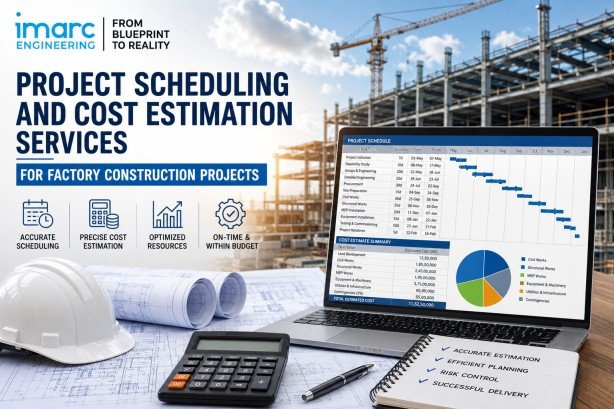
Project Scheduling and Cost Estimation Services
If you’re planning a new factory or expanding an existing one, two questions sit ahead of almost everything else: what will this actually cost, and how long will it really take before production can start? Both sound simple. In practice, factory projects tend to go off track not because nobody built a schedule or nobody wrote a budget, but because the two were built separately, updated separately, and never talked to each other.
Why Factory Projects Need Integrated Scheduling and Cost Estimation
Schedule and cost are connected, even when documented separately. A design change during detailed engineering doesn’t just cost money in rework; it can push back every procurement package that depended on the design being frozen. A delay in equipment delivery doesn’t just extend the schedule; it adds site supervision, storage, and financing costs. Project Scheduling and Cost Estimation consulting helps businesses manage these interdependencies by keeping the schedule and cost plan aligned, updated, and maintained together rather than as two separate documents.
Why Factories Aren’t Just Bigger Buildings
For many conventional building projects, construction completion is a major indicator of readiness. A factory is different . A factory isn’t. It can be structurally finished and handed over while still months from production readiness, because that depends on far more than the building itself:
- Process equipment procurement and installation
- Utility systems (compressed air, steam, chilled water, power)
- Electrical infrastructure and automation
- Piping, instrumentation, and controls
- Statutory and factory-specific approvals
- Testing, commissioning, and trial production
This is why factory scheduling needs to be treated as its own discipline, not a scaled-up version of building construction planning.
What a Reliable Factory Construction Schedule Looks Like
A schedule built for decision-making, not just a client presentation
- Executive Milestones-The handful of dated leadership tracks: engineering freeze, procurement completion, civil handover, equipment installation complete, utilities ready, trial production, and commercial production start.
- Work-Package Level-Civil, structural, MEP, process equipment, utilities, and electrical, each tracked as its own stream with dependencies on the others.
- Activity Level-The detailed sequence within each package , for equipment installation, for example: delivery, inspection, foundation readiness, positioning, alignment, piping tie-in, electrical connection, and testing.
- Critical Path Analysis- Depending on the project, the critical path may run through civil works, engineering, long-lead equipment procurement, utilities, installation, or commissioning , or some combination of these. It’s shaped by site conditions, foundation complexity, and sequencing, not by a fixed rule. Identifying it early helps the project team focus attention where delays will have the greatest impact.
Long-Lead Equipment and Procurement Scheduling
Transformers, chillers, boilers, compressors, production lines, and large electrical panels can have lead times or can have lead times ranging from several weeks to several months . Because they’re ordered early and arrive late, it’s easy to lose track of them until their absence stalls a crew that’s otherwise ready to install them. A disciplined approach tracks each item through its full cycle:
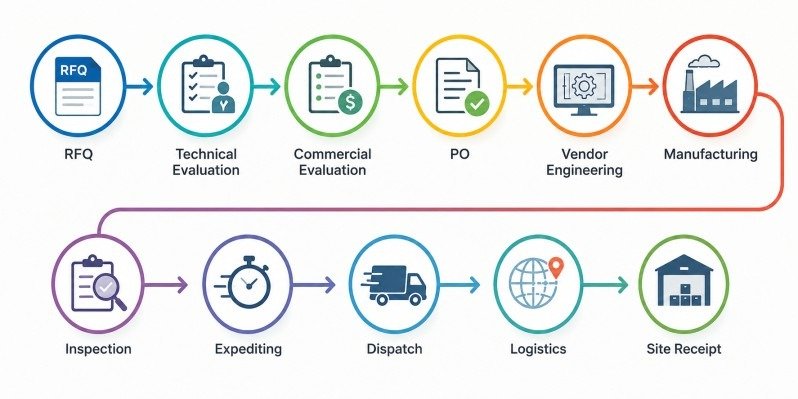
Flagging slippage during vendor engineering or manufacturing ,while there’s still time to expedite or resequence other work ,is far more useful than discovering the delay when the truck doesn’t arrive.
Factory Construction Cost Estimation by Project Stage
A common mistake is presenting a single cost figure as though it’s equally reliable at every stage of a project. It isn’t. Estimate detail should increase as project definition matures:
- Early concept , used for investment screening, built mostly on benchmarks and assumptions
- Feasibility , refined enough to support a preliminary go/no-go decision
- Design development , detailed enough to seek budget approval
- Detailed engineering , precise enough to control tendering and contracts
- Execution , a definitive, quantity-based estimate used for ongoing cost control
Direct, Indirect and Project Risk Costs
Estimates should separate direct costs (materials, equipment, labour, installation) from indirect costs (site management, temporary facilities, QA/QC, project management), and from contingency and escalation ,which aren’t the same thing. Escalation covers expected price movement over time. Contingency provides an allowance for project uncertainty and risk, and how it’s calculated depends on the estimating methodology and risk framework in use. Keeping these separate gives a factory owner a clearer picture of where their financial headroom actually sits.
Schedule-Cost Integration
The most useful project-control tool is a cost-loaded schedule: each work package carries its budget, planned finish date, actual finish date, and cost status side by side. This lets an owner answer a question a standalone budget or standalone schedule can’t: are we spending in line with the progress we’ve actually made?
Resource-Loaded Scheduling and Baseline Control
A realistic schedule accounts for resource availability, not just activity durations and dependencies. Labour crews, specialist contractors, cranes, installation equipment, site access, and shutdown windows can all become constraints. Resource-loaded scheduling flags periods where planned work exceeds available resources, so activities can be resequenced before they affect key milestones.
Once the master schedule is reviewed and approved, it should be baselined. The baseline becomes the reference point for measuring planned versus actual progress, identifying slippage, and assessing recovery options ,without it, on track is a matter of opinion rather than measurement.
Factory Project Risk and Change Control
Common causes of factory cost overruns and schedule slippage include:
- Estimates locked in before scope was properly defined
- Quantities shifting once detailed engineering is complete
- Design changes arriving late
- Productivity assumptions that don’t reflect real site conditions
- Approvals treated as paperwork rather than schedule dependencies
- Teams working off disconnected schedules
- Changes entering execution before their impact is priced
That last point deserves a formal mechanism: every significant change should be assessed for its scope, cost, schedule, procurement, resource, and commissioning impact before it’s approved, not after.
Approval dependencies are also worth building into the timeline directly rather than treating them as background administration ,building/factory plan approvals, environmental consents, fire and electrical approvals, utility connections, and labour or factory registrations can all sit on the schedule. The exact requirements depend on project location, industry, and applicable regulations, so they should be confirmed for each specific site.
Greenfield vs Brownfield Project Scheduling
A greenfield factory, built on a new site with no existing operations, is comparatively easier to schedule. A brownfield expansion has to account for shutdown windows, live utility tie-ins, and restricted working areas, while also protecting production continuity , construction sequencing has to be coordinated around operating areas, shutdown windows, and tie-in opportunities. Using the same planning approach for both project types is a common and costly mistake.
Construction Cash-Flow Forecasting
A cost estimate becomes more useful once it’s time-phased against the schedule. Monthly cash-flow forecasting helps an owner anticipate equipment advances, contractor payments, procurement commitments, and commissioning costs ,rather than looking only at a single total CAPEX figure.
Who Benefits From This Service
- Companies planning new manufacturing plants
- Manufacturers expanding existing facilities
- Owners undertaking brownfield expansions or relocations
- Industrial developers and investors evaluating CAPEX
- EPC/EPCM contractors coordinating multiple disciplines
- Businesses adding new production lines or capacity
How IMARC Engineering Can Help
IMARC Engineering provides scheduling and cost estimation support for manufacturing and industrial projects, built to hold up once construction starts rather than just at the proposal stage:
- Work breakdown structure and master schedule tailored to your plant
- Long-lead equipment tracking from RFQ through site delivery
- Cost estimates matched to your project’s actual stage of definition, with a clear basis of estimate
- Schedule-cost integration and resource-loaded scheduling
- Statutory and factory-specific approval dependencies mapped into the timeline
- Greenfield and brownfield-specific planning, including shutdown and tie-in sequencing
- Ongoing project controls ,tracking planned versus actual cost and progress, and forecasting likely cost and completion date, not just cost spent to date
Consult With An Expert: https://www.imarcengineering.com/contact?service=project-scheduling-and-cost-estimation
Typical Project Deliverables
- Project WBS and master schedule
- Detailed activity and procurement schedules
- Critical-path analysis
- Cost estimate and cost breakdown
- Cost-loaded schedule and cash-flow forecast
- Schedule baseline
- Progress tracking and variance reporting
- Risk and recovery analysis
Conclusion
Factory construction projects lose time and money far more often from disconnected planning than from any single bad decision. Treating scheduling and cost estimation as one integrated exercise . Tied to real procurement lead times, real approval dependencies, and a cost estimate that’s honest about its own maturity ,is what separates projects that stay predictable from those that quietly drift for months before anyone notices. The objective is to establish a realistic timeline, a defensible CAPEX forecast, and a framework for spotting deviations early enough to actually do something about them.
Contact Us:
IMARC Engineering
Phone: +91-120-433-0800
Email: sales@imarcengineering.com
India: C-130, Sector 2, Noida, Uttar Pradesh 201301
LinkedIn: https://www.linkedin.com/showcase/imarc-engineering/
About the Author