Introduction
Most industrial plants in India hold the environmental approvals they are supposed to hold. Consent to Establish, Consent to Operate, authorisations for hazardous waste, and — where applicable — Environmental Clearance are on file. Monitoring is scheduled. Registers are maintained.
The harder question is different: does the plant, as it actually runs today, still match what those approvals describe?
Production volumes change. Equipment ages. Effluent treatment plants ETPs get retrofitted, experience temporary operating constraints during peak load, or run below design efficiency. New waste streams appear that were never formally categorised. Monitoring is sometimes outsourced to a lab whose reports nobody reviews closely. Over years, a gap opens between the documented environmental position of a plant and its operating reality — without any single event causing it.
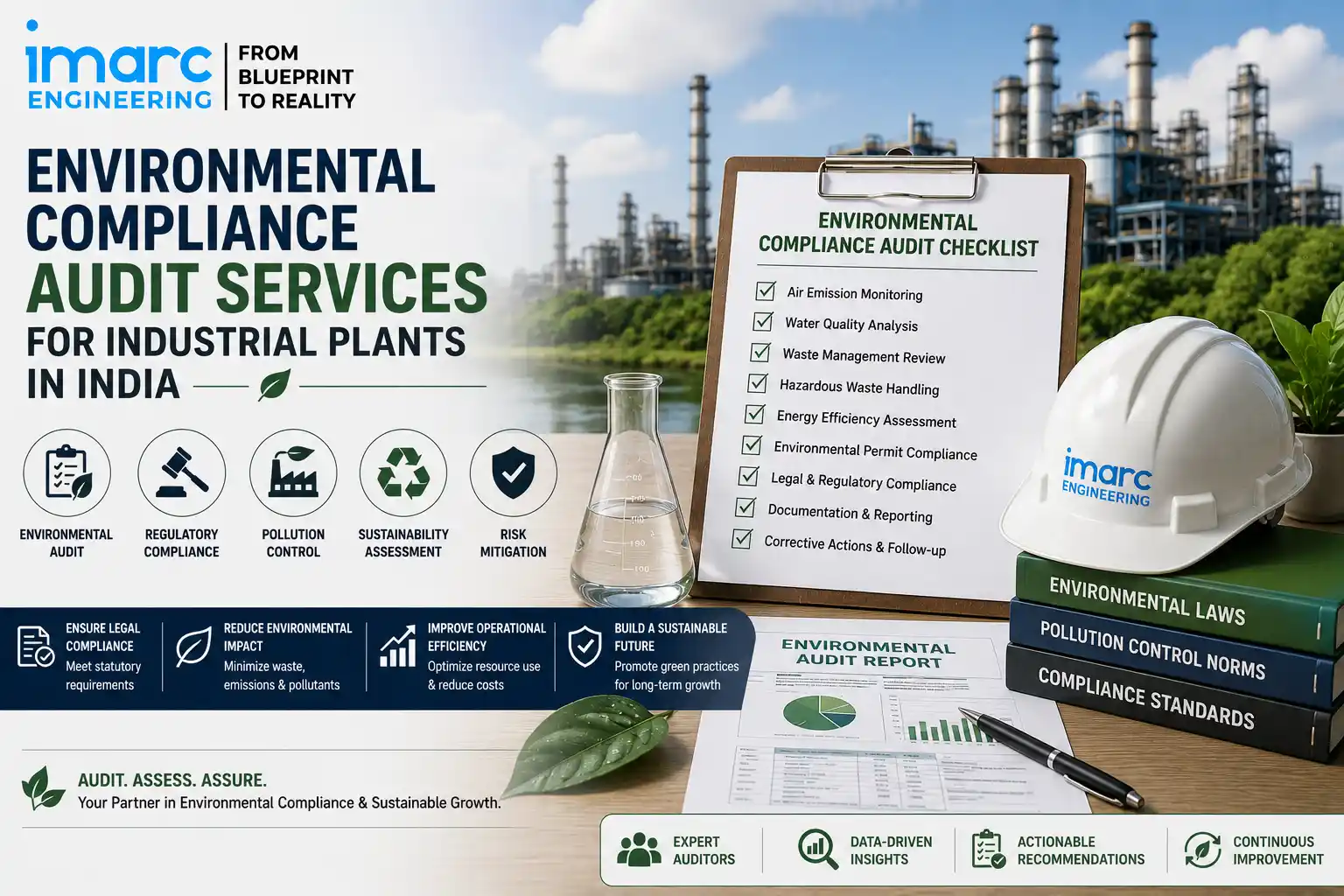
That is where Environmental Compliance Audit Services become useful. A structured audit compares what the plant is required to do against what is actually happening in operations, utility areas, waste-storage locations and environmental records.
.
This article explains what such an audit actually covers, why the gap between documentation and operations arises, and how plant owners, EHS managers and project heads can prepare for one — whether or not they ever formally engage outside support.
Why Environmental Compliance Audits Matter for Industrial Plants
Environmental obligations for an industrial plant in India are not fixed at the point of commissioning. They are anchored in instruments — consents, authorisations and, where applicable, an Environmental Clearance — that carry conditions, and those conditions are meant to be tracked continuously against actual operations, not just referred to once during the original approval process.
Three structural reasons make periodic verification necessary:
- Approvals are conditional, not absolute. A Consent to Operate under the Water (Prevention and Control of Pollution) Act, 1974 and the Air (Prevention and Control of Pollution) Act, 1981 is granted subject to stated conditions on discharge quality, emission limits, monitoring frequency and reporting — conditions that stop reflecting reality the moment operations drift from what was originally described.
- Plants change faster than paperwork. Capacity utilisation, product mix, raw material sourcing, and equipment all evolve. Environmental clearance and consent conditions are not always revisited at the same pace, particularly for incremental changes that are not treated internally as “major.”
- Regulatory oversight is ongoing, not one-time. Pollution Control Boards and, where applicable, MoEFCC exercise continuing powers of inspection, monitoring review and consent renewal. A plant’s environmental position is therefore something that is checked repeatedly over its operating life, not settled permanently at commissioning.
A compliance audit does not create new obligations. It verifies whether obligations that already exist are being met in practice, and organises the findings so that management can act on them with clear ownership and priority — rather than discovering gaps only when a regulator, customer or incident forces the issue.
It is worth being precise about what an audit is not. It is not a guarantee of compliance, not a substitute for statutory inspection, and not a legal opinion. It is a structured, evidence-based review that gives management an accurate, current picture of where the plant stands.
What Does an Environmental Compliance Audit Actually Check?
In short: an environmental compliance audit compares each applicable regulatory condition against physical, documentary and operational evidence at the plant, and records where the two align, where they diverge, and how serious each divergence is.
At a working level, this typically spans nine areas. The applicability, depth and sequence of each area depends on the plant’s industry category, production capacity, location and existing consent/clearance conditions — no two audits look identical.
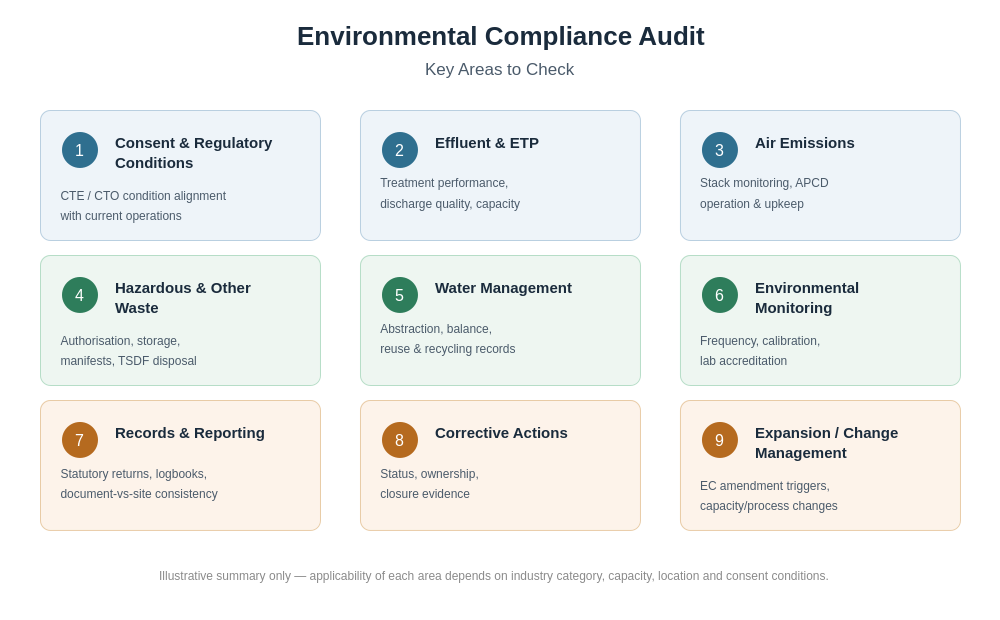
Figure: Environmental Compliance Audit — Key Areas to Check
The nine areas, examined in detail through the rest of this article, are:
- Consent and regulatory conditions (CTE/CTO alignment)
- Effluent, water use and ETP performance
- Air emissions and pollution-control equipment
- Hazardous and other waste management
- Water abstraction, balance and reuse
- Environmental monitoring, calibration and lab practices
- Records, registers and statutory reporting
- Status and closure of prior corrective actions
- Expansion, modification and change-management triggers
A well-run audit does not simply confirm the existence of a document. It tests whether the document’s content is still consistent with what is happening on the plant floor — a distinction that matters more than it might first appear, as the next section explains.
Major Environmental Compliance Problems Industrial Plants Face
Environmental non-compliance in operating plants is rarely the result of a single dramatic failure. It usually accumulates from smaller, unglamorous gaps that are individually explainable but collectively significant. Common patterns include:
- Consent-condition mismatch. The Consent to Operate references production capacity, product categories or effluent/emission limits that no longer match current operations, following unrecorded incremental changes.
- ETP underperformance. The effluent treatment plant was designed for a certain load and quality, but current influent characteristics, hydraulic loading or maintenance condition mean treated effluent quality is inconsistent, especially during peak production or plant upsets.
- Water-balance inconsistencies. Water abstraction, consumption and discharge figures reported in registers do not reconcile cleanly with metering data or production volumes.
- Air-emission control gaps. Air pollution control devices (bag filters, scrubbers, ESPs) are present but not consistently maintained, monitored, or operated at the parameters assumed in the original consent application.
- Hazardous-waste documentation problems. Waste is generated, stored and disposed of, but authorisation categories, quantities recorded in annual returns, manifest documentation, or storage conditions do not fully align with the Hazardous and Other Wastes (Management and Transboundary Movement) Rules, 2016.
- Weak monitoring records. Self-monitoring is conducted, but frequency, parameters tested, or laboratory accreditation status fall short of what the consent conditions specify.
- Incomplete corrective-action closure. Findings from a previous inspection, audit or complaint were acknowledged but never formally closed out with evidence, leaving an open item that resurfaces at the next review.
- Outdated environmental-clearance condition tracking. For plants that hold an Environmental Clearance under the EIA Notification, 2006, specific conditions (monitoring commitments, compliance report submissions, expansion thresholds) are not tracked as a living checklist and lapse from institutional memory as personnel change.
- Expansion-related compliance uncertainty. Debottlenecking, capacity enhancement or product-mix changes proceed without a clear internal assessment of whether they trigger fresh consent amendment or EC-related requirements.
- Poor ownership of environmental actions. Environmental compliance is treated as a documentation task assigned to one individual, rather than an operational responsibility distributed across production, maintenance and EHS functions.
- Discrepancies between documents and actual plant conditions. Site layout, storage areas, or process flow have changed since the last approved drawing or description was filed.
- Inspection readiness problems. Records exist but are scattered, undated, or not readily retrievable when a regulator visits.
These gaps do not automatically translate into penalties, closure notices or project delays — outcomes depend on the nature of the gap, the regulator’s assessment and the plant’s response. But left unaddressed, they raise the probability of avoidable friction: additional scrutiny during renewal, delayed approvals for expansion, unplanned remediation cost, and — increasingly — difficulty satisfying customer or investor environmental due diligence and ESG documentation requests.
Consent and Regulatory Compliance Checks
Consent verification is normally the starting point of an audit because it defines the baseline against which everything else is measured. Typical checks include:
- Confirming the plant’s current Consent to Establish (CTE) and Consent to Operate (CTO) status, validity period and renewal timeline with the relevant State Pollution Control Board/Pollution Control Committee.
- Comparing consent conditions — permitted capacity, product categories, discharge/emission limits, monitoring obligations — against actual current operations.
- Checking whether any condition has been amended, and whether the amendment has been reflected in internal records.
- Identifying whether category classification (e.g., red/orange/green, where applicable under the relevant state classification scheme) still matches the plant’s current activities.
- Reviewing whether any activity at the plant falls outside what the consent describes, which may require a fresh application or amendment rather than being treated as a minor internal change.
Important scope note: not every plant requires every type of approval, and consent categories, thresholds and procedures vary by state and by industry sector. Applicability must always be assessed against the specific plant’s classification, location and the current rules of the relevant State Pollution Control Board or Pollution Control Committee.
Effluent, Water and ETP Compliance
Effluent-related findings can be significant during compliance audits because ETP performance is sensitive to operational variables that shift continuously.
Checks typically include:
- Comparing effluent treatment plant design capacity and design influent characteristics against current actual loading.
- Reviewing treated effluent quality data (BOD, COD, TSS, pH, and other parameters specified in the consent) against permissible limits, over a representative period rather than a single sample.
- Verifying maintenance records for ETP equipment — aeration systems, clarifiers, filtration, sludge handling — and cross-checking against observed physical condition.
- Checking disposal or reuse pathway for treated effluent (into a water body, on land for irrigation, sewer, or reuse within the plant) against what the consent authorises.
- Reviewing sludge generation, characterisation and disposal records, since ETP sludge is frequently a hazardous waste stream requiring separate authorisation and manifest tracking.
- Identifying any bypass arrangements, whether formally authorised or informal, that allow untreated or partially treated effluent to be discharged during upset conditions.
Where a plant’s actual effluent characteristics have moved materially from what the ETP was designed for — due to product-mix changes, capacity increases, or new process lines — this is flagged as a priority finding, since it often cannot be resolved through operational fixes alone and may require design review or capacity augmentation.
Air Emissions and Pollution-Control Systems
Air-side checks focus on whether pollution-control equipment is not just installed, but functioning as intended and monitored per the applicable conditions under the Air (Prevention and Control of Pollution) Act, 1981.
Key checkpoints:
- Stack emission monitoring records (manual and, where mandated, continuous emission monitoring systems) compared against the frequency and parameters specified in the consent.
- Operating parameters of air pollution control devices (pressure drop across bag filters, scrubber liquid flow, ESP field voltage, etc.) checked against design and maintenance logs.
- Fugitive emission sources — material handling, storage, loading/unloading — assessed for control measures where applicable.
- Stack height, number of stacks and their correspondence with what is described in the consent application and drawings.
- Calibration records and accreditation status of laboratories used for stack monitoring.
Gaps here often surface as a mismatch between “control equipment exists” and “control equipment is operated and maintained at the parameters assumed when the consent was granted” — a distinction that is easy to overlook in day-to-day operations but material during any regulatory review.
Hazardous and Other Waste Management
Hazardous and other waste management is governed by the applicable provisions of the Hazardous and Other Wastes (Management and Transboundary Movement) Rules, 2016, along with the relevant regulatory requirements administered by the applicable authorities.
Audit checks typically cover:
- Whether all hazardous waste streams generated at the plant are correctly identified and categorised against the schedules of the 2016 Rules.
- Whether current authorisation (as part of, or alongside, the consent) covers the actual types and quantities of waste being generated — not only the types anticipated when the authorisation was first obtained.
- On-site storage practices — labelling, secondary containment, storage duration — against the Rules’ requirements.
- Manifest documentation for waste transported off-site, and whether the receiving Treatment, Storage and Disposal Facility (TSDF) or recycler holds current, valid authorisation.
- Annual returns and record-keeping obligations, and whether quantities reported reconcile with actual generation and disposal records.
- Import/export documentation, for the limited set of plants engaged in transboundary movement of hazardous or other waste, which carries additional conditions under the 2016 Rules.
This is an area where documentation gaps are common even at plants with otherwise strong environmental performance, because waste streams evolve — new processes generate new waste types, packaging materials change, or maintenance activities introduce waste categories that were never formally added to the authorisation.
Environmental Monitoring, Records and Data Integrity
A compliance audit places significant weight on whether monitoring and reporting are not just occurring, but occurring correctly and consistently. Typical checks:
- Whether monitoring frequency for each parameter matches what the consent specifies, and whether gaps in the monitoring calendar exist.
- Whether monitoring is conducted through a laboratory holding valid recognition/accreditation as required (for example, NABL accreditation or CPCB/SPCB recognition, where mandated).
- Whether raw monitoring data, calibration certificates and chain-of-custody records are retained and retrievable, not only summary reports.
- Consistency between monitoring reports, statutory returns filed with the regulator, and internal production/discharge records for the same period.
- Whether previous excursions beyond permissible limits were documented, investigated and reported as required, rather than quietly noted and left unaddressed.
Data integrity matters as much as the underlying environmental performance: a plant with genuinely good performance but poor record-keeping can still struggle to demonstrate compliance convincingly during an inspection or third-party review.
Environmental Clearance and Expansion-Related Risks
For plants that fall within the scope of the EIA Notification, 2006 (as amended) and hold an Environmental Clearance, the audit also examines EC-specific obligations, which are distinct from — and additional to — Water Act/Air Act consent conditions.
Checks typically include:
- Whether specific conditions attached to the EC (environmental safeguards, monitoring commitments, compliance report submission schedules) are being tracked and met.
- Whether periodic compliance reports have been submitted through the PARIVESH portal (the MoEFCC’s single-window system for Environment, Forest, Wildlife and Coastal Regulation Zone clearances) as required.
- Whether any expansion, modernisation or product-mix change since the EC was granted has been assessed against applicable thresholds to determine whether a fresh EC, an amendment, or a “Change in Product Mix” type application is required.
- Whether site conditions (layout, green belt, effluent/emission points) match what was assessed and approved in the EC.
Because thresholds, applicable categories and procedures under the EIA Notification, 2006 are project- and sector-specific, and because the regulatory framework has been amended and clarified over time, this assessment should always be based on the current official notification and any applicable amendments — not on assumptions carried over from an earlier project or an outdated understanding of the rules.
When Should an Industrial Plant Conduct an Environmental Compliance Audit?
There is no single mandated frequency for a voluntary environmental compliance audit — organisations typically build this into their internal EHS assurance calendar. Common trigger points include:
- Before a regulatory inspection, where advance notice or a scheduled review is expected.
- Before CTO renewal or amendment, where applicable, to identify and close gaps ahead of submission.
- Before expansion, debottlenecking or process modification, to determine whether existing approvals still cover the intended change.
- After an incident, complaint, or excursion beyond permissible limits, to assess root cause and prevent recurrence.
- Before an acquisition, merger or investment, as part of environmental due diligence.
- Before a customer or ESG assessment, where the plant’s environmental documentation will be reviewed by a third party as part of a supply-chain or investment evaluation.
- As part of periodic internal compliance assurance, independent of any external trigger, to maintain a current picture of the plant’s status.
What Happens After an Environmental Compliance Audit?
A useful audit output is not a narrative report alone — it is a structured, trackable action plan. A sound closure process follows a consistent sequence for each finding:
Finding → Risk classification → Owner → Corrective action → Deadline → Evidence → Closure verification
- Finding: the specific gap identified, described with reference to the applicable condition or requirement.
- Risk classification: a considered assessment of severity and likely consequence — not every finding carries the same weight, and treating all findings as equally urgent dilutes attention on the ones that matter most.
- Owner: a named individual or function accountable for resolving the finding — not “EHS department” as a whole.
- Corrective action: the specific step(s) required, distinguished from a general intention to “improve.”
- Deadline: a realistic date, factoring in procurement, design or approval lead times where relevant.
- Evidence: the documentation or physical verification that will demonstrate the action was actually completed.
- Closure verification: a final check, ideally independent of the person who implemented the fix, confirming the finding is genuinely resolved rather than administratively closed.
This structure is what turns an audit from a one-time diagnostic exercise into a functioning management system.
How to Prepare for an Environmental Compliance Audit
Preparation reduces both the time an audit takes and the number of findings that arise simply from records being hard to locate. Plants preparing for an audit typically assemble:
- Regulatory documents: current CTE/CTO, hazardous waste authorisation, Environmental Clearance (where applicable), and any amendment letters.
- Technical records: ETP design basis, air pollution control equipment specifications, process flow diagrams, site layout drawings.
- Monitoring reports: stack emissions, effluent quality, ambient air/noise (where applicable), groundwater (where applicable), with supporting raw data and calibration certificates.
- Waste records: hazardous waste inventory, manifests, annual returns, TSDF/recycler authorisation copies.
- Consent and clearance documents: complete condition lists, not summaries, cross-referenced against current operations.
- Previous audit or inspection findings: including status of prior corrective actions, whether internally generated or from a regulatory visit.
- Corrective-action records: evidence of closure for past findings, not just the original action plan.
- Physical plant verification readiness: ensuring that storage areas, ETP, stack access points and waste yards are accessible and represent current operating conditions, since an auditor will typically walk the site alongside reviewing documents.
A short internal pre-check against this list — even without external support — often surfaces the most obvious gaps before a formal audit begins.
How IMARC Engineering Helps Industrial Plants
The problems described above often cannot be identified through documentation review or a plant walkthrough alone. They surface when documents, technical records and physical conditions are checked against each other, systematically.
| Client Challenge | What Should Be Checked | IMARC Engineering Support |
| Consent-condition mismatch | Current CTE/CTO conditions vs. actual capacity, product mix and discharge/emission parameters | Reviews consent documents against operating data and helps identify where an amendment or fresh application may be needed |
| ETP or effluent concerns | ETP design basis vs. current influent load, treated effluent quality trends, sludge handling | Assesses ETP performance data and supports prioritisation of corrective or upgrade actions |
| Air-emission risks | APCD operating parameters, stack monitoring frequency and results, fugitive sources | Reviews monitoring records and equipment maintenance logs against consent conditions |
| Hazardous-waste documentation gaps | Waste categorisation, authorisation scope, manifests, annual returns | Helps reconcile actual waste generation with existing authorisation and documentation |
| Weak monitoring evidence | Monitoring frequency, lab accreditation, data retention and consistency with statutory returns | Reviews monitoring programme design and record-keeping practices against applicable conditions |
| Expansion-related regulatory uncertainty | Whether planned capacity/process changes trigger consent amendment or EC-related requirements | Supports early-stage assessment of regulatory implications before project commitments are made |
| Open audit or inspection findings | Status, ownership and evidence for previously identified findings | Helps structure a corrective-action tracker with defined owners, deadlines and closure evidence |
| Inspection readiness | Accessibility and organisation of statutory records and physical plant condition | Supports pre-inspection readiness reviews aligned to how records and site conditions are typically checked |
| ESG/customer environmental documentation | Whether existing documentation can withstand third-party due diligence review | Helps compile and organise environmental documentation for customer, investor or ESG assessment requests |
IMARC Engineering works as an engineering and project-aligned advisory partner: it supports plants in assessing environmental compliance gaps, connecting regulatory requirements with actual plant conditions, and helping prioritise corrective actions based on risk and operational impact. This work is advisory and technical in nature — IMARC Engineering does not act as a statutory authority, does not issue approvals, and does not replace licensed legal or regulatory professionals where such services are specifically required for a given matter.
Planning an environmental compliance audit for an industrial plant? Learn more about Environmental Compliance Audit Services and assess your facility’s regulatory, operational and documentation readiness: https://www.imarcengineering.com/contact?service=environmental-compliance-audits
Common Mistakes Industrial Plants Make
- Treating consent renewal as a paperwork task rather than an opportunity to reconcile documented conditions with actual operations.
- Assuming equipment presence equals compliance — an ETP or APCD that exists but is poorly maintained or operated outside design parameters does not meet the intent of the consent condition.
- Closing corrective actions administratively without retaining evidence that would satisfy an external reviewer.
- Not reassessing regulatory implications before expansion, leading to last-minute discovery that a planned change requires prior approval.
- Fragmented record-keeping, where monitoring data, consent documents and internal production records are held by different functions and never cross-checked.
- Underestimating hazardous-waste documentation obligations, particularly for waste streams introduced after the original authorisation was granted.
- Relying on outdated regulatory understanding, rather than checking the current applicable rules, notifications and consent conditions before making compliance decisions.
Conclusion
Environmental compliance at an operating industrial plant is not a fixed state achieved once and maintained automatically — it is a continuing alignment exercise between what was approved, what is documented, and what is actually happening on the plant floor. Gaps in this alignment are common, usually explainable, and rarely the result of deliberate non-compliance. What matters is whether they are identified early, classified honestly by risk, and closed with real evidence rather than administrative sign-off.
A structured environmental compliance audit — whether conducted internally or with external technical support — gives plant leadership an accurate, current picture of where the facility stands, and a defensible basis for the decisions that follow: renewal applications, expansion plans, inspection readiness, and increasingly, the environmental documentation that customers and investors expect to see.
Contact Us:
IMARC Engineering
Phone: +91-120-433-0800
Email: sales@imarcengineering.com
India: C-130, Sector 2, Noida, Uttar Pradesh 201301
LinkedIn: https://www.linkedin.com/showcase/imarc-engineering/
About the Author