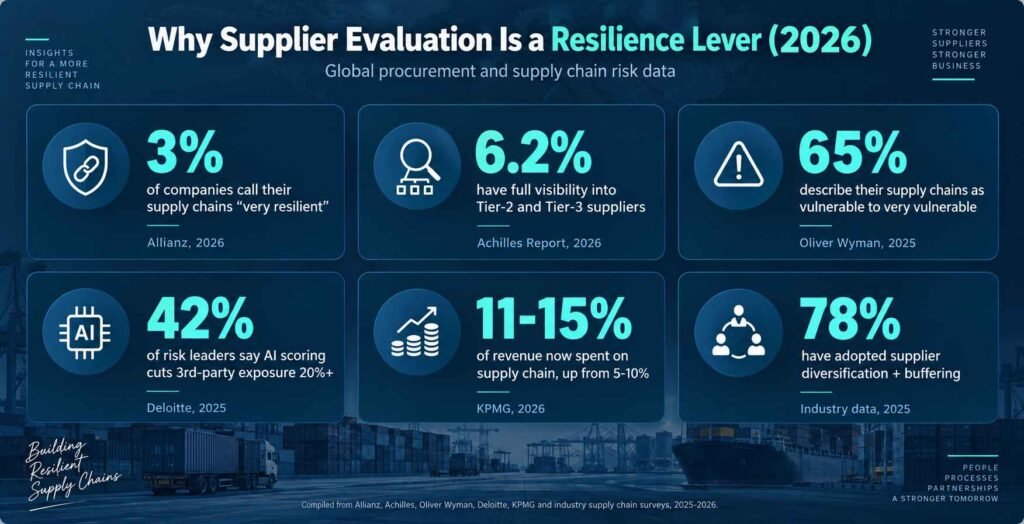
Supply chains in 2026 are being tested more often, and more unpredictably, than at almost any point in the last decade. Freight route disruptions, tariff shifts, and regional conflicts are turning what used to be occasional shocks into a near-constant operating condition. Allianz’s 2026 risk data shows that only 3% of companies consider their supply chains “very resilient,” even as disruption frequency keeps climbing.
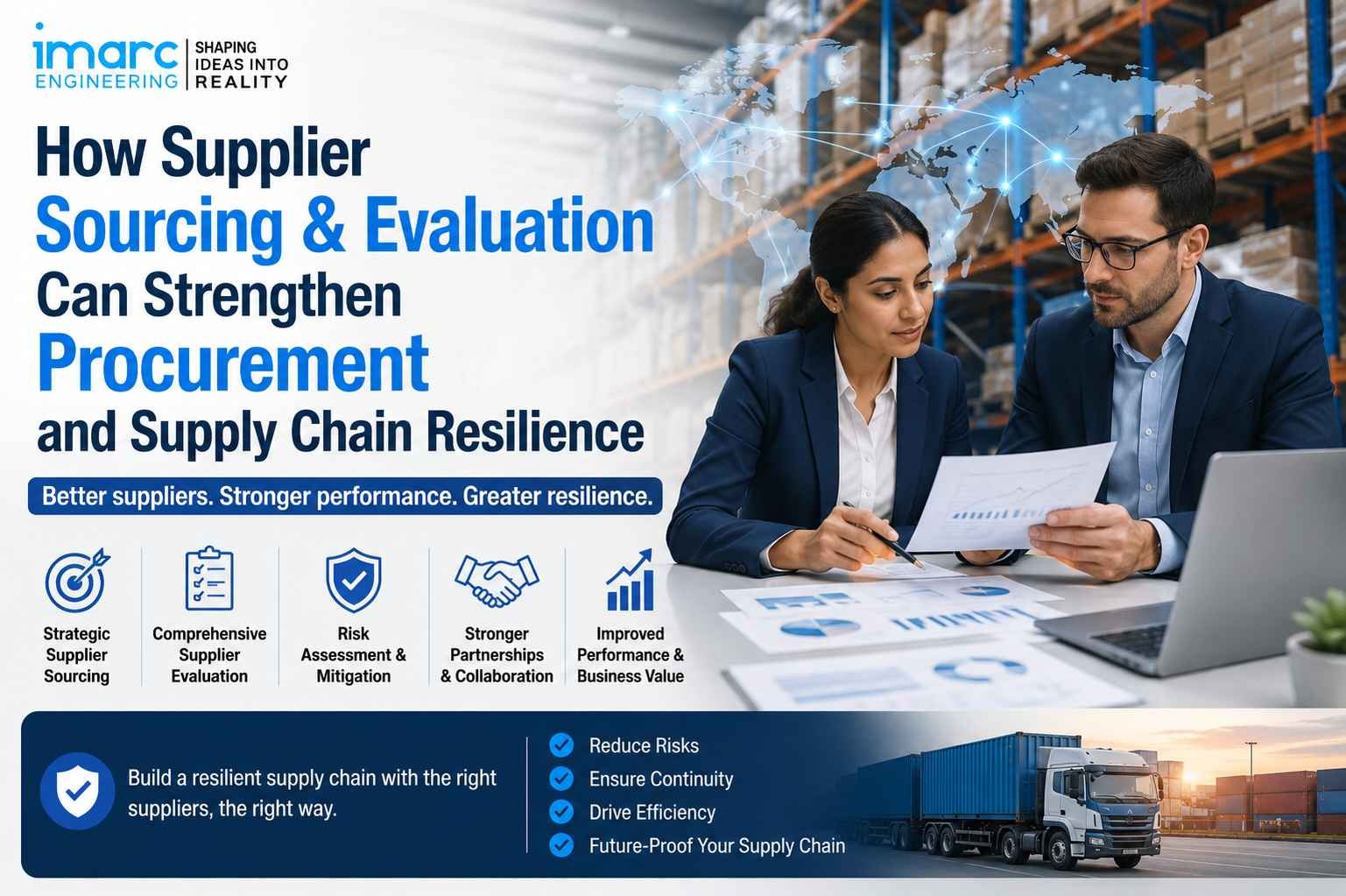
For manufacturers, the first line of defense against this volatility is not inventory or logistics. It is the supplier base itself. A structured supplier sourcing and evaluation service identifies vendors on capability and risk exposure rather than price alone, and that single shift in procurement discipline is what separates companies that absorb a shock from those that stall production because of one.
Why Supplier Evaluation Has Become a Resilience Function, Not Just a Cost Function
Procurement teams have traditionally evaluated suppliers to negotiate better pricing. That mandate has expanded considerably. KPMG’s 2026 U.S. Supply Chain Survey of 462 senior executives found that 73% of supply chain leaders are planning to transform their operating model within the next one to three years, and “managing and mitigating risks” was cited as the single most important transformation objective by 51% of respondents.
Sourcing and evaluation now has to answer questions that go well beyond unit cost:
- Can this supplier scale output if a competing vendor fails?
- Does it hold live certifications, licenses, and quality accreditations, not just historical ones?
- How exposed is it to single-region raw material or logistics dependency?
- Does its financial position support the order volumes being committed?
- Can it be audited and re-scored on a fixed cycle rather than only at onboarding?
Companies that build these questions into a repeatable evaluation framework are the ones showing up in the resilience data. Oliver Wyman’s 2025 research found that 65% of organisations describe their supply chains as “vulnerable to very vulnerable,” largely because supplier risk visibility stops at the first tier.
The Visibility Gap That Evaluation Is Meant to Close
Most companies still cannot see far enough into their own supplier network to know where the next disruption will originate. According to the Achilles Annual Risk and Sustainability Report 2026, drawn from 2,805 organisations across construction, energy, and industrial manufacturing, only 6.2% of respondents reported full visibility into their Tier-2 and Tier-3 supplier relationships. Separately, Dun & Bradstreet’s Manufacturing Pulse data shows that 47% of manufacturers are blocked from monitoring deeper supply chain tiers purely by a lack of usable data, and that formal compliance monitoring typically stops at Tier 2 for the large majority of companies.
That gap has a direct cost. EFESO’s Global Supply Chain Survey 2026 found that only 20% of companies conduct monthly supply chain risk assessments and just 14% run regular stress tests or crisis simulations, yet 48% of high-performing companies have mature digital risk-monitoring capabilities compared with only 10% of lower-performing peers. Structured, cyclical supplier evaluation is what converts a company from the 20% checking occasionally into the group that catches a problem before it reaches the production line.
A few figures illustrate what is at stake:
- Billion-dollar weather disasters now occur roughly every three weeks, adding another source of disruption to global supply chains.
- 42% of risk leaders believe AI-assisted supplier risk scoring alone could cut third-party financial exposure by at least 20% (Deloitte, 2025)
- 78% of companies have adopted supplier diversification and inventory buffering together as resilience strategies, up sharply since 2025
- Companies are now allocating 11 to 15% of revenue to supply chain functions, up from 5 to 10% in 2024, reflecting how much resilience spend has grown (KPMG, 2026)
Sourcing Risk Tiers: What Evaluation Focus Should Look Like at Each Level
Not every supplier carries the same exposure, and evaluation depth should scale with risk rather than apply uniformly across the vendor base.
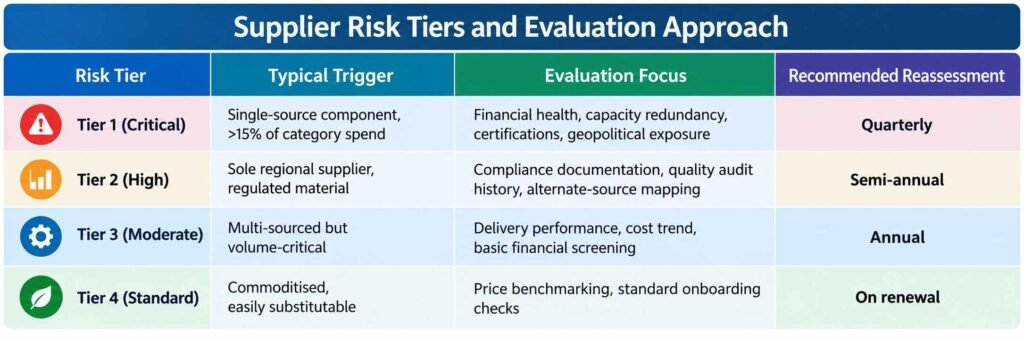
This kind of tiered structure is precisely what a formal sourcing and evaluation engagement builds before it becomes a checklist exercise buried in a spreadsheet. Gitnux’s 2026 procurement data shows that supplier risk assessments are now conducted quarterly by 60% of organisations, and multi-sourcing strategies are in place across 55% of critical categories, both signs that tiered evaluation is becoming the industry norm rather than the exception.
India’s Supplier Base Faces Its Own Resilience Pressure
India’s manufacturing supply chains carry a specific vulnerability: a large, dispersed MSME vendor base that is still building the systems needed to prove reliability to larger buyers. As of February 2026, more than 79 million enterprises are registered on the Udyam and Udyam Assist platforms, and the MSME sector contributes close to 30% of GDP and over 45% of India’s exports, according to CII data. That scale is an asset, but it also means procurement teams sourcing locally are evaluating a fragmented, unevenly documented supplier universe.
Global buyers are already recalibrating what they look for. Tier-1 EV, defence, and electronics manufacturers are now prioritising local Tier-2 and Tier-3 vendors that can demonstrate traceability and consistent quality, not just competitive pricing, as global OEMs shift focus from “how cheap” to “how reliable.” Geopolitical shocks are compounding the pressure: following early-2026 West Asia conflict escalation, ocean freight costs on some routes for Indian exporters spiked from around USD 300 to over USD 8,500 per shipment, prompting the government’s RELIEF scheme in March 2026 to partially reimburse eligible MSME exporters facing logistics cost escalations of up to 50%.
For Indian manufacturers, this makes supplier evaluation a two-way discipline: assessing inbound vendors with the same rigour that their own buyers are now applying to them.
What a Structured Sourcing and Evaluation Framework Should Include
- Pre-qualification screening covering financial stability, statutory compliance, and manufacturing capacity before a vendor enters the shortlist
- On-site or virtual capability audits benchmarked against defined quality and process standards
- Risk-tiered reassessment cycles rather than a single onboarding check that is never repeated
- Documented alternate-source mapping for every Tier 1 and Tier 2 category
- Scorecards that combine cost, quality, delivery reliability, and compliance rather than price in isolation
- Integration of evaluation data into ERP or vendor management systems so scores update as performance changes
How IMARC Engineering’s Expertise Can Help in Supplier Sourcing and Evaluation
- Structures supplier identification and shortlisting around technical capability, capacity, and compliance documentation specific to the industry vertical
- Conducts on-ground and desk-based vendor audits covering financial health, quality systems, and regulatory certifications
- Builds risk-tiered evaluation frameworks so critical single-source vendors are reassessed far more frequently than commoditised suppliers
- Maps alternate-source options for high-risk categories before a disruption forces a reactive search
- Supports EPCM clients with vendor scorecards that plug directly into procurement and ERP workflows
- Advises on supplier diversification strategies suited to India’s dispersed MSME vendor landscape
Get in Touch With Our Team: https://www.imarcengineering.com/contact?service=supplier-identification-and-evaluation
Conclusion
Supplier sourcing and evaluation is no longer a procurement formality carried out once at onboarding. With visibility gaps still common beyond Tier 1 and disruption frequency rising, a tiered, continuously updated evaluation framework is what actually determines whether a shock becomes a delay or a shutdown. Manufacturers that treat evaluation as an ongoing discipline, not a checklist, build supply chains that hold up under pressure rather than merely surviving it.
Frequently Asked Questions
What is supplier sourcing and evaluation in procurement?
It is the structured process of identifying potential vendors and assessing them against criteria such as financial stability, quality systems, compliance, capacity, and delivery reliability, before and after onboarding, rather than selecting suppliers on price alone.
How does supplier evaluation improve supply chain resilience?
It surfaces risk concentration, such as single-source dependency or weak Tier-2 visibility, early enough that alternate sourcing can be arranged before a disruption forces a reactive scramble, reducing production downtime and cost exposure.
How often should suppliers be reassessed?
Reassessment frequency should scale with risk. Critical, single-source suppliers typically warrant quarterly review, while standard commoditised vendors can be reassessed at renewal.
Why is Tier-2 and Tier-3 supplier visibility important?
Most disruptions originate beyond the direct, Tier-1 relationship. Industry data shows the large majority of companies still cannot see into their deeper supplier tiers, which is where hidden risk concentration usually sits.
Is supplier evaluation different for Indian MSME vendors?
Indian sourcing often involves a larger, more fragmented vendor base with uneven documentation, making structured pre-qualification and capability audits especially important before committing to volume-critical suppliers.
Contact Us:
IMARC Engineering
Phone: +91-120-433-0800
Email: sales@imarcengineering.com
India: C-130, Sector 2, Noida, Uttar Pradesh 201301
LinkedIn: https://www.linkedin.com/showcase/imarc-engineering/
About the Author