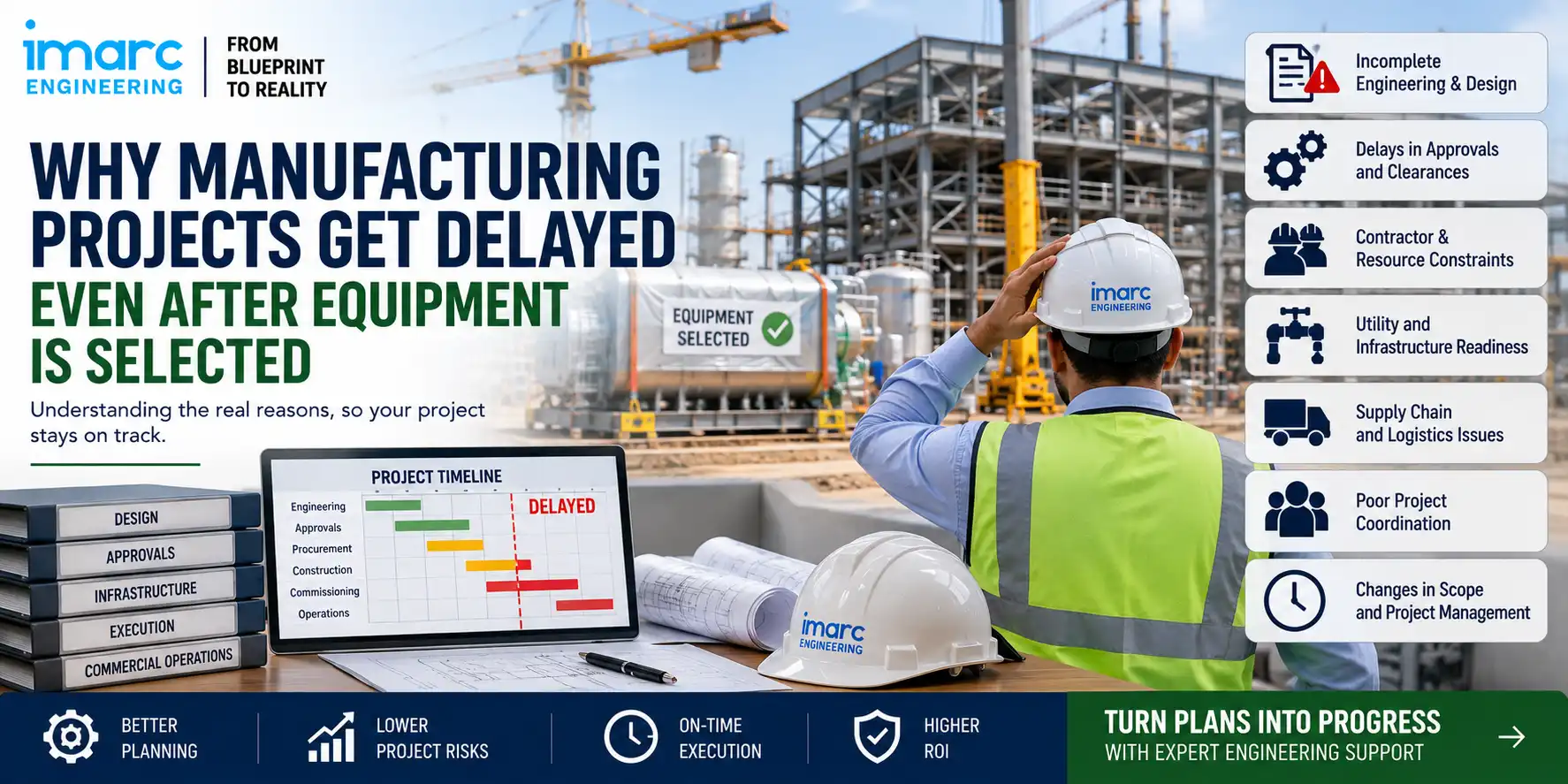
Selecting the right equipment is a major milestone in any manufacturing project, reflecting weeks of technical evaluation and vendor discussions. But equipment selection is not the same as equipment readiness on the shop floor.
Between the decision to buy and the day production starts, several activities still have to happen: commercial finalisation, purchase order issuance, technical documentation, vendor drawings, manufacturing, inspection, logistics, site readiness, installation, commissioning, and coordination between multiple suppliers. Once equipment has been selected, a structured Procurement Strategy and Cost Benchmarking approach can help align supplier evaluation, commercial decisions and procurement milestones with the overall project schedule. Any one of these stages can slip, and when it does, the project timeline slips with it.
This is why a project can remain stalled even after the equipment decision has been made. The problem often lies in the activities surrounding the equipment rather than in the machine itself.
Manufacturing projects can remain delayed after equipment selection because selection only determines what will be purchased. Purchase-order finalisation, vendor drawings, manufacturing, inspection, logistics, site readiness, installation and commissioning must still be completed and coordinated. A delay at any of these stages can affect the planned production-start date.
Why Equipment Selection Does Not Mean the Project Is Ready
Equipment selection is only a decision point within the wider project execution cycle. Once the machine is selected, the project still depends on commercial approvals, technical documentation, supplier actions, site preparation and coordinated installation. Each activity has its own dependencies and can affect the overall production-readiness schedule.
Selecting equipment answers the question “what will we buy.” It does not answer “when will it arrive, ready to run.” A pump, boiler, or packaging line still needs a signed contract, approved drawings, a manufacturing slot at the vendor’s factory, inspection sign-off, transport, a ready foundation, trained installers, and a commissioning plan before it contributes a single unit of output. Treating selection as the finish line, rather than the starting point of execution, is where many project delays begin.
7 Reasons Manufacturing Projects Get Delayed Even After Equipment Is Selected
1. Purchase Order and Commercial Finalisation Take Too Long
Even after a vendor is chosen, internal approval layers, commercial negotiation, and contract finalisation can take weeks. Advance payment terms, bank guarantees, and legal clauses are often negotiated after the technical decision, not before. Every additional approval cycle can push the PO release date and compress the time available for downstream manufacturing, delivery and installation activities.
2. Vendor Drawings and Technical Documents Are Not Approved on Time
Once a PO is placed, the vendor issues General Arrangement (GA) drawings, foundation and load data, utility requirements, electrical interface details, and other technical documents for approval. These approvals often move slowly because they require input from multiple internal departments — civil, electrical, process — before a single sign-off can be issued. A delayed drawing approval can delay the vendor’s manufacturing start. A document register showing submission dates, responsible reviewers and target approval dates can help prevent technical documentation from becoming an invisible project bottleneck.
3. Equipment Manufacturing Takes Longer Than Planned
Vendor production schedules are not always as firm as they appear at the quotation stage. Long-lead components, raw material availability, customisation, and the vendor’s overall order book can extend manufacturing time well beyond the originally quoted period, particularly for engineered-to-order equipment.
4. Inspection and Approval Become Bottlenecks
Pre-dispatch inspection, quality checks, and acceptance testing are often planned late, close to the promised delivery date. If inspection scheduling, travel, or documentation is not arranged in advance, equipment can sit ready at the vendor’s works awaiting a sign-off that has not yet been booked.
5. The Site Is Not Ready When Equipment Arrives
Civil foundations, building structures, electrical connections, utilities, and material-handling arrangements are sometimes still incomplete when equipment reaches the site. Because civil and procurement work streams run on separate schedules, equipment can arrive well before the site can accept it, resulting in storage costs, exposure risk, and idle capital.
6. Multiple Equipment Suppliers Are Not Properly Coordinated
Manufacturing projects rarely involve a single vendor. Interdependent equipment, shared utility interfaces, automation and control system interfaces, and installation sequencing mean that one supplier’s delay can directly stall another supplier’s activity. Without a coordinated schedule across vendors, these dependencies are often discovered only after they have already caused a delay.
7. Delivery and Supplier Performance Are Not Properly Monitored
Delivery schedules are frequently tracked informally, through emails and phone calls rather than a structured system. The Government of India’s Department of Expenditure, in its Manual for Procurement of Goods (Second Edition, 2024), highlights that procuring entities are expected to actively monitor supplier performance against contracted delivery milestones and to follow up and escalate proactively rather than after a deadline has already been missed. Where planned-versus-actual tracking, vendor follow-up, and documentation are not maintained consistently, delays are often identified too late to be corrected without further schedule loss.
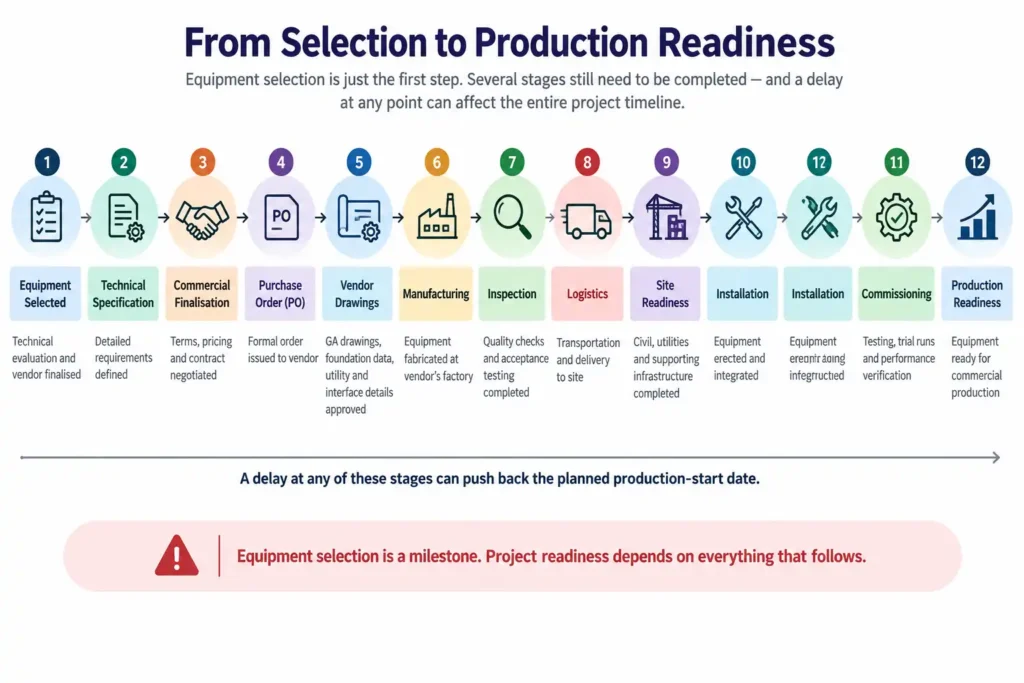
Common Delay Points:
- PO / approval delays
- Vendor documentation
- Manufacturing
- Inspection
- Delivery
- Site readiness
- Installation
- Supplier coordination
The flow above shows that equipment selection is only the first of twelve stages between decision and production readiness.
Case History: What Happens When Equipment Procurement Gets Ahead of Site Readiness
A documented case from the Comptroller and Auditor General (CAG) of India’s Report No. 12 of 2017 illustrates how equipment procurement and site readiness can fall out of step. At Dr. Harisingh Gour Vishwavidyalaya, Sagar (Madhya Pradesh), equipment was purchased for a Central Instrumentation Laboratory, including a higher-specification model bought without retendering. The audit found that this equipment remained uninstalled because construction of the laboratory building had not been completed.
The official record does not attribute this to any single cause beyond the timing mismatch between procurement and civil construction. The broader lesson for manufacturing projects is straightforward: procuring or receiving equipment ahead of site readiness does not save time — it simply shifts the delay from the supplier’s schedule to idle, uninstalled capital sitting on site.
Common Mistakes That Delay Equipment Delivery and Project Execution
- Treating equipment selection as the end of procurement rather than the start of execution
- Failing to assign clear responsibility for technical document approvals
- Not defining measurable delivery milestones and escalation points
- Starting vendor follow-up only after a milestone is already at risk
- Planning site readiness separately from equipment delivery
- Failing to assign ownership for cross-vendor interfaces and dependencies
- Scheduling inspection and acceptance activities only after equipment is declared ready
- Treating equipment delivery and installation as separate outcomes instead of connected project activities
Equipment Procurement Delay Prevention Checklist
☐ Technical specification approved
☐ Vendor selected
☐ Commercial terms finalised
☐ PO released
☐ Delivery date documented
☐ Vendor drawings received
☐ Drawings approved
☐ Manufacturing schedule confirmed
☐ Inspection schedule confirmed
☐ Pre-dispatch requirements completed
☐ Logistics arranged
☐ Foundation ready
☐ Utilities ready
☐ Installation team available
☐ Commissioning plan prepared
☐ Vendor responsibilities defined
☐ Project milestones being tracked
Equipment Selection to Project Execution: Key Delay Points
| Project Stage | Common Problem | Possible Impact |
| Equipment Selection | Treated as project completion rather than a checkpoint | Downstream activities are not planned or resourced in parallel |
| Commercial Finalisation | Slow internal approvals and late PO release | Manufacturing start is pushed back before it even begins |
| Vendor Documentation | GA drawings and interface data pending approval | Vendor cannot start or continue manufacturing |
| Manufacturing | Long-lead items, capacity constraints at vendor’s works | Delivery date slips beyond the quoted schedule |
| Inspection | Pre-dispatch inspection scheduled late | Ready equipment held up awaiting sign-off |
| Logistics | Transport and handling arranged only after dispatch is due | Delivery delay compounds manufacturing delay |
| Site Readiness | Civil, electrical, or utility work incomplete | Equipment arrives with nowhere to be installed |
| Installation | Installation crew or equipment not aligned with vendor sequence | Installation cannot start even after delivery |
| Commissioning | Interdependent systems not ready together | Commissioning, and production start, gets pushed further |
How IMARC Engineering Helps Manufacturing Projects Avoid These Delays
Once equipment has been selected, the practical challenge shifts from choosing the right machine to keeping every downstream activity moving in step. Commercial finalisation and PO release often slow down when technical and commercial terms are negotiated separately; aligning them early, with clear delivery milestones written into the contract, helps reduce back-and-forth after the order is placed.
Vendor coordination becomes important when multiple equipment suppliers have interdependent delivery and installation requirements. Coordinating documentation, schedules, and interfaces can help reduce the risk of one supplier’s delay affecting downstream activities such as installation or commissioning.
Delivery tracking addresses a different problem: schedules that exist on paper but are not actively followed up. Structured tracking of planned-versus-actual delivery, combined with timely escalation, gives project teams visibility before a milestone is missed rather than after.
Site and installation coordination connects procurement to civil and utility readiness, so that equipment does not arrive before foundations, power, or handling arrangements are in place.
IMARC Engineering supports manufacturing companies across these areas — including procurement strategy and cost benchmarking, supplier evaluation, and coordination through installation and commissioning — as part of overall project execution support, rather than as an isolated purchasing function.
For manufacturers planning new equipment purchases or managing multiple suppliers during plant setup or expansion, early procurement and execution coordination can help identify schedule risks before they affect installation and commissioning.
Talk to our project and procurement experts to identify the gaps delaying your project: http://imarcengineering.com/contact?service=procurement-strategy-and-cost-benchmarking
Conclusion
Equipment selection is an important project milestone, but schedule risk often shifts to execution once the technical decision has been made. Delayed approvals, poorly coordinated suppliers and misalignment between equipment delivery and site readiness can turn a completed purchasing decision into a project bottleneck.
Manufacturing companies that treat procurement and execution as one connected process, rather than separate handoffs, are better placed to protect their project timelines. For companies seeking support in coordinating procurement, vendor management and execution after equipment selection, IMARC Engineering can help align these activities from planning through project execution.
Contact Us:
IMARC Engineering
Phone: +91-120-433-0800
Email: sales@imarcengineering.com
India: C-130, Sector 2, Noida, Uttar Pradesh 201301
LinkedIn: https://www.linkedin.com/showcase/imarc-engineering/
About the Author