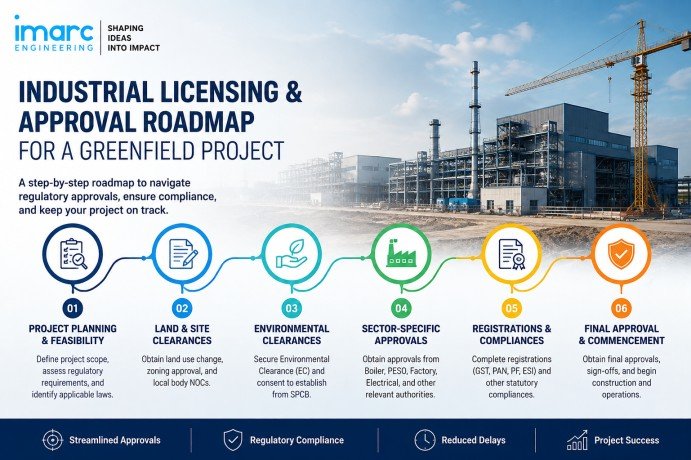
Industrial Licensing & Approval Roadmap for a Greenfield Project
Most greenfield manufacturing projects in India don’t stall because a licence gets rejected. They stall because the wrong approval is pursued at the wrong time, or a critical dependency is discovered only after construction has started. A boiler may be installed before the design receives the required approval. A tank farm may be positioned before applicable PESO separation requirements are assessed. Land may be purchased before confirming that the intended industrial use is permissible.
These are not simply approval problems; they are sequencing problems that surface as regulatory delays. That distinction matters because it changes how the risk should be managed. A well-built industrial licensing and approval roadmap doesn’t just identify what’s required; it maps approvals against their dependencies and project stages so that site selection, design, construction, and commissioning remain aligned with the applicable regulatory requirements.
Why a Checklist Isn’t Enough
Ask most project teams what approvals a greenfield plant needs, and they’ll list Environmental Clearance, Factory Licence, Fire NOC, Pollution Consent, and a handful of others. That list isn’t wrong, it’s just incomplete in the way that matters. It doesn’t say who grants each approval, what has to happen before it can be applied for, or what it unlocks next.
A usable roadmap answers six questions for every approval on the list: why it’s needed, who grants it, at what project stage it applies, what precedes it, what documentation it requires, and what it enables afterward. Once those six questions are answered, a regulatory checklist becomes something closer to a project schedule, which is what it needs to be.
India’s National Single Window System now maps applicable central and state approvals for a given project profile, but NSWS itself notes that its output is indicative and recommends independent verification. That caveat is worth taking seriously. Automated tools can tell you which approvals might apply; they can’t tell you how those approvals depend on each other, or which ones will actually decide your commissioning date.
The Five Stages Every Roadmap Should Cover
1. Site and feasibility screening. Before land is finalised, the site itself should be tested against land use classification, environmental sensitivity, proximity to forest or protected areas, groundwater availability, power access, and any CRZ applicability. PARIVESH 2.0’s Know Your Approvals tool now allows GIS-based screening for environmental, forest, wildlife, and CRZ triggers using nothing more than project coordinates, and the Ministry positions it explicitly as an early planning step, not a post-purchase formality.
2. Pre-establishment approvals. This covers land use confirmation, building plan approval, and the environmental permissions that must precede construction, chiefly Environmental Clearance for projects listed under the EIA Notification, 2006, and Consent to Establish from the state pollution control board. Getting these sequenced correctly matters because they feed directly into detailed design.
3. Construction-phase approvals. Structural and fire plan sanctions, factory building approvals, and any boiler or pressure vessel design approvals sit here. Factory rules typically require prior permission for the site and construction before civil work proceeds, so this stage overlaps heavily with engineering design rather than following it.
4. Pre-commissioning approvals. This is the stage projects most often underestimate. A constructed facility still cannot begin commercial operations until the applicable pre-operational approvals are in place, which may include Consent to Operate, factory licensing or registration, electrical safety approvals, PESO permissions and product-specific regulatory approvals. CTE and CTO are two distinct permissions granted at two distinct stages, not interchangeable paperwork, and treating them as the same thing is one of the more expensive mistakes a project team can make.
5. Operational compliance. Once production begins, the obligations don’t end. Licence renewals, periodic inspections, six-monthly EC compliance reporting, and hazardous waste returns move the project into a continuous compliance cycle rather than a one-time approval exercise.
Build the Roadmap Around Dependencies, Not a List
The real value of a roadmap comes from mapping what depends on what. A simplified version looks like this:
Project and process classification → site screening → environmental sensitivity check → industrial licence applicability → Environmental Clearance and CTE → building and factory plan approval → construction → fire, electrical, and PESO approvals → factory licence and CTO → product-specific certification → trial production → commercial production.
The actual sequence shifts by state and sector, but the logic holds everywhere: some approvals can run in parallel, others cannot start until a predecessor is granted, and treating them as one flat list hides which approvals are actually sitting on the critical path.
Two dependencies deserve special attention because they’re easy to miss during early planning:
- Water. If groundwater abstraction is proposed, CGWA-related permissions depend on hydrogeological data, water level readings, and proposed borewell details that should be gathered during site screening, not after the plant is designed.
- Hazardous materials. For chemical, pharma, or energy projects, PESO scrutinises the site layout itself before construction, covering storage zones, separation distances, and access. This effectively makes the plant layout a regulatory document, so layout decisions made purely on engineering logic can force a redesign later.
Know What’s Actually a Licence
- One distinction is worth flagging on its own: “industrial licence” is not a catch-all term for every factory-related approval.
- Under the current framework, compulsory industrial licensing applies to only four categories: defence and aerospace equipment, industrial explosives, specified hazardous chemicals, and tobacco products.
- Everything else, from Environmental Clearance to the Factory Licence to Consent to Operate, is a separate approval track with its own authority and trigger.
- Conflating them leads to project teams either chasing licences they don’t need or assuming they’re covered when they aren’t.
The Mistakes That Cost the Most Time
- Buying land before regulatory screening: By the time environmental or zoning constraints surface, the site is already committed.
- Designing before checking approvals: Fire separation, hazardous storage, and pollution-control requirements should shape the layout, not get retrofitted into it.
- Treating CTE and CTO as the same approval: They’re granted at different stages by the same board, for different purposes.
- Assuming plant approval covers product approval: A facility can have the necessary operating approvals while specific products may still require BIS certification under an applicable Quality Control Order (QCO), or other sector-specific approvals, before manufacture or sale.
- Letting project data drift across applications: If the capacity figure in the EC application doesn’t match the one in the factory licence application, expect queries and delays.
Turn It Into a Live Document
A roadmap that sits in a PDF nobody updates isn’t a roadmap. It works best as a running register: each approval listed with its authority, trigger, current status, dependency, target date, and an owner, ideally reviewed alongside the EPC master schedule rather than as a standalone compliance exercise. Grouping approvals into critical, high, medium, and low priority based on how directly they affect construction or commissioning start also helps teams focus effort where delays actually bite.
How IMARC Engineering Can Help
IMARC Engineering supports greenfield manufacturers in integrating regulatory planning with the broader project schedule rather than treating approvals as a separate compliance workstream. Support can include:
- Candidate-site regulatory screening before land commitment
- Project-specific approval and dependency mapping
- Environmental, factory, fire, electrical and applicable PESO approval planning
- Alignment of approval requirements with layout and engineering decisions
- Live approval tracking against construction and commissioning milestones
Discuss Your Greenfield Project Approval Requirements: https://www.imarcengineering.com/contact?service=industrial-licensing-incentive-advisory
Conclusion
A greenfield project’s approval roadmap shouldn’t be built as a list of licences to collect. It should be built as an approval schedule structured around dependencies, running alongside site selection, engineering design, construction, and commissioning.
Projects rarely lose months because an approval is rejected outright. Delays are more often caused by approvals being pursued in the wrong sequence or requirements being identified too late to incorporate into project planning. Getting the sequence right before land is acquired and design is frozen can help keep a greenfield project on schedule.
Contact Us:
IMARC Engineering
Phone: +91-120-433-0800
Email: sales@imarcengineering.com
India: C-130, Sector 2, Noida, Uttar Pradesh 201301
LinkedIn: https://www.linkedin.com/showcase/imarc-engineering/
About the Author