Introduction
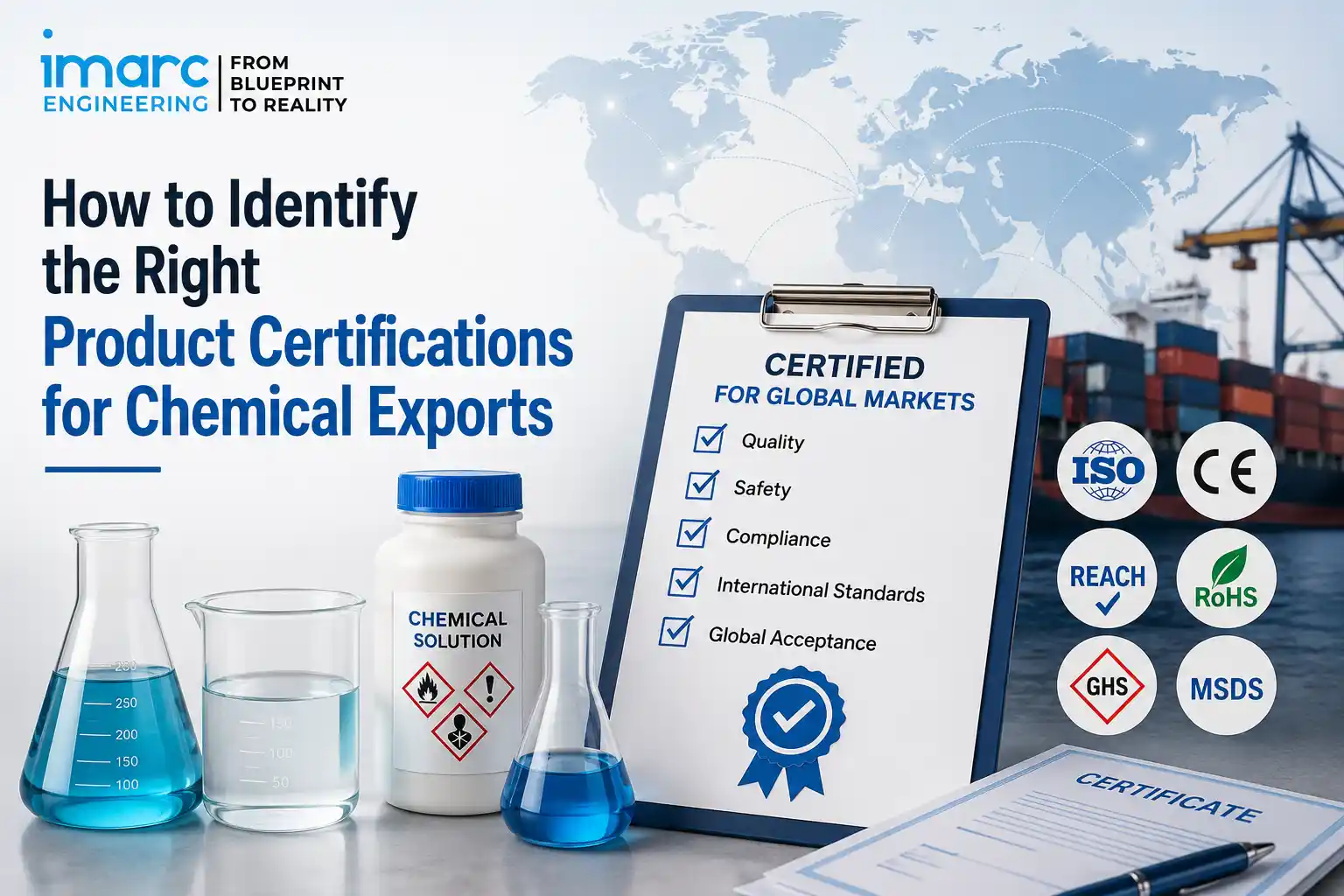
The right product certifications and compliance requirements for chemical exports are not selected from a generic global checklist. They depend on the destination country’s regulations, the product’s chemical identity and composition, intended use, hazard classification, applicable trade classification, and buyer-specific requirements.
When certification and compliance requirements are considered only after an export order is confirmed, manufacturers may face additional testing, documentation changes, shipment delays, or customer onboarding issues. Mapping these requirements early helps exporters understand the applicable compliance pathway and prepare the necessary evidence before making commercial commitments.
Requirements can vary significantly by destination market, chemical composition, intended use, shipment volume, and buyer expectations. Manufacturers may therefore need Product Certification Support Services to assess applicable requirements, identify documentation and operational gaps, and prepare for market-specific compliance before entering a new export market.
Why Certification Choices Matter for India’s Chemical Exporters
India’s chemical manufacturing and export ecosystem continues to expand under policy support and rising global demand. Manufacturing growth is estimated at around 7% at constant prices in FY 2025-26, according to MoSPI’s First Advance Estimates, while FDI into manufacturing rose 18% in FY 2024-25 to US$19.04 billion, according to the Ministry of Commerce & Industry and DPIIT.
As more Indian chemical manufacturers target international markets, product certification has become an important commercial and compliance consideration alongside price, lead time and product quality. Identifying applicable certification and documentation requirements early can help reduce avoidable re-testing, shipment delays and customer onboarding issues.
What “Right Certification” Means for Chemical Exports
The right certification is the one that is:
- Required by the destination market for your substance or mixture
- Recognised by the applicable regulator, conformity-assessment framework or buyer, as relevant
- Aligned with your exact product specification and use conditions
- Supported by valid test data, labelling and documentation
- Maintainable for the volumes and supply period you plan
A certificate that is prestigious but irrelevant to the target market does not improve export readiness. A mandatory registration or conformity mark that is missing can stop the shipment entirely.
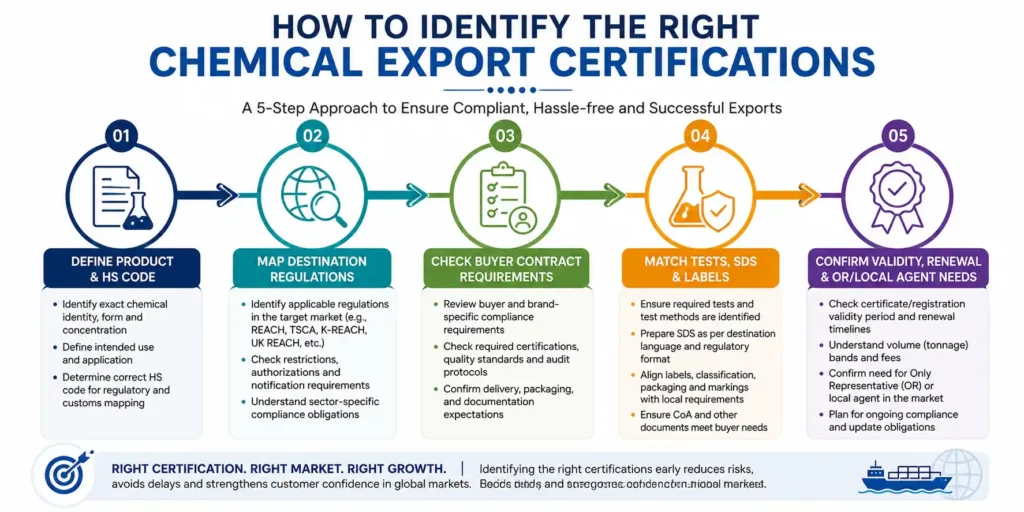
Step 1: Start With Product Identity, Use and HS Classification
Certification scope depends on what the product is and how it is used.
Clarify:
- Exact chemical identity, concentration and product form
- Intended use — industrial intermediate, specialty, agrochemical input, consumer-adjacent use, etc.
- Hazard classification under GHS-aligned systems where applicable
- Correct HS code for customs and regulatory mapping
Incorrect substance identification, use classification or trade classification can send the exporter down the wrong compliance or customs pathway.
Step 2: Map Destination-Market Regulatory Pathways
Different markets impose different chemical control regimes. Common examples exporters encounter include:
- EU — REACH registration or downstream-user obligations, CLP labelling, and in some cases authorisation or restriction checks
- United Kingdom — UK REACH-related obligations for that market
- United States — TSCA inventory status, import certification, new-chemical/significant-new-use requirements and substance-specific restrictions, where applicable
- Korea, Japan, Turkey and others — local REACH-like or chemical inventory frameworks
- Sector overlays — additional rules when the chemical is used in food-contact, cosmetics, pharma intermediates or other regulated value chains
The right method is market-by-market mapping for the actual substance and tonnage band, not copying another exporter’s certificate set.
Step 3: Separate Mandatory Approvals From Buyer-Driven Requirements
Not every certificate is legally mandatory. Many are commercially mandatory.
Distinguish between:
- Regulatory market-access requirements imposed by the destination jurisdiction
- Buyer and brand requirements such as specific ISO systems, audit protocols, impurity limits or customer-approved labs
- Transport and handling requirements for dangerous goods classification, packaging and documentation
- Origin and customs documents needed for clearance and preferential trade claims
A practical certification plan covers all four layers. Covering only one still leaves shipment or onboarding risk.
Step 4: Align SDS, Labels, Packaging and Test Evidence
Certification is incomplete if supporting documents do not match the approved product story.
Check consistency across:
- Safety Data Sheet content and language requirements
- Hazard classification, SDS and label elements aligned with the destination market’s implementation of GHS, where applicable
- Packaging and marking rules for the mode of transport
- Certificate of Analysis and test methods accepted by the buyer
- Traceability from batch records to export documentation
Many chemical export failures happen here: the registration exists, but the SDS, label or CoA does not match what the market expects.
Step 5: Plan Validity, Tonnage Bands and Local Representation
Some regimes require local representatives, volume-based registration tiers or renewals.
Before finalising the certification route, confirm:
- Whether an Only Representative, importer, local representative or other locally established responsible entity is required under the applicable regime
- Whether current registration covers your planned annual tonnage
- Renewal, update and change-of-composition obligations
- Cost and lead time for data generation if new testing is needed
- Whether multiple destinations can share data packages or need separate filings
This prevents a certificate that works for the first trial order but fails when volumes scale.
Government Support Context for Exporters
Indian chemical exporters should also monitor current DGFT and other relevant government programmes for any applicable export-promotion, testing, certification or market-access support. Eligibility, covered expenses, reimbursement limits and application conditions can change, so current scheme guidelines should be verified before financial support is included in project economics.
Such support may help reduce eligible compliance costs, but it does not replace the need to identify the correct destination-market requirements first.
Certification Decision Framework for Chemical Exporters
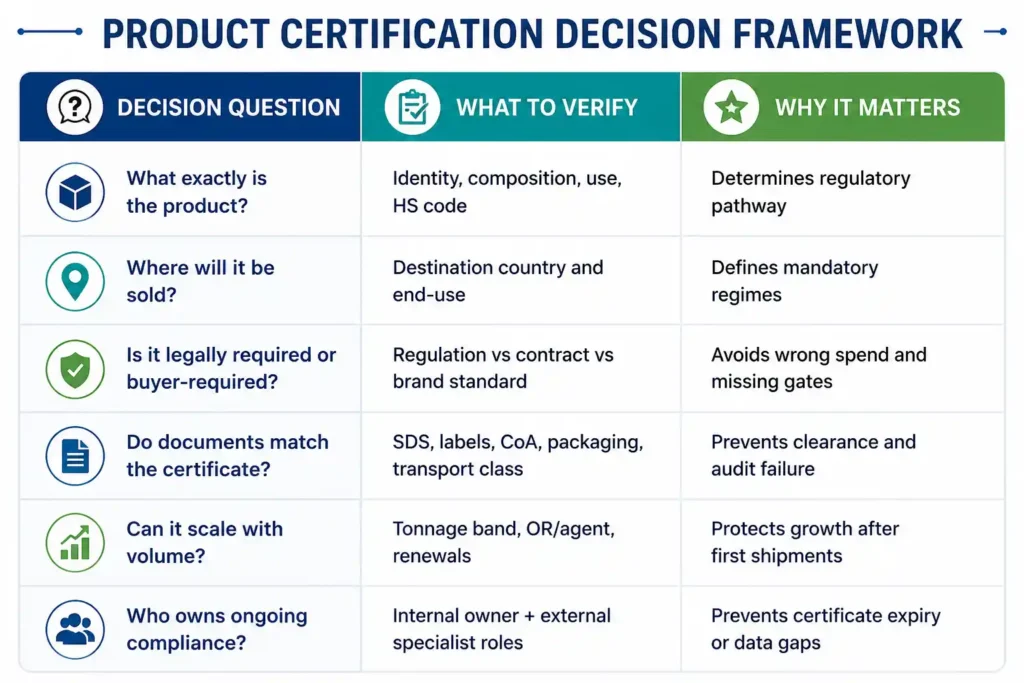
Practical Sequence Before You Commit Export Orders
- Freeze product identity, composition, specification, intended use and HS classification.
- List target countries and intended uses.
- Map mandatory chemical regulations for each destination.
- Add buyer and brand requirements from draft contracts.
- Identify required tests, SDS/label updates and local representation.
- Estimate lead time and cost for first shipment and for scaled volume.
- Assign internal ownership for renewals and change control.
- Only then confirm commercial delivery dates to customers.
This sequence protects both compliance and credibility.
How IMARC Engineering Supports Product Certification Readiness
IMARC Engineering supports chemical manufacturers in assessing the operational, technical and documentation requirements that underpin product certification and export-market readiness, support can include:
- Review of product, process and plant information relevant to certification requirements
- Identification of documentation and operational gaps that may affect customer or regulatory reviews
- Coordination inputs for quality, process and plant teams preparing for certification or market-entry requirements
- Support for manufacturers aligning production capabilities with export-market expectations
- Project advisory for chemical and process manufacturing facilities preparing to enter or expand in international markets
For manufacturers evaluating certification requirements before committing to a new export market, structured readiness assessment can help identify gaps early and reduce avoidable compliance and commercial delays.
Planning to export chemical products to a new market? Contact IMARC Engineering to discuss your certification and export-readiness requirements: https://www.imarcengineering.com/contact?service=product-facility-certification-support
Common Mistakes When Selecting Chemical Export Certifications
- Copying another company’s certificate list without checking substance and destination fit
- Starting certification after the sales commitment is already signed
- Treating SDS and labels as separate from registration obligations
- Ignoring tonnage thresholds and local representative requirements
- Assuming one global certificate covers all markets
- No owner for renewals, composition changes and buyer audit follow-up
Conclusion
Identifying the right product certifications for chemical exports requires more than selecting a recognised certificate. Requirements need to be mapped against the product’s identity and composition, intended use, destination market, regulatory framework, buyer expectations, testing evidence and ongoing compliance obligations.
A market-specific approach helps manufacturers avoid unnecessary certification costs, identify documentation and testing gaps earlier, and prepare more reliably for customer onboarding and international shipments.
For manufacturers entering new export markets, IMARC Engineering supports the assessment of certification-related operational, technical and documentation requirements as part of broader product certification and export-readiness planning.
Contact Us:
IMARC Engineering
Phone: +91-120-433-0800
Email: sales@imarcengineering.com
India: C-130, Sector 2, Noida, Uttar Pradesh 201301
LinkedIn: https://www.linkedin.com/showcase/imarc-engineering/
About the Author