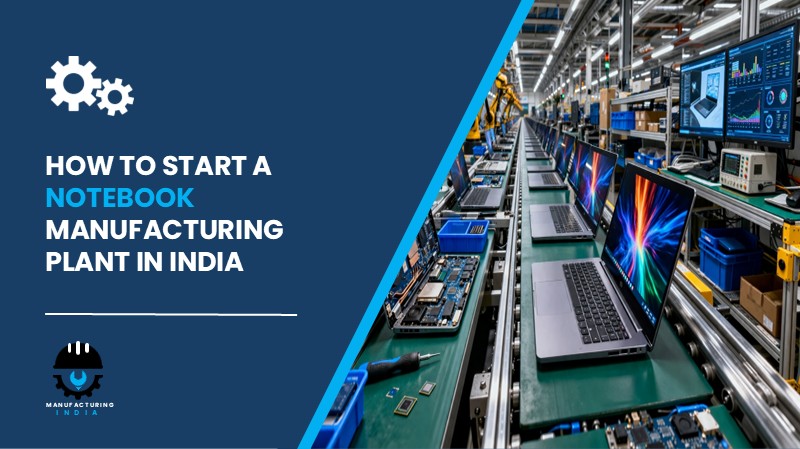
Setting up a notebook manufacturing plant in India presents a compelling investment case for entrepreneurs and institutional investors alike. Notebooks portable personal computers integrating display screens, keyboards, touchpads, processors, memory, storage, batteries, and connectivity modules within compact designs are foundational to the functioning of the IT and ITES sector, the education ecosystem, corporate enterprises, gaming, healthcare, and government bodies. As India accelerates its digital transformation, the demand for locally produced notebooks has moved from an opportunity to a structural imperative for the country’s electronics manufacturing sector.
India’s competitive advantages in land, labour, supply chain depth, and policy architecture make it strategically sound for establishing this type of production facility. The government’s Make in India and Production Linked Incentive (PLI) schemes for electronics manufacturing are actively incentivising domestic value addition and reducing import dependency. States such as Tamil Nadu, Telangana, Uttar Pradesh, and Maharashtra have emerged as key hubs for electronics assembly, offering industrial estates, SEZ facilities, and supporting infrastructure for notebook and IT hardware manufacturers. With rising domestic consumption and growing export opportunities, the investment case for a notebook plant in India has rarely been stronger.
India’s notebook manufacturing sector sits at the intersection of favourable policy, cost-competitive production, and surging digital demand across education, enterprise, and government sectors. With gross profit margins ranging between 25–40% and net margins of 8–18%, a well-structured notebook manufacturing plant in India offers healthy financial returns and a credible break-even path across multiple capacity tiers.
What is a Notebook?
A notebook, commonly known as a laptop, is a portable personal computer that contains all essential computing components display screen, keyboard, touchpad, processor, memory, storage, battery, and connectivity modules within a compact and mobile form factor. Modern notebooks are constructed using precise electronic components including microprocessors, RAM modules, solid-state drives, lithium-ion or lithium-polymer batteries, printed circuit boards, display panels, and lightweight aluminium-magnesium alloy or reinforced polymer enclosures.
The design of notebooks enables users to work efficiently while maintaining energy savings and handling multiple tasks simultaneously, making them valuable tools for students, businesses, gamers, designers, engineers, and home computer users. The primary production method is component sourcing, PCB assembly (SMT), sub-assembly integration, system assembly, software flashing, testing, and packaging a multi-stage process that combines precision electronics assembly with rigorous quality verification.
End-use industries served by notebook manufacturing include IT and ITES, education, corporate enterprises, gaming, healthcare, government, and the creative and engineering sectors.
Cost of Setting Up a Notebook Manufacturing Plant in India
The total cost of establishing a notebook manufacturing facility depends on plant capacity, technology choices, location, level of automation, and regulatory compliance requirements. Investors should approach cost planning with a detailed project report covering both capital and operational dimensions.
1. Capital Expenditure (CapEx)
Land and Site Development form a substantial part of the overall investment, covering land registration, boundary development, and related infrastructure charges. Investors may consider Special Economic Zones (SEZs) or established industrial estates to benefit from lower land costs, customs duty exemptions, and faster regulatory clearances.
Civil Works and Construction encompass the manufacturing shed, clean assembly areas, quality control laboratory, raw material and finished goods storage, and an administrative block. The design must accommodate electrostatic discharge (ESD)-safe flooring, controlled environments for PCB assembly, and adequate ventilation across production zones.
Machinery and Equipment constitute the largest portion of capital expenditure for a notebook manufacturing plant. Key machinery required includes:
- SMT (Surface Mount Technology) lines
- Reflow ovens
- Assembly conveyors
- Automated testing systems
- BIOS flashing stations
- Packaging lines
Other Capital Costs include the Effluent Treatment Plant (ETP), pre-operative expenses, plant commissioning charges, and import duties applicable to certain specialised machinery or components not sourced domestically.
Request a Sample Report for In-Depth Market Insights: https://www.imarcgroup.com/notebook-manufacturing-plant-project-report/requestsample
2. Operational Expenditure (OpEx)
Raw Material Cost is the dominant component of the operating cost structure for a notebook manufacturing plant, accounting for approximately 60–70% of total OpEx. Key raw materials include:
- E-paper display (EPD) module – the core component and single largest cost item, typically sourced from E Ink Holdings or other display manufacturers
- System-on-chip (SoC) and memory – processor, RAM, and storage chips
- Battery – Li-Polymer battery pack
- Printed circuit board assembly (PCBA) – the mainboard integrating all electronics
- Chassis and enclosure – metal (aluminium) or high-grade plastic casing and glass cover
- Stylus/digitizer – active electromagnetic resonance (EMR) pen technology
Long-term supplier contracts are essential for stabilising raw material costs and ensuring continuity of supply across these components.
Utility Cost, covering electricity, water, and operational power for SMT lines and assembly systems, accounts for approximately 5–10% of total OpEx. Other operating costs include transportation, packaging, salaries and wages, maintenance, depreciation, and applicable taxes. By the fifth year of operations, the total operational cost is expected to increase substantially due to inflation, market fluctuations, and potential rises in the cost of key materials such as the EPD module and semiconductor components.
3. Plant Capacity
The proposed manufacturing facility at reference scale is designed with an annual production capacity of 500,000 units, enabling economies of scale while maintaining operational flexibility. Capacity can be customised per individual investor requirements, and profitability improves meaningfully with higher capacity utilisation rates.
4. Profit Margins and Financial Projections
The notebook manufacturing plant demonstrates healthy profitability under normal operating conditions. Gross profit margins typically range between 25–40%, supported by stable demand and value-added applications. Net profit margins range between 8–18%. Full financial projections including NPV (Net Present Value), IRR (Internal Rate of Return), payback period, break-even analysis, and a detailed profit and loss account are available in the detailed project report.
Why Set Up a Notebook Plant in India?
Core Digital Infrastructure Demand. Notebooks function as essential instruments for educational institutions, business organisations, medical facilities, and government bodies undergoing digital transformation. This embedded role in India’s digitisation agenda means demand is structural, not cyclical.
Remote Work and Hybrid Work Adoption. The adoption of hybrid and remote work as standard practices has created a situation where businesses of all sizes require notebooks as fundamental work resources. This transition has permanently elevated the baseline demand for portable computers across the corporate sector.
Education Sector Expansion. Emerging market educational institutions are actively building digital learning systems, requiring large-quantity purchases of basic and intermediate laptop computers. India’s school and university digitisation programmes represent a sustained procurement pipeline for notebook manufacturers.
Government Policy and PLI Incentives. Government programmes supporting electronics manufacturing through PLI schemes and domestic value addition policies create better project outcomes and improved financial returns. According to the India Brand Equity Foundation (IBEF) and the India Cellular and Electronics Association (ICEA), India can boost its total laptop and tablet production to reach USD 100 billion by 2025 through ongoing structural reforms.
Active Industry Investment. In January 2025, Taiwanese technology company MSI entered into a strategic partnership with India-based Syrma SGS Technology Limited to begin manufacturing notebook computers locally in India — a clear signal of growing OEM confidence in the Indian manufacturing ecosystem. In January 2026, ASUS partnered with GoPro to launch a co-branded ProArt laptop, illustrating continued product innovation driving replacement demand cycles.
Localisation Economics and Export Opportunity. Local assembly and manufacturing delivers reduced import dependency, decreased logistics expenses, and shorter delivery periods. Indian manufacturers are projected to grow their market share to 26% in global laptop and tablet markets, positioning India as a significant electronics manufacturing exporter.
Manufacturing Process Step by Step
The notebook manufacturing process uses component sourcing, PCB assembly (SMT), sub-assembly integration, system assembly, software flashing, testing, and packaging as the primary production method.
- Component Sourcing: Procurement of EPD modules, SoC and memory chips, Li-Polymer battery packs, PCBA mainboards, chassis enclosures, and stylus components from verified suppliers
- PCB Assembly SMT Lines: Surface Mount Technology lines place and solder electronic components onto printed circuit boards using reflow ovens for precise thermal bonding
- Reflow Oven Processing: Assembled PCBs pass through reflow ovens to achieve proper solder joint formation and board integrity
- Sub-Assembly Integration: Battery packs, display modules, and storage drives are integrated into sub-assemblies on dedicated assembly conveyors
- System Assembly: All sub-assemblies — motherboard, display, keyboard, chassis, and enclosure are brought together in the final system assembly stage
- Software Flashing: BIOS flashing stations load firmware and operating system images onto the completed units
- Automated Testing: Automated testing systems verify hardware performance, connectivity, display quality, battery function, and keyboard response
- Quality Assurance and Technical Tests: Each unit undergoes defined quality assurance criteria including technical tests for compliance and reliability
- Packaging and Dispatch: Finished notebooks are packaged using appropriate materials and dispatched to end-use sectors including IT, education, enterprise, gaming, and healthcare customers
Key Applications
Notebooks serve a broad range of industries and use cases that together sustain long-term production volume:
- Education: Student laptops, digital classrooms, and e-learning devices for schools, colleges, and universities
- Corporate and Enterprise: Office productivity tools and remote work systems for businesses of all sizes
- Gaming and Content Creation: High-performance notebooks for graphics rendering, game development, and multimedia creation
- Healthcare and Government: Data management, diagnostics support, and administrative operations across public sector institutions
- IT and ITES: Software development, enterprise IT operations, cloud computing, and AI application workflows
- Personal Computing: General home computing, online education, and personal productivity applications
Leading Manufacturers
The global notebook market is served by several multinational companies with extensive production capacities and diverse application portfolios. Key players operating in this industry include:
- Acer Inc.
- Apple Inc.
- ASUSTeK Computer Inc.
- Dell
- HP Development Company, L.P.
- Huawei Technologies Co., Ltd.
- LG
- Lenovo
- Micro-Star International Co., Ltd. (MSI)
- Microsoft Corporation
- Panasonic Corporation
- Razer Inc.
- Samsung Electronics Co., Ltd.
- Sony Corporation
- TOSHIBA CORPORATION
Timeline to Start the Plant
- Feasibility study and project report preparation
- Land acquisition and site development
- Regulatory approvals and environmental clearances
- Factory licence and fire safety compliance
- Machinery procurement and installation
- Raw material supplier agreements and supply chain setup
- Trial production and quality testing
- Commercial production launch
Licences and Regulatory Requirements
Starting a notebook manufacturing unit in India requires several approvals:
- Business registration (Proprietorship, LLP, or Pvt Ltd)
- Factory Licence under the Factories Act
- Environmental Clearance from State Pollution Control Board
- GST Registration
- Fire Safety NOC
- Effluent Treatment Plant (ETP) operational clearance
- Occupational Health and Safety compliance
Key Challenges to Consider
High Capital Requirements. Establishing a notebook manufacturing facility demands substantial upfront investment in SMT lines, reflow ovens, automated testing systems, and BIOS flashing stations, which collectively represent the largest share of CapEx.
Raw Material Price Volatility. The EPD module, SoC and memory chips, Li-Polymer battery packs, and PCBA mainboards are subject to global semiconductor supply chain fluctuations. Price volatility in these components can materially impact the operating cost structure, which has raw materials at 60–70% of OpEx.
Regulatory Compliance. Electronics manufacturing in India involves multiple compliance layers including environmental clearances, factory licensing, e-waste management regulations, and electronics-specific certifications that require dedicated compliance resources.
Technology and Innovation Pressure. The introduction of energy-saving processors, AI processor technology, faster solid-state drives, and high-refresh-rate screens continuously shifts product design requirements, demanding regular investment in process and product upgrades.
Competition from Global Players. The notebook market is served by well-capitalised global manufacturers including Lenovo, Dell, HP, Apple, ASUS, and MSI, who operate at significant scale advantages. New entrants must differentiate through localisation economics, OEM partnerships, or niche segment targeting.
Skilled Manpower. SMT operations, automated testing, BIOS flashing, and quality assurance functions require trained electronics technicians and engineers, creating a skilled workforce dependency that must be planned for through recruitment and ongoing training programmes.
Frequently Asked Questions
1. How much does it cost to set up a notebook manufacturing plant in India? The total cost depends on capacity, location, technology, and automation level. The investment covers land and site development, civil construction, machinery (SMT lines, reflow ovens, automated testing systems, BIOS flashing stations, packaging lines), raw materials, and pre-operative expenses. A detailed feasibility report provides plant-specific cost estimates.
2. Is notebook manufacturing profitable in India in 2026? Yes. The notebook manufacturing plant demonstrates gross profit margins of 25–40% and net profit margins of 8–18% under normal operating conditions, supported by stable and growing demand across education, enterprise, gaming, and government sectors.
3. What machinery is required for a notebook plant in India? Key equipment includes SMT lines, reflow ovens, assembly conveyors, automated testing systems, BIOS flashing stations, and packaging lines.
4. What licences and approvals are required to start a notebook plant in India? Required approvals include business registration, Factory Licence under the Factories Act, Environmental Clearance from the State Pollution Control Board, GST Registration, Fire Safety NOC, ETP operational clearance, and Occupational Health and Safety compliance.
5. What raw materials are needed for notebook manufacturing? Key raw materials include the EPD module, system-on-chip (SoC) and memory chips, Li-Polymer battery pack, PCBA mainboard, chassis and enclosure (aluminium or high-grade plastic), and stylus/digitizer components.
6. What are the environmental compliance requirements for a notebook plant in India? The facility must obtain Environmental Clearance from the State Pollution Control Board, operate a functional Effluent Treatment Plant, comply with e-waste management regulations, and implement advanced monitoring systems to detect any process deviations.
7. What is the best location to set up a notebook plant in India? Ideal locations offer proximity to electronics component suppliers, access to skilled labour, reliable infrastructure, and eligibility for PLI scheme benefits. States with established electronics manufacturing clusters such as Tamil Nadu, Telangana, Uttar Pradesh, and Maharashtra are strategically preferred.
8. What is the break-even period for this type of plant in India? The break-even period depends on plant capacity, utilisation rate, and prevailing market pricing. A detailed financial analysis covering payback period, NPV, and IRR is available in the full project report through the sample request.
9. What government incentives are available for manufacturers in India? Government programmes including PLI schemes for IT hardware and electronics manufacturing, domestic value addition policies, and SEZ incentives are available to notebook manufacturers in India, creating improved project economics and financial returns.
Key Takeaways for Investors
The notebook manufacturing plant in India represents a compelling opportunity anchored by structural demand from IT and ITES, education, corporate enterprise, healthcare, gaming, and government sectors all of which are undergoing sustained digital transformation. Financial viability is demonstrated across plant capacities, with gross margins of 25–40% and net margins of 8–18% providing a sound return framework for investors at multiple investment scales. According to the India Cellular and Electronics Association (ICEA), India is positioned to grow its laptop and tablet production to USD 100 billion by 2025, while Indian manufacturers are projected to capture a 26% share of the global laptop and tablet market through ongoing structural reforms. With remote work adoption, digital education expansion, AI-driven computing demand, and government PLI support all reinforcing the demand base, the long-term sustainability of notebook production in India is firmly established.
About the Author