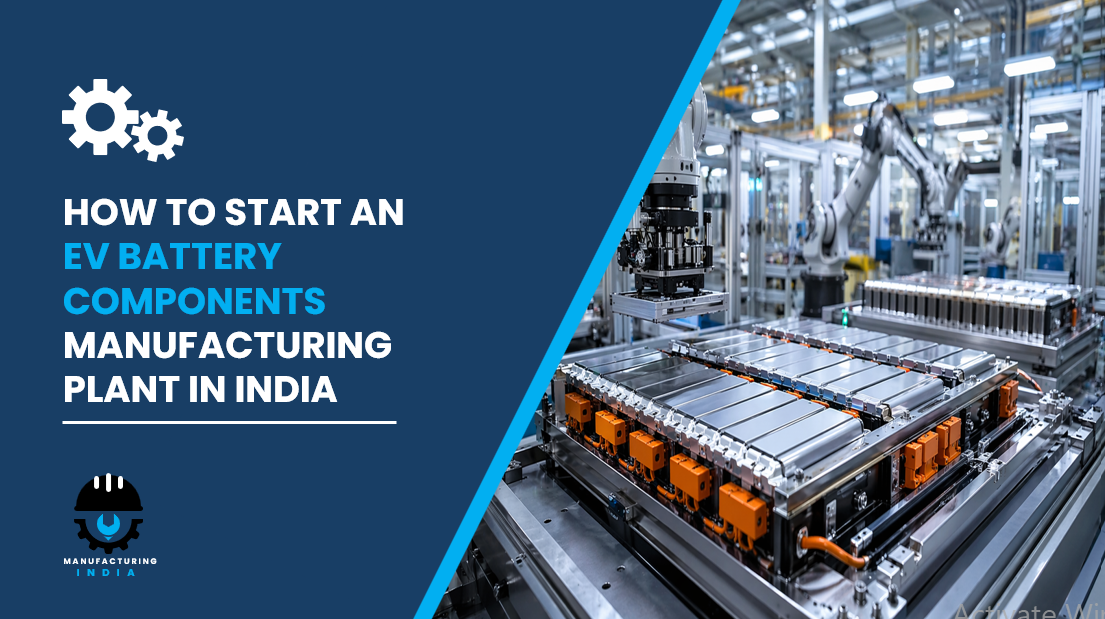
Setting up an EV battery components manufacturing plant in India presents a compelling investment case, driven by the country’s rapid transition toward electric mobility and clean transportation. The demand for core battery components – electrodes, separators, and electrolytes – is rising in lockstep with EV adoption across the automotive sector. As domestic OEM supply chains evolve to support electric passenger vehicles, commercial transport, and two-wheelers, locally manufactured battery components are becoming a strategic necessity for manufacturers seeking both cost efficiency and supply chain resilience.
India’s structural advantages – rapid urbanisation, expanding infrastructure corridors, and the Make in India initiative – create a highly suitable environment for advanced battery component production. Industrial states such as Gujarat, Maharashtra, Haryana, and Uttar Pradesh offer proximity to automotive hubs, access to technically skilled labour, and availability of SEZs and designated industrial estates. Active domestic investment by established players further cements India’s positioning as a long-term manufacturing base for this critical clean energy sector.
India’s EV battery components manufacturing opportunity is backed by strong policy support, cost-competitive production conditions, and surging demand from domestic OEMs. With established players such as PCBL Ltd and Assurance Intl committing billions to this space, the investment case is both credible and timely. Plants with optimised capacity utilisation can achieve viable payback periods underpinned by healthy gross and net margin profiles.
What are EV Battery Components?
EV battery components are the core building blocks of lithium-ion and advanced battery systems used in electric vehicles. These components – including electrodes, separators, electrolytes, lightweight enclosures, insulation films, hybrid converters, and fire-retardant materials – collectively determine battery performance, safety, energy density, and lifecycle. Product variants within this manufacturing segment include SLA (sealed lead-acid), AGM (absorbent glass mat), VRLA (valve-regulated lead-acid), lithium-ion, tubular, and gel battery types. The production method involves a series of controlled unit operations covering active material preparation, electrode processing, module assembly, and quality assurance. End-use industries served include the electric vehicle sector, clean transportation, OEM supply chains, energy storage, and the broader clean energy manufacturing ecosystem.
Cost of Setting Up an EV Battery Components Manufacturing Plant in India
The cost of establishing an EV battery components manufacturing plant depends on capacity, technology selection, site location, degree of automation, and regulatory compliance requirements.
1. Capital Expenditure (CapEx)
Land and site development represent the first major capital commitment. Investors may select SEZ locations, MIDC-designated estates in Maharashtra, or GIDC plots in Gujarat to benefit from infrastructure advantages and fiscal incentives. Civil works encompass production sheds, laboratory facilities, raw material and finished goods storage, and an administrative block.
Key machinery required includes:
- Electrode coating and drying systems
- Calendering and slitting machines
- Separator processing units
- Electrolyte preparation and filling systems
- Enclosure and module assembly lines
- Insulation film and fire-retardant component integration equipment
- Hybrid converter assembly systems
- Quality testing and inspection instruments
Other capital costs include ETP installation, pre-operative expenses, commissioning charges, and import duties on specialised equipment not available domestically.
Request a Sample Report for In-Depth Market Insights: https://www.imarcgroup.com/ev-battery-components-manufacturing-plant-project-report/requestsample
2. Operational Expenditure (OpEx)
Raw material costs constitute the largest share of recurring operational expenditure. Key inputs for EV battery component production include active cathode and anode materials (such as NMC811 CAM), separator substrates, electrolyte chemicals, enclosure-grade polymers, insulation materials, and fire-retardant compounds. Securing long-term supplier contracts mitigates feedstock price volatility. Utility costs – electricity, water, and controlled-environment systems — are significant given the energy-intensive nature of electrode processing. Other operating costs include transportation, packaging, salaries and wages, maintenance, depreciation on capital assets, and applicable taxes. A five-year cost projection should account for annual escalations in labour, utilities, and input material prices as India’s domestic EV ecosystem matures.
3. Plant Capacity
The EV battery components plant can be configured across a range of output capacities to suit investor objectives and demand projections. Domestic players illustrate the diversity of scale options available: Assurance Intl’s December 2024 Haryana facility targets production of SLA, AGM, VRLA, lithium-ion, tubular, and gel battery variants, while Altilium’s Plymouth plant processes 300 kg of black mass daily to produce NMC811 CAM. Plant capacity is fully customisable per investor requirements, and profitability improves meaningfully as capacity utilisation rates approach optimal thresholds.
4. Profit Margins and Financial Projections
A comprehensive financial model for an EV battery components plant in India should incorporate NPV, IRR, payback period, gross margin, and net margin projections across a five-year horizon. The economics of this manufacturing unit are supported by growing domestic and export demand, input cost efficiencies from local sourcing, and the premium pricing commanded by high-performance, safety-compliant components in the EV supply chain. Specific margin ranges and detailed projections are available through the full IMARC Group project report.
Why Set Up an EV Battery Components Plant in India?
Rising EV Adoption Driving Component Demand. The market for EV battery component manufacturing is expanding steadily, supported by accelerating EV adoption and strong government backing for domestic battery supply chains. As penetration deepens across passenger vehicles, commercial transport, and two-wheelers, demand for locally produced electrodes, separators, and enclosures is intensifying across every tier of the supply chain.
Innovation in Battery Material Design. Manufacturing is increasingly focused on materials that deliver better safety, efficiency, and lightweight properties. In November 2024, Sabic introduced new battery component technologies at The Battery Show North America — including lightweight enclosures, insulation films, hybrid converters, and fire-retardant materials — setting new benchmarks for performance and safety that new manufacturing facilities must be equipped to meet.
Active Domestic Industry Investment. The segment is attracting major industrial players. In August 2024, PCBL Ltd announced an INR 3,500 Crore investment plan over five years, including its foray into EV battery component production in partnership with an Australian firm. In December 2024, Assurance Intl announced INR 300 Crore to establish a Haryana plant producing multiple battery types, strengthening OEM supply chains and expanding domestic employment.
Policy and Regulatory Tailwinds. India’s Make in India initiative, combined with PLI schemes for advanced chemistry cell batteries, provides fiscal incentives and capital support designed to reduce import dependency and develop a self-reliant domestic clean energy supply chain.
Cost-Competitive Manufacturing Base. India offers competitive land costs, a large technically skilled labour pool, and proximity to automotive manufacturing clusters in Gujarat, Maharashtra, Haryana, and Tamil Nadu – structural advantages that directly reduce the cost base of an EV battery components manufacturing plant.
Local Supply Chain Preference. Indian OEMs and EV assemblers are progressively sourcing battery components domestically to improve supply chain resilience, lower logistics costs, and meet domestic content requirements, creating a reliable and growing demand base for local manufacturers.
Manufacturing Process – Step by Step
The EV battery components manufacturing process uses a series of controlled unit operations to transform raw feedstocks into finished automotive-grade components.
- Raw Material Receipt and Incoming QC: Active cathode materials, anode substrates, separator films, electrolyte chemicals, and enclosure materials are received and verified against defined quality standards.
- Active Material Preparation: Cathode and anode materials, including NMC811 CAM, are processed and conditioned to achieve target electrochemical properties.
- Electrode Coating and Drying: Slurry-form active materials are coated onto current collector foils and precision-dried to achieve uniform thickness and adhesion.
- Calendering and Slitting: Dried electrode sheets are rolled to target porosity and slit to required dimensional specifications.
- Separator Processing: Separator films are cut, inspected, and staged for cell assembly.
- Electrolyte Preparation and Filling: Electrolyte solutions are formulated and filled under controlled atmospheric conditions.
- Enclosure and Module Assembly: Lightweight enclosures, insulation films, hybrid converters, and fire-retardant components are assembled around the cell stack.
- Quality Testing and Inspection: Finished components undergo electrochemical, mechanical, and thermal testing to confirm automotive safety and performance compliance.
- Packaging and Dispatch: Certified components are packaged and dispatched to EV OEMs and downstream end-use facilities.
Key Applications
EV battery components serve diverse industries and segments across the electric mobility and clean energy ecosystem.
- Electric Passenger Vehicles: Lithium-ion cells and modules delivering propulsion energy for consumer EVs.
- Commercial Electric Vehicles: High-capacity battery systems for electric buses, trucks, and logistics fleets.
- Electric Two- and Three-Wheelers: Compact battery packs for India’s fastest-growing EV segment.
- OEM Supply Chains: Components supplied directly to vehicle assembly lines for integration into complete EV systems.
- Clean Energy Storage: Battery components supporting stationary storage systems tied to renewable energy installations.
Leading Manufacturers
The global EV battery components industry is served by a mix of chemical majors, speciality materials companies, and dedicated battery manufacturers. Key players operating in this space include:
- Revex
- Mitra Chem
- NanoGraf
- Cabot Corporation
- PCBL Ltd
- Assurance Intl
- Altilium
- Sabic
Timeline to Start the Plant
- Feasibility study and project report preparation
- Land acquisition and site development
- Regulatory approvals and environmental clearances
- Factory licence and fire safety compliance
- Machinery procurement and installation
- Raw material supplier agreements and supply chain setup
- Trial production and quality testing
- Commercial production launch
Licences and Regulatory Requirements
Starting an EV battery components manufacturing unit in India requires several approvals:
- Business registration (Proprietorship, LLP, or Pvt Ltd)
- Factory Licence under the Factories Act
- Environmental Clearance from State Pollution Control Board
- GST Registration
- Fire Safety NOC
- Hazardous/Chemical compliance (applicable for electrolyte chemicals and battery-grade materials)
- Effluent Treatment Plant (ETP) operational clearance
- Occupational Health and Safety compliance
Key Challenges to Consider
High Capital Requirements. Establishing a full-scale EV battery components manufacturing plant involves substantial upfront capital for land, civil works, precision machinery, and quality infrastructure, creating a high entry barrier.
Raw Material Price Volatility. Key inputs including NMC811 CAM, separator substrates, electrolyte chemicals, and enclosure-grade polymers are subject to global price fluctuations, requiring long-term supply contracts or hedging mechanisms.
Regulatory Compliance. Production involves electrochemically active and potentially hazardous materials, demanding strict adherence to environmental, chemical storage, and safety regulations at both central and state levels.
Technology and Innovation Pressure. The rapid advancement of battery material design — including multi-functional lightweight enclosures, improved insulation films, and next-generation fire-retardant systems — requires continuous R&D investment and technology upgrades.
Competition. The market includes well-resourced players such as Revex, Mitra Chem, NanoGraf, Cabot Corporation, PCBL Ltd, Assurance Intl, Altilium, and Sabic, demanding strong differentiation on quality, cost, and reliability.
Skilled Manpower. This manufacturing unit requires personnel with expertise in electrochemistry, precision manufacturing, and battery quality systems — a technical talent profile that remains relatively limited in India’s current industrial labour market.
Frequently Asked Questions
1. How much does it cost to set up an EV battery components manufacturing plant in India? Setup costs vary by capacity, technology, automation level, and location; full CapEx and OpEx breakdowns are available in IMARC Group’s project report.
2. Is EV battery components manufacturing profitable in India in 2026? Yes — active domestic commitments including PCBL Ltd’s INR 3,500 Crore investment and Assurance Intl’s INR 300 Crore Haryana project demonstrate strong commercial confidence in sector profitability.
3. What machinery is required for an EV battery components plant in India? Key equipment includes electrode coating and drying systems, calendering and slitting machines, separator processing units, electrolyte filling systems, module assembly lines, and quality testing instruments.
4. What licences and approvals are required to start an EV battery components plant in India? Required approvals include business registration, Factory Licence, Environmental Clearance, GST registration, Fire Safety NOC, hazardous chemical compliance, ETP clearance, and occupational health and safety compliance.
5. What raw materials are needed for EV battery components manufacturing? Key raw materials include NMC811 CAM, anode substrates, separator films, electrolyte chemicals, enclosure-grade polymers, insulation materials, and fire-retardant compounds.
6. What are the environmental compliance requirements for an EV battery components plant in India? Plants require Environmental Clearance from the State Pollution Control Board, operational ETP systems, hazardous materials handling compliance, and occupational health and safety adherence.
7. What is the best location to set up an EV battery components plant in India? Gujarat, Maharashtra, Haryana, and Uttar Pradesh offer strategic advantages including automotive cluster proximity, industrial infrastructure, skilled labour access, and government incentives.
8. What is the break-even period for this type of plant in India? Break-even timelines depend on plant scale and capacity utilisation; detailed payback period projections are included in the IMARC Group project report.
9. What government incentives are available for manufacturers in India? The Make in India initiative and ACC PLI scheme offer fiscal incentives, capital subsidies, and production-linked benefits to eligible battery component manufacturers.
Key Takeaways for Investors
The EV battery components manufacturing plant in India represents a high-potential investment opportunity aligned with the country’s accelerating electric mobility transition and rising demand from OEMs, clean transport operators, and energy storage integrators. The financial model — incorporating NPV, IRR, gross margin, net margin, and payback period across a five-year horizon — demonstrates viable profitability across a range of plant capacities. Domestic investment commitments of INR 3,500 Crore by PCBL Ltd and INR 300 Crore by Assurance Intl signal strong commercial confidence in this sector. As EV penetration deepens across India’s automotive landscape, demand for locally produced, high-performance battery components is set to grow sustainably, creating a durable and scalable revenue opportunity for early-mover manufacturers.
About the Author