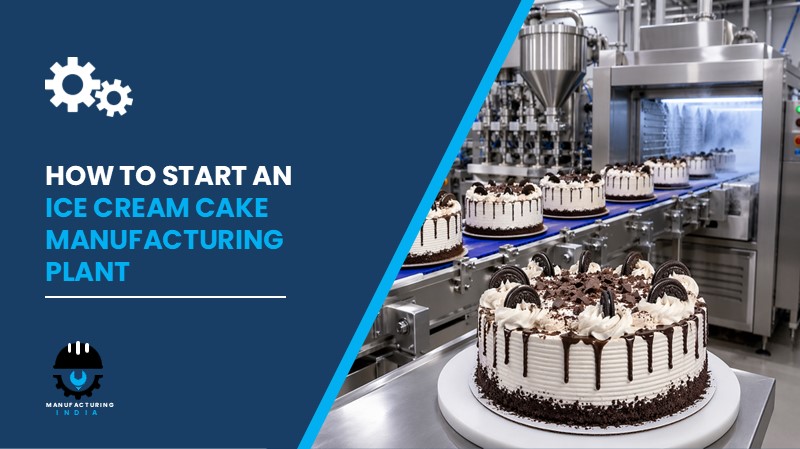
Setting up an ice cream cake manufacturing plant in India presents a compelling investment case, driven by surging consumer demand for indulgent, customized, and premium frozen desserts. This frozen confectionery product — which blends creamy, velvety ice cream layers with moist, flavorful cake — has become the go-to choice for birthdays, weddings, anniversaries, and special celebrations. As consumer preferences broaden to include health-conscious, dairy-free, and gourmet variants, the domestic manufacturing opportunity is expanding steadily across India’s urban and tier-2 markets.
India’s advantages for this investment are substantial. Rapid urbanisation, the Make in India initiative, and growing cold-chain logistics infrastructure in key manufacturing states such as Maharashtra, Gujarat, and Uttar Pradesh create a highly supportive production environment. The rise of e-commerce platforms and food delivery services has expanded market reach, enabling domestic producers to serve both planned celebrations and spontaneous consumer demand at scale. For investors evaluating a domestic ice cream cake manufacturing plant, India offers a cost-competitive, policy-supported, and demand-driven operating base that is difficult to replicate elsewhere.
“An ice cream cake manufacturing plant in India combines strong policy support, cost-competitive production, and accelerating consumer demand from the celebrations and premium dessert segments. With customizable plant capacities, favourable gross and net margin projections, and a viable break-even timeline, this investment is strategically sound for 2026.”
What is Ice Cream Cake?
Ice cream cake is a frozen confectionery product that combines the creamy indulgence of ice cream with the sweetness of cake. As described in the IMARC Group project report, it features creamy, velvety ice cream layers sandwiched between layers of moist, flavorful cake, with contrasting textures and temperatures creating a distinctive sensory experience. The product’s versatility makes it suitable for birthday celebrations, summertime refreshment, weddings, holidays, and everyday indulgence across all age groups.
Product variants span standard layered formats, low-fat and reduced-sugar options, dairy-free and oatmilk-based formulations, vegan and gluten-free versions, and premium gourmet creations using organic ingredients, exotic flavors, and handcrafted decorations. Functional variants incorporating probiotics and superfoods represent an emerging health-oriented segment gaining traction with wellness-focused consumers. The ice cream cake manufacturing process covers unit operations from ingredient preparation and mixing through freezing, layering, decorating, and packaging. End-use channels include retail supermarkets, specialty dessert shops, convenience stores, e-commerce platforms, and food delivery services.
Cost of Setting Up an Ice Cream Cake Manufacturing Plant in India
The total investment for this production facility depends on capacity, technology selection, plant location, automation level, and regulatory compliance requirements.
1. Capital Expenditure (CapEx)
Land and site development is the first major cost component. Investors may choose sites within Special Economic Zones (SEZs), food processing industrial estates, or cold-chain logistics hubs in Maharashtra, Gujarat, or Uttar Pradesh to benefit from infrastructure support and fiscal incentives. Civil works and construction cover the main production shed, cold storage and freezing rooms, quality control laboratory, raw material warehouse, finished goods storage, and administrative block — all built to meet food-grade hygiene and temperature control standards.
Machinery and equipment represent a significant capital outlay for the facility. Key machinery required includes:
- Mixing and blending equipment for cake and ice cream bases
- Baking and cooling systems for cake layer preparation
- Ice cream processing and freezing equipment
- Layering and assembly lines for product construction
- Blast freezing and hardening units
- Decoration and finishing systems
- Packaging and sealing machinery
- Cold storage and refrigeration infrastructure
- Quality control and testing instruments
Other capital costs include effluent treatment plant (ETP) setup, pre-operative expenses, trial production costs, commissioning charges, and applicable import duties on specialized equipment.
Request a Sample Report for In-Depth Market Insights: https://www.imarcgroup.com/ice-cream-cake-manufacturing-plant-project-report/requestsample
2. Operational Expenditure (OpEx)
Raw material cost forms the largest share of ongoing operational expenses. Key inputs include dairy ingredients such as vanilla ice cream and soft serve bases, cake components including sponge cake layers and red velvet cake pieces, sweeteners, flavoring agents, whipped icing, cream cheese icing, colorful sprinkles, and packaging materials. For health-focused product lines, inputs such as plant-based dairy alternatives, oatmilk, organic ingredients, probiotics, and superfoods are additionally required. Establishing long-term supplier contracts is essential to managing raw material price volatility.
Utility costs — particularly electricity for refrigeration, blast freezing, and cold storage operations — form a significant recurring expense. Other operating costs include cold-chain transportation, packaging procurement, staff salaries, maintenance, depreciation, and applicable taxes. A five-year operational cost model should account for food-sector raw material inflation and energy price trends.
3. Plant Capacity
Capacity can be configured to suit investor requirements, from smaller artisanal-scale operations to large-format industrial production. The IMARC Group project report notes that capacity parameters are customizable based on the investor’s target market — whether supplying regional retail chains, food delivery platforms, or institutional buyers such as hotel groups. Profitability improves progressively with higher capacity utilisation rates across the unit.
4. Profit Margins and Financial Projections
The full project report provides detailed financial projections including Net Present Value (NPV), Internal Rate of Return (IRR), payback period, gross margin, and net margin across a five-year horizon. The analysis covers income projections, expenditure projections, taxation, depreciation, liquidity, uncertainty, and sensitivity analysis. Investors should reference the complete report for capacity-specific margin data and break-even timelines.
Why Set Up an Ice Cream Cake Plant in India?
Growing Demand for Premium and Gourmet Desserts. Consumers are increasingly seeking high-quality products crafted with superior ingredients, innovative flavor profiles, and artisanal techniques. Premium variants featuring organic ingredients, exotic flavors, and handcrafted decorations command higher pricing and cater to sophisticated palates across India’s expanding urban base.
Expanding Celebrations and Social Media Culture. Personalized products for birthdays, weddings, and anniversaries are a significant demand driver. The trend of sharing visually appealing desserts on social media platforms has amplified demand for intricately designed products, creating strong manufacturing growth opportunities for domestic investors.
Health-Conscious Product Innovation. The shift toward reduced sugar, plant-based, vegan, gluten-free, and allergen-free formulations broadens market addressability significantly. Functional ingredients such as probiotics and superfoods represent a high-growth product extension well-aligned with India’s rapidly expanding wellness-oriented urban consumer segment.
Policy and Cost Advantages. The Make in India initiative and food processing investment schemes provide strong policy tailwinds for new entrants. India’s cost advantages in land, labour, and domestic dairy supply reduce input costs relative to developed markets, supporting competitive pricing and stronger margins.
Active Global Industry Expansion. In April 2024, Rich Products and Hometown Food Company introduced the first Funfetti Ice Cream Cake across major US grocery chains including ShopRite, Publix, and Kroger. In January 2025, Dairy Queen relaunched its Red Velvet Cake Blizzard Treat and Red Velvet Blizzard Cupid Cake. In 2025, FAT Brands — operating a global franchise network of over 2,300 locations — expanded its ice cream cake offering through a new tri-branded concept in Roanoke, Texas. These global developments confirm strong market momentum that India-based producers are well-positioned to leverage.
E-Commerce and Digital Distribution Growth. In March 2024, Baskin-Robbins launched nationwide mobile ordering via the BR App, underscoring the growing importance of digital channels. India’s rapidly expanding food delivery ecosystem and e-commerce infrastructure offers domestic manufacturers scalable, direct-to-consumer distribution at competitive logistics costs.
Manufacturing Process – Step by Step
The ice cream cake manufacturing process involves multiple unit operations as outlined in the IMARC Group project report, covering raw material procurement through to finished product dispatch.
- Raw Material Procurement and Inspection: Dairy ingredients, cake components, sweeteners, flavorings, and packaging materials are sourced, inspected, and quality-cleared for production.
- Cake Layer Preparation: Mixing, baking, and cooling of cake bases to defined recipe specifications.
- Ice Cream Base Preparation: Blending of dairy or plant-based ingredients to achieve the required flavor profile and consistency.
- Freezing and Hardening: Ice cream base is processed through freezing equipment to defined temperature and texture standards.
- Layering and Assembly: Cake and ice cream layers are combined with whipped icing, cream cheese icing, colorful sprinkles, and other inclusions as per product specification.
- Blast Freezing: Assembled products undergo blast freezing for rapid and consistent hardening.
- Decoration and Finishing: Application of toppings and decorative elements per the product design brief.
- Quality Control Testing: Batch-level testing covering texture, temperature compliance, microbiological safety, and compositional checks.
- Packaging and Cold Storage: Products are sealed, labeled, and transferred to cold storage for dispatch preparation.
- Dispatch to End-Use Channels: Distribution to supermarkets, specialty dessert shops, convenience stores, food delivery services, and e-commerce platforms.
Key Applications
The product serves a broad range of consumption occasions and distribution channels across the frozen confectionery segment.
- Birthday Celebrations: The primary consumption occasion, driven by demand for customized designs and personalized flavors.
- Weddings and Special Occasions: A premium alternative to traditional cakes, chosen for novelty, visual appeal, and uniqueness.
- Holidays and Seasonal Events: High-volume demand periods tied to festive celebrations and family gatherings.
- Summertime Refreshment: Strong seasonal demand as a refreshing frozen dessert indulgence.
- Retail Distribution: Supplied through supermarkets, specialty dessert shops, and convenience stores for planned and impulse purchases.
- E-Commerce and Food Delivery: Online platforms enabling home delivery of customized products, a rapidly growing channel.
- Gourmet and Artisanal Foodservice: Premium variants for high-end foodservice, corporate gifting, and institutional buyers.
Leading Manufacturers
The global market features established players driving product innovation, distribution expansion, and new format development. Key manufacturers identified in the IMARC Group project report include:
- Rich Products (in partnership with Hometown Food Company)
- Baskin-Robbins
- FAT Brands (operating Great American Cookies, Marble Slab Creamery, and Pretzelmaker)
- Dairy Queen
- Cold Stone Creamery
- Carvel (in collaboration with Oatly)
Timeline to Start the Plant
- Feasibility study and project report preparation
- Land acquisition and site development
- Regulatory approvals and environmental clearances
- Factory licence and fire safety compliance
- Machinery procurement and installation
- Raw material supplier agreements and supply chain setup
- Trial production and quality testing
- Commercial production launch
Licences and Regulatory Requirements
Starting an ice cream cake manufacturing unit in India requires several approvals:
- Business registration (Proprietorship, LLP, or Pvt Ltd)
- Factory Licence under the Factories Act
- Environmental Clearance from State Pollution Control Board
- GST Registration
- Fire Safety NOC
- Cold storage and food-grade facility compliance certification
- Effluent Treatment Plant (ETP) operational clearance
- Occupational Health and Safety compliance
Key Challenges to Consider
High Capital Requirements. Cold storage infrastructure, blast freezing systems, and food-grade production equipment represent significant upfront investment. Disciplined capital planning and appropriate project financing are essential for early-stage viability.
Raw Material Price Volatility. Dairy ingredients, cake base components, sweeteners, plant-based alternatives, and specialty flavorings are subject to price fluctuations. Long-term supplier contracts and diversified procurement strategies help manage this ongoing risk effectively.
Regulatory Compliance. Food manufacturing in India involves stringent requirements across production standards, cold storage norms, and environmental compliance. Dedicated compliance resources are necessary for sustainable operations.
Technology and Innovation Pressure. Rapidly evolving consumer demand for vegan, gluten-free, and probiotic-enriched formulations requires continuous product development investment to remain competitive in a dynamic market.
Competition. Established global players including Baskin-Robbins, Dairy Queen, Cold Stone Creamery, and FAT Brands maintain strong brand recognition and distribution networks. India-based manufacturers must differentiate through quality, customisation, and local market relevance.
Skilled Manpower. Frozen confectionery production requires trained food technologists, cold-chain logistics specialists, and quality control personnel — a continuing workforce management challenge across Indian states.
Frequently Asked Questions
1. How much does it cost to set up an ice cream cake manufacturing plant in India?
Total investment varies with capacity, location, technology, and automation. Detailed CapEx and OpEx estimates are available in the IMARC Group project report.
2. Is ice cream cake manufacturing profitable in India in 2026?
Yes — growing demand from celebrations, premium desserts, and health-conscious segments supports strong profitability potential. NPV, IRR, and five-year margin projections are detailed in the full report.
3. What machinery is required for an ice cream cake plant in India?
Key equipment includes mixing and blending systems, baking and cooling units, ice cream freezing equipment, layering lines, blast freezers, decoration systems, packaging machinery, and refrigeration infrastructure.
4. What licences and approvals are required to start an ice cream cake plant in India?
Required approvals include business registration, Factory Licence, Environmental Clearance, GST Registration, Fire Safety NOC, cold storage certification, ETP clearance, and Occupational Health compliance.
5. What raw materials are needed for ice cream cake manufacturing?
Key inputs include dairy ingredients, cake components, sweeteners, whipped icing, cream cheese icing, colorful sprinkles, plant-based alternatives, oatmilk, organic ingredients, probiotics, superfoods, and packaging materials.
6. What are the environmental compliance requirements for an ice cream cake plant in India?
The unit must secure Environmental Clearance from the State Pollution Control Board, operate an approved ETP, and comply with food processing waste management norms.
7. What is the best location to set up an ice cream cake plant in India?
Maharashtra, Gujarat, and Uttar Pradesh offer established food processing zones, cold-chain infrastructure, and proximity to dairy raw material suppliers and distribution networks.
8. What is the break-even period for this type of plant in India?
Break-even timelines vary by capacity, pricing strategy, and market penetration rate. Detailed payback period analysis across configurations is available in the IMARC Group project report.
9. What government incentives are available for manufacturers in India?
Investors may access the Make in India initiative, food processing investment schemes, state-level industrial incentives, and fiscal benefits available in SEZs and food processing industrial estates.
Key Takeaways for Investors
An ice cream cake manufacturing plant in India presents a well-timed investment opportunity anchored by strong demand from the premium desserts, celebrations, and health-conscious food segments. The production facility is financially viable across multiple plant capacities, with detailed NPV, IRR, and payback period projections available through the IMARC Group project report. With sustained global innovation spanning gourmet artisanal formats, dairy-free formulations, and functional ingredient-enriched variants, demand sustainability across consumer segments is firmly established. Investors establishing this unit now are strategically positioned to capitalise on India’s urbanisation momentum, expanding cold-chain infrastructure, and growing appetite for premium frozen confectionery.
About the Author