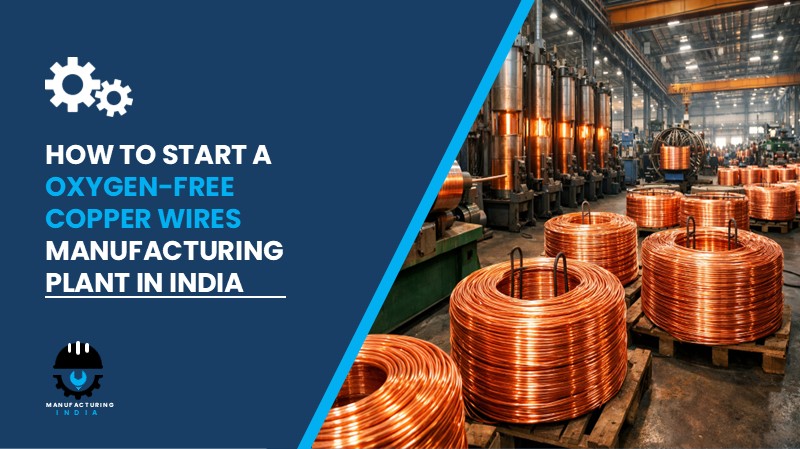
Setting up an oxygen-free copper wires manufacturing plant in India presents a compelling investment case at a moment when the country’s electronics industry, automotive sector, energy transmission infrastructure, and telecommunications network are all simultaneously scaling — and all requiring the superior electrical conductivity, corrosion resistance, and signal integrity that only oxygen-free copper (OFC) wires can reliably deliver. Oxygen-free copper wires, manufactured through electrolysis or other refined processes to reduce oxygen content to less than 0.001%, represent a precision materials category where conventional copper simply cannot meet the performance standards demanded by modern high-fidelity electronics, aerospace wiring, EV battery connections, telecom infrastructure, and advanced motor windings. As India advances across these technology-intensive sectors simultaneously, the domestic requirement for high-purity OFC wires is growing into a commercially significant and structurally durable investment opportunity.
India’s positioning for OFC wire production is strengthening on multiple dimensions. In the Indian Union Budget FY26, the Department of Telecommunications and IT received an allocation of INR 81,005.24 Crore (USD 9.27 Billion), aimed at strengthening digital infrastructure — an investment expected to boost demand for high-quality components including oxygen-free copper wires essential for advanced telecom networks. India’s copper smelting and refining capacity, particularly in Gujarat and Rajasthan, provides access to high-purity copper cathode — the critical raw material for OFC production. The Make in India initiative and government support for electronics and power equipment manufacturing provide policy tailwinds, while industrial estates in Gujarat, Maharashtra, and Rajasthan offer the energy infrastructure, inert gas supply chain access, and logistics connectivity that an OFC wire manufacturing facility requires to operate at commercial scale efficiently and competitively.
Investing in an oxygen-free copper wires manufacturing plant in India today aligns the country’s growing demand from electronics, automotive, energy transmission, and telecommunications sectors with domestic copper cathode availability, government investment in digital and energy infrastructure, and a global market growing from USD 1.91 Billion in 2025 to USD 3.32 Billion by 2034 at a 6.3% CAGR. With gross profit margins of 15–25% and net profit margins of 8–15%, the unit economics are commercially viable, and the facility’s scalable wire drawing and annealing production model — designed for 10,000 to 30,000 tons annually — supports sound returns across a well-defined investment horizon.
What are Oxygen-Free Copper Wires?
Oxygen-free copper (OFC) wires are high-purity copper wires manufactured using electrolysis or other refined processes to reduce oxygen content to less than 0.001%. This exceptional purity level enhances electrical conductivity, corrosion resistance, and durability significantly compared to conventional copper wire, making OFC wires ideal for precision electronics, high-fidelity audio systems, aerospace, telecommunications, and automotive applications where signal integrity and minimal power loss are critical performance requirements.
OFC wires are available in various grades — including C10100 (ETP OFC), C10200 (OFC), and C11000 (electrolytic tough pitch) — catering to diverse performance requirements across end-use applications. These wires exhibit superior tensile strength, flexibility, and thermal stability compared to conventional copper wires, enabling reliable performance across the demanding operating conditions of automotive under-hood environments, aerospace electronics, transformer windings, and high-current battery connections. The high-purity copper ensures consistent performance, long service life, and compatibility with automated and semi-automated wire-drawing and extrusion systems used in industrial-scale production.
The primary production process covers copper melting and refining, casting, extrusion, wire drawing, annealing, surface treatment, quality inspection, and spooling and packaging. End-use industries served include electronics and electrical equipment, automotive, energy transmission, telecommunication, audio and video systems, and industrial machinery. Applications span electrical wiring, magnet wires, high-fidelity audio cables, power distribution, telecom cables, and automotive wiring harnesses.
Cost of Setting Up an Oxygen-Free Copper Wires Manufacturing Plant in India
The cost of establishing an oxygen-free copper wires manufacturing plant in India depends on plant capacity, wire grade mix from C10100 through C11000, the degree of vertical integration between copper refining and wire drawing, geographic location, level of automation, and the purity and dimensional tolerance quality compliance requirements applicable to OFC wire supplied to electronics, automotive, and aerospace customers.
1. Capital Expenditure (CapEx)
Land and Site Development forms a foundational component of total capital investment, covering land acquisition charges, site registration, boundary development, inert gas storage containment infrastructure, drainage, and site utilities including high-capacity electrical supply for melting furnaces. Investors may explore industrial estates in Gujarat — home to India’s largest copper refining facilities including Sterlite and Hindalco operations — where proximity to copper cathode supply significantly reduces inbound logistics costs on the dominant raw material, or Maharashtra and Rajasthan where established metalworking and cable manufacturing clusters provide supporting industry infrastructure.
Civil Works and Construction cover the main production building housing melting furnaces — which require reinforced foundations and inert atmosphere infrastructure — casting lines, extrusion presses, wire drawing halls, annealing furnace bays, surface treatment stations, quality control laboratories, finished goods spooling and warehousing areas, an administrative block, and utilities infrastructure including high-capacity transformer substations and inert gas supply systems for oxygen-free atmosphere maintenance throughout the casting and early processing stages.
Machinery and Equipment represent the largest single component of total CapEx for an oxygen-free copper wires manufacturing plant. Key machinery required includes:
- High-capacity melting furnaces
- Casting machines
- Extrusion presses
- Drawing machines
- Annealing ovens
- Surface treatment systems
- Spooling and inspection equipment
Other Capital Costs include an effluent treatment plant (ETP) for managing process water and any surface treatment effluents, inert gas handling and recovery systems to maintain oxygen-free atmospheres during melting and casting, dust collection systems for wire drawing operations, pre-operative expenses, commissioning charges, and import duties on high-precision wire drawing dies or specialised continuous casting equipment not available domestically at the required OFC specification.
Request a Sample Report for In-Depth Market Insights: https://www.imarcgroup.com/oxygen-free-copper-wires-manufacturing-plant-project-report/requestsample
2. Operational Expenditure (OpEx)
Raw Material Cost is the overwhelmingly dominant operational expense, accounting for approximately 85–90% of total OpEx — the highest raw material cost concentration of any wire manufacturing category. The primary raw materials are copper cathode at 99.99%+ purity and inert gas — primarily nitrogen or argon used to maintain oxygen-free atmospheres during melting and casting operations that define the product’s distinguishing quality characteristic. Copper cathode, as the base metal consumed in the largest volumes, is a globally traded commodity whose pricing moves with LME copper futures and domestic copper production economics. The premium-grade 99.99%+ purity cathode required for OFC production commands a premium over standard electrolytic tough pitch copper, adding further cost sensitivity. Long-term procurement contracts with reliable copper cathode suppliers — including domestic refiners and import-route suppliers — are essential for production cost stability.
Utility Cost is the second-largest OpEx component, representing 5–10% of total operating expenses, covering electricity for high-capacity melting furnaces, extrusion presses, drawing machines, annealing ovens, and surface treatment systems. Melting furnace operations are the most energy-intensive production stage, requiring sustained high-temperature operation to process copper cathode into refined melt under controlled oxygen-free conditions.
Other Operating Costs include transportation and distribution to electronics manufacturers, automotive wiring harness producers, transformer and motor manufacturers, telecom cable producers, and audio equipment manufacturers, protective spool and reel packaging for finished OFC wire products, salaries and wages for metallurgical process operators and quality control chemists, routine machinery maintenance including drawing die replacement and furnace refractory upkeep, depreciation on high-value melting and extrusion equipment, and applicable taxes. By the fifth year of operations, total operational costs are projected to increase substantially due to inflation, LME copper price movements, inert gas cost changes, supply chain disruptions, rising consumer demand, and shifts in the global copper and electronics economy — all factors requiring careful incorporation into the multi-year financial model.
3. Plant Capacity
The proposed manufacturing facility for an oxygen-free copper wires plant is designed with an annual production capacity ranging between 10,000 and 30,000 tons, enabling economies of scale while maintaining the operational flexibility to serve diverse wire grades, diameters, and surface specifications across electronics, automotive, energy, and telecommunications customer segments. Plant capacity can be customised per investor requirements and scaled through additional wire drawing lines and annealing capacity as customer volumes and market penetration grow. Profitability improves meaningfully with higher capacity utilisation, making long-term supply agreements with large electronics manufacturers, automotive wiring harness producers, or transformer manufacturers a strategic commercial foundation for the investment.
4. Profit Margins and Financial Projections
The financial projections for an oxygen-free copper wires manufacturing plant demonstrate commercially viable profitability potential under normal operating conditions. Gross profit margins typically range between 15–25%, supported by stable demand across electronics, automotive, energy transmission, and telecommunications applications and the premium value-add that reduced oxygen content, superior conductivity, and tighter dimensional tolerances command relative to conventional copper wire pricing. Net profit margins are projected at 8–15%. A comprehensive financial analysis covering NPV (net present value), IRR (internal rate of return), payback period, gross margin progression, and net margin development across a five-year horizon is essential before committing capital. The project’s ROI profile and long-term sustainability are assessed against realistic assumptions on capital investment, production capacity utilisation, copper cathode pricing trends, and demand outlook from the electronics, automotive, energy, telecom, and audio end-use sectors.
Why Set Up an Oxygen-Free Copper Wires Plant in India?
Growing Demand in Electronics and Electrical Equipment. OFC wires cater to industries requiring reliable, high-conductivity, and durable wiring solutions where conventional copper’s residual oxygen content creates performance limitations. India’s rapidly expanding electronics manufacturing sector — producing consumer electronics, industrial electronics, medical devices, and defence electronics — is generating increasing domestic demand for OFC wire as manufacturers transition to higher-specification components to meet export quality requirements and domestic premium market growth.
India’s Telecommunications Infrastructure Investment. In the Indian Union Budget FY26, the Department of Telecommunications and IT received an allocation of INR 81,005.24 Crore (USD 9.27 Billion), aimed at strengthening digital infrastructure. This investment is expected to boost demand for high-quality components including oxygen-free copper wires essential for advanced telecom networks — a direct, government-funded demand signal that provides a procurement anchor for domestic OFC wire producers with telecom-grade product qualification.
Automotive Industry Growth and EV Wiring Harness Requirements. India’s automotive industry, including its rapidly expanding EV segment, requires reliable wiring harnesses and motor windings that benefit from OFC wire’s high tensile strength and flexibility. Automotive wiring harnesses are increasingly specifying OFC wire for critical circuits where resistance to vibration-induced fatigue and elevated temperature oxidation is mandatory for long-term vehicle reliability. As India’s vehicle production scales and EV adoption grows, automotive OFC wire demand represents a growing and structurally durable customer segment.
Growing Renewable Energy and Power Transmission Sector. Expanding electrical infrastructure across power generation, renewable energy integration, and grid modernisation drives demand for efficient, low-loss copper wires in transformers, motors, and power distribution systems. High-efficiency power lines and transformers increasingly utilise OFC wires to reduce resistive power losses — a commercially and technically justified premium in high-value power infrastructure where lifecycle efficiency economics justify the price premium over conventional copper wire.
Technological Advancements in Processing Efficiency. In June 2024, a research study published by MDPI highlighted advancements in dry, cold forging of oxygen-free copper using massively nitrogen-supersaturated CoCrMo dies, enabling a 70% reduction in copper bar thickness in a single stroke under low friction, without galling or copper debris adhesion. These findings demonstrate potential improvements in processing efficiency and tool longevity, offering significant implications for producing oxygen-free copper wires at reduced conversion costs — an innovation trajectory that benefits Indian producers who invest in advanced process technology from the outset.
Urbanisation, Industrial Automation, and Smart Electronics Growth. Urbanisation, industrial automation, and the proliferation of smart electronics are driving the requirement for precision wiring across data centres, smart building systems, industrial motor controls, and consumer electronics. The growth of high-fidelity audio and video equipment has further increased demand for OFC cables specifically — a premium consumer segment where brand differentiation on OFC conductor quality supports higher selling prices and margins.
Manufacturing Process — Step by Step
The oxygen-free copper wires manufacturing process uses copper melting and refining, casting, extrusion, wire drawing, annealing, surface treatment, quality inspection, and spooling and packaging as the primary production method. Each stage requires precisely controlled oxygen-free atmosphere maintenance — achieved through inert gas blanketing — temperature profiles, drawing speed, and annealing parameters to produce OFC wire meeting the sub-0.001% oxygen content, conductivity, dimensional tolerance, and surface quality specifications required by electronics, automotive, and industrial customers.
- Copper Cathode Receipt and Preparation: High-purity copper cathode at 99.99%+ purity is received from certified suppliers, quality-checked for chemical composition and surface condition, and transferred to cathode storage in preparation for oxygen-free melt processing.
- Copper Melting and Refining under Inert Atmosphere: Copper cathode is charged into high-capacity melting furnaces operating under controlled inert gas atmosphere — nitrogen or argon — that prevents oxygen re-introduction during the melt stage. Melt temperature, furnace atmosphere oxygen content, and hold time are precisely monitored and controlled to achieve the sub-0.001% oxygen specification that defines OFC grade material.
- Casting: Refined oxygen-free copper melt is cast into rod or bar form using casting machines operating under inert atmosphere conditions, with controlled solidification rate and mould cooling to achieve the grain structure and surface quality required for subsequent wire drawing processing without internal voids or segregation.
- Extrusion: Cast OFC rod is processed through extrusion presses to reduce cross-section and improve dimensional consistency, creating the extrusion billet geometry required for efficient multi-pass wire drawing to fine wire diameters.
- Wire Drawing: Extruded OFC rod is drawn through progressive dies in drawing machines to reduce diameter from rod dimensions to the target wire gauge — whether intermediate wire for magnet wire production, fine wire for electronics or audio applications, or heavy wire for power distribution — with drawing lubricant applied at each pass to minimise friction heat and surface damage.
- Annealing: Drawn OFC wire is processed through annealing ovens under protective inert atmosphere to relieve work hardening from the drawing process, restore the conductor’s ductility and flexibility, and develop the tensile strength, elongation, and electrical conductivity specifications required for the target application.
- Surface Treatment: Annealed OFC wire is processed through surface treatment systems for cleaning, brightening, or tin plating where specified by customer requirements — tin-plated OFC wire being a common requirement for automotive and soldering-intensive electronics applications.
- Quality Inspection: Finished OFC wire is comprehensively tested at inspection equipment stations covering electrical conductivity, oxygen content verification, tensile strength, elongation, surface condition, and dimensional measurement across the wire diameter range, ensuring compliance with ASTM, EN, or customer-specific standards.
- Spooling and Packaging: Inspected and approved OFC wire is spooled onto reels of specified dimensions using spooling and inspection equipment, labelled with grade, specification, and batch traceability information, and packaged for dispatch to electronics manufacturers, automotive wiring harness producers, transformer and motor manufacturers, telecom cable producers, and audio equipment manufacturers.
Key Applications
Oxygen-free copper wires manufactured in India serve a commercially diverse and technically demanding range of applications across multiple high-growth industrial sectors:
- Electronics and Electrical Equipment: OFC wires ensure minimal signal loss and high conductivity for sensitive devices including transformers, inductors, and precision signal wiring where oxygen-induced conductivity degradation would compromise device performance.
- Automotive Industry: Reliable wiring harnesses and motor windings benefit from OFC wire’s high tensile strength, flexibility, and resistance to corrosion and fatigue failure in demanding under-hood and battery connection environments.
- Energy Transmission: High-efficiency power lines and transformers utilise OFC wires to reduce resistive power losses in electrical infrastructure where lifecycle energy efficiency justifies the premium over conventional copper wire.
- Telecommunication and Audio Systems: Superior signal integrity supports high-quality audio, video, and data transmission in telecom cables, high-fidelity audio cables, and broadcast-grade signal interconnect applications.
Leading Manufacturers
The global oxygen-free copper wires industry is served by a group of specialised copper processing companies with extensive production capabilities across multiple wire grades, diameters, and surface specifications. Key players in the global market include:
- Sandvik
- Luvata
- Elektrokoppar
- NBM Metals
- Mitsubishi Materials
- Ningbo Jintian Copper
Timeline to Start the Plant
Establishing an oxygen-free copper wires manufacturing plant in India involves a structured multi-phase development sequence. Investors should plan for the following phases:
- Feasibility study and project report preparation
- Land acquisition and site development
- Regulatory approvals and environmental clearances
- Factory licence and fire safety compliance
- Machinery procurement and installation
- Raw material supplier agreements and supply chain setup
- Trial production and quality testing
- Commercial production launch
Licences and Regulatory Requirements
Starting an oxygen-free copper wires manufacturing unit in India requires several approvals spanning business registration, industrial, chemical handling, environmental, and safety compliance domains:
- Business registration (Proprietorship, LLP, or Pvt Ltd)
- Factory Licence under the Factories Act
- Environmental Clearance from the State Pollution Control Board
- GST Registration
- Fire Safety NOC
- Hazardous/Chemical compliance applicable to inert gas handling — specifically large-scale nitrogen and argon storage and distribution systems under gas safety regulations
- Effluent Treatment Plant (ETP) operational clearance for managing surface treatment effluents and process water
- Occupational Health and Safety compliance
Key Challenges to Consider
Extreme Raw Material Cost Concentration and LME Copper Volatility. Copper cathode at 99.99%+ purity accounts for approximately 85–90% of total OpEx — the highest raw material cost concentration in the wire manufacturing category — with pricing directly tied to LME copper futures that can fluctuate 20–30% or more annually. Managing this cost concentration requires active copper price hedging strategies, forward purchasing aligned with customer order books, long-term procurement contracts with domestic refiners, and careful inventory positioning relative to LME copper price cycle expectations.
Inert Atmosphere Technology Complexity and Operating Cost. Maintaining oxygen-free conditions throughout the melting, casting, and critical early processing stages requires continuous inert gas supply, sealed furnace and casting environments, and reliable gas monitoring systems. Inert gas represents a significant secondary input cost that must be managed through on-site nitrogen generation, long-term industrial gas contracts, or gas recovery systems — adding operational complexity beyond conventional copper wire manufacturing.
Premium Grade Cathode Supply and Purity Certification. The 99.99%+ purity copper cathode required for OFC production is available from a more limited supplier base than standard electrolytic tough pitch copper, and its supply must be accompanied by certified chemical composition documentation for customer quality traceability requirements. Building robust premium cathode procurement channels — from domestic refiners including Hindalco and Sterlite, and import routes — requires investment in supplier qualification and relationship management.
Customer Qualification Cycles for Aerospace and Automotive Applications. Supplying OFC wire to aerospace, automotive, and precision electronics customers requires passage through rigorous material qualification and supply chain approval processes that verify chemical composition, mechanical properties, and process consistency across production batches. These qualification cycles can extend 12–24 months and require documented process control data, third-party testing, and continuous improvement evidence before production volume approvals are granted.
Competition from Established Global Producers. The competitive landscape includes globally established OFC wire producers such as Sandvik, Luvata, Mitsubishi Materials, and Ningbo Jintian Copper, which carry established customer qualifications, proven product portfolios across wire grades, and significant scale advantages. New Indian entrants must compete through domestic supply chain advantages, competitive pricing, faster local delivery, and the ability to customise wire specifications for India-specific application requirements to establish commercial positions against established international suppliers.
Skilled Metallurgical Workforce. Maintaining the process discipline required to consistently achieve sub-0.001% oxygen content, target dimensional tolerances, and surface quality specifications across high-volume wire drawing and annealing operations demands trained copper metallurgists, wire drawing process specialists, and analytical quality control chemists — a technical workforce requiring ongoing investment in recruitment, university collaboration, and specialised training programmes.
Frequently Asked Questions
1. How much does it cost to set up an oxygen-free copper wires manufacturing plant in India?
The total setup cost depends on plant capacity, wire grade and diameter mix, level of vertical integration, location, and automation level. CapEx covers land and site development, inert atmosphere-capable civil construction, core machinery including high-capacity melting furnaces, casting machines, extrusion presses, drawing machines, annealing ovens, surface treatment systems, and spooling and inspection equipment, along with inert gas infrastructure, ETP, and other capital costs. A detailed project report with full CapEx and OpEx breakdowns is available on request.
2. Is oxygen-free copper wires manufacturing profitable in India in 2026?
Yes. The project demonstrates gross profit margins of 15–25% and net profit margins of 8–15% under normal operating conditions, supported by stable and growing demand from electronics, automotive, energy transmission, and telecommunications sectors. India’s government investment of INR 81,005.24 Crore in telecommunications infrastructure for FY26 and the country’s expanding electronics and EV manufacturing base provide specific and quantified domestic demand anchors for OFC wire producers.
3. What machinery is required for an oxygen-free copper wires plant in India?
Key machinery includes high-capacity melting furnaces, casting machines, extrusion presses, drawing machines, annealing ovens, surface treatment systems, and spooling and inspection equipment. High-capacity melting furnaces with inert atmosphere capability are the most technically critical and capital-intensive equipment items, as they define the oxygen-free quality characteristic of the entire production.
4. What licences and approvals are required to start an oxygen-free copper wires plant in India?
Required approvals include business registration, a Factory Licence under the Factories Act, Environmental Clearance from the State Pollution Control Board, GST registration, a Fire Safety NOC, hazardous/chemical compliance approvals for inert gas handling and storage, ETP operational clearance for surface treatment effluents, and Occupational Health and Safety compliance.
5. What raw materials are needed for oxygen-free copper wires manufacturing?
The primary raw materials are copper cathode at 99.99%+ purity and inert gas — specifically nitrogen or argon. Copper cathode accounts for approximately 85–90% of total operating expenses, making copper cathode procurement strategy, LME price risk management, and purity certification assurance the most critical operational cost and quality management levers for the investment.
6. What are the environmental compliance requirements for an oxygen-free copper wires plant in India?
The unit must obtain Environmental Clearance from the State Pollution Control Board, operate a certified ETP for managing surface treatment effluents and process water, comply with industrial gas safety regulations for inert gas storage and distribution, implement dust collection systems for wire drawing operations, and maintain monitoring systems for wastewater discharge and air emissions in line with applicable state pollution control standards.
7. What is the best location to set up an oxygen-free copper wires plant in India?
Optimal locations offer proximity to domestic copper cathode refining facilities or import-capable port terminals, reliable high-capacity electricity supply for furnace operations, inert gas supply chain access, and logistics connectivity to electronics manufacturing, automotive, and energy infrastructure customer clusters. Industrial estates in Gujarat — home to India’s major copper refineries — and Maharashtra are among the most strategically relevant options, with established metalworking infrastructure and copper industry supply chains.
8. What is the break-even period for this type of plant in India?
The break-even period depends on plant capacity, customer qualification timelines, capacity utilisation rate, LME copper pricing trends, and demand conditions across electronics, automotive, and energy sectors. A detailed financial analysis including payback period, NPV, and IRR projections is included in the full project report, available via the sample request link.
9. What government incentives are available for manufacturers in India?
The Make in India initiative, PLI schemes for electronics and specialty materials manufacturing, and state-level industrial promotion policies in Gujarat and Maharashtra provide financial and regulatory support for OFC wire production investments. Capital subsidies, power tariff concessions, and export promotion benefits may be applicable depending on the chosen plant location and production profile.
Key Takeaways for Investors
An oxygen-free copper wires manufacturing plant in India represents a commercially grounded investment in a technically differentiated materials category driven by structural demand growth from electronics manufacturing, automotive wiring, energy transmission, and telecommunications infrastructure — sectors that are all simultaneously expanding in India with government policy support and private capital investment. The project demonstrates financial viability across annual production capacities of 10,000 to 30,000 tons, with gross profit margins of 15–25% and net profit margins of 8–15% confirming commercially viable unit economics when supported by scale, copper procurement discipline, and a product grade mix oriented toward higher-specification OFC categories. The global oxygen-free copper wires market, valued at USD 1.91 Billion in 2025, is projected to reach USD 3.32 Billion by 2034, growing at a CAGR of 6.3% from 2026 to 2034, with India’s government investment in telecommunications, electronics, and energy infrastructure placing domestic demand at the forefront of the country’s advanced materials requirements. With India’s electronics and automotive manufacturing sectors deepening their OFC wire specifications, telecom network buildout accelerating under INR 81,005.24 Crore in government FY26 investment, and process innovations in dry forging and inert atmosphere casting improving production efficiency, demand sustainability for India-based oxygen-free copper wires production is structurally robust across the full investment horizon.
About the Author