Setting up a milk powder manufacturing plant in India presents a compelling investment case backed by surging demand across the food and beverage, infant nutrition, bakery and confectionery, and dairy processing industries. Milk powder – a dehydrated dairy product valued for its extended shelf life, ease of transport, and nutritional density – has emerged as a cornerstone ingredient in modern food manufacturing. India’s vast dairy ecosystem, combined with growing urban consumption of packaged and processed foods, is generating consistent downstream demand for this shelf-stable product, making it one of the most attractive segments for food-sector investment in 2026.
India’s structural advantages compound the opportunity. Rapid urbanisation is shifting consumer preferences toward convenient, long-shelf-life dairy formats, while the government’s Make in India initiative continues to support domestic manufacturing across the food processing value chain. States such as Gujarat and Maharashtra, with their established dairy cooperatives, cold-chain infrastructure, and industrial estates, offer ideal conditions for milk powder production at scale. Proximity to raw milk supply zones, lower land and labour costs relative to developed markets, and a large institutional buyer base – from FMCG companies to school feeding programmes – make India strategically sound for this investment.
India’s milk powder manufacturing sector is well-positioned at the intersection of policy support, cost-competitive dairy procurement, and expanding demand from infant nutrition, bakery, and processed food industries. With gross profit margins of 20–30% and net margins of 8–12%, a well-capitalised plant offering 10,000–20,000 MT annual capacity can achieve break-even within a financially viable horizon, making this an investment with measurable and sustainable returns.
What is Milk Powder?
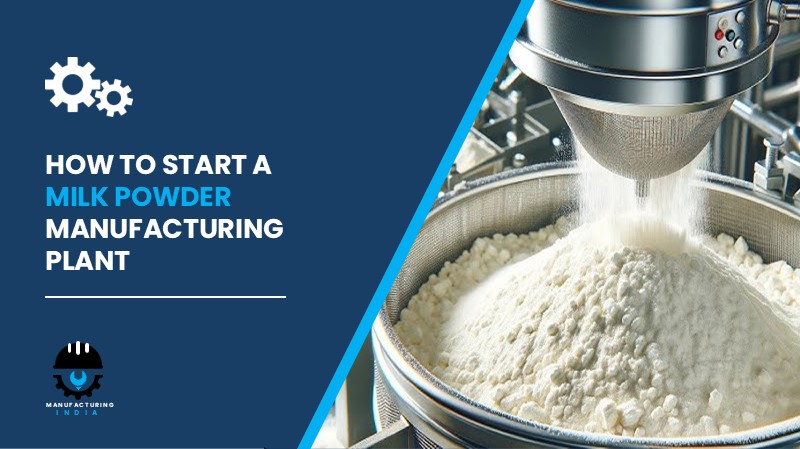
Milk powder is a dehydrated dairy product that results from the complete evaporation of water from liquid milk through controlled thermal processes, retaining its original nutritional value throughout. It is composed of proteins, lactose, milk fats, minerals, and vitamins in a highly concentrated form. This concentrated composition gives the product a long shelf life while remaining more economical to store and transport than fresh milk. The product is available in several distinct forms – whole milk powder, skimmed milk powder, and fat-filled milk powder – with selection determined by fat content and the intended application.
The production process involves pasteurization, evaporation, spray drying, and packaging as its primary stages. One of the defining commercial qualities of milk powder is its reliable solubility and ease of reconstitution, which accounts for its widespread adoption in food production and infant feeding. End-use industries served include food and beverage manufacturing, infant nutrition, bakery and confectionery, dairy processing, and the pharmaceutical and nutraceutical sector.
Cost of Setting Up a Milk Powder Manufacturing Plant in India
The cost of establishing a milk powder manufacturing plant in India depends on several interdependent variables: production capacity, technology selection, geographic location, level of process automation, and the scope of regulatory compliance requirements. A detailed project report – covering CapEx, OpEx, and multi-year financial projections – is essential before committing capital.
1. Capital Expenditure (CapEx)
Land and Site Development: forms a substantial portion of the total capital investment, covering land registration charges, boundary development, drainage, and related civil preparatory expenses. Investors should evaluate Special Economic Zones (SEZs) and designated dairy processing industrial estates, which often offer concessional land rates and pre-cleared environmental permissions, reducing both cost and timeline.
Civil Works and Construction: includes construction of the main processing shed, quality control laboratory, raw milk intake bay, dry powder storage silos, finished goods warehouse, effluent treatment area, and the administrative block. Proper hygiene-grade construction is mandatory in dairy processing facilities.
Machinery and Equipment: represents the largest single component of CapEx. Key machinery required includes:
- Pasteurizers
- Evaporators
- Spray dryers
- Fluidized bed dryers
- Silos
- Packaging machines
Other Capital Costs: include the Effluent Treatment Plant (ETP), pre-operative and commissioning expenses, import duties on specialised drying equipment where applicable, and contingency provisions.
Request a Sample Report for In-Depth Market Insights: https://www.imarcgroup.com/milk-powder-manufacturing-plant-project-report/requestsample
2. Operational Expenditure (OpEx)
Raw Material Cost: is the dominant operating expense driver for any milk powder manufacturing facility. Raw milk – the sole primary raw material – accounts for approximately 75–85% of total OpEx. Given this concentration, long-term procurement contracts with dairy cooperatives or large milk aggregators are essential to stabilise input costs and ensure consistent production quality. Procurement strategy should account for seasonal fluctuations in raw milk supply, which directly impact throughput planning.
Utility Cost: covering electricity for spray drying and refrigeration, water for processing and cleaning, and steam for pasteurization and evaporation – represents 10–15% of total OpEx, making energy efficiency a meaningful lever for margin improvement.
Other Operating Costs: encompass transportation and outbound logistics, primary and secondary packaging materials, salaries and wages for production, quality, and administrative staff, routine equipment maintenance, depreciation on capital assets, and applicable taxes. By the fifth year of operations, total operational costs are projected to increase substantially, driven by inflation, market fluctuations, potential increases in raw milk procurement costs, supply chain disruptions, and rising consumer demand dynamics.
3. Plant Capacity
The proposed manufacturing facility is designed with an annual production capacity ranging between 10,000 and 20,000 MT, enabling economies of scale while maintaining operational flexibility for diverse product grades. Capacity can be customised to suit individual investor requirements, whether a smaller entry-scale unit or a larger integrated dairy processing complex. As a general principle, profitability improves meaningfully at higher capacity utilisation rates, making demand-side planning critical to the plant’s financial performance.
4. Profit Margins and Financial Projections
The project demonstrates healthy profitability under normal operating conditions. Gross profit margins typically range between 20–30%, supported by stable demand and value-added applications across multiple end-use industries. Net profit margins range between 8–12% after accounting for full operating costs, depreciation, and tax obligations.
A complete financial model for this investment encompasses NPV (Net Present Value), IRR (Internal Rate of Return), payback period analysis, gross and net margin projections, a detailed profit and loss account, liquidity analysis, sensitivity analysis, and uncertainty analysis – all of which are covered in the full project report.
Why Set Up a Milk Powder Plant in India?
Essential Nutritional Demand: Milk powder is a critical source of nutrition for populations in areas with limited cold-chain infrastructure, making it the most widely consumed dairy format in several high-growth markets. This structural role in food security ensures demand does not fluctuate with economic cycles in the way discretionary food products do.
Stable, Broad-Based Applications: The product’s versatility – serving household consumption, infant formula production, bakery mixes, dairy-based beverages, confectionery fillings, and processed food formulations – means demand is distributed across multiple buyer segments. This diversification insulates manufacturers from single-sector demand slowdowns.
Urbanisation and Lifestyle Alignment: The changing lifestyle of urban populations, increasingly busy schedules, and growing reliance on convenient packaged foods have resulted in an acceleration in milk powder consumption. India’s ongoing urbanisation trajectory reinforces this trend across Tier 1 and Tier 2 cities alike.
Policy and Regulatory Tailwinds: Government-supported nutrition programmes, school feeding initiatives, and dairy development policies in developing countries – including India – are sustaining institutional demand. The Make in India framework supports domestic dairy processing investment through infrastructure incentives and preferential procurement policies.
Active Industry Investment: The global milk powder industry has seen notable product launches in recent months. In January 2026, Sujal Dairy Private Limited entered Nepal’s instant milk powder segment with the launch of Delite Dairy Pride, an instant full cream milk powder enriched with calcium, protein, and vitamins A and D, available across modern retail and e-commerce channels. In May 2025, Nova Dairy introduced a skimmed milk powder targeting health-conscious consumers, designed for everyday use, cooking, and wellness-oriented recipes. These launches reflect the rising commercial activity in this segment and the growing appetite for new product formats.
Export and Shelf-Life Advantage: The long shelf life and ease of transport make milk powder a highly competitive export commodity. Indian manufacturers can efficiently access international markets, particularly in Southeast Asia and Africa, where cold-chain limitations favour powdered dairy formats.
Manufacturing Process – Step by Step
The milk powder manufacturing process uses pasteurization, evaporation, spray drying, and packaging as the primary production method. The following are the main stages involved:
- Raw Milk Intake and Quality Testing: Incoming raw milk is received, weighed, and subjected to quality checks for fat content, SNF, acidity, and microbial load before entering the process line.
- Pasteurization: Raw milk passes through a pasteurizer where it is heated to eliminate pathogens while preserving nutritional integrity, meeting food safety standards.
- Evaporation: The pasteurized milk is fed into evaporators, which remove a large proportion of the water content under controlled temperature and vacuum conditions, concentrating the milk solids.
- Spray Drying: The concentrated milk is atomised into a fine mist and introduced into a spray dryer where hot air rapidly removes the remaining moisture, producing fine milk powder particles.
- Fluidized Bed Drying: The powder passes through a fluidized bed dryer for secondary drying and to achieve the desired moisture content, particle size, and bulk density specifications.
- Silo Storage: Finished powder is transferred to silos for intermediate bulk storage under controlled humidity and temperature conditions to preserve quality.
- Packaging: The final product is packaged into appropriate formats – from bulk industrial bags to consumer retail packs – and dispatched to end-use industries including food and beverage manufacturers, infant nutrition producers, bakeries, and dairy processors.
Key Applications
Milk powder serves a diverse range of industries, each relying on its unique functional and nutritional properties:
- Food and Beverage Industry: Used in beverages, sauces, soups, ready-to-eat meals, and dairy analogues for its emulsifying and flavour-enhancing properties.
- Infant Nutrition Industry: Serves as a primary ingredient in infant formula, delivering essential proteins, minerals, and controlled fat content.
- Bakery and Confectionery Industry: Improves texture, browning, moisture retention, and nutritional value in baked goods and chocolates.
- Dairy Processing Industry: Used in yogurt, ice cream, cheese analogues, and recombined dairy products for consistency and shelf stability.
- Pharmaceutical and Nutraceutical Industry: Acts as a carrier and nutritional base in medical foods, supplements, and fortified formulations.
Leading Manufacturers
The global milk powder industry is served by several multinational companies with extensive production capacities and diverse application portfolios. Key players include:
- Arla Foods amba
- Danone S.A.
- Saputo Inc.
- Schreiber Foods
- Lactalis Ingredients
- Nestlé S.A.
- Olam International Limited
- Royal FrieslandCampina N.V.
- Westland Milk Products
- Dairy Farmers of America, Inc.
- HOCHDORF Swiss Nutrition AG
- Fonterra Co-Operative Group Limited
Timeline to Start the Plant
- Feasibility study and project report preparation
- Land acquisition and site development
- Regulatory approvals and environmental clearances
- Factory licence and fire safety compliance
- Machinery procurement and installation
- Raw material supplier agreements and supply chain setup
- Trial production and quality testing
- Commercial production launch
Licences and Regulatory Requirements
Starting a milk powder manufacturing unit in India requires several approvals:
- Business registration (Proprietorship, LLP, or Pvt Ltd)
- Factory Licence under the Factories Act
- Environmental Clearance from State Pollution Control Board
- GST Registration
- Fire Safety NOC
- FSSAI (Food Safety and Standards Authority of India) licence – mandatory for all dairy food manufacturing units
- Effluent Treatment Plant (ETP) operational clearance
- Occupational Health and Safety compliance
Key Challenges to Consider
High Capital Requirements: Establishing a milk powder plant – with its spray drying systems, evaporators, and controlled-environment storage – involves significant upfront investment in machinery and civil works, requiring careful project financing planning.
Raw Material Price Volatility: Raw milk, which constitutes 75–85% of total OpEx, is subject to seasonal procurement fluctuations and pricing variability. Securing long-term supplier contracts and diversifying procurement zones are essential risk mitigation strategies.
Regulatory Compliance: Dairy processing in India is governed by FSSAI standards, environmental clearance requirements, and effluent discharge norms. Navigating these across central and state-level jurisdictions requires dedicated compliance resources.
Technology and Innovation Pressure: The industry is evolving with product launches targeting specific nutritional profiles – such as skimmed milk powder for health-conscious consumers and fortified formats for institutional nutrition programmes. Investors must factor in ongoing product development capacity.
Competition from Global Players: The presence of established multinationals such as Nestlé S.A., Fonterra Co-Operative Group Limited, Danone S.A., and Arla Foods amba creates competitive benchmarks on quality, cost, and product range that domestic producers must be prepared to meet.
Skilled Manpower: Operating spray dryers, evaporators, and quality control systems requires trained food technologists and dairy engineers. Talent acquisition and retention in manufacturing-intensive states must be built into the operational plan.
Frequently Asked Questions
1. How much does it cost to set up a milk powder manufacturing plant in India?
The total cost depends on capacity, technology, location, and automation level. The full CapEx breakdown – covering land, civil works, machinery (including pasteurizers, evaporators, spray dryers, and packaging machines), and other capital costs – is available in IMARC Group’s detailed project report.
2. Is milk powder manufacturing profitable in India in 2026?
Yes. The project demonstrates gross profit margins of 20–30% and net profit margins of 8–12% under normal operating conditions, supported by stable multi-sector demand.
3. What machinery is required for a milk powder plant in India?
Key equipment includes pasteurizers, evaporators, spray dryers, fluidized bed dryers, silos, and packaging machines.
4. What licences and approvals are required to start a milk powder plant in India?
Required approvals include business registration, Factory Licence, FSSAI licence, Environmental Clearance, GST Registration, Fire Safety NOC, ETP clearance, and Occupational Health and Safety compliance.
5. What raw materials are needed for milk powder manufacturing?
Raw milk is the primary raw material, accounting for 75–85% of total operating expenditure.
6. What are the environmental compliance requirements for a milk powder plant in India?
An operational Effluent Treatment Plant (ETP) is mandatory. Environmental Clearance from the State Pollution Control Board and compliance with effluent discharge norms are also required.
7. What is the best location to set up a milk powder plant in India?
Ideal locations offer proximity to raw milk supply, access to utilities and transport infrastructure, and alignment with local zoning regulations. Gujarat and Maharashtra are among the most established dairy processing states. SEZs and food processing industrial estates offer additional advantages.
8. What is the break-even period for this type of plant in India?
The break-even period depends on capacity utilisation, pricing strategy, and cost management. A detailed payback period analysis is included in the full feasibility report available from IMARC Group.
9. What government incentives are available for manufacturers in India?
Food processing manufacturers in India can access incentives under the Make in India initiative, PLI schemes for food processing, state-level capital subsidy programmes, and support from institutions such as NABARD for dairy sector investments.
Key Takeaways for Investors
A milk powder manufacturing plant in India represents a structurally sound investment opportunity, underpinned by consistent demand from the food and beverage, infant nutrition, bakery and confectionery, and dairy processing industries. The financial profile is compelling across plant capacities, with gross margins of 20–30% and net margins of 8–12% providing a healthy return framework for investors who manage raw material procurement strategically. The global milk powder market was valued at USD 38.47 Billion in 2025 and is projected to reach USD 61.76 Billion by 2034, exhibiting a CAGR of 5.4% from 2026 to 2034 – a trajectory that reflects sustained long-term demand for India-produced milk powder in both domestic and export markets. With urbanisation trends, institutional nutrition programmes, and convenience-oriented consumer behaviour all reinforcing demand growth, the investment case for this facility remains robust well beyond the immediate planning horizon.
About the Author