A defect keeps returning to the same line. A customer complaint closes, then reopens months later. An auditor flags the same non-conformity twice. In each case, someone likely ran an RCA and signed off a corrective action — yet the problem came back.
This is usually not a failure of effort but of depth. Internal teams, under production pressure, often stop at the first plausible explanation — operator error, a machine glitch, a supplier lot — before reaching the system-level reason the failure was possible at all.
This is where an external Root Cause Analysis Consul tant in India can add value: not by repeating the same first-pass conclusion faster, but by asking why the process or control allowed the failure to occur.Choosing the right consultant, however, requires a structured evaluation of experience, investigation depth and corrective-action capability.
Quick Answer: How Should You Choose a Root Cause Analysis Consultant?
Choose a consultant based on demonstrated manufacturing-sector experience, willingness to physically investigate the shop floor rather than work only from documents, and evidence-based methodology rather than one fixed template. A strong Root Cause Analysis Consultant should handle data analysis, understand how RCA connects to CAPA, lead cross-functional investigations across quality, production, maintenance, and procurement, and deliver a report naming a corrective action, an owner, a timeline, and a way to verify the fix worked.
Why Manufacturing Problems Need More Than a Surface-Level RCA
Most manufacturing investigations end at the immediate cause: a worn tool, a mislabelled batch, a supplier variation. These explanations are usually true, but rarely complete. A useful way to see this is as a chain:
- Immediate Cause — what directly triggered the failure
- Contributing Cause — conditions that made it more likely
- Root/Systemic Cause — the process or control gap that allowed it
- Corrective Action — the change that closes that gap
- Effectiveness Verification — proof the change actually worked
Stopping at “operator error” answers who failed, not why the system allowed it. A capable consultant investigates why the inspection step, process design, or control system did not catch the failure earlier.
What Should You Check Before Hiring a Root Cause Analysis Consultant?
7 CHECKS BEFORE HIRING A ROOT CAUSE ANALYSIS CONSULTANT
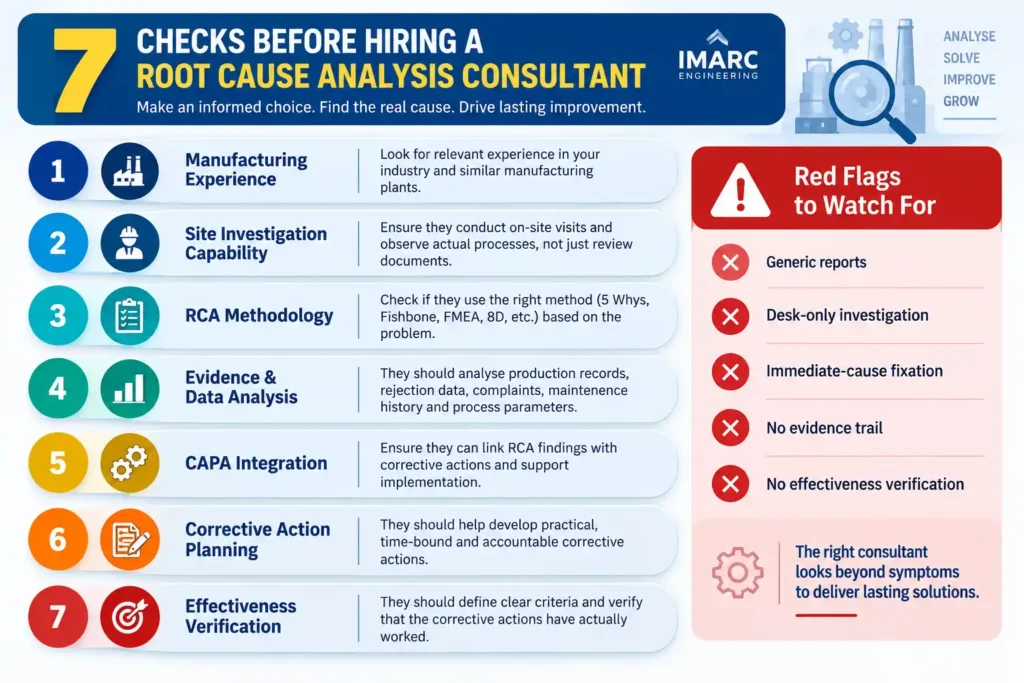
Relevant Manufacturing Experience
Generic consulting experience does not transfer easily to a factory floor. A consultant familiar with pharmaceuticals, food and beverage, chemicals, automotive components, electronics, engineering goods, or FMCG understands sector-specific failure patterns and constraints.
Site Investigation Capability
RCA done entirely from emailed data rarely finds the real cause. The consultant should observe machines, walk the process sequence, watch operator practices, and check material flow and records on-site — desk review cannot replace direct observation.
Problem-Specific Methodology
5 Whys, Fishbone, Pareto, FMEA, Fault Tree Analysis, 8D and process mapping suit different situations. The important question is whether the consultant can select the method based on the problem rather than applying one tool to every investigation.
Evidence-Based Investigation
A defensible RCA connects problem, evidence, cause, verification, and corrective action in a traceable line, using production records, rejection data, complaint logs, maintenance history, and process parameters. A cause with no supporting evidence is a hypothesis, not a finding.
CAPA Capability
RCA that does not feed a workable CAPA is only half the job. The flow runs from root cause to corrective action, implementation, and effectiveness verification — the consultant should carry findings that far.
Cross-Functional Investigation
Recurring problems often cross departmental boundaries. Quality, production, maintenance, engineering, stores, procurement and suppliers may each hold part of the evidence, so the consultant should be able to coordinate a structured investigation without defaulting to blame.
Reporting and Deliverables
The final report should include a clear problem statement, evidence reviewed, root and contributing causes, corrective action with owner and timeline, and effectiveness criteria.
When Should a Manufacturing Plant Hire an RCA Consultant?
External Root Cause Analysis Support is worth considering when:
- Defects or non-conformities recur despite previous fixes
- Customer complaints repeat for the same product or process
- A CAPA has been reopened more than once
- The internal team cannot agree on the actual root cause
- A major audit finding needs a defensible investigation
- A supplier quality issue keeps resurfacing across batches
- Equipment failures follow a repeating pattern despite maintenance changes
- Rejection or rework rates trend upward without a clear explanation
- Previous corrective actions have not proven effective over time
- The problem spans multiple departments and needs neutral facilitation
These situations do not guarantee a consultant will eliminate the problem, but they are reasonable triggers for external RCA support and a fresh perspective.
Red Flags When Choosing a Root Cause Analysis Consultant
● Using the same generic template or RCA method for every problem
● No meaningful, hands-on plant visit before conclusions are drawn
● Jumping quickly to operator blame instead of examining the system
● Skipping a genuine review of data, records and process evidence
● Listing observations without proposing concrete corrective actions
● No defined criteria for verifying effectiveness
● Inability to connect RCA findings to a workable CAPA plan
● A report-only engagement with no clarity on follow-up support
What Should a Root Cause Analysis Consultant Deliver?
A practical checklist for comparing vendors:
☐ Clear, specific problem definition
☐ Structured evidence collection from relevant sources
☐ Investigation methodology matched to the problem type
☐ Identified root cause, supported by evidence
☐ Analysis of contributing and systemic causes
☐ Basic risk assessment of recurrence
☐ Corrective action plan with defined scope
☐ Assigned responsibility and realistic timeline
☐ Defined effectiveness verification criteria
☐ A complete, evidence-based final RCA report
If a proposal is missing several items, ask the consultant how they intend to address the gaps.
Manufacturing Context in India
India’s manufacturing sector currently contributes about 16–17% of GDP, according to the Press Information Bureau. As manufacturing output scales, unresolved recurring problems such as rework, rejection and audit findings can become increasingly important operational concerns.
Illustrative Manufacturing Scenario
A mid-sized component plant faced repeated dimensional rejections on one part. The apparent cause was tool wear, so the team repeatedly replaced the tool whenever rejections increased.
A deeper investigation found that the tool-change interval had been set for a different material grade and was never revalidated after a supplier change. The root cause was therefore an outdated maintenance parameter rather than tool wear alone. The corrective action updated the maintenance schedule and added periodic revalidation, with rejection trends tracked afterward. This is an illustrative scenario, not a documented case study.
How to Compare RCA Consultants Before Making a Decision
| Evaluation Area | What to Ask | What a Strong Consultant Should Show |
|---|---|---|
| Industry Experience | Have they handled similar plants? | Relevant manufacturing experience |
| Site Investigation | Will they visit the plant? | Shop-floor verification |
| RCA Method | How do they select the methodology? | Problem-specific approach |
| Evidence | What data will they review? | Records + process evidence |
| CAPA | Can they convert findings into actions? | Corrective-action linkage |
| Reporting | What will the final report contain? | Evidence-based RCA report |
| Effectiveness | How is the solution verified? | Defined effectiveness criteria |
| Follow-up | What happens after the report? | Implementation/closure support |
How IMARC Engineering Supports Root Cause Analysis for Manufacturing Problems
EPCM companies in India such as IMARC Engineering support manufacturing plants with integrated engineering, project management and industrial advisory capabilities for recurring quality and process problems. Its scope, as described on its official website, includes root cause investigation, evidence and process review, cross-functional problem analysis, corrective action planning, CAPA integration, and effectiveness verification, alongside broader quality-system and regulatory compliance support (GMP, ISO, FDA, BIS).
This kind of support is typically useful for plants needing an independent perspective on a stalled or reopened CAPA, or an investigation led without internal political stakes in the outcome. Manufacturing teams considering external RCA support can assess whether the available CAPA and quality-related capabilities match the scope of their problem.
Learn How RCA Can Prevent Recurring Quality Problems: https://www.imarcengineering.com/contact?service=corrective-and-preventive-action-support
Conclusion
Choosing a Root Cause Analysis Consultant in India is ultimately a decision about depth, not speed. A consultant who stops at “who made the mistake” may leave the underlying system unchanged. The right consultant helps the plant understand why the system allowed the failure, what needs to change and how evidence will show whether the corrective action has worked.
FAQs
What does a root cause analysis consultant do?
A Root Cause Analysis Consultant investigates manufacturing failures beyond the obvious symptom, gathering evidence, applying appropriate methodology, and identifying the systemic cause. They then help translate that finding into a corrective action plan with clear ownership, timelines, and verification criteria.
When should a manufacturing plant hire an RCA consultant?
Consider external support when defects, complaints, or audit findings keep recurring, when a CAPA has been reopened repeatedly, when internal teams cannot agree on the true cause, or when a problem spans multiple departments and needs neutral facilitation.
What should I check before choosing an RCA consultant in India?
Check for relevant manufacturing-sector experience, willingness to physically investigate the plant, evidence-based methodology matched to the problem, CAPA integration capability, and a report format with clear ownership and effectiveness criteria.
Which RCA methods are used in manufacturing?
Common methods include 5 Whys, Fishbone/Ishikawa diagrams, Pareto analysis, FMEA, Fault Tree Analysis, 8D, and process mapping combined with data trend analysis. A capable consultant selects the method based on the failure rather than applying the same tool everywhere.
Can an RCA consultant also support CAPA closure?
Yes. RCA identifies the underlying cause, while CAPA translates the finding into corrective action and verifies whether the action is effective. A consultant may support both activities when the engagement includes CAPA planning, implementation guidance and effectiveness verification.
Contact Us:
IMARC Engineering
Phone: +91-120-433-0800
Email: sales@imarcengineering.com
India: C-130, Sector 2, Noida, Uttar Pradesh 201301
About the Author