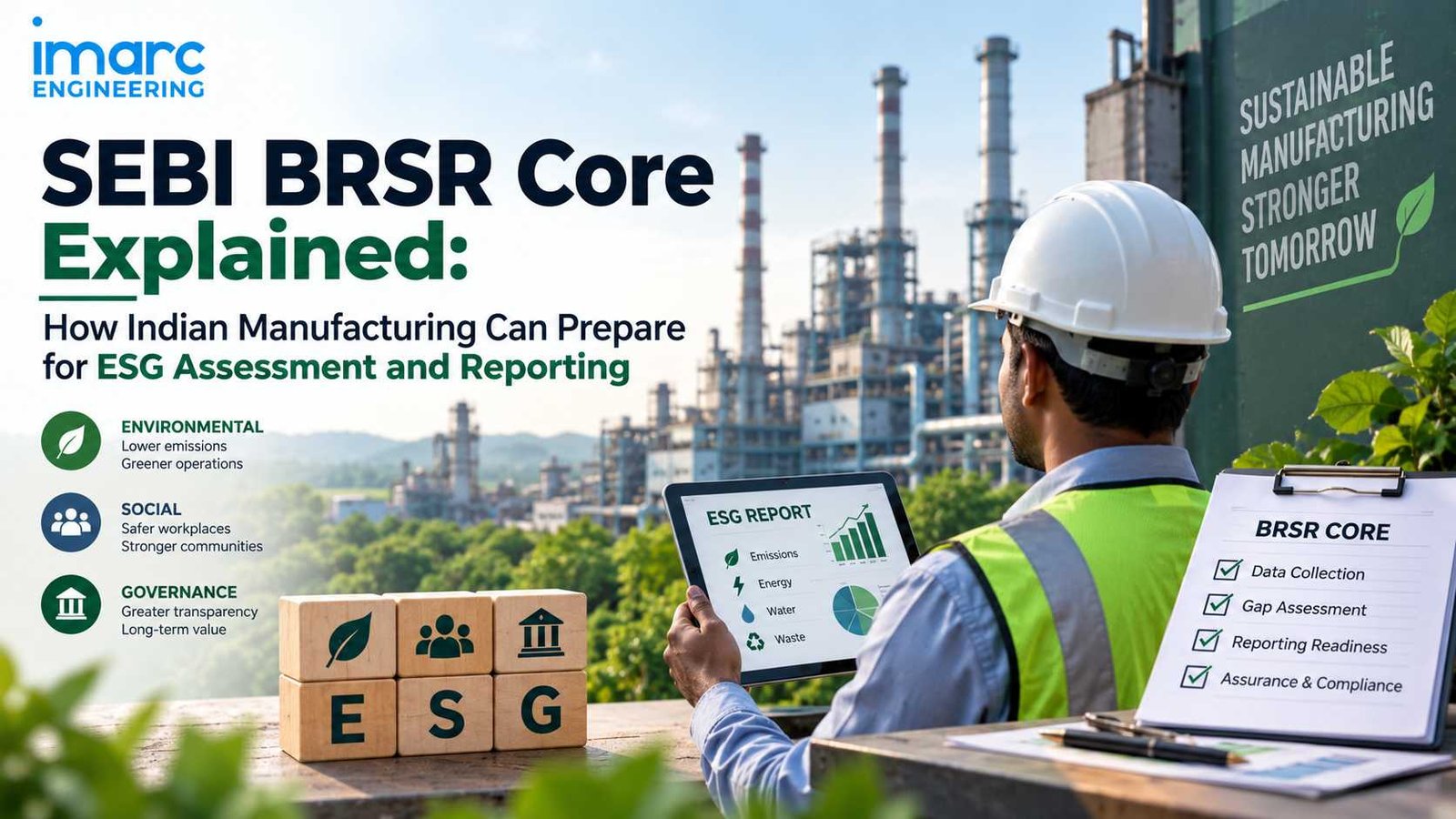
ESG reporting in India has moved from a voluntary disclosure exercise to a market-cap-linked regulatory obligation with mandatory third-party verification. For manufacturers, that shift matters more than for most sectors, since the metrics under scrutiny, including energy use, GHG emissions, water consumption, and waste generation, sit at the core of a factory’s daily operations, not in a peripheral corporate function.
As regulatory expectations increase, manufacturers need reliable systems to collect, validate, and document ESG data across their operations. Strong ESG reporting practices can also help companies identify operational inefficiencies, improve resource management, and strengthen stakeholder confidence in their sustainability performance.
Preparing for this shift is where working with an experienced environmental impact assessment consulting firm becomes practical rather than optional, since the underlying emissions, water, and waste data required for BRSR Core assurance is the same data an environmental assessment engagement is built to establish and verify.
What Is BRSR Core?
BRSR Core is a focused subset of SEBI’s broader Business Responsibility and Sustainability Reporting (BRSR) framework, first introduced through a July 2023 circular. Where full BRSR covers a wide range of qualitative and quantitative disclosures, BRSR Core narrows the focus to nine ESG attributes that require independent, reasonable-assurance-level verification rather than self-reported disclosure alone.
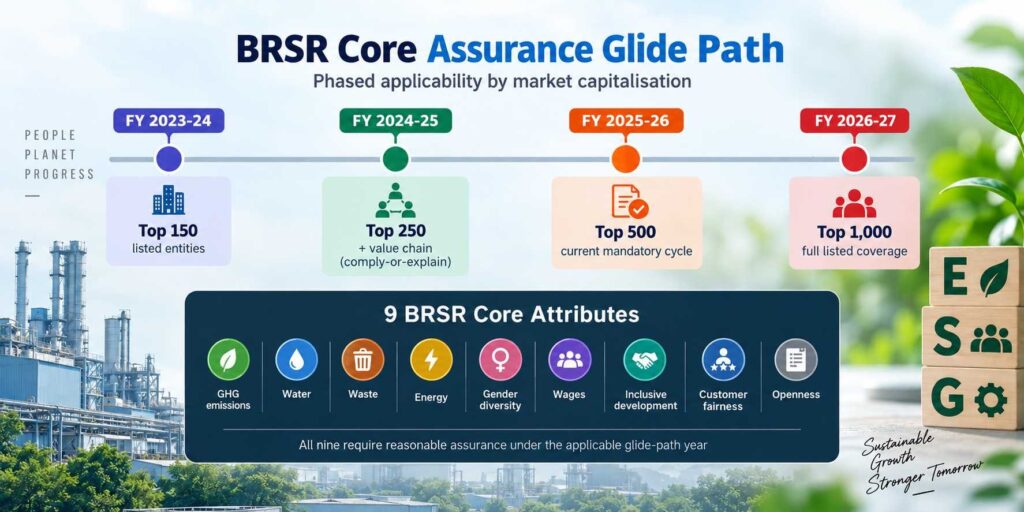
The nine BRSR Core attributes cover:
- Greenhouse gas (GHG) emissions
- Water consumption and management
- Waste management
- Energy consumption
- Gender diversity in the workforce
- Wages paid, including gender pay parity
- Inclusive development, including spend directed toward local sourcing and community initiatives
- Fair and ethical business practices in customer engagement
- Openness of business, including concentration of purchases and sales
Reasonable assurance, the standard BRSR Core mandates, is a meaningfully higher bar than the limited assurance most companies are used to. It requires extensive testing, larger sample sizes, an assessment of internal control effectiveness, and a positive opinion from the assurance provider, rather than the negative-assurance style opinion typical of limited assurance engagements. Notably, this exceeds what the EU’s Corporate Sustainability Reporting Directive (CSRD) currently requires, which starts at limited assurance.
Where India Stands on the BRSR Core Glide Path Right Now
SEBI rolled out BRSR Core applicability in phases based on market capitalisation, and the current position matters directly for manufacturers evaluating their compliance timeline:
- BRSR Core assessment or assurance became mandatory for the top 150 listed entities by market capitalisation starting FY2023-24
- Coverage extended to the top 250 listed entities from FY2024-25
- The top 500 listed entities are now under mandatory assessment or assurance obligations for FY2025-26, the current reporting cycle
- Full coverage extends to the top 1,000 listed entities from FY2026-27, bringing the vast majority of India’s listed market capitalisation into scope
- Value chain ESG disclosures, covering upstream and downstream partners that cumulatively represent 75% of a listed entity’s purchases or sales by value, were made applicable to the top 250 entities from FY2024-25, though SEBI’s March 2025 circular eased this to a voluntary, comply-or-explain basis for FY2025-26
- SEBI’s March 2025 circular also replaced the term “assurance” with “assessment or assurance,” giving companies added flexibility in how the nine core attributes are verified
For manufacturers sitting near the top-500 or top-1,000 market cap boundary, this is not a distant compliance milestone. Companies crossing into either band as of the 31 March cut-off for their financial year are already inside the mandatory verification cycle.
Why Manufacturing Faces Higher Exposure Under BRSR Core
Several of the nine mandatory attributes map almost directly onto data manufacturers already track for environmental compliance, which is both an advantage and a risk depending on how well that existing data is structured.
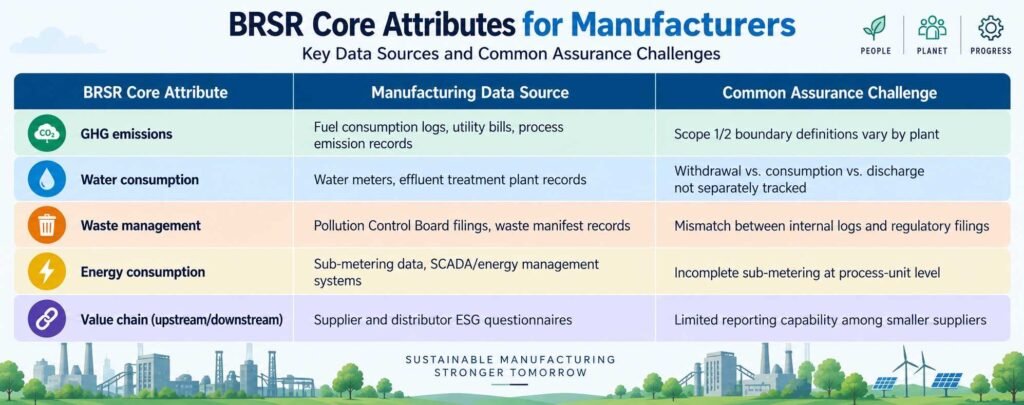
- GHG emissions and energy consumption metrics require plant-level data that is frequently split across multiple utility meters, fuel logs, and shift-wise production records, making consolidation harder than for a services company reporting at the corporate level
- Water consumption disclosures require distinguishing between withdrawal, consumption, and discharge, a distinction many manufacturing sites have not historically tracked with the granularity assurance providers now expect
- Waste management data must reconcile with existing Pollution Control Board consent-to-operate filings, and discrepancies between the two data sets are a common finding during assurance engagements
- Value chain disclosures, even on a comply-or-explain basis, place pressure on manufacturers to collect ESG data from suppliers who may have no internal reporting capability of their own
- Gender diversity and wage data, while less operationally complex, still require HR systems capable of producing auditable, plant-wise breakdowns rather than company-wide averages
BRSR Core Attributes Mapped to Manufacturing Data Sources
How Manufacturers Should Prepare for BRSR Core Assessment
- Map current market capitalisation against the glide path now, since companies crossing into the top-500 or top-1,000 band mid-cycle need lead time to establish assurance-ready data trails
- Conduct a readiness assessment well before the assurance provider is engaged, to surface data gaps in energy sub-metering, water tracking, and waste reconciliation early
- Assign clear internal ownership for each of the nine attributes, since assurance reviewers consistently flag data with no identifiable internal owner
- Build supplier ESG data collection into procurement contracts ahead of the value chain reporting deadline, rather than requesting it reactively once disclosures become mandatory
- Reconcile internal emissions and waste data against existing statutory filings, such as Pollution Control Board consents, before external assurance begins
- Brief the audit committee on assurance provider independence requirements, since SEBI’s guidance places specific emphasis on this governance layer
For detailed insights, explore IMARC Engineering’s guide on Environmental Impact and Sustainability Studies: https://www.imarcengineering.com/blog/how-environmental-impact-studies-reduce-project-risks-india
How IMARC Engineering’s Expertise Can Help in ESG Assessment and Reporting
- Conducting BRSR Core readiness assessments to identify data gaps in emissions, water, waste, and energy tracking before formal assurance begins
- Establishing plant-level sub-metering and data reconciliation processes aligned with assurance provider expectations
- Reconciling internal environmental data against existing Pollution Control Board filings and consent conditions
- Supporting supplier ESG data collection frameworks ahead of value chain reporting requirements
- Structuring internal ownership and documentation processes for each of the nine BRSR Core attributes
Get in Touch With Our Team: https://www.imarcengineering.com/contact?service=environmental-impact-sustainability-studies
Conclusion
BRSR Core has turned ESG reporting into a data governance exercise as much as a disclosure one, and manufacturers are more exposed than most sectors given how directly the nine core attributes map to plant-level operations. With the top 500 entities already inside the mandatory assurance cycle and the top 1,000 following in FY2026-27, manufacturers approaching either threshold have a narrowing window to build assurance-ready data systems before the assurance provider, not the compliance calendar, becomes the constraint.
Frequently Asked Questions
What is the difference between BRSR and BRSR Core?
Full BRSR is a broader qualitative and quantitative disclosure framework, while BRSR Core is a focused subset of nine ESG attributes that require independent, reasonable-assurance-level verification rather than self-reported disclosure.
Which companies must comply with BRSR Core in FY2025-26?
The top 500 listed entities by market capitalization are under mandatory assessment or assurance obligations for the current FY2025-26 reporting cycle, with the top 1,000 entities joining from FY2026-27.
Is value chain ESG reporting mandatory for manufacturers?
As of SEBI’s March 2025 circular, value chain disclosures for the top 250 entities remain on a voluntary, comply-or-explain basis for FY2025-26, though this is expected to tighten as the framework matures.
Why does manufacturing face more BRSR Core complexity than services companies?
Several core attributes, particularly GHG emissions, water, waste, and energy, require plant-level operational data that is often fragmented across multiple systems, unlike corporate-level disclosures typical in services businesses.
Contact Us:
IMARC Engineering
Phone: +91-120-433-0800
Email: sales@imarcengineering.com
India: C-130, Sector 2, Noida, Uttar Pradesh 201301
LinkedIn: https://www.linkedin.com/showcase/imarc-engineering/
About the Author