Introduction
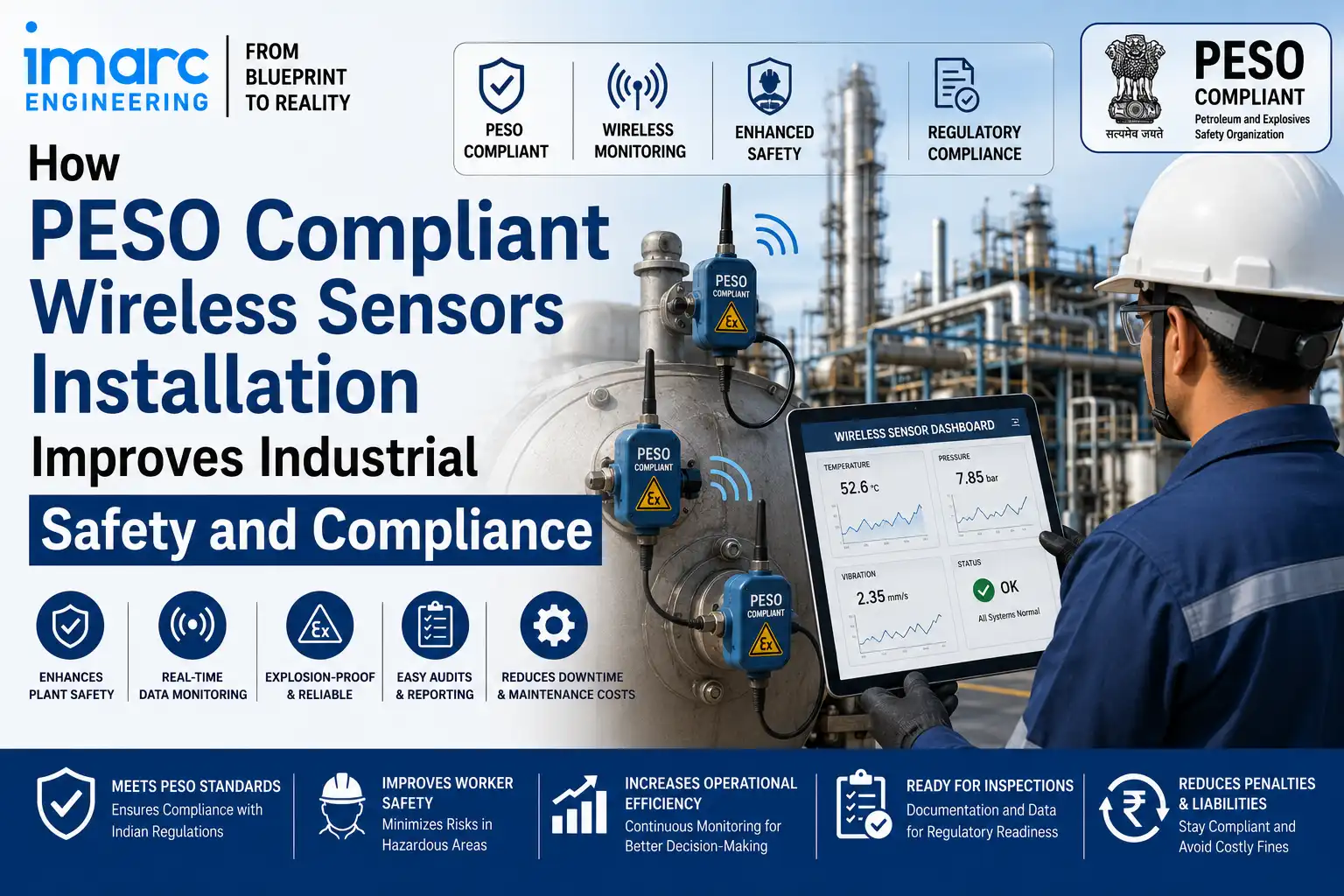
Wireless sensors are becoming standard equipment across India’s oil and gas terminals, chemical plants, pharmaceutical units, and FMCG manufacturing facilities, monitoring temperature, pressure, gas concentration, and vibration in real time.
Without PESO Compliant Wireless Sensors Installation, wireless monitoring systems installed inside hazardous areas can become regulatory liabilities instead of operational assets. An uncertified transmitter operating in a classified hazardous zone can become a potential ignition source, a licensing violation, and a plant-shutdown risk that often surfaces only after the equipment is commissioned.
IMARC Engineering provides PESO compliance advisory, hazardous area classification, and wireless sensor installation certification services for industrial facilities across India. This article draws on that work to explain what PESO compliant wireless sensors installation requires, why explosion-protection approval is non-negotiable in hazardous environments, and why compliant installation is a statutory obligation, not an engineering preference.
Why PESO Compliant Wireless Sensors Installation Is Critical for India’s Hazardous Industries in 2026
India’s hazardous-process industries are expanding at a pace that is outrunning ad-hoc, uncertified instrumentation practices.
Expanding Hazardous-Area Industrial Base
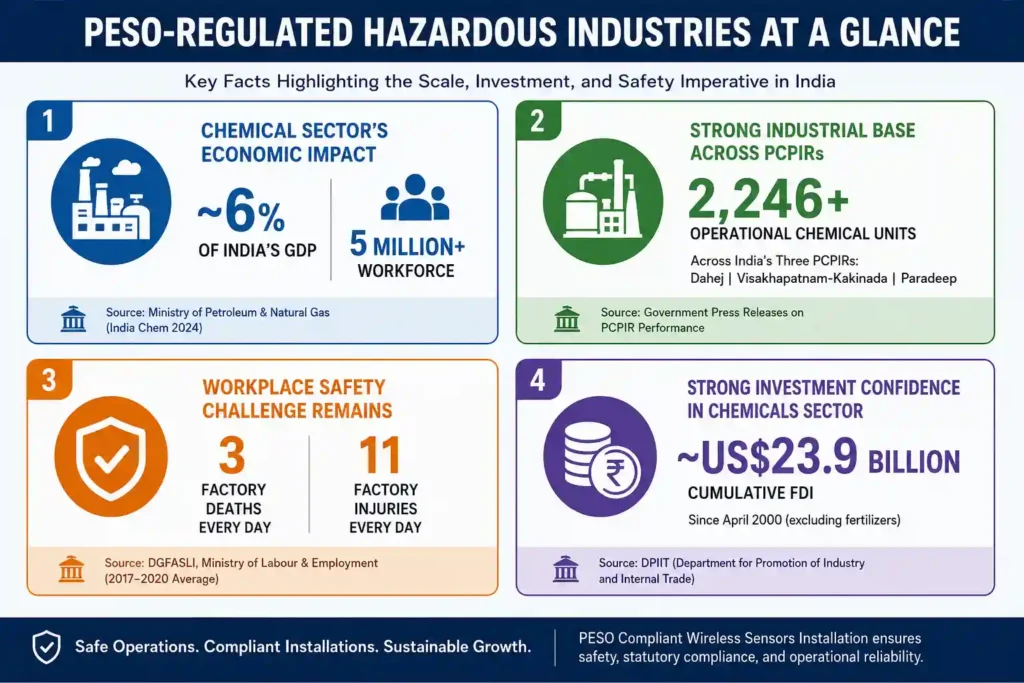
India’s chemical and petrochemical sector contributes close to 6% of the country’s GDP and supports employment for over 5 million people, per the Ministry of Petroleum and Natural Gas addressing India Chem 2024.
India ranks as the sixth-largest chemicals producer globally and exports to more than 175 countries, with chemicals accounting for roughly 15% of total exports, per the same government address.
PCPIR and Cluster Investment Growth
India’s three operational Petroleum, Chemicals and Petrochemicals Investment Regions at Dahej, Visakhapatnam-Kakinada, and Paradeep together host over 2,246 operational chemical units, per government press releases on PCPIR performance.
Cumulative FDI into India’s chemicals sector, excluding fertilizers, has reached approximately US$23.9 billion since April 2000, per DPIIT data.
Rising Workplace Safety Enforcement
Registered factories in India reported an average of 1,109 deaths and more than 4,000 injuries each year between 2017 and 2020, per the Ministry of Labour and Employment’s Directorate General Factory Advice Service and Labour Institutes (DGFASLI).
Chemical and chemical-products units accounted for the largest single share of factory injuries and deaths reported in Gujarat in 2019, per state-level DGFASLI data, underlining why hazardous-area instrumentation compliance is under increasing regulatory scrutiny.
Industry 4.0 and Wireless Monitoring Adoption
Make in India 2.0’s technology roadmap explicitly promotes IoT-enabled factories and 5G/6G connectivity as part of India’s broader manufacturing modernization push, per NITI Aayog’s published roadmap.
The Ministry of Electronics and Information Technology projects that manufacturing’s digital transformation, including sensor-based monitoring, could generate over 10 million new jobs, underscoring how central wireless instrumentation has become to industrial strategy.
Why Non-Compliant Wireless Sensor Installations Create Risk That Is Difficult to Unwind
Most installation failures follow a predictable pattern: sensors selected on price and delivery time rather than certification, zone classification skipped or assumed, and installation carried out by teams unfamiliar with explosion-protection standards.
The categories of risk that surface after a non-compliant installation:
- Ignition and explosion risk: A non-certified device or improperly rated enclosure operating in a classified zone can act as an ignition source in the presence of flammable gas or vapour.
- Regulatory non-compliance: Installations without valid PESO/CCOE approval expose the facility to licence suspension if inspecting authorities identify the gap during a routine or triggered audit.
- Insurance and liability exposure: Insurers can deny claims following an incident if the installed equipment lacked the statutory explosion-protection certification required for the zone.
- Costly retrofitting: Replacing non-certified sensors after commissioning means shutting down live process lines, re-running cable and conduit work, and repeating commissioning tests.
- Export and certification failures: Facilities supplying export markets with their own hazardous-area standards can fail buyer or regulator audits if domestic PESO compliance is incomplete.
- Legal and criminal liability: Non-compliance with the Explosives Act, 1884 and the Petroleum Act, 1934 carries statutory penalties, and any resulting incident can trigger criminal proceedings against the occupier.
Structured, PESO compliant wireless sensors installation prevents these outcomes by verifying certification and installation quality before the system goes live, not after an incident.
Key Requirements for PESO Compliant Wireless Sensors Installation
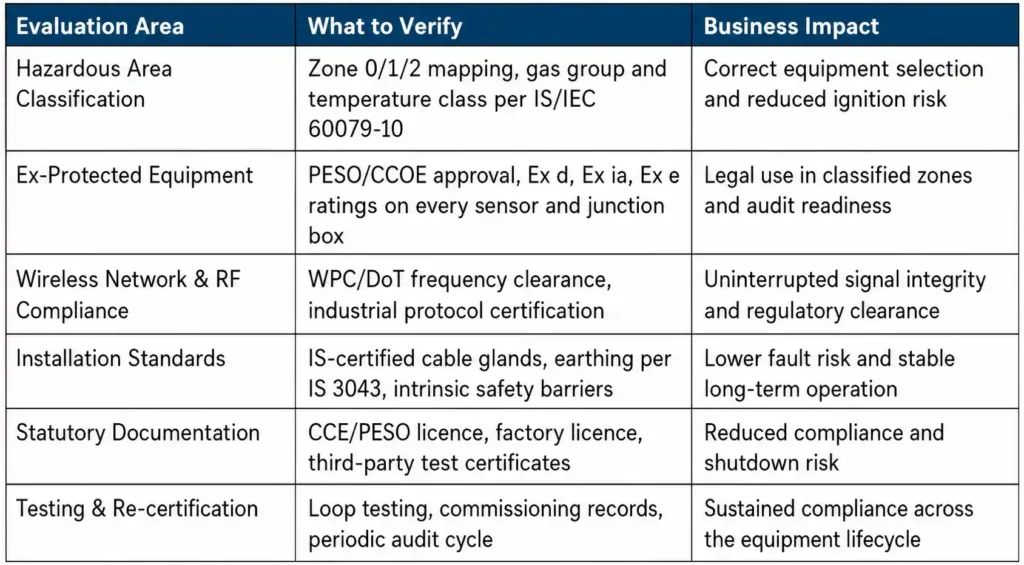
A credible PESO compliant wireless sensors installation examines six interconnected areas. A weakness in any one of them can compromise the safety case for the entire installation.
1. Hazardous Area Classification and Zone Mapping
- Zone 0, Zone 1, and Zone 2 mapping for every location where sensors will be installed
- Gas group (IIA, IIB, IIC) and temperature class determination per IS/IEC 60079-10
- Documented area classification drawings that installation teams and auditors can both reference
Zone classification is the foundation. Every downstream equipment and cabling decision depends on it being correct.
2. PESO/CCOE-Approved Explosion-Protected Equipment
- Sensors and enclosures rated Ex d (flameproof), Ex ia (intrinsically safe), or Ex e (increased safety) as required by the zone
- Valid PESO/CCOE type-approval certificates for each device model, not just a manufacturer’s international certification
- Verification against the applicable gazette notifications governing flameproof electrical fittings
3. Wireless Network and RF Compliance
- WPC/DoT frequency clearance for the wireless spectrum the sensor network operates on
- Use of established industrial wireless protocols with a track record in hazardous environments
- Interference testing to confirm reliable signal transmission across the classified area
4. Installation, Cabling, and Grounding Standards
- IS-certified cable glands matched to the enclosure’s protection rating
- Earthing and bonding executed per IS 3043 to eliminate stray-current ignition risk
- Intrinsic safety barriers correctly specified and installed between hazardous and safe areas
5. Statutory Documentation and Licensing
- Valid factory licence and CCE/PESO approval under the Petroleum Rules, 2002 for the site
- Third-party test certificates for every explosion-protected component installed
- A compliance file structured for internal sign-off, insurer review, and statutory inspection
6. Testing, Commissioning, and Periodic Re-Certification
- Loop testing and functional verification of every sensor before the system is handed over
- Commissioning records retained as evidence of a verified, working installation
- A periodic re-inspection and re-certification cycle, since PESO compliance is not a one-time approval
PESO Compliant Wireless Sensors Installation: Evaluation Framework
How IMARC Engineering Supports PESO Compliant Wireless Sensors Installation
IMARC Engineering helps manufacturers design, verify, and implement PESO Compliant Wireless Sensors Installation across hazardous industrial facilities through independent engineering verification, hazardous area classification, statutory documentation support and compliance audits.
- Hazardous area survey and zone classification: On-site assessment to map Zone 0/1/2 boundaries, gas groups, and temperature classes before equipment selection begins.
- Equipment specification and Ex-certification review: Verifying that every sensor, enclosure, and junction box carries valid PESO/CCOE approval for the classified zone it will occupy.
- PESO/CCOE documentation and licensing support: Preparing and coordinating the statutory filings required under the Petroleum Rules, 2002 and applicable gazette notifications.
- Installation supervision and third-party testing: On-site oversight of cabling, earthing, and gland work, with independent testing coordinated before commissioning.
- Compliance audit and certification documentation: Structured reporting suitable for internal sign-off, insurer review, or statutory inspection.
- Ongoing regulatory monitoring: Tracking re-certification and periodic inspection timelines so compliance does not lapse after commissioning.
IMARC Engineering supports facilities across oil and gas, chemicals, pharmaceuticals, and FMCG manufacturing, where hazardous-area classification and explosion-protection requirements differ significantly by process and by product handled.
Contact IMARC Engineering’s team for PESO compliant wireless sensors installation support across India : https://www.imarcengineering.com/contact?service=smart-factory-industry-4-integration
Common Mistakes in PESO Compliant Wireless Sensors Installation
- Skipping zone classification: Selecting sensors before the hazardous area is formally classified means equipment ratings are guessed, not verified.
- Using non-certified sensors: International certification alone is not sufficient; devices installed in India require valid PESO/CCOE approval.
- Ignoring RF and WPC licensing: Deploying a wireless sensor network without frequency clearance risks both regulatory action and signal interference.
- Poor cable gland and earthing practice: Incorrect glanding or inadequate earthing undermines the protection rating of an otherwise certified enclosure.
- Treating certification as one-time: PESO compliance requires periodic re-inspection; installations that are never revisited drift out of compliance silently.
- Relying on vendor self-declaration: Accepting a supplier’s compliance claim without independent verification leaves the gap undiscovered until an audit or incident.
Conclusion
India’s hazardous-process industries are scaling quickly, supported by strong chemical and petrochemical sector growth, expanding PCPIR investment, and rising adoption of wireless, sensor-based monitoring under the Make in India 2.0 push.
This growth also means more classified zones, more instrumentation, and greater regulatory scrutiny of how that instrumentation is certified and installed.
As hazardous industrial operations continue to expand across India, PESO Compliant Wireless Sensors Installation is becoming a prerequisite for safe, compliant and uninterrupted plant operations. Through hazardous area classification, Ex-equipment verification, statutory documentation, installation audits and regulatory advisory, IMARC Engineering helps manufacturers deploy wireless monitoring systems that satisfy statutory requirements while improving long-term operational reliability.
Contact Us:
IMARC Engineering
Phone: +91-120-433-0800
|Email: sales@imarcengineering.com
India: C-130, Sector 2, Noida, Uttar Pradesh 201301
LinkedIn: https://www.linkedin.com/showcase/imarc-engineering/
About the Author