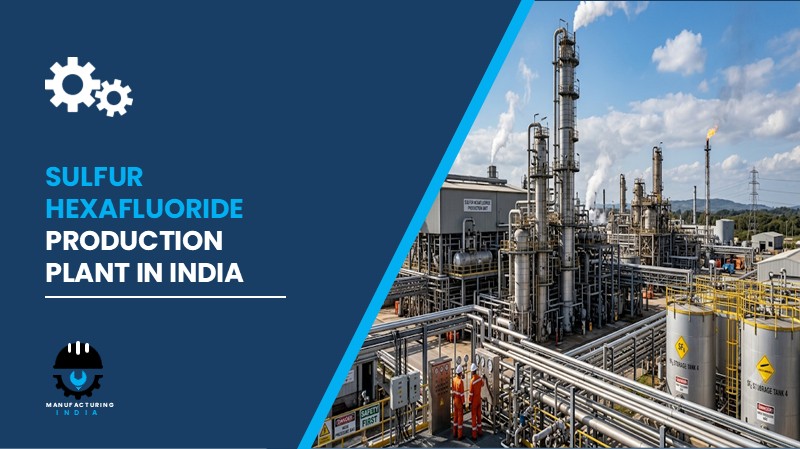
Sulfur Hexafluoride Production Plant in India
Setting up a sulfur hexafluoride production plant in India presents a compelling investment case at a time when the country’s electricity grid is undergoing its most transformative expansion in history, renewable energy capacity is being added at record pace, high-voltage transmission infrastructure is scaling to support India’s 500 GW renewable energy target, and the semiconductor manufacturing sector is developing under the India Semiconductor Mission. Sulfur hexafluoride (SF₆) — the colorless, odorless, non-flammable, and chemically inert manmade gas composed of a central sulfur atom bonded to six fluorine atoms — is the industry standard for insulating high-voltage electrical equipment including circuit breakers, gas-insulated switchgear, and gas-insulated substations. Its exceptional dielectric strength and arc-quenching properties make it irreplaceable in the transmission and distribution infrastructure that every unit of India’s renewable energy generation requires to reach consumers. As India’s power grid expands and modernises, its electronics manufacturing deepens, and its renewable energy deployment accelerates, the domestic requirement for reliably supplied, high-purity sulfur hexafluoride is growing into a commercially significant and strategically important specialty gas investment opportunity.
India’s grid expansion data directly validates the commercial environment for sulfur hexafluoride producers serving the electrical infrastructure sector. As per the Ministry of New and Renewable Energy, India added a record 44.5 GW of renewable energy capacity in 2025 — a deployment rate that requires corresponding expansion of high-voltage transmission infrastructure, gas-insulated switchgear, and substation capacity that collectively constitute the largest domestic demand driver for sulfur hexafluoride. Every gas-insulated substation deployed to integrate India’s solar and wind capacity onto the grid contains substantial SF₆ volumes in its switchgear, circuit breakers, and bus-bar systems — creating a direct and quantifiable linkage between India’s renewable energy ambition and the commercial demand for domestic SF₆ production capacity. Industrial gas estates in Gujarat, Maharashtra, and Tamil Nadu offer the fluorine handling infrastructure, elemental sulfur supply chains, and high-pressure gas cylinder filling capability that a sulfur hexafluoride production facility requires.
Investing in a sulfur hexafluoride production plant in India today aligns India’s record 44.5 GW renewable energy addition in 2025, expanding high-voltage grid infrastructure, and growing semiconductor manufacturing under the India Semiconductor Mission with a global sulfur hexafluoride market growing from USD 293.69 Million in 2025 to USD 472.28 Million by 2034 at a CAGR of 5.42%. With gross profit margins of 26–35% and net profit margins of 15–22% at an annual production capacity of 3,000 MT, the unit economics are commercially sound, and the investment’s alignment with India’s renewable energy and grid modernisation megatrend supports durable long-term returns.
What is Sulfur Hexafluoride?
Sulfur hexafluoride (SF₆) is a manmade, inorganic gas composed of a central sulfur atom bonded to six fluorine atoms. It is colorless, odorless, non-flammable, and chemically inert. Because it is roughly five times denser than air, its unique molecular structure provides outstanding dielectric strength and arc-quenching capabilities, making it the industry standard for insulating high-voltage electrical equipment like circuit breakers and gas-insulated switchgear. It is also used in semiconductor manufacturing, window insulation, and specialized medical procedures like retinal surgery.
Sulfur hexafluoride’s exceptional properties derive from its stable molecular architecture: the six fluorine atoms surrounding the central sulfur create a completely symmetric, highly electron-withdrawing cage structure that makes SF₆ extraordinarily resistant to electrical breakdown, chemically inert under normal operating conditions, and an extremely effective medium for quenching electrical arcs in high-voltage switchgear. These properties make it irreplaceable in gas-insulated substations, which enable compact, reliable, and maintenance-efficient high-voltage electrical infrastructure critical for urban grid densification and renewable energy integration. However, SF₆ is also a potent greenhouse gas with a global warming potential approximately 23,500 times that of CO₂ over 100 years, driving growing regulatory attention to its handling, recovery, and recycling in end-use applications — a regulatory dynamic that increases the commercial value of high-purity SF₆ from reliable domestic suppliers who can support certified leak management programmes.
The primary production process covers synthesis from elemental sulfur and fluorine, purification, and compression into gas cylinders. End-use industries served include electrical power transmission, semiconductor manufacturing, magnesium processing, medical imaging, soundproof glazing, and renewable energy switchgear. Applications span dielectric insulator in gas-insulated switchgear, etching gas in electronics production, cover gas in molten magnesium casting, tracer gas for environmental testing, and thermal and acoustic insulation in multi-pane windows.
Cost of Setting Up a Sulfur Hexafluoride Production Plant in India
The cost of establishing a sulfur hexafluoride production plant in India depends on production capacity, fluorine generation technology, purification system specification, geographic location — particularly proximity to elemental sulfur supply and electrical equipment manufacturer customers — degree of automation, and the comprehensive safety, environmental, and quality compliance requirements applicable to a high-purity fluorinated gas manufacturing facility.
1. Capital Expenditure (CapEx)
Land and Site Development forms a foundational component of total capital investment, covering land acquisition charges, site registration, boundary development, and site utilities. The location must offer easy access to key raw materials such as elemental sulfur and fluorine gas. Proximity to target markets — particularly India’s high-voltage electrical equipment manufacturers in Gujarat, Maharashtra, and Karnataka, and the substation construction supply chains serving India’s power grid expansion — will help minimise distribution costs. The site must have robust infrastructure, including reliable transportation, utilities, and waste management systems. Compliance with local zoning laws and environmental regulations must also be ensured. Industrial gas manufacturing estates in Gujarat and Tamil Nadu with established fluorine handling infrastructure and compressed gas cylinder operations offer the most commercially advantaged operating environments.
Plant Layout Optimisation is critical for a sulfur hexafluoride production facility, given the simultaneous requirements of fluorine gas handling, high-temperature synthesis, purification column operations, and high-pressure gas compression and cylinder filling. The layout should be optimised to enhance workflow efficiency, safety, and minimise material handling. Separate areas for raw material storage for elemental sulfur and fluorine gas with appropriate containment and safety infrastructure, the synthesis reactor zone, purification and distillation operations, compression and gas storage, cylinder filling stations, quality control laboratory, and finished cylinder storage and dispatch must be designated. Space for future expansion should be incorporated to accommodate business growth.
Machinery and Equipment represent the largest single component of total CapEx for a sulfur hexafluoride production plant. Essential equipment includes:
- Gas reactors
- Purification columns
- Distillation units
- Sulfur handling systems
- Fluorine generation modules
- Gas compressors
- Storage tanks
- Cylinder filling stations
Other Capital Costs include effluent treatment systems to minimise environmental impact and ensure compliance with emission standards, advanced monitoring systems to detect leaks or deviations in the process, SF₆ gas recovery systems for recycling process off-gas, pre-operative expenses, PESO approval and gas safety certification costs, commissioning charges, and import duties on specialised fluorine generation modules or high-purity gas compression equipment not available domestically at the required specification.
Request a Sample Report for In-Depth Market Insights: https://www.imarcgroup.com/sulfur-hexafluoride-manufacturing-plant-project-report/requestsample
2. Operational Expenditure (OpEx)
Raw Material Cost is the overwhelmingly dominant operational expense, accounting for approximately 52–62% of total OpEx. The primary raw materials are elemental sulfur and fluorine gas. Elemental sulfur — as the primary sulfur-containing feedstock consumed stoichiometrically in the synthesis reaction — drives the majority of raw material cost and is available from domestic petroleum refinery desulfurisation operations and import sources at competitive prices. Fluorine gas — as the fluorine source for the direct fluorination synthesis — is the highest-hazard and most technically demanding input, requiring specialised generation, storage, and handling infrastructure given its extreme reactivity, toxicity, and corrosive properties. Long-term contracts with reliable suppliers will help mitigate price volatility and ensure a consistent supply of materials, with sustainability and supply chain risks assessed carefully given fluorine gas’s unique handling requirements.
Utility Cost is the second-largest OpEx component, representing approximately 12–16% of total operating expenses — a relatively elevated proportion reflecting the energy demands of fluorine generation module operation, synthesis reactor temperature management, purification column and distillation unit operation, and high-pressure gas compressor power consumption across the full production and compression sequence. Electricity for compression and fluorine generation constitutes the primary utility input requiring competitive industrial tariff negotiation.
Other Operating Costs include transportation and distribution of high-pressure compressed SF₆ gas cylinders and bulk containers to electrical equipment manufacturers, semiconductor fabrication facilities, magnesium processing operations, window insulation manufacturers, and medical device companies, specialised high-pressure cylinder and bulk container packaging, salaries and wages for industrial gas process engineers and safety-certified operators, routine machinery maintenance including compressor overhaul, cylinder testing, and purification column servicing, SF₆ gas recovery and recycle system operation, depreciation on production equipment, and applicable taxes. By the fifth year, the total operational cost is expected to increase substantially due to factors such as inflation, market fluctuations, and potential rises in the cost of key materials. Additional factors, including supply chain disruptions, rising consumer demand, and shifts in the global economy, are expected to contribute to this increase.
3. Plant Capacity
The proposed production facility for sulfur hexafluoride is designed with an annual production capacity of 3,000 MT, enabling economies of scale while maintaining operational flexibility to serve electrical power transmission, semiconductor manufacturing, magnesium processing, medical imaging, soundproof glazing, and renewable energy switchgear customers across India’s rapidly expanding industrial and infrastructure economy. Plant capacity can be customised per investor requirements and scaled through additional synthesis reactor trains and compression capacity as demand from India’s grid expansion programme, semiconductor mission, and electrical equipment manufacturing sector develops.
4. Profit Margins and Financial Projections
The financial projections for a sulfur hexafluoride production plant demonstrate healthy profitability potential under normal operating conditions. Gross profit margins typically range between 26–35%, supported by stable demand and value-added applications across power transmission, electronics, and industrial sectors. Net profit margins are projected at 15–22% — commercially sound returns reflecting the meaningful value-added synthesis and purification conversion of elemental sulfur and fluorine into a precisely specified, high-purity specialty gas. A comprehensive financial analysis covering NPV, IRR, payback period, and five-year projections is essential before committing capital, with projections developed based on realistic assumptions related to capital investment, operating costs, production capacity utilisation, pricing trends, and demand outlook.
Why Set Up a Sulfur Hexafluoride Production Plant in India?
Critical Electrical Insulation and Arc-Quenching Medium for India’s Grid Expansion. Sulfur hexafluoride is widely used in high-voltage switchgear, gas-insulated substations, circuit breakers, transformers, and other power transmission equipment due to its exceptional dielectric strength and arc-extinguishing properties, making it indispensable for modern electrical infrastructure. India’s record 44.5 GW renewable energy capacity addition in 2025, confirmed by the Ministry of New and Renewable Energy, requires corresponding expansion of high-voltage transmission and substation infrastructure — each gas-insulated substation containing substantial SF₆ volumes — creating direct, renewable-energy-driven institutional demand for domestic sulfur hexafluoride supply.
Megatrend Alignment with Power Grid Modernisation and Renewable Integration. Rapid expansion of power grids, renewable energy integration, urban electrification, industrial automation, and data center development is driving demand for reliable high-voltage transmission and distribution systems, supporting continued consumption of SF₆ in critical electrical applications. India’s 500 GW renewable energy target by 2030 — requiring massive transmission and substation expansion across the country — and the corresponding private and public investment in high-voltage electrical equipment constitute a sustained, multi-year institutional demand environment for sulfur hexafluoride that few specialty gas investment categories can match.
Semiconductor Manufacturing Demand from India Semiconductor Mission. SF₆ serves as an etching gas in electronics production and dielectric insulation in semiconductor manufacturing applications, creating a growing demand layer from India’s India Semiconductor Mission as domestic chip fabrication capacity develops. Every semiconductor fabrication facility that comes online under India’s semiconductor mission creates recurring demand for SF₆ as a chamber cleaning and plasma etching process gas, adding a technology-driven institutional demand stream alongside the dominant electrical infrastructure application.
Policy and Infrastructure Investment Driving Downstream Demand. Government investments in grid modernisation, renewable energy projects, transmission network expansion, railway electrification, and industrial infrastructure development are indirectly boosting demand for sulfur hexafluoride used in advanced electrical equipment. India’s Revamped Distribution Sector Scheme (RDSS), National Infrastructure Pipeline, and dedicated renewable energy transmission projects all include significant substation and switchgear investment that creates institutional SF₆ procurement demand.
Advanced Emissions Detection Technology Confirming Market Innovation. In December 2024, LightPath Technologies, Inc. announced a new version of its Optical Gas Imaging (OGI) camera platform to detect fugitive ammonia and sulfur hexafluoride (SF₆) emissions for industrial and manufacturing applications. This specialised technology development — specifically designed to detect SF₆ emissions — confirms both the continued industrial importance of SF₆ and the growing market for emissions management tools that support the responsible use, recovery, and recycling of SF₆ in electrical infrastructure. It signals that the industry is moving toward better leak management rather than elimination of SF₆, creating sustained demand for high-purity SF₆ alongside a growing SF₆ recovery and recycling service market.
Localisation and Supply Chain Reliability Creating Commercial Opportunity. Utilities, EPC contractors, and electrical equipment manufacturers increasingly seek dependable regional suppliers to ensure product availability, reduce lead times, and maintain uninterrupted project execution, creating opportunities for producers with robust manufacturing capabilities and secure raw material sourcing. India’s growing domestic electrical equipment manufacturing base — producing switchgear, transformers, and substation components for both domestic use and export — provides an immediate, proximate industrial customer base for a domestic SF₆ producer that import suppliers cannot serve with the same delivery reliability, lead time, and technical support capability.
Production Process — Step by Step
The sulfur hexafluoride production process uses synthesis from elemental sulfur and fluorine, purification, and compression into gas cylinders as the primary production method. Each stage requires precisely controlled reaction parameters, purity verification, and compression safety management to deliver sulfur hexafluoride meeting the dielectric performance, purity, and moisture specifications required by electrical equipment, semiconductor, and industrial gas customers.
- Elemental Sulfur Preparation: Elemental sulfur is received from certified suppliers, quality-checked for purity and moisture content, and melted in sulfur handling systems to produce a liquid sulfur melt suitable for controlled vaporisation into the synthesis reactor feed stream.
- Fluorine Generation: Fluorine gas is generated from hydrogen fluoride electrolysis in fluorine generation modules at controlled temperature and current density, producing dry fluorine gas at the specified purity and flow rate for controlled introduction into the synthesis reactor.
- Synthesis Reaction in Gas Reactors: Vaporised sulfur and fluorine gas are contacted in gas reactors under controlled conditions, where the direct fluorination reaction converts elemental sulfur and fluorine into crude sulfur hexafluoride gas containing SF₆ as the primary product alongside minor quantities of sulfur difluoride (SF₂), disulfur decafluoride (S₂F₁₀), and other sulfur fluoride by-products requiring removal in downstream purification.
- Crude SF₆ Purification in Purification Columns: Crude synthesis gas is processed through purification columns and distillation units to remove sulfur fluoride impurities, unreacted fluorine, sulfur dioxide, and other contaminants from the SF₆ product stream through a combination of adsorption, absorption, and cryogenic distillation separation steps.
- Quality Verification: Purified SF₆ is analysed for purity, moisture content, air content, and impurity profile against the target specification — typically 99.8%+ purity for electrical grade and 99.9%+ for electronic grade — before proceeding to compression and cylinder filling.
- Gas Compression: Specification-grade SF₆ gas is compressed to the target cylinder or bulk container pressure using gas compressors, with multi-stage compression and interstage cooling managing the temperature rise associated with SF₆ compression to the pressures required for commercial cylinder storage and distribution.
- Cylinder Filling and Weighing: Compressed SF₆ is filled into high-pressure cylinders or bulk storage tanks at cylinder filling stations, with each cylinder weighed to verify the correct fill weight before sealing, with manifolding systems enabling efficient simultaneous filling of multiple cylinders per filling cascade.
- Quality Testing and Certification: Filled cylinders are tested for fill weight, pressure, leak integrity, and a sample lot tested for purity by gas chromatography, moisture by coulometric titration, and air content, verifying specification compliance before release for distribution.
- Dispatch: Specification-compliant SF₆ cylinders and bulk containers are labelled, tagged with batch certification, and dispatched to electrical power transmission equipment manufacturers, semiconductor fabrication facilities, magnesium processing operations, window insulation manufacturers, and medical device companies under appropriate dangerous goods transport compliance.
Key Applications
Sulfur hexafluoride produced in India serves commercially important and technically demanding applications across electrical infrastructure, electronics, industrial, and medical sectors:
- Electrical Power Transmission and Distribution: The primary application — used as the dielectric insulating and arc-quenching medium in gas-insulated switchgear (GIS), circuit breakers, and substations across high-voltage transmission and distribution networks.
- Electronics and Semiconductor Manufacturing: Applied as a plasma etching and chamber cleaning gas in semiconductor fabrication processes, and as a dielectric insulation material in advanced electronic components.
- Medical Industry: Used as a tamponade gas in retinal and vitreoretinal surgeries for ophthalmic procedures requiring long-acting intraocular gas tamponade.
- Metal Processing and Industrial Applications: Serves as a protective cover gas in magnesium casting operations and molten metal processing to prevent oxidation, and as a tracer gas for environmental testing and leak detection applications.
Leading Producers
The global sulfur hexafluoride industry is served by a group of large multinational industrial gas companies with extensive production capacities and diverse application portfolios. Key players in the global market include:
- Linde plc
- Air Products and Chemicals, Inc.
- Solvay SA
- Messer Group GmbH
Timeline to Start the Plant
Establishing a sulfur hexafluoride production plant in India involves a structured multi-phase development sequence. Investors should plan for the following phases:
- Feasibility study and project report preparation
- Land acquisition and site development
- Regulatory approvals and environmental clearances
- Factory licence and fire safety compliance
- Machinery procurement and installation
- Raw material supplier agreements and supply chain setup
- Trial production and quality testing
- Commercial production launch
Licences and Regulatory Requirements
Starting a sulfur hexafluoride production unit in India requires comprehensive approvals spanning business registration, compressed gas safety, fluorine handling, environmental, and greenhouse gas compliance domains:
- Business registration (Proprietorship, LLP, or Pvt Ltd)
- Factory Licence under the Factories Act
- Environmental Clearance from the State Pollution Control Board
- GST Registration
- Fire Safety NOC
- PESO (Petroleum and Explosives Safety Organisation) approval and Gas Cylinder Rules compliance for compressed SF₆ cylinder filling, storage, and distribution operations
- Hazardous/Chemical compliance under the Manufacture, Storage and Import of Hazardous Chemical (MSIHC) Rules applicable to fluorine gas handling as an acutely toxic and extremely reactive Schedule 1 chemical
- Effluent treatment systems operational clearance to minimise environmental impact and ensure compliance with emission standards
- SF₆ greenhouse gas monitoring and reporting obligations under applicable environmental regulations given SF₆’s extremely high global warming potential
- Occupational Health and Safety compliance including fluorine exposure monitoring, emergency response planning, and comprehensive SF₆ leak detection across all production and filling areas
Key Challenges to Consider
Fluorine Gas Handling — The Most Technically Demanding Industrial Chemical. Fluorine gas is the most reactive and one of the most hazardous chemicals in routine commercial use — it reacts violently with virtually all organic materials, metals, and water, requires special materials of construction including nickel, Monel, and PTFE throughout all process contact systems, and demands the highest level of industrial gas safety management. Establishing and maintaining a safe fluorine generation and synthesis operation requires dedicated process safety engineering expertise, specialised materials, explosion-proof facilities, and rigorous operator training that represent the primary technical entry barrier and ongoing operational challenge for SF₆ production.
SF₆ Greenhouse Gas Regulatory Pressure and Long-Term Technology Risk. SF₆’s global warming potential of approximately 23,500 times CO₂ over 100 years is driving progressive regulatory tightening in developed markets — with the EU F-Gas Regulation phasing down SF₆ use in new electrical equipment and promoting alternative insulating gases including fluoronitrile and fluoroketone-based alternatives. While India’s current regulatory framework does not mandate SF₆ phase-down, producers must evaluate the long-term regulatory trajectory and assess the potential for alternative insulating gas adoption in new switchgear platforms over the investment horizon.
Competition from Established Multinational Industrial Gas Companies. The competitive landscape is dominated by large multinational industrial gas companies including Linde plc, Air Products and Chemicals, Solvay SA, and Messer Group GmbH with global production scale, established safety management systems, long-standing customer relationships with major electrical equipment manufacturers, and product quality reputations built over decades. New Indian producers must compete through domestic supply chain proximity, competitive pricing, customer service responsiveness, and the strategic supply security advantages that locally produced SF₆ provides to Indian electrical equipment manufacturers and grid operators seeking to reduce import exposure.
High Capital Cost of Fluorine Generation Technology. Fluorine generation modules — based on high-current electrolysis of hydrogen fluoride — represent specialised, capital-intensive process equipment with long procurement lead times from a limited number of global suppliers. The capital cost of fluorine generation infrastructure, combined with the specialised materials of construction required throughout the SF₆ synthesis and purification train, results in a relatively high CapEx per unit of production capacity compared to conventional specialty chemical manufacturing.
Cylinder and Container Management Logistics. Distributing SF₆ as a compressed gas in high-pressure cylinders or bulk containers requires a managed cylinder return, testing, and refilling logistics infrastructure that adds operational complexity and capital investment beyond production facility requirements. Building and managing a commercial cylinder fleet across India’s dispersed electrical infrastructure customer base requires dedicated logistics management, cylinder tracking systems, and regulatory compliance under Gas Cylinder Rules for every cylinder in the fleet.
SF₆ Purity Specification Compliance for GIS Applications. Gas-insulated switchgear manufacturers require SF₆ meeting IEC 60376 specification standards for moisture, air content, sulfur fluoride impurities, and dielectric performance — specifications that require comprehensive analytical quality control capability including gas chromatography, coulometric moisture analysis, and dielectric strength testing throughout production and filling operations.
Frequently Asked Questions
1. How much does it cost to set up a sulfur hexafluoride production plant in India?
The total capital investment depends on plant capacity, technology, and location, covering land acquisition, site preparation, and necessary infrastructure. Equipment costs — for gas reactors, purification columns, distillation units, sulfur handling systems, fluorine generation modules, gas compressors, storage tanks, and cylinder filling stations — represent a significant portion of capital expenditure, with fluorine generation module infrastructure adding substantially to total capital requirements. A detailed project report with full CapEx and OpEx breakdowns is available on request.
2. Is sulfur hexafluoride production profitable in India in 2026?
Yes. The project demonstrates gross profit margins of 26–35% and net profit margins of 15–22% under normal operating conditions, supported by India’s record 44.5 GW renewable energy capacity addition in 2025 driving grid infrastructure investment, the India Semiconductor Mission creating semiconductor manufacturing demand for SF₆ etching gas, and the global SF₆ market growing from USD 293.69 Million in 2025 to USD 472.28 Million by 2034 at a 5.42% CAGR.
3. What machinery is required for a sulfur hexafluoride production plant in India?
Key machinery includes gas reactors, purification columns, distillation units, sulfur handling systems, fluorine generation modules, gas compressors, storage tanks, and cylinder filling stations. Fluorine generation modules and gas compressors are the most capital-intensive and technically critical equipment, as they determine fluorine feedstock availability and final SF₆ product compression to the pressures required for commercial distribution.
4. What licences and approvals are required to start a sulfur hexafluoride production plant in India?
Required approvals include business registration, a Factory Licence under the Factories Act, Environmental Clearance from the State Pollution Control Board, GST registration, a Fire Safety NOC, PESO approval and Gas Cylinder Rules compliance for compressed gas operations, MSIHC Rules compliance for fluorine gas handling as a Schedule 1 hazardous chemical, effluent treatment systems clearance, SF₆ greenhouse gas monitoring and reporting obligations, and Occupational Health and Safety compliance including fluorine exposure monitoring.
5. What raw materials are needed for sulfur hexafluoride production?
The primary raw materials are elemental sulfur and fluorine gas. Elemental sulfur accounts for approximately 52–62% of total operating expenses together with fluorine gas generation costs, making elemental sulfur procurement from domestic refinery desulfurisation operations and fluorine generation module operation efficiency the most critical cost management levers for the investment.
6. What are the environmental compliance requirements for a sulfur hexafluoride production plant in India?
The unit must obtain Environmental Clearance from the State Pollution Control Board, operate effluent treatment systems to minimise environmental impact and ensure compliance with emission standards, install advanced monitoring systems to detect leaks or deviations in the process, implement SF₆ gas recovery and recycling systems for process off-gas, and maintain greenhouse gas monitoring and reporting for SF₆ emissions given its extremely high global warming potential.
7. What is the best location to set up a sulfur hexafluoride production plant in India?
Optimal locations offer established industrial gas handling infrastructure, proximity to elemental sulfur supply from petroleum refineries, reliable high-capacity electricity for fluorine generation and gas compression, access to electrical equipment manufacturer customer clusters, and logistics connectivity for compressed gas cylinder distribution. Industrial gas estates in Gujarat and Tamil Nadu with established fluorine handling capability are among the most strategically relevant options.
8. What is the break-even period for this type of plant in India?
The break-even period depends on plant capacity, capacity utilisation rate, elemental sulfur and fluorine generation cost trends, and demand conditions across electrical infrastructure, semiconductor, and industrial customer segments. A detailed financial analysis including payback period, NPV, and IRR projections is included in the full project report, available via the sample request link.
9. What government incentives are available for manufacturers in India?
The Make in India initiative, PLI schemes for specialty chemicals and electronics manufacturing supporting downstream SF₆ demand, India Semiconductor Mission creating semiconductor fabrication demand, and state-level industrial gas manufacturing incentives in Gujarat and Tamil Nadu provide financial and regulatory support for sulfur hexafluoride production investments. Export promotion benefits under specialty industrial gas categories may also be applicable.
Key Takeaways for Investors
A sulfur hexafluoride production plant in India represents a commercially sound and strategically well-timed investment in the specialty industrial gas that is the industry standard for high-voltage electrical infrastructure insulation — a product whose domestic demand is directly and structurally driven by India’s renewable energy deployment trajectory, confirmed by the Ministry of New and Renewable Energy’s record 44.5 GW renewable energy capacity addition in 2025, and the corresponding expansion of gas-insulated switchgear and substation infrastructure that connects every watt of that capacity to India’s national grid. The project demonstrates financial viability at an annual production capacity of 3,000 MT, with gross profit margins of 26–35% and net profit margins of 15–22% confirming commercially sound unit economics supported by the meaningful technical value-added synthesis and purification of elemental sulfur and fluorine into a precisely specified, IEC 60376-compliant specialty gas that commands significant pricing premiums over its raw material inputs. The global sulfur hexafluoride market, valued at USD 293.69 Million in 2025, is projected to reach USD 472.28 Million by 2034, growing at a CAGR of 5.42%, with India’s 500 GW renewable energy target, RDSS grid modernisation programme, India Semiconductor Mission, and expanding electrical equipment manufacturing base collectively creating a multi-sector domestic demand environment of exceptional breadth and policy-backed durability. With LightPath Technologies’ December 2024 SF₆ optical gas imaging camera launch confirming the industry’s active investment in responsible SF₆ management technology, and India’s grid expansion trajectory creating the most favourable domestic demand environment for SF₆ in the country’s history, demand sustainability for India-based sulfur hexafluoride production is structurally robust, grid-expansion-anchored, and commercially compelling across the full investment horizon.
About the Author