Key takeaways
- India’s drone market was valued at approximately USD 1,219.7 million (₹10,977 crore) in 2025 and is projected to reach USD 3,231.1 million (₹29,080 crore) by 2030, growing at a CAGR of roughly 21.51%.
- India currently holds less than 1% of the global drone market, which stood at approximately USD 40.6 billion in 2025, making the domestic growth runway substantially larger than current market share suggests.
- The Production-Linked Incentive scheme offers incentives of up to 20% on value addition for drone and drone-component manufacturers, and has reportedly driven a sevenfold revenue increase among participating firms since its introduction.
- The February 2022 restriction on imported drones has strengthened the domestic manufacturing opportunity, while the reduction in GST on drones to 5% has further supported adoption and industry growth.
- The defense and security segment is the fastest-growing application category, projected at a CAGR of roughly 26.4%, driven by military modernization, border surveillance, and ISR procurement programs.
- India’s manufacturing base has expanded to an estimated 500+ drone-related companies, including over 200 startups, with roughly 60-70% component overlap between defense and civilian drone platforms giving manufacturers a genuine dual-use production advantage.
Introduction
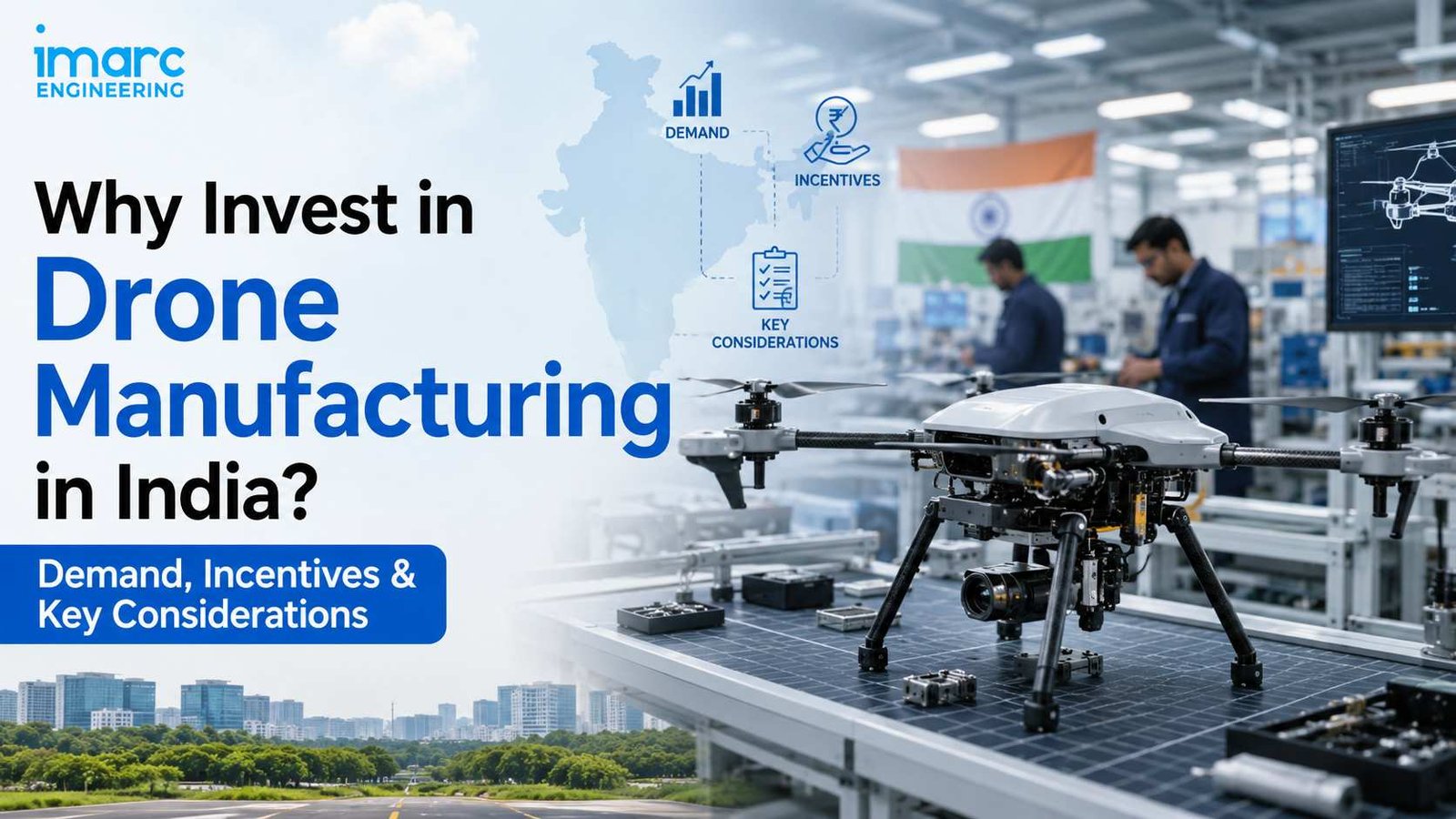
India’s drone sector has moved from a heavily import-dependent, tightly regulated category to one of the more actively incentivized manufacturing opportunities in the country’s industrial policy landscape. Liberalized rules, restrictions on the import of fully built drones, and layered production incentives have combined to attract investment and expand domestic manufacturing capacity over the past several years. This guide walks through what drone manufacturing in India looks like as an investment opportunity in 2026, using current market data, policy incentives, and the segments driving the strongest growth.
For a detailed, step-by-step breakdown of the setup process, licensing requirements, and cost structure involved, see IMARC Engineering’s guide on How to Set Up a Drone Manufacturing Plant in India.
India’s Drone Manufacturing Opportunity: The Numbers Behind the Growth
India’s drone market was valued at approximately USD 1,219.7 million, or ₹10,977 crore, in 2025. It is projected to reach USD 3,231.1 million, or ₹29,080 crore, by 2030, a CAGR of roughly 21.51%, according to industry data compiled by IBEF. That growth rate significantly outpaces the global drone market’s projected 7.3% CAGR over a comparable period, reflecting how much of India’s expansion is still catching up to a market it entered relatively late.
The scale of the remaining opportunity is clearer against the global backdrop: India currently holds less than 1% of the global drone market, which was valued at approximately USD 40.6 billion in 2025 and is projected to reach USD 57.8 billion by 2030. Even modest share gains against that global base represent a substantial addressable opportunity for domestic manufacturers positioned to compete on both cost and increasingly capable technology.
What’s Driving India’s Drone Manufacturing Growth
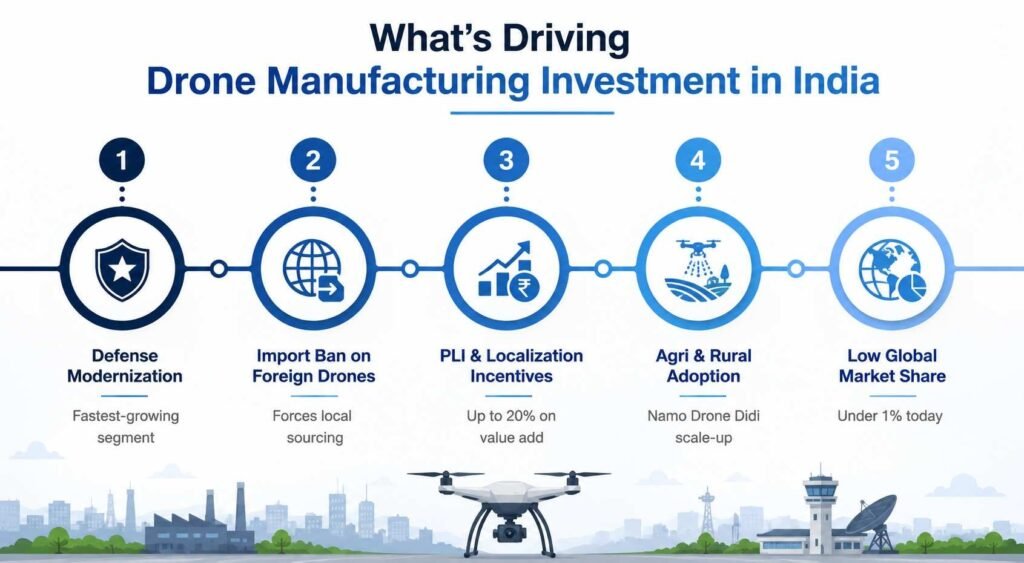
- Defense modernization: The defense and security segment is projected to grow at a CAGR of roughly 26.4%, the fastest of any application category, driven by military procurement, ISR requirements, and border surveillance demand under the broader Make in India defense push.
- Import substitution by policy: A February 2022 ban on foreign drone imports has structurally redirected demand toward domestic manufacturers, removing the option to simply import capacity that a manufacturer previously could have relied on.
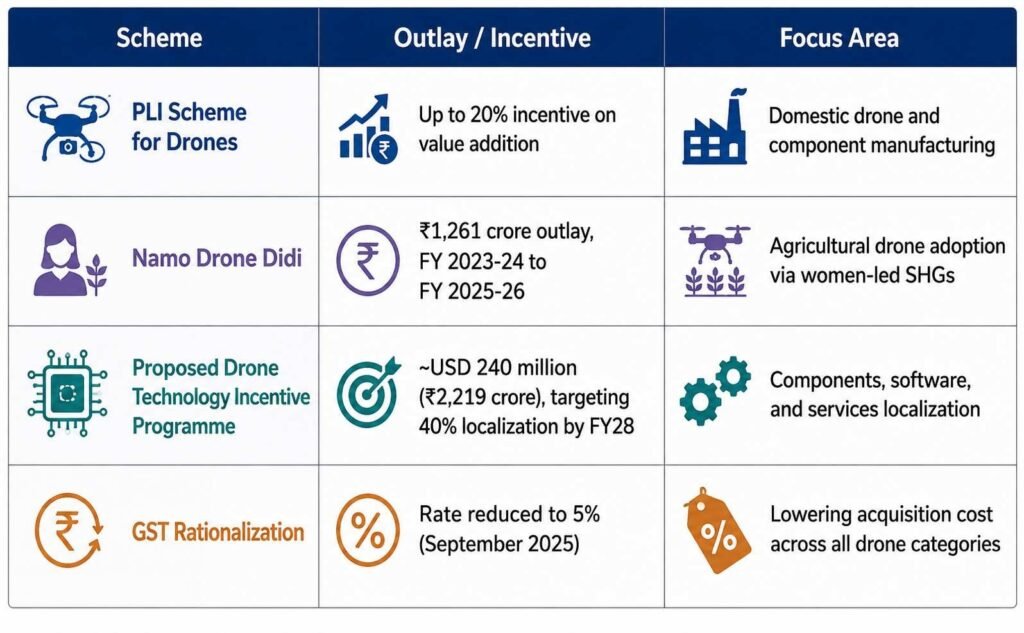
- Direct manufacturing incentives: The PLI scheme provides incentives linked to value addition for eligible drone and drone-component manufacturers, strengthening the economics of domestic production.
- Agricultural and rural adoption: The Namo Drone Didi initiative, training women-led self-help groups in agricultural drone operation, is scaling adoption in a segment that barely existed at commercial volume five years ago.
- Structurally low starting share: India’s relatively small share of the global drone market indicates significant headroom for domestic industry growth, provided manufacturers can address technology, supply-chain, certification and market-access requirements.
Government Incentive Schemes Shaping the Sector
Multiple, layered government programs currently support drone manufacturing investment, each targeting a different part of the value chain.
Where the Manufacturing Base Stands in 2026
India’s drone manufacturing base has grown to an estimated 500-plus drone-related companies, including more than 200 startups, concentrated around hubs in Tamil Nadu, Karnataka, Telangana, and Maharashtra, states with strong public-private R&D ties and, in several cases, defense corridor infrastructure already in place.
A structural advantage specific to this sector is the roughly 60-70% component overlap between defense and civilian drone platforms, airframes, sensors, and ground systems in particular, which means manufacturers investing in defense-grade production capability are often simultaneously building capacity that serves the commercial and agricultural segments as well.
What Investors Should Weigh Before Committing Capital
- Component and battery import dependency remains a real constraint, since India’s domestic supply chain for high-density batteries, precision sensors, and certain chipsets is still developing relative to demand.
- Skilled workforce availability for drone-specific manufacturing and systems integration is tighter than for more established manufacturing categories, and needs to be planned for explicitly rather than assumed.
- Testing and certification infrastructure under the Drone Rules 2021 framework, while significantly liberalized compared to the pre-2021 regime, still requires early engagement to avoid delays at the certification stage.
- Segment choice matters: defense, agriculture, and commercial logistics drones carry different regulatory pathways, customer procurement cycles, and margin structures, and a facility built around one segment does not automatically transfer efficiently to another.
Discuss Your Drone Manufacturing Investment with IMARC Engineering Experts: https://www.imarcengineering.com/contact-us
How IMARC Engineering Supports Drone Manufacturing Projects in India
- Feasibility grounded in current market data: Investment cases are built against real segment-level growth rates and policy incentives, not generic industry averages.
- Facility design matched to target segment: Plant layout and process design account for the specific requirements of defense-grade, agricultural, or commercial drone manufacturing, since these differ meaningfully in precision, testing, and compliance needs.
- PLI and incentive scheme navigation: Applications and compliance milestones for PLI and related state or central incentive programs are managed to protect eligibility throughout the project timeline.
- Regulatory and certification sequencing: Testing and certification requirements under the Drone Rules 2021 framework are planned early and in parallel with construction, rather than addressed only once a facility is ready to produce.
- Supply chain and component sourcing support: Strategy for managing import-dependent components, batteries, sensors, and chipsets, is built into the project plan from the outset, rather than left as an operational problem to solve after commissioning.
Final Thoughts
India’s drone manufacturing sector presents a compelling industrial opportunity in 2026, supported by policy measures, expanding applications and significant headroom for domestic industry growth. However, the opportunity is not uniform across every segment. Manufacturers positioned to benefit will be those that align facility design, technology capabilities, supply chains and certification strategy with clearly defined markets such as defence, agriculture and commercial applications, rather than building generic capacity around headline growth projections.
Contact Us:
IMARC Engineering
Phone: +91-120-433-0800
Email: sales@imarcengineering.com
India: C-130, Sector 2, Noida, Uttar Pradesh 201301
LinkedIn: https://www.linkedin.com/showcase/imarc-engineering/
About the Author