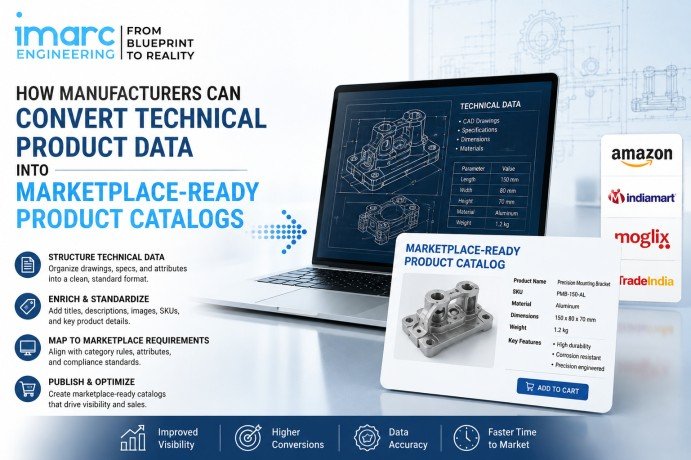
Most manufacturers already have the product knowledge buyers are searching for. It sits inside engineering datasheets, ERP exports, product drawings, compliance certificates, BOMs, test reports, and design files. The problem is not a shortage of information. It is that this information was created for engineering, production, and quality use, not for a buyer comparing five suppliers on a B2B marketplace, a procurement professional evaluating specifications, or an AI search tool extracting product information in seconds.
As B2B buying becomes increasingly digital and AI-assisted, manufacturers need structured, consistent, buyer-friendly product data that can be published across marketplaces, distributor portals, export platforms, and digital channels. This is where product catalogue digitization services for manufacturers become strategic rather than administrative activities.
Why Marketplace-Ready Product Data Has Become a Priority
Manufacturers are dealing with three changes simultaneously: more digital sales channels, buyers using AI and conversational search during product research, and increasing requirements for traceable technical and compliance data.
The shift toward AI-assisted B2B buying is significant. Forrester’s 2025 Buyers’ Journey Survey found that 94 percent of business buyers now use AI during their purchasing process, with generative AI and conversational search ranked as a more meaningful information source than vendor websites or sales.
A buyer may never begin with a manufacturer’s website. They may start with an AI assistant or marketplace search and ask which product meets a specification, which supplier offers the required material, or which manufacturer holds the required certification. If the underlying product data is incomplete or inconsistent, the manufacturer can become invisible during evaluation, even when the product itself is technically competitive.
What “Marketplace-Ready” Actually Means
Marketplace-ready does not mean copying a datasheet into a listing. A marketplace-ready product record must work for the technical buyer needing precise specifications, the procurement professional needing quick comparison, the marketplace’s search system that depends on structured attributes, AI and answer engines that extract information, and compliance teams that need traceability.
Engineering data: Industrial Power Supply, 230V AC input, 24V DC output, 10 A, IP65, -10°C to 50°C.
Marketplace-ready data: IP65 Industrial 24V DC Power Supply, 10 A. Input Voltage 230V AC, Output Current 10 A, Ingress Protection IP65, Operating Temperature -10°C to 50°C. Application: industrial automation and control panels. Key benefit: protection against dust and water ingress for demanding operating environments.
The technical data has not changed. It has simply been structured, contextualized, and translated into buyer language.
The Conversion Process: From Engineering File to Buyer-Ready Listing
Step 1: Centralize and Audit the Source Data
Product information is usually fragmented across ERP, PLM, engineering drawings, spreadsheets, and existing marketplace listings, creating real risk: one distributor may show an old specification while a marketplace uses a different unit of measurement. A structured audit should identify duplicate SKUs, conflicting values, outdated documents, and missing certifications, with one clear goal: a single approved source of product truth before multi-channel publishing begins. The more structured a manufacturer’s source documentation already is, whether datasheets, BOMs, test reports, or HSN codes, the faster this audit can move, though fragmented or unstructured data can still be audited and converted into a usable framework.
Step 2: Map Data to Channel-Specific Attribute Schemas
Every marketplace and distributor portal enforces its own product structure. An internal specification like “SS304 / 25 m³/hr / 32 m head / 7.5 kW” may need separate fields for material, flow rate, head, and motor power depending on the channel. The engineering information stays the same, but the structure changes by destination. Manufacturers should build one centralized attribute model and map each channel to it, rather than manually re-entering data everywhere, improving consistency, publishing speed, and catalog maintenance.
Step 3: Translate Specifications Into Buyer Language
Engineers communicate through specifications. Buyers search through applications and outcomes. “IP65, 24V DC, stainless-steel enclosure” becomes “designed for automation environments requiring protection from dust and water exposure.” The specification is never diluted, only combined with application context, helping both the engineer and the non-specialist buyer judge fit.
Step 4: Structure Content for AI and Answer Engines
Forrester’s research confirms generative AI and conversational search are increasingly shaping B2B buying journeys, though buyers still validate AI-generated answers against trusted sources before acting on them. This means product data needs to be explicit, structured, and machine-readable, not just optimized for keywords. A pump listed only as “high-performance, suitable for multiple applications” gives an AI system nothing concrete to extract or compare. The same product listed with flow rate, head, material, motor power, and application gives both search engines and AI assistants clear information to interpret and cite.
Freshness matters too: AirOps’ 2026 research found roughly 83 percent of AI citations for evaluation-stage queries came from pages updated within the past twelve months. Product data should be maintained as an operating system, not published once and forgotten.
Step 5: Publish, Monitor, and Govern
Specifications change, models get discontinued, and certifications get renewed. Updating this in only one location creates conflicting information across channels. A practical governance system assigns data ownership, version control, and update tracking, with a quarterly review as a reasonable baseline, more frequently for fast-changing products. The goal is preventing catalog decay, where an accurate listing quietly becomes unreliable over time.
Where Product Data and Regulatory Readiness Intersect
For manufacturers exporting to Europe, product data is increasingly tied to market access. The EU’s Carbon Border Adjustment Mechanism entered its definitive regime on January 1, 2026, covering cement, iron and steel, aluminium, fertilisers, electricity, and hydrogen, raising the importance of reliable emissions-linked production data. Separately, under the EU Batteries Regulation, industrial batteries above 2 kWh and EV batteries placed on the EU market must carry a battery passport from February 18, 2027. Manufacturers in affected sectors should increasingly treat product information as controlled, traceable business data rather than static marketing content.
Three Trends Shaping Catalog Strategy in 2026
- AI-assisted buying is becoming central to B2B discovery, meaning product data must support SEO, marketplace search, and AI discovery simultaneously, not one at the expense of the others.
- Regulatory data requirements are rising in parallel, making data readiness part of commercial readiness for export-oriented manufacturers.
- And catalog management is becoming an ongoing operational function rather than a one-time upload, as portfolios expand across more channels.
Common Marketplace Listing Mistakes That Cost Manufacturers Leads
- Copying the same generic description across multiple listings, making it harder to differentiate products or answer application-specific buyer questions
- Keeping critical specifications only inside PDFs instead of presenting key attributes directly within product listings
- Using internal engineering shorthand that procurement teams and non-technical buyers may not easily understand
- Publishing inconsistent specifications across websites, distributor catalogs, and marketplaces, reducing buyer confidence in product information
- Treating catalog publishing as a one-time exercise instead of maintaining product information as specifications, certifications, and models change
- Combining multiple product variants into a single unclear description instead of structuring specifications and differences by model or SKU
How IMARC Engineering Can Help
Manufacturers usually already hold the technical information needed for strong marketplace catalogs, but it is scattered across engineering, quality, procurement, and commercial teams. IMARC Engineering helps convert this fragmented technical information into structured, marketplace-ready product catalogs, including technical data audits, SKU and attribute mapping, specification standardization, product catalog digitization, and catalog governance workflows. The objective is accurate, structured, and maintainable product information that supports marketplace discovery, distributor sales, export requirements, and AI-assisted research, reducing the manual burden for manufacturers managing large or fast-changing SKU catalogs.
Request a Product Catalog Data Audit: https://www.imarcengineering.com/contact?service=ecommerce-listing-and-marketplace-onboarding
Conclusion
Technical product data and marketplace-ready content are not the same thing. Engineering teams create information to define and control a product, while marketplaces, distributors, and AI systems need that same information structured to be accurate, comparable, and easy to interpret.
Manufacturers gaining an advantage in digital B2B channels are not necessarily those with the largest catalogs, but those that turn existing technical knowledge into consistent, usable product information across every channel where buyers search. Building a single source of truth and maintaining it through structured catalog governance helps keep that information accurate, current, and ready for digital discovery.
Contact Us:
IMARC Engineering
Phone: +91-120-433-0800
Email: sales@imarcengineering.com
India: C-130, Sector 2, Noida, Uttar Pradesh 201301
LinkedIn: https://www.linkedin.com/showcase/imarc-engineering/
About the Author