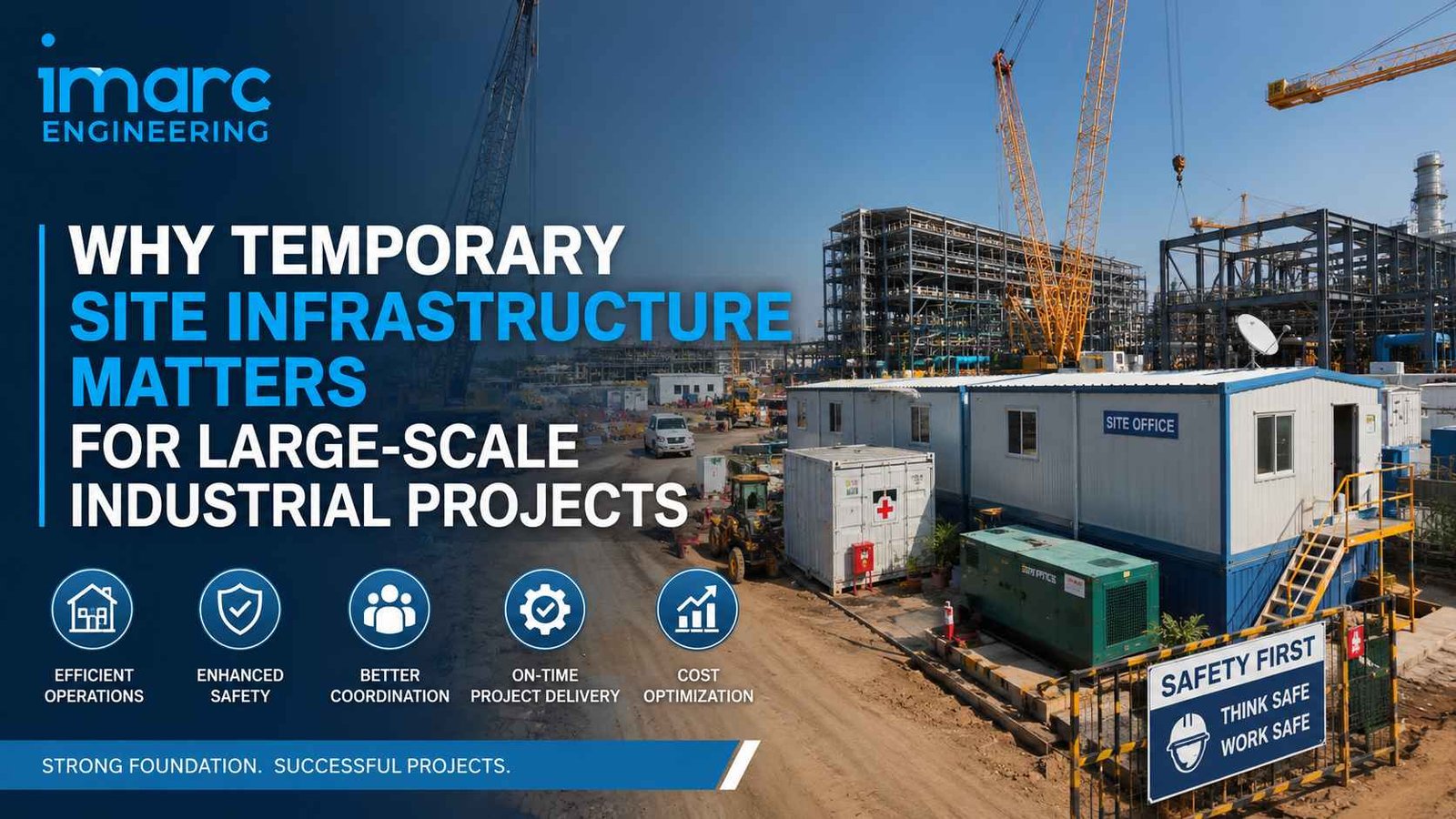
Large-scale industrial projects in India, from petrochemical complexes to manufacturing plants, rarely fail because of the main structure. They lose time and money in the first 90 to 180 days, when the site office is not yet functional, power is unreliable, water is not potable, and workforce facilities are not compliant. Government data shows how widespread this problem already is at the national level.
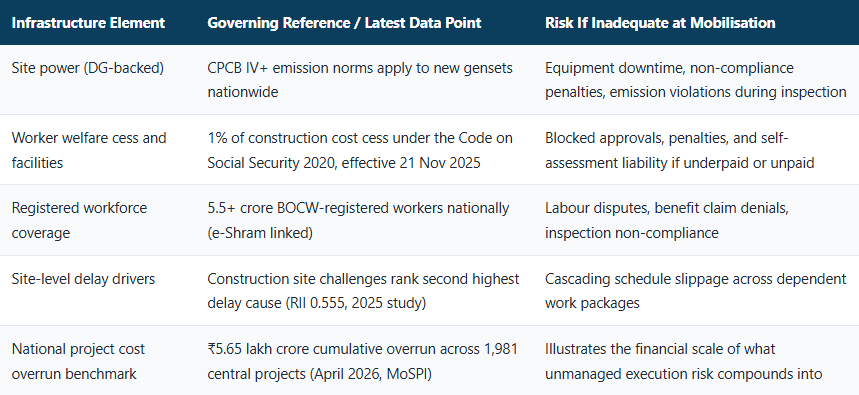
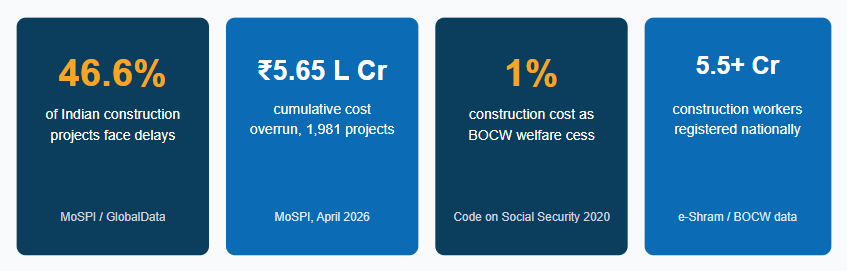
As of April 2026, the Ministry of Statistics and Programme Implementation reported that 1,981 ongoing central sector infrastructure projects, each valued at ₹150 crore or more, had a had a cumulative increase of ₹5.66 lakh crore between their original and revised costs, with total revised costs rising to ₹42.78 lakh crore from an original estimate of ₹37.12 lakh crore. Separately, Industry analysis citing GlobalData and other industry datasets has estimated that 46.6% of Indian construction projects face delays.
These are national aggregates, not project-specific outcomes, but the underlying causes, poor early-stage planning, weak site readiness, and coordination failures at mobilisation, are the same ones that determine whether an individual EPCM project stays on schedule. This is exactly where Temporary Site Infrastructure planning earns its place in the project execution schedule, not as an afterthought, but as a defined work package with its own budget, timeline, and compliance checklist.
What Temporary Site Infrastructure Actually Covers
For an EPCM contractor, temporary site infrastructure is the full set of enabling works that must exist before permanent construction can begin at scale. On a typical greenfield industrial site, this includes:
- Site offices for the EPCM team, client representatives, and contractors, with structured cabling and network connectivity
- Power backup through diesel generator sets, now required to meet CPCB IV+ emission norms for new gensets
- Potable water supply and storage, plus wastewater and sanitation systems for the workforce
- Worker housing, canteens, and welfare facilities as mandated under the labour welfare framework
- Site security, boundary fencing, access control, and CCTV coverage
- Temporary access roads, material laydown yards, and storage sheds
- First aid rooms and emergency response points, positioned per site safety planning
The Regulatory Weight Behind Workforce Facilities
Workforce infrastructure on an industrial site is not discretionary. It sits inside a labour compliance framework that has tightened materially in the last year. The four central Labour Codes came into force on 21 November 2025, introducing a consolidated framework for labour, occupational safety and social-security requirements. For industrial construction projects, workforce welfare, safety, sanitation and other site-facility obligations should be assessed against the requirements applicable to the project, location and workforce.
The scale of the workforce this cess supports is large. Government data puts registered Building and Other Construction Workers at over 5.5 crore nationally, with active integration into the e-Shram portal for benefit delivery. For a large industrial project with a workforce running into the thousands at peak, this translates directly into a defined obligation for site housing, drinking water, crèche facilities where applicable, and medical access, all of which need to be planned as temporary infrastructure from day one, not retrofitted after a labour inspection.
Where Projects Actually Lose Time
Delay-cause studies on Indian infrastructure and industrial construction consistently point to site-level and resource-related factors, not just design or approval issues. A 2025 peer-reviewed delay analysis using the Relative Importance Index found material-related issues (RII of 0.562) and construction site challenges (RII of 0.555) ranking above contractor-related inefficiencies (RII of 0.506) as primary delay drivers. Site challenges of this kind, unreliable power for equipment, no proper laydown area, contaminated or insufficient water, workforce facilities that fall short of statutory norms, are precisely the risks that a dedicated temporary infrastructure package is built to close before they compound into schedule slippage.
The Numbers at a Glance
Building It as a Defined Work Package
The projects that avoid these delays treat temporary site infrastructure as a scheduled, budgeted work package with clear ownership, not a set of ad hoc arrangements made after mobilisation. In practice, this means:
- Sizing DG capacity and CPCB IV+ compliant power before equipment mobilisation, not after the first outage
- Budgeting the 1% welfare cess and workforce facility costs into the project cost plan at the DPR stage
- Sequencing site offices, connectivity, and access roads ahead of the main construction workforce ramp-up
- Building water treatment and sanitation capacity for peak workforce numbers, not average numbers
- Aligning site security and access control with the project’s overall HSE plan from day one
For an EPCM firm managing a large industrial site, this is where an experienced execution partner adds measurable value, not by designing the plant faster, but by making sure the site is actually ready to build on. IMARC Engineering’s temporary site infrastructure service is structured around exactly this gap, covering site office setup, power and water utilities, workforce facilities, and compliance documentation as one coordinated package rather than fragmented vendor arrangements.
Planning mobilisation for an upcoming industrial project? IMARC Engineering’s site infrastructure team can help scope, budget, and sequence the temporary works package before ground-breaking, reducing the early-stage risk that shows up later as schedule and cost overrun.
Get in Touch With Our Team: https://www.imarcengineering.com/contact?service=temporary-site-office-setup-and-utilities
Contact Us:
IMARC Engineering
Phone: +91-120-433-0800
Email: sales@imarcengineering.com
India: C-130, Sector 2, Noida, Uttar Pradesh 201301
LinkedIn: https://www.linkedin.com/showcase/imarc-engineering/
About the Author