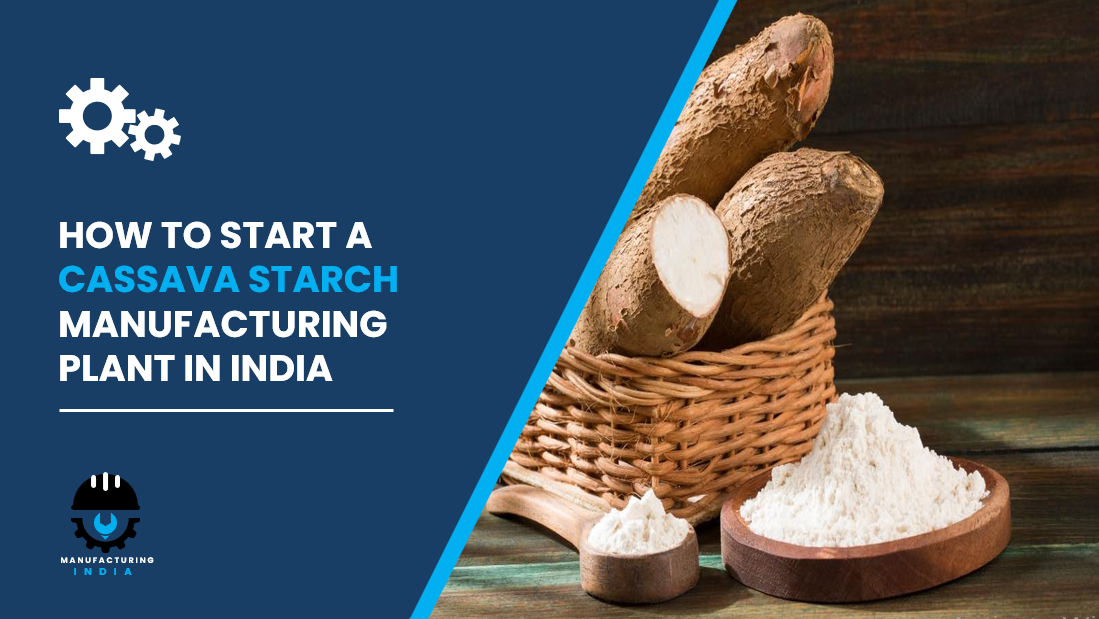
Setting up a cassava starch manufacturing plant in India presents a compelling investment case driven by the country’s rapidly expanding food processing industry, surging demand for gluten-free and clean-label ingredients, growing consumption of processed and convenience foods, and the broadening industrial use of starch-based products across paper, textiles, pharmaceuticals, adhesives, and biodegradable packaging. Cassava starch — extracted from the roots of the cassava plant (Manihot esculenta) — is a fine, white, odourless powder composed primarily of amylose and amylopectin, valued for its high viscosity, neutral taste, excellent thickening ability, superior binding properties, and natural gluten-free, non-allergenic profile. Its applicability across both food and non-food industrial sectors makes it one of the most versatile and commercially resilient starch products available, significantly reducing demand concentration risk for producers.
India’s southern and eastern states — including Tamil Nadu, Andhra Pradesh, Odisha, and Kerala — have established cassava cultivation traditions that provide a domestic raw material base for processors, while the country’s large and growing food processing, paper, textile, and pharmaceutical industries create an equally substantial domestic buyer base. The Make in India initiative, food processing sector PLI scheme, and agro-industrial investment support further reinforce the policy environment for this investment. With increasing global and domestic preference for biodegradable packaging, gluten-free formulations, and plant-based food ingredients, a cassava starch manufacturing plant in India is positioned at the intersection of three of the most consequential consumer and industrial trends of the decade.
A cassava starch manufacturing plant in India combines a versatile, multi-industry product with a cost-effective tropical agricultural feedstock, delivering gross margins of 25–35% and net margins of 12–20%. With a global market valued at USD 5.70 billion in 2025 and projected to reach USD 8.40 billion by 2034 at a CAGR of 4.4%, this investment offers stable and diversified financial returns across food, industrial, and pharmaceutical demand channels for India-based producers.
What is Cassava Starch?
Cassava starch is a carbohydrate-rich powder extracted from the roots of the cassava plant (Manihot esculenta). It is composed primarily of amylose and amylopectin, offering high viscosity, neutral taste, excellent thickening ability, and superior binding properties. The starch appears as a fine, white, odourless powder and is valued for its clarity, freeze-thaw stability, and smooth texture. Naturally gluten-free and non-allergenic, cassava starch is widely used in food formulations and industrial applications.
It exhibits good film-forming capacity and biodegradability, making it suitable for both edible and non-edible applications — including modified starch derivatives for enhanced performance characteristics. The primary production method spans cleaning and washing, peeling, rasping (grating), starch extraction, fibre separation, sedimentation, dewatering, drying, and milling. The product serves end-use industries including food and beverages, paper and pulp, textiles, pharmaceuticals, adhesives, animal feed, and biodegradable packaging — with applications as a thickening agent, stabiliser, binder, sizing agent, coating material, excipient, and biodegradable polymer base.
Cost of Setting Up a Cassava Starch Manufacturing Plant in India
The total cost of establishing a cassava starch manufacturing plant in India depends on production capacity, extraction technology, plant location, degree of automation, and regulatory compliance requirements.
1. Capital Expenditure (CapEx)
The capital investment required to set up this facility covers several major cost heads. Land and site development — including land registration, boundary development, process water infrastructure, and related site works — forms a substantial portion of total CapEx. Investors should consider locating the unit in close proximity to cassava cultivation zones in Tamil Nadu, Andhra Pradesh, Kerala, or Odisha to minimise root transportation costs and preserve root quality. Cassava roots deteriorate rapidly after harvest — typically within 24–48 hours — making proximity to farmgate supply a critical operational requirement that directly affects extraction yield and product quality. Industrial estates and agro-processing zones in these states offer additional infrastructure support.
Civil works and construction costs cover the root receiving and weighing yard, washing and peeling area, rasping and extraction hall, starch settling and dewatering section, drying zone, milling and sieving room, quality control laboratory, effluent treatment area, finished goods warehouse, and administrative block. High water consumption across washing, extraction, and settling stages requires dedicated water management infrastructure including recycling and treatment systems.
Machinery and equipment represent the largest component of total capital expenditure for this cassava starch manufacturing plant. Key machinery required includes:
- Root washing and peeling machines
- Raspers or graters
- Starch extraction units
- Hydrocyclones
- Dryers
- Milling and sieving systems
- Packaging machines
Other capital costs include effluent treatment plant (ETP) installation for high-volume process wastewater containing starch, fibre, and cyanide compounds from cassava root processing, pre-operative and commissioning expenses, and utility connection charges for electricity, water, and steam supply.
Request a Sample Report for In-Depth Market Insights: https://www.imarcgroup.com/cassava-starch-manufacturing-plant-project-report/requestsample
2. Operational Expenditure (OpEx)
The operating cost structure of a cassava starch manufacturing plant is overwhelmingly dominated by raw material procurement. Raw material cost — covering cassava roots as the primary input along with water and sulfur dioxide used in the extraction and whitening process — accounts for approximately 70–80% of total OpEx, making cassava root procurement the single most critical cost management lever in the business. Investors should establish long-term supply agreements with cassava farmers and aggregators in the plant’s surrounding agricultural zone, incorporating minimum guaranteed offtake volumes to ensure production continuity across growing seasons. The high root-to-starch conversion ratio (approximately 4–5 kg of fresh roots per kg of starch) means that small improvements in procurement cost have a disproportionate impact on overall plant profitability.
Utility costs, covering electricity, water, and steam required for rasping, hydrocyclone separation, and flash drying operations, account for 15–20% of OpEx — a moderately high share reflecting the water-intensive and thermally active nature of starch extraction and drying. Other operating costs include transportation and logistics for finished starch dispatch to food manufacturers, paper mills, textile factories, and pharmaceutical buyers, packaging materials, salaries and wages, maintenance and repairs of extraction and milling equipment, depreciation of fixed assets, and applicable taxes. By the fifth year of operations, total operational costs are projected to increase substantially due to inflation, cassava root price escalation, market fluctuations, supply chain disruptions, and rising consumer and industrial demand dynamics.
3. Plant Capacity
The proposed manufacturing facility is designed with an annual production capacity ranging between 50,000–200,000 MT, enabling economies of scale while maintaining operational flexibility. Capacity can be customised based on specific investor requirements, cassava root catchment area size and yield, and capital availability. Profitability and unit economics improve meaningfully with higher capacity utilisation, and the large-scale, continuous-flow nature of cassava starch extraction makes high throughput a central operational priority for cost-efficient production.
4. Profit Margins and Financial Projections
The cassava starch manufacturing plant demonstrates healthy and consistent profitability potential under normal operating conditions. Gross profit margins typically range between 25–35%, supported by stable multi-sector demand across food, industrial, and pharmaceutical channels, and the value differential between low-cost cassava root inputs and the finished starch product. Net profit margins are projected in the range of 12–20%. Key financial indicators including NPV, IRR, payback period, liquidity analysis, and sensitivity analysis are covered comprehensively in the full project report.
Why Set Up a Cassava Starch Manufacturing Plant in India?
Rising Demand for Gluten-Free and Clean-Label Ingredients. Increasing consumer preference for gluten-free food products is strongly driving demand for cassava starch as an alternative thickening and binding agent in food formulations. India’s health-conscious urban consumer base is expanding rapidly, and food manufacturers across bakery, confectionery, snacks, and ready-meal segments are actively reformulating products to meet clean-label and allergen-free positioning requirements.
Industrial Versatility Reducing Demand Concentration Risk. Cassava starch’s applicability across the food and beverage, paper and pulp, textile, pharmaceutical, adhesives, animal feed, and biodegradable packaging industries reduces dependence on any single sector and enhances revenue diversification for the manufacturer. This multi-industry demand base is a key structural advantage that differentiates cassava starch from more narrowly applied industrial inputs.
Biodegradable and Sustainable Profile Aligned with Global Trends. Cassava starch aligns directly with global sustainability initiatives, particularly in biodegradable plastics and eco-friendly packaging. As India’s regulatory environment increasingly encourages the phasing out of single-use plastics and the adoption of biodegradable alternatives, starch-based packaging solutions — for which cassava starch is a primary feedstock — are positioned for accelerating institutional and industrial demand.
Abundant Agricultural Availability Supporting Supply Stability. Cassava is widely cultivated in tropical regions, ensuring a stable raw material supply in major producing countries. Africa’s dominant position in global cassava production — with cultivation across 40 countries and Nigeria alone having produced 60 million tons over the 60 years from 1961 to 2020 — demonstrates the crop’s agricultural reliability and yield potential. High yields such as Zambia’s 34.85 tons per hectare further support productivity and cost efficiency for large-scale processors.
Active Global Industry Investment. In February 2026, Cameroon’s Minister of Agriculture and Rural Development commissioned a new cassava processing facility in Minkoa, outfitted with semi-modern equipment designed to process cassava roots into starch and flour under the government’s import-substitution initiative. In November 2025, Dei Biopharma launched a USD 50 million cassava starch production facility in Namasagali, Uganda — representing the initial phase of an agro-processing industrial hub aimed at producing locally sourced excipients and active pharmaceutical ingredients (APIs) — confirming strong global private investment confidence in cassava starch production at commercial scale.
Export-Oriented Opportunity for India-Based Producers. Major cassava starch-producing regions have strong export potential, supported by global food and industrial demand from paper mills, textile manufacturers, pharmaceutical companies, and food processors in markets that lack domestic cassava cultivation. India-based producers are well-positioned to serve export demand in South Asia, the Middle East, and Southeast Asia alongside their domestic buyer base.
Manufacturing Process — Step by Step
The cassava starch manufacturing process uses cleaning and washing, peeling, rasping (grating), starch extraction, fibre separation, sedimentation, dewatering, drying, and milling as the primary production method. The process involves multiple unit operations, material handling stages, and quality verification checkpoints throughout.
- Root Receipt and Weighing: Fresh cassava roots are received from contracted farmers and aggregators, weighed, and inspected for root quality, size consistency, and starch content before entering the processing line. Rapid processing after harvest is essential to preserve starch yield and quality.
- Cleaning and Washing: Roots are passed through root washing machines to remove soil, surface contaminants, and fibrous peel matter, using large volumes of water to achieve food-grade cleanliness standards.
- Peeling: Washed roots undergo mechanical peeling using peeling machines to remove the outer bark and residual peel, reducing cyanide-bearing compounds and improving starch purity in the extracted product.
- Rasping (Grating): Peeled roots are fed into raspers or graters that rupture the root cells and reduce the cassava to a fine slurry, maximising the release of starch granules from the cellular matrix and improving overall extraction yield.
- Starch Extraction: The cassava slurry is mixed with water and processed through starch extraction units to separate the starch-rich liquid from the fibrous bagasse material. Sulfur dioxide may be added at this stage to improve starch whiteness and inhibit enzymatic browning.
- Fibre Separation: Extracted starch milk is passed through fine screens and separation equipment to remove residual fibre, cell wall fragments, and bagasse from the starch suspension.
- Hydrocyclone Purification (Sedimentation): Starch milk is processed through hydrocyclones to concentrate the starch, remove dissolved impurities, proteins, and soluble sugars, and produce a high-purity starch slurry through counter-current washing stages.
- Dewatering: Purified starch slurry is dewatered using centrifuges or vacuum filters to reduce moisture content before drying, producing a starch cake of consistent moisture level.
- Drying: Dewatered starch is dried using flash dryers to reduce final moisture content to specification — typically below 14% — producing free-flowing dry cassava starch powder.
- Milling and Sieving: Dried starch is milled using milling and sieving systems to achieve the required particle size distribution and screen out oversize particles, producing a uniform fine powder meeting customer grade specifications.
- Quality Control and Testing: Finished cassava starch is tested for moisture content, whiteness, viscosity, pH, ash content, particle size, and microbial parameters against applicable FSSAI, food-grade, industrial-grade, and pharmaceutical-grade specifications.
- Packaging and Dispatch: Approved starch is packaged in bags or bulk containers and dispatched to food and beverage manufacturers, paper mills, textile factories, pharmaceutical companies, adhesive producers, and biodegradable packaging manufacturers.
Key Applications
The cassava starch manufacturing plant serves multiple high-volume industries with consistent and growing demand for starch-based inputs:
- Food and Beverage Industry: Used as a thickener in soups, sauces, gravies, bakery products, confectionery, and gluten-free formulations — the largest and most diversified end-use application segment.
- Paper and Pulp Industry: Applied as a surface sizing and coating agent to enhance paper strength, printability, and smoothness across packaging and printing paper grades.
- Textile Industry: Used for warp sizing to strengthen yarn during weaving and to improve fabric finish and processing efficiency in textile manufacturing.
- Pharmaceutical Industry: Functions as a binder and disintegrant in tablet manufacturing due to its compressibility and solubility properties, serving both domestic pharmaceutical manufacturers and API excipient buyers.
- Adhesives and Bioplastics: Serves as a base material in starch-based adhesives, biodegradable packaging films, and compostable polymer applications aligned with sustainability regulations and circular economy initiatives.
Leading Manufacturers
The global cassava starch industry is served by several major producers with extensive production capacities and diversified application portfolios. Key players include:
- Tate & Lyle
- Cargill, Incorporated
- Ingredion
- AGRANA Starch
- Psaltry International Limited
- KPN Pharma Co., Ltd.
- Visco Starch
- SPAC Starch Products Ltd.
- Vaighai Agro
Timeline to Start the Plant
- Feasibility study and project report preparation
- Land acquisition and site development
- Regulatory approvals and environmental clearances
- Factory licence and fire safety compliance
- Machinery procurement and installation
- Raw material supplier agreements and supply chain setup
- Trial production and quality testing
- Commercial production launch
Licences and Regulatory Requirements
Starting a cassava starch manufacturing unit in India requires several approvals:
- Business registration (Proprietorship, LLP, or Pvt Ltd)
- Factory Licence under the Factories Act
- Environmental Clearance from State Pollution Control Board
- GST Registration
- Fire Safety NOC
- FSSAI (Food Safety and Standards Authority of India) licence — mandatory for food-grade starch production and supply to food manufacturers
- Effluent Treatment Plant (ETP) operational clearance — critical given the high-volume, cyanide-containing process wastewater from cassava root washing and extraction
- Occupational Health and Safety compliance
Key Challenges to Consider
High Capital Requirements. Starch extraction units, hydrocyclone systems, flash dryers, and milling and sieving lines represent substantial CapEx investments. The high water infrastructure requirement — for washing, extraction, and effluent treatment — adds further civil works complexity and upfront investment above standard agro-processing norms.
Raw Material Price Volatility. Cassava roots — accounting for 70–80% of total OpEx — are subject to seasonal availability, rainfall-dependent yield variability, and farm-gate price movements in cultivation zones. Establishing long-term procurement contracts with farmers and aggregators and operating a geographically diversified sourcing base are essential strategies for protecting production margins.
Regulatory Compliance. Managing cyanide-bearing effluent from cassava root processing to meet State Pollution Control Board discharge standards, obtaining FSSAI food safety certification for food-grade output, and maintaining continuous ETP operation all require dedicated compliance investment and monitoring systems specific to cassava processing.
Technology and Innovation Pressure. Growing demand for modified cassava starch derivatives — including pre-gelatinised, cross-linked, and hydroxypropylated grades with enhanced performance characteristics — requires producers to consider investing in downstream modification capabilities to access premium industrial and pharmaceutical market segments.
Competition. Global players such as Tate & Lyle, Cargill, Incorporated, Ingredion, and AGRANA Starch maintain dominant market positions with established supply networks. Domestic Indian producers such as SPAC Starch Products Ltd. and Vaighai Agro also operate in this space. New entrants must compete on raw material cost advantage, product consistency, FSSAI and pharmaceutical-grade certification, and distribution proximity to buyer clusters.
Skilled Manpower. Operating hydrocyclone purification systems, flash dryers, and quality control laboratory testing for multiple starch grades — across food, pharmaceutical, and industrial specifications — requires technically trained process and quality assurance personnel, which can be challenging to recruit in rural cassava-belt locations.
Frequently Asked Questions
1. How much does it cost to set up a cassava starch manufacturing plant in India? Total investment depends on production capacity (50,000–200,000 MT annually), extraction technology, location proximity to cassava cultivation zones, and automation level. Key cost components include land and site development, civil construction, machinery (root washing and peeling machines, raspers, starch extraction units, hydrocyclones, dryers, milling and sieving systems, and packaging machines), water and process infrastructure, ETP, and working capital. A detailed project report provides capacity-specific CapEx and OpEx estimates.
2. Is cassava starch manufacturing profitable in India in 2026? Yes. The facility demonstrates gross profit margins of 25–35% and net profit margins of 12–20% under normal operating conditions. Profitability improves with higher capacity utilisation, effective cassava root procurement cost management, and product range diversification into higher-value pharmaceutical-grade and modified starch grades.
3. What machinery is required for a cassava starch manufacturing plant in India? Key equipment includes root washing and peeling machines, raspers or graters, starch extraction units, hydrocyclones, dryers, milling and sieving systems, and packaging machines.
4. What licences and approvals are required to start a cassava starch manufacturing plant in India? Required approvals include business registration, Factory Licence under the Factories Act, Environmental Clearance from the State Pollution Control Board, GST registration, FSSAI food safety licence for food-grade starch production, ETP operational clearance for cyanide and high-organic process wastewater, Fire Safety NOC, and Occupational Health and Safety certification.
5. What raw materials are needed for cassava starch manufacturing? The primary raw material is fresh cassava roots (Manihot esculenta). Supporting process materials include water — consumed in large volumes across washing, extraction, and hydrocyclone stages — and sulfur dioxide, used to improve starch whiteness and inhibit enzymatic browning during extraction.
6. What are the environmental compliance requirements for a cassava starch manufacturing plant in India? Operators must obtain Environmental Clearance, maintain an operational Effluent Treatment Plant to manage high-volume, cyanide-containing process wastewater from root washing and extraction operations, comply with State Pollution Control Board guidelines on effluent quality before discharge, and implement water recycling systems to minimise fresh water consumption and wastewater generation volumes.
7. What is the best location to set up a cassava starch manufacturing plant in India? Ideal locations offer maximum proximity to cassava root cultivation areas to minimise post-harvest deterioration and transportation costs. Tamil Nadu — India’s largest cassava-producing state — along with Andhra Pradesh, Kerala, and Odisha are the strongest location options, offering established cassava farming communities, agro-industrial infrastructure, and access to both domestic food processing and export logistics networks.
8. What is the break-even period for this type of plant in India? Break-even depends on production scale, cassava root procurement costs, capacity utilisation, product grade mix, and prevailing market pricing for food-grade versus industrial-grade cassava starch. A detailed feasibility study provides project-specific break-even, NPV, and IRR projections aligned to investor capacity and target market strategy.
9. What government incentives are available for manufacturers in India? Cassava starch manufacturers in India can benefit from the PLI scheme for food processing, capital subsidies under state-level agro-processing investment schemes in Tamil Nadu and Andhra Pradesh, tax exemptions under state industrial promotion policies, reduced utility tariffs in food processing industrial estates, and export-linked benefits for starch products supplied to international paper, textile, and pharmaceutical buyers. MSME development scheme funding may provide additional support for smaller-scale producers targeting domestic markets.
Key Takeaways for Investors
The cassava starch manufacturing plant opportunity in India is underpinned by robust, structurally diversified demand across food and beverage, paper and pulp, textiles, pharmaceuticals, adhesives, and biodegradable packaging industries — all of which are growing in parallel with India’s industrial scale-up and consumer market expansion. The financial profile is strong across the 50,000–200,000 MT annual capacity range, with gross margins of 25–35% and net margins of 12–20%, supported by India’s established cassava cultivation base and the versatile, multi-sector demand profile that characterises cassava starch as an industrial commodity. The global cassava starch market, valued at USD 5.70 billion in 2025, is projected to reach USD 8.40 billion by 2034 at a CAGR of 4.4%, confirming a sustained and growing demand runway. As global producers including Dei Biopharma commit USD 50 million to new cassava starch facilities targeting pharmaceutical excipient markets, and as demand for gluten-free ingredients and biodegradable packaging accelerates across both developing and developed economies, India-based cassava starch producers are positioned for durable, multi-decade demand growth across every tier of their diversified application portfolio.
About the Author