Setting up a laptop manufacturing plant in India presents a compelling investment opportunity, driven by accelerating demand for portable computing devices across consumer, enterprise, education, government, and institutional sectors; rapid digital transformation across industries; rising adoption of remote work and online learning; growing penetration of AI-enabled laptops; and the expanding policy push for domestic electronics manufacturing across India and other emerging economies. As one of the most strategically significant segments of the global electronics and technology industry, laptop manufacturing integrates component sourcing, precision circuit board assembly, mechanical fabrication, software configuration, quality assurance, and supply chain management to serve a broad range of consumer, commercial, and institutional end markets.
Growth is driven by rising demand for portable, high-performance computing devices, rapid expansion of digital infrastructure, and advancements in processor technology, battery efficiency, display quality, and wireless connectivity. Asia Pacific leads global production, with manufacturers concentrated in China, Taiwan, and increasingly in India, Vietnam, and Mexico. The global laptop market size was valued at USD 155.74 Billion in 2025. According to IMARC Group estimates, the market is expected to reach USD 204.45 Billion by 2034, exhibiting a CAGR of 3.07% from 2026 to 2034.
Expanding adoption of remote work, online education, and cloud computing; growing demand for gaming laptops and high-performance creator devices; and the increasing shift toward premium, AI-enabled, and thin-and-light form factors are driving sustained demand growth. Government initiatives such as India’s Production Linked Incentive (PLI) scheme for IT hardware, make in India mandates, and public procurement programs are accelerating local laptop manufacturing investment and ecosystem development.
Laptop manufacturing sits at the intersection of electronics design, precision engineering, software integration, supply chain management, and digital infrastructure investment, supported by structurally growing global technology adoption and expanding digital inclusion in emerging economies. With gross profit margins typically ranging between 15 to 25% and a well-defined break-even trajectory at scale, a dedicated laptop manufacturing plant represents both a financially sound and strategically well-timed investment for electronics manufacturers, EMS operators, ODM/OEM players, and institutional investors targeting the evolving global computing, digital education, and enterprise technology markets.
What is a laptop?
A laptop is a portable, compact personal computer featuring an integrated screen, keyboard, and touchpad, designed for mobile use with a rechargeable battery, enabling it to function as a fully capable computing device in any location. Housed in a clamshell design that folds shut for protection and portability, it integrates essential components including the processor, memory, storage, graphics, connectivity interfaces, and power management circuitry into a single, easily transportable unit.
Modern laptops serve a wide spectrum of use cases spanning document creation and browsing for everyday consumer and student use, to enterprise productivity, software development, data analytics, AI inference, and graphic design for professional and corporate applications, to high-frame-rate gaming and content creation for specialist consumer segments. The primary raw materials for laptop manufacturing include printed circuit boards (PCBs), processors (CPUs/GPUs), display panels (LCD/OLED), DRAM memory modules, solid-state storage (SSDs), battery cells, keyboard assemblies, structural casings (aluminium alloy or high-grade plastic), cooling components, and an extensive array of connectors, cables, and passive electronic components.
Standard laptop product formats include mainstream consumer notebooks, ultrabooks and thin-and-light premium devices, 2-in-1 convertibles with detachable or 360-degree hinge designs, gaming laptops with dedicated GPU and high-refresh-rate displays, workstation-class laptops for creative and engineering professionals, and ruggedised or business-grade enterprise notebooks. End-use segments include individual consumers, students and educational institutions, corporate enterprises and SMEs, government departments, defence, healthcare institutions, content creators, and gaming communities.
Cost of Setting Up a Laptop Manufacturing Plant
The total cost of establishing a laptop manufacturing plant depends on several variables including plant throughput capacity (units per year), product mix (mainstream consumer, gaming, enterprise, ultrabook), level of automation (semi-automatic assembly versus fully automated SMT and test lines), geographic location and proximity to component supply clusters, cleanroom and ESD-controlled environment requirements, and applicable regulatory and certification compliance requirements. A thorough feasibility assessment covering all CapEx and OpEx components is essential before committing capital, given the technology-intensive, precision-engineering, and quality-compliance-dependent nature of commercial laptop manufacturing.
1. Capital Expenditure (CapEx)
Capital investment for a laptop manufacturing plant covers several broad cost heads. Land and site development forms a meaningful part of the overall investment, encompassing land registration charges, boundary development, drainage, site grading, ESD-controlled flooring for assembly areas, and related civil infrastructure expenses. A typical commercial laptop manufacturing facility requires a land parcel sized to accommodate the component receiving and incoming inspection area, SMT assembly hall, mechanical fabrication and casing area, system integration and final assembly area, software flashing and configuration bays, burn-in and quality testing rooms, packaging and dispatch bay, quality control laboratory, effluent and waste management infrastructure, and on-site utility installations. Investors may consider locating the facility in electronics manufacturing clusters, special economic zones (SEZs), or government-designated IT hardware parks for policy incentives and supply chain proximity.
Civil works and construction costs cover the component receiving dock, incoming quality inspection area, ESD-controlled SMT assembly hall with cleanroom-grade air filtration, mechanical fabrication and casing area, system integration room, software flashing bays, burn-in testing racks, packaging zone, waste and scrap management area, quality control laboratory, and the administrative block. Machinery and equipment costs represent the largest single portion of total capital expenditure. Key machinery and equipment required includes:
- Surface Mount Technology (SMT) Assembly Lines: High-speed SMT placement machines, solder paste printers, reflow ovens, automated optical inspection (AOI) machines, X-ray inspection systems for BGA verification, wave soldering machines for through-hole components, selective soldering systems, and PCB depanelling routers.
- Mechanical Fabrication and Casing Equipment: CNC milling and precision machining centres for aluminium alloy casing fabrication, injection moulding machines for plastic structural components, anodising and surface finishing lines, precision stamping presses, ultrasonic welding machines for plastic assembly, and CNC laser cutting systems.
- System Integration and Final Assembly Equipment: Automated and manual assembly workstations with ESD-controlled fixtures, torque-controlled screwdriving systems, thermal paste application dispensers, hinge assembly and testing jigs, display panel bonding and lamination equipment, and precision cable routing and connector installation tools.
- Software Flashing and Configuration Systems: BIOS flashing stations, operating system image deployment servers, driver installation bays, firmware validation test benches, UEFI configuration stations, serial number programming systems, and asset tagging and traceability systems.
- Quality Testing and Burn-In Equipment: Burn-in racks and thermal stress chambers for accelerated reliability testing, automated functional test stations for keyboard, touchpad, display, audio, connectivity, and battery performance, drop and vibration test rigs, ingress protection test chambers (for ruggedised models), electromagnetic compatibility (EMC) pre-compliance test benches, and display colour calibration and uniformity testing systems.
- Packaging and Dispatch Equipment: Automated tray and carton erection systems, foam and moulded pulp insert placement lines, shrink-wrapping units, barcode and serial number label printing and application systems, carton sealing and palletisation machines, and automated palletisers and stretch-wrapping systems.
- Quality Control and Laboratory Equipment: Coordinate measuring machines (CMMs) for dimensional inspection of casings, ESD monitoring equipment, soldering quality inspection tools, microscopes for PCB and component inspection, environmental test chambers for temperature and humidity cycling, battery capacity and cycle-life test stations, and spectrophotometers for display colour quality measurement.
- Utility and Support Systems: Electrical substations and transformers, standby diesel generators for cleanroom and ESD environment continuity, compressed air systems, temperature and humidity-controlled HVAC for assembly areas, ESD flooring and earthing systems, nitrogen reflow systems for SMT soldering quality, water treatment and purification systems, and UPS systems for critical test and server infrastructure.
- Material Handling and Dispatch Equipment: ESD-safe component storage and retrieval systems, automated conveyor lines between assembly stations, anti-static carts and trolleys, forklift trucks and pallet jacks, and loading dock levellers and restraints for finished goods dispatch.
Other capital costs include utility connections (electricity, internet, and cooling supply), pre-operative expenses, plant commissioning costs, SMT line installation and calibration, import duties on precision CNC equipment, automated optical inspection systems, and burn-in and EMC test chambers not manufactured domestically.
Request a Sample Report for In-Depth Market Insights: https://www.imarcgroup.com/laptop-manufacturing-plant-project-report/requestsample
2. Operational Expenditure (OpEx)
The operating cost structure of a laptop manufacturing plant is heavily weighted toward component and raw material procurement. Raw material costs, primarily PCBs, processors, displays, memory, storage, and structural casings, typically account for 80 to 85% of total operating expenses, making component sourcing strategy, supplier relationship management, and bill-of-materials (BOM) cost optimisation the primary commercial priorities for operational cost control. Electricity costs for SMT reflow ovens, HVAC systems, burn-in chambers, test equipment, and facility lighting and climate control account for approximately 5 to 10% of total OpEx.
Additional operating costs include packaging materials (retail cartons, moulded pulp inserts, accessory pouches, and palletisation materials), outbound logistics and last-mile delivery, salaries and wages for SMT technicians, assembly operators, quality control engineers, software engineers, and warehouse personnel, periodic equipment maintenance and SMT nozzle and feeder servicing, ESD material replenishment, solder paste and flux consumption, software licence costs for production management and ERP systems, and applicable BIS, CE, FCC, RoHS, and export certification and renewal costs.
3. Plant Capacity
The proposed laptop manufacturing facility is designed with an annual production capacity ranging between 1 to 5 million units, enabling meaningful economies of scale while preserving operational flexibility across the full product range, from mainstream consumer notebooks and student devices to premium ultrabooks, gaming laptops, enterprise-grade workstations, and ruggedised government and defence-specification laptops. Plant capacity can be customised based on the investor’s specific capital availability, target market scale, available component supplier base, and chosen product mix across end-use segments such as consumer retail, enterprise, government, education, and export markets.
Profitability improves considerably at higher capacity utilisation levels, given the significant fixed-cost component of SMT equipment, cleanroom infrastructure, automated test lines, and software deployment servers, making early offtake agreements with retail chains, enterprise IT procurement departments, government bodies, educational institutions, and export trading partners strategically important for achieving break-even at pace.
4. Profit Margins and Financial Projections
A laptop manufacturing plant demonstrates healthy profitability potential under normal operating conditions. Gross profit margins typically range between 15 to 25%, supported by stable and growing demand across consumer, enterprise, government, education, and export markets; the structural digitalisation of economies across both developed and emerging markets; rising enterprise refresh cycles driven by AI-enabled compute requirements and cloud computing adoption; and differentiation opportunities through premium branded, thin-and-light, gaming, and AI-capable laptop product formats for modern retail, e-commerce, and enterprise procurement. Net profit margins range between 5 to 10%. Financial projections incorporate NPV analysis, IRR calculations, payback period modelling, and sensitivity analysis across plant capacity utilisation, component price scenarios, and end-market demand conditions, providing investors with a comprehensive view of long-term financial viability.
Why Set Up a Laptop Manufacturing Plant?
Core Electronics and Computing Product:
- Laptops are essential end-user computing devices integrating processing, storage, display, power management, and connectivity, making them a cornerstone product across education, enterprise, government, gaming, and consumer markets in the digital economy, with large, structurally growing, and globally diversified demand.
Megatrend Alignment:
- Growth in remote work, digital education, cloud computing, AI-enabled applications, and enterprise mobility is driving sustained global demand for laptops. Refresh cycles in corporate IT, government digitisation programmes, and rising penetration in emerging markets continue to support stable, long-term growth across multiple end-use segments.
Policy and Manufacturing Incentives:
- Government initiatives promoting electronics manufacturing, digital inclusion, and domestic assembly, including India’s Production Linked Incentive (PLI) scheme for IT hardware, localisation mandates, and public procurement preference policies, are directly supporting laptop manufacturing investment with capital subsidies, tax exemptions, and preferential land allocation.
Supply Chain Localisation and Reliability:
- Global brands and enterprise procurement teams increasingly prefer regional manufacturing and assembly partners to reduce lead times, mitigate geopolitical and logistics risk, manage component cost volatility, and ensure dependable supply, creating strong commercial opportunities for localised laptop manufacturing and assembly operations.
Gaming and AI Laptop Growth:
- The rapidly expanding gaming laptop segment and the emerging category of AI-enabled laptops with on-device neural processing units (NPUs) are creating premium-margin, high-growth product opportunities for manufacturers capable of qualifying and assembling differentiated high-performance computer platforms.
Education and Government Demand:
- Large-scale government and state-sponsored laptop distribution programmes across India and other emerging economies and rising institutional procurement for digitally equipped school and college infrastructure, create high-volume, recurring institutional offtake channels for domestic manufacturers.
Export Market Opportunities:
- India’s growing electronics export ambitions and competitive manufacturing cost structure, combined with the global sourcing diversification away from single-country dependence on Chinese manufacturing, create expanding export revenue opportunities for well-credentialled Indian laptop manufacturers.
Automation and Technology Advances:
- Adoption of AI-driven SMT quality inspection, robotic assembly and screwdriving, automated burn-in testing, predictive maintenance systems, and digital twin-based production management is improving yield, quality, throughput, and operational efficiency across modern laptop manufacturing facilities.
How Laptops Are Manufactured
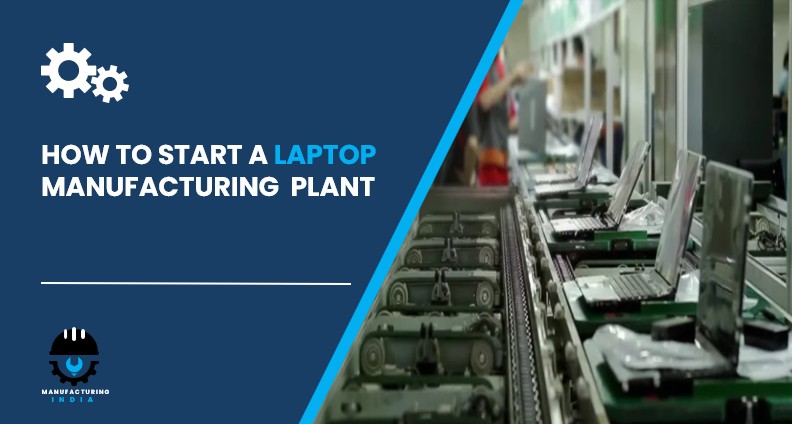
The laptop manufacturing sequence encompasses component receipt and incoming quality inspection, PCB assembly via surface mount technology (SMT), mechanical casing fabrication, system integration and final assembly, software flashing and configuration, functional quality testing and burn-in, cosmetic inspection, packaging, and dispatch as the core stages of commercial production. Each stage involves specific unit operations, quality assurance checkpoints, and process control protocols aligned to international certification standards (BIS, CE, FCC, RoHS, ISO 9001, and applicable export standards).
- All incoming components including PCBs, processors, memory, storage, display panels, batteries, keyboards, casings, and connectors are received at the incoming dock, verified against purchase orders, and subjected to incoming quality inspection protocols including dimensional verification, electrical parameter testing, visual inspection, and sampling-based functional tests before release to the production floor.
- Bare PCBs are loaded onto automated SMT lines where solder paste is applied via stencil printing, surface-mount components are placed by high-speed pick-and-place machines at programmed coordinates, and boards are passed through reflow ovens to form reliable solder joints. Automated optical inspection (AOI) and X-ray inspection verify solder quality and component placement. Through-hole components are soldered via selective soldering machines.
- Assembled motherboards undergo functional electrical testing, boundary scan testing, and ICT (in-circuit testing) to verify component integrity and electrical performance before system integration. Sub-assemblies including display modules, battery packs, keyboard units, and cooling modules are prepared in dedicated sub-assembly areas.
- Aluminium alloy casing parts are machined on CNC milling centres, surface-finished via anodising or coating processes, and inspected for dimensional conformance. Plastic structural components are produced via injection moulding, painted or surface-treated, and inspected for dimensional accuracy and cosmetic quality before assembly.
- Tested motherboards, display assemblies, batteries, keyboards, touchpads, cooling systems, and structural casings are assembled into complete laptop units at ESD-controlled assembly workstations using torque-controlled screwdriving tools and precision assembly fixtures. Cable routing, connector seating, and hinge assembly are completed at dedicated stations.
- Assembled units are connected to BIOS flashing stations and OS deployment servers where firmware, BIOS, operating system images, drivers, and factory-configured software are written to storage. Serial numbers, asset tags, and security certificates are programmed. Configuration validation scripts verify all pre-installed software and hardware recognition.
- Completed units undergo comprehensive automated functional testing covering display quality, keyboard and touchpad response, audio, camera, wireless connectivity, USB and port functionality, and battery performance. Units are loaded into burn-in racks and subjected to thermal stress cycling to screen for early-life hardware failures. Failed units are routed to a repair station for diagnosis and rework.
- Passed units undergo final cosmetic inspection for scratches, surface defects, and assembly quality before being cleaned, accessorised (chargers, documentation, cables), and packed into retail or bulk cartons with appropriate inserts and labels. Cartons are sealed, palletised, and dispatched to distribution centres, retail partners, or enterprise customers under documented traceability records.
Key Applications
Laptops manufactured at a dedicated commercial facility serve a broad range of end-use channels, each with specific form factor, performance, display, connectivity, and certification requirements.
Consumer Retail and E-Commerce Channels
Mass-market consumer laptops designed for household usage, entertainment, personal productivity, and everyday computing are widely distributed through consumer electronics retail stores, e-commerce marketplaces, and direct-to-consumer online platforms. This segment represents the largest-volume sales channel in the global laptop industry due to broad consumer adoption and expanding digital lifestyles.
Enterprise and Corporate IT Sector
Enterprise-grade business laptops equipped with advanced security systems, enterprise management software, MIL-STD durability certifications, and extended support services are commonly procured by corporate IT departments and managed service providers in bulk quantities. This segment represents a premium-margin institutional market supported by recurring enterprise hardware refresh cycles and increasing digital transformation initiatives.
Government and Defence Applications
Government procurement programs focused on digital governance, administrative modernization, and defence-grade rugged computing systems generate substantial institutional demand for domestically manufactured laptops. Manufacturers possessing relevant certifications, cybersecurity compliance, and security clearances are well-positioned to benefit from this specification-driven procurement segment.
Education and Academic Institutions
Laptop distribution initiatives for schools, colleges, and universities, along with digital classroom programs and student subsidy schemes in India and international markets, are creating significant recurring demand for affordable, durable, and education-oriented laptop models. Long battery life, reliability, and cost efficiency remain critical purchasing factors within this highly volume-driven segment.
Gaming and Content Creation Industry
Gaming laptops featuring high-performance processors, dedicated graphics processing units (GPUs), high-refresh-rate displays, and advanced thermal management systems are witnessing strong global demand. Similarly, creator-focused workstation laptops equipped with color-accurate displays and professional-grade computing performance continue to represent a premium-margin segment driven by the rapid growth of gaming, streaming, animation, and digital content production industries.
Healthcare and Institutional Applications
Hospitals, pharmaceutical companies, clinical facilities, and research organizations require durable, secure, and highly reliable laptops for electronic medical record management, clinical research, diagnostics, and healthcare data processing. This creates a compliance-focused institutional demand channel for certified computing solutions tailored to medical and research environments.
Export Market Opportunities
Export-oriented laptop manufacturing for markets across the GCC region, Southeast Asia, Africa, and Europe is emerging as a significant revenue opportunity for cost-competitive and export-certified manufacturers. These opportunities are further supported by India’s growing electronics manufacturing ecosystem, expanding bilateral trade partnerships, and increasing focus on electronics exports under industrial development initiatives.
Leading Laptop Manufacturers
The global laptop manufacturing industry is dominated by multinational OEMs, Taiwanese ODM manufacturers, and a growing base of regional assemblers and EMS companies. Key players include:
- Lenovo Group Limited (China/Hong Kong)
- HP Inc. (USA)
- Dell Technologies (USA)
- Apple Inc. (USA)
- Acer Inc. (Taiwan)
- ASUSTeK Computer Inc. (Taiwan)
- Samsung Electronics (South Korea)
- Microsoft Corporation (USA)
- Xiaomi Inc. (China)
- Dixon Technologies (India)
- Syrma SGS Technology (India)
- Optiemus Electronics (India)
Recent Industry Developments
April 2025:
The Tamil Nadu government and Dixon Technologies entered into a Memorandum of Understanding (MoU) to establish a laptop manufacturing facility at Oragadam near Chennai with a proposed investment of INR 1,000 crore. The project represents a major development in India’s domestic laptop manufacturing ecosystem and supports the objectives of the Production Linked Incentive (PLI) Scheme for IT hardware manufacturing.
January 2025:
Syrma SGS Technology Limited partnered with MSI to manufacture laptops for the Indian market, beginning with assembly operations at MSI’s facility in Chennai. The collaboration is aimed at strengthening India’s Electronics Manufacturing Services (EMS) sector while supporting the government’s Make in India initiative and the localization of laptop production.
Timeline to Start the Plant
Investors planning a laptop manufacturing plant should anticipate the following phased development timeline, typically ranging from 12 to 24 months depending on site development requirements, regulatory approval timelines, and the lead time for SMT equipment, automated test lines, cleanroom HVAC, and ESD infrastructure:
- Feasibility study and detailed project report preparation
- Land acquisition, site assessment, and utility availability evaluation
- Regulatory approvals: Factory Licence, BIS product certification, Environmental Clearance, Consent to Establish, PLI scheme registration, and utility connections
- Civil construction: SMT assembly hall with ESD-controlled flooring, mechanical fabrication area, system integration room, software flashing bays, burn-in and test area, packaging zone, quality laboratory, and administrative block
- Specialised machinery procurement, SMT line installation, CNC machine setup, HVAC and ESD system commissioning, and utility infrastructure setup
- Component supply chain development through qualified supplier agreements for PCBs, processors, displays, memory, storage, batteries, and casings
- Plant commissioning, SMT line calibration, test system programming, and trial production runs
- Product qualification, BIS certification, CE and FCC compliance testing, ISO 9001 and RoHS certification, and enterprise buyer technical qualification
- Distribution channel development, retail and enterprise key account relationships, and commercial production ramp-up to design capacity
Licences and Regulatory Requirements
Starting a laptop manufacturing unit requires several approvals, which vary by country and jurisdiction:
- Business registration (Proprietorship, LLP, or Private Limited Company)
- BIS Certification under the Electronics and Information Technology Goods (Requirement for Compulsory Registration) Order for mandatory product categories in India
- Factory Licence under applicable factories legislation
- Industrial Entrepreneur Memorandum (IEM) filing with the Department for Promotion of Industry and Internal Trade (India)
- Environmental Clearance from the relevant national authority (where applicable based on project scale and chemical usage)
- Consent to Establish and Consent to Operate from the relevant State Pollution Control Board
- PLI scheme for IT hardware registration with the Ministry of Electronics and Information Technology (MeitY) in India
- CE marking certification (mandatory for export to European Union markets)
- FCC certification (mandatory for export to the United States market)
- RoHS (Restriction of Hazardous Substances) compliance certification for the European and other regulated markets
- ISO 9001 Quality Management System certification
- ISO 14001 Environmental Management System certification
- ISO 45001 Occupational Health and Safety Management System certification
- Waste Electrical and Electronic Equipment (WEEE) compliance registration for export markets
- EPR (Extended Producer Responsibility) registration for e-waste and packaging compliance in India
- GST Registration
- Fire Safety NOC
- Electricity Board approval and grid connectivity permits
- Import or Export Code (IEC) for international trade
- MSME registration (where applicable, for access to government subsidy and incentive schemes)
- Software licence and IP compliance documentation for pre-installed operating system and firmware
Key Challenges to Consider
Component Cost Volatility and Global Supply Chain Dependence
Key raw materials such as processors, DRAM memory, NAND flash storage, and LCD/OLED display panels are sourced from a highly concentrated global supplier network dominated by a limited number of semiconductor and display manufacturers. Fluctuations in component pricing, semiconductor shortages, and geopolitical disruptions within global supply chains can significantly impact manufacturing margins. As a result, laptop manufacturers must implement strong procurement strategies, supplier diversification, inventory buffering, and supply chain risk management practices to ensure operational stability.
Rapid Technological Advancements and Product Obsolescence
The laptop industry is characterized by short product life cycles driven by continuous advancements in processor architectures, display technologies, battery systems, and evolving consumer preferences for new form factors. Manufacturers must maintain agile product development capabilities, efficient component transition management, and streamlined end-of-life product phase-out strategies to remain competitive in a rapidly changing technology landscape.
BIS Certification and Regulatory Compliance Challenges
Compliance with regulatory standards such as mandatory BIS registration, CE and FCC certifications, RoHS documentation, and evolving e-waste and Extended Producer Responsibility (EPR) regulations creates substantial compliance costs and product approval timelines. Manufacturers must establish dedicated regulatory affairs and compliance management systems to support smooth product launches and ongoing market access.
Competition from Global OEMs and ODM Manufacturers
The global laptop market is highly competitive, with established OEM brands such as Lenovo, HP, Dell, and Apple competing alongside experienced Taiwanese ODM manufacturers that possess decades of expertise in SMT assembly, supply chain integration, and product design. Domestic manufacturers must differentiate themselves through niche market focus, government procurement opportunities, cost-efficient manufacturing, localized assembly capabilities, or service-oriented enterprise solutions.
Skilled Workforce and Technical Talent Availability
Laptop manufacturing requires a technically skilled workforce including SMT process engineers, PCB assembly technicians, firmware developers, software engineers, mechanical tooling specialists, and quality assurance personnel. Ensuring the availability of trained professionals, particularly in manufacturing locations outside major metropolitan regions, and managing employee attrition within the competitive electronics manufacturing sector remain ongoing operational challenges.
Infrastructure and Power Supply Requirements
Commercial laptop manufacturing facilities require advanced infrastructure including cleanroom-grade HVAC systems for SMT assembly operations, humidity-controlled storage environments for sensitive electronic components, electrostatic discharge (ESD)-protected flooring and grounding systems, and uninterrupted power supply systems for testing laboratories and server infrastructure. These requirements contribute significantly to capital investment and ongoing operational expenses.
Logistics and Distribution Management Complexity
Managing inbound logistics for fragile and high-value electronic components sourced from international suppliers, along with outbound distribution of finished laptops through retail, e-commerce, and enterprise channels, adds substantial complexity to the supply chain. Proper packaging, transit protection, inventory coordination, and timely delivery management are critical for minimizing product damage and maintaining supply chain efficiency.
Export Compliance and International Certification Requirements
Expanding into export markets across the EU, USA, GCC, and Southeast Asia requires manufacturers to obtain and maintain multiple certifications including CE, FCC, BIS, and RoHS approvals. Additionally, companies must comply with export control regulations related to encryption technologies, wireless communication standards, and country-specific import duty and tariff regulations. These certification and compliance obligations create additional administrative, operational, and financial burdens for export-oriented laptop manufacturers.
Project Economics
Capital Expenditure (CapEx) and Operational Expenditure (OpEx) Analysis
Capital Investment (CapEx)
SMT assembly equipment, CNC machining centres, automated test and burn-in infrastructure, software deployment servers, and cleanroom HVAC and ESD systems account for the largest portion of total capital expenditure. The cost of land and site development including civil construction of the SMT assembly hall, mechanical fabrication area, system integration room, software flashing bays, burn-in and test area, packaging zone, quality laboratory, and administrative block forms a substantial part of the overall investment, ensuring a solid foundation for safe, precision-controlled, and certification-compliant plant operations across the multi-year asset depreciation cycle.
Operating Expenditure (OpEx)
In the first year of operations, the operating cost for the laptop manufacturing plant is projected to be significant, covering raw material and component procurement (accounting for approximately 80 to 85% of total OpEx, the dominant cost component), electricity for SMT, HVAC, test, and burn-in systems, packaging materials, transportation and last-mile delivery logistics, salaries and wages for assembly operators, SMT engineers, quality control staff, software engineers, and warehouse personnel, depreciation, taxes, equipment maintenance costs, and applicable product certification and regulatory compliance costs. By the fifth year, the total operational cost is expected to increase due to component price movements, electricity tariff increases, labour cost growth, and logistics cost inflation.
Frequently Asked Questions
1. How much does it cost to set up a laptop manufacturing plant?
Total setup cost depends on plant throughput capacity (units per year), product mix (consumer, gaming, enterprise, ruggedised), level of automation, cleanroom and ESD environment requirements, geographic location, and applicable regulatory certification requirements. Capital investment covers land, civil works, SMT assembly lines, CNC machining centres, system integration and assembly workstations, software flashing servers, burn-in and test equipment, HVAC and ESD infrastructure, packaging lines, quality laboratory equipment, and pre-operative costs. A detailed project report provides capacity-specific cost estimates.
2. Is laptop manufacturing profitable?
Yes. Gross profit margins typically range between 15 to 25% and net margins between 5 to 10%, supported by growing demand across consumer, enterprise, government, education, and export markets; the structural digitalisation of economies globally; rising enterprise refresh cycles driven by AI-enabled compute and cloud computing adoption; and product differentiation opportunities through premium branded, thin-and-light, gaming, and AI-enabled laptop formats.
3. What machinery is required for a laptop manufacturing plant?
Essential machinery and equipment includes SMT placement machines, solder paste printers, reflow ovens, automated optical inspection (AOI) systems, X-ray inspection systems, CNC milling machines for casing fabrication, injection moulding machines for plastic components, system integration assembly workstations, BIOS and OS flashing stations, burn-in rack test systems, automated functional test stations, packaging lines, and quality control laboratory instruments.
4. What licences are required to start a laptop manufacturing plant?
Required approvals include business registration, BIS product certification for mandatory categories, Factory Licence, Environmental Clearance where applicable, Consent to Establish and Operate from the State Pollution Control Board, PLI scheme for IT hardware registration (India), CE marking (EU export), FCC certification (US export), RoHS compliance, EPR registration for e-waste, GST registration, fire safety NOC, and Import/Export Code.
5. What raw materials are needed for laptop manufacturing?
Primary raw materials include processors (CPUs/GPUs/SoCs), printed circuit boards (PCBs), DRAM memory modules, NAND flash SSDs, display panels (LCD/OLED), battery cells and battery management modules, keyboard assemblies, touchpad modules, aluminium alloy and plastic casing components, cooling assemblies (heat pipes, fans), connectors, cables, passive electronic components, and packaging materials (retail cartons, moulded inserts, accessory pouches).
6. What are the environmental compliance requirements?
Operators must obtain Consent to Operate, comply with RoHS (Restriction of Hazardous Substances) regulations for product composition, implement Extended Producer Responsibility (EPR) programmes for e-waste take-back, manage solder paste, flux, and chemical waste through licensed disposal contractors, comply with applicable packaging waste regulations, and maintain environmental management systems certified to ISO 14001.
7. What is the best location to set up a laptop manufacturing plant?
Ideal locations offer proximity to electronics component supply clusters (minimising logistics costs and lead times), access to reliable and competitively priced electricity (a significant operating cost for SMT and HVAC), availability of high-quality technical and engineering workforce, compliance with industrial zoning and environmental regulations, cold chain logistics infrastructure and freight connectivity for component import and finished goods export, and government-designated electronics manufacturing clusters or SEZs for policy incentives.
8. How long does it take to start a laptop manufacturing plant?
The timeline typically ranges from 12 to 24 months, depending on site development requirements, regulatory approval timelines (particularly BIS certification, Factory Licence, and Environmental Clearance), SMT equipment and CNC machine procurement lead times, cleanroom HVAC and ESD system installation, civil works completion, software deployment infrastructure setup, trial production runs, and product certification under BIS, CE, FCC, and applicable export standards.
9. What government incentives are available for laptop manufacturers?
In India, the Production Linked Incentive (PLI) scheme for IT hardware provides production-linked financial incentives for eligible domestic laptop manufacturers achieving prescribed incremental sales targets and local value addition requirements. State-level concessions on power tariffs, stamp duty, land in electronics manufacturing clusters and SEZs, and GST reimbursement offer further financial benefits. The Make in India initiative and public procurement preference policies also support domestic manufacturers.
10. What is the break-even period for a laptop manufacturing plant?
Break-even typically ranges from 3 to 5 years, depending on scale, automation level, component procurement cost structure, electricity tariff, product mix between commodity-grade consumer assembly and premium-margin enterprise or gaming laptop formats, and customer offtake contract flow. Securing early supply agreements with retail chains, enterprise IT procurement departments, government bodies, educational institutions, and export trading houses can significantly support a smoother ramp-up and faster break-even achievement.
Key Takeaways for Investors
The laptop manufacturing plant opportunity is underpinned by sustained demand growth across consumer retail, enterprise IT, government, education, gaming, and export markets, all aligned with global digital transformation, remote work expansion, AI computing adoption, and electronic device penetration megatrends.
The structural digitalisation of global economies, the growing enterprise refresh cycle driven by AI-enabled compute requirements, rising government and educational institution digital infrastructure investment, the expanding gaming laptop and premium computing segment, and India’s growing electronics export ambitions supported by PLI and Make in India policy frameworks create a robust and diversified demand base for well-positioned domestic laptop manufacturers.
With a well-defined market demand base across multiple end-use segments, strong product differentiation opportunities through certified BIS-compliant grades, government and enterprise supply relationships, and premium value-added AI-capable and gaming laptop formats, capital-efficient assembly economics once SMT and CNC assets are fully depreciated, and the fundamental role of domestic laptop manufacturing in delivering digital inclusion, enterprise compute supply security, and government-preferred local sourcing, laptop manufacturing offers both medium-term commercial viability and long-term demand sustainability for well-positioned manufacturers operating at scale with strong brand, distribution, certification, and supply chain foundations.
About the Author