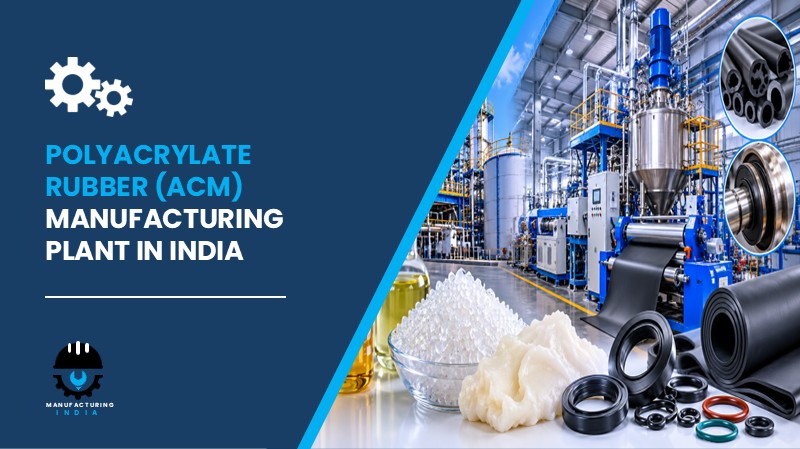
Setting up a polyacrylate rubber (ACM) manufacturing plant in India presents a compelling investment case at a time when the country’s automotive sector is expanding rapidly, its automobile exports are scaling to record levels, its industrial machinery and oil and gas equipment manufacturing is deepening, and the global shift toward higher-efficiency engines and advanced transmission systems is creating sustained demand for the one elastomer category that uniquely combines heat resistance, oil resistance, and long service life in the most demanding automotive sealing environments. Polyacrylate rubber (ACM) — the specialty synthetic elastomer produced by emulsion polymerisation of acrylic ester monomers and engineered specifically for applications requiring maximum resistance to high temperatures, lubricating oils, transmission fluids, and oxidative degradation — is an indispensable component in modern automatic transmissions, turbocharged engine systems, powertrain assemblies, and industrial fluid-handling equipment. As India’s automotive OEM supply chain deepens its technical specifications, its component export volumes accelerate, and its domestic industrial machinery manufacturing expands, the domestic requirement for reliably produced, specification-grade ACM rubber is growing into a commercially significant specialty elastomers investment opportunity.
India’s automotive sector data confirms the exceptional growth momentum of this opportunity. According to the India Brand Equity Foundation (IBEF), automobile exports increased by 19% in FY25, surpassing 5.3 million units, driven by strong overseas demand for passenger cars, two-wheelers, and commercial vehicles. This export performance directly reflects the robust manufacturing activity and growing global demand for Indian-made vehicle components and materials — including the specialty rubber components that require ACM as the elastomer of choice in high-temperature sealing applications. India’s automotive manufacturing clusters in Pune, Chennai, Gurugram, Sanand, and Aurangabad provide immediate proximity to the OEM and tier-1 component manufacturers that constitute the primary customer base for an ACM rubber producer, while chemical industrial estates in Gujarat and Maharashtra offer the polymerisation reactor infrastructure, acrylate monomer supply chains, and regulatory expertise required for specialty elastomer manufacturing.
Investing in a polyacrylate rubber (ACM) manufacturing plant in India today aligns India’s 19% automobile export growth, expanding automatic transmission and turbocharged engine adoption, and a global ACM market growing from USD 896.4 Million in 2025 to USD 1,553.46 Million by 2034 at a CAGR of 6.3%. With gross profit margins of 20–25% and net profit margins of 10–15% at annual production capacities of 10,000–15,000 tons, the unit economics are commercially sound and the investment’s technical specialisation creates defensible competitive positioning in India’s rapidly upgrading automotive components supply chain.
What is Polyacrylate Rubber (ACM)?
Polyacrylate rubber (ACM) is a synthetic elastomer produced by polymerising acrylic ester monomers through emulsion polymerisation. It has been tailored specifically for overcoming high-temperature, lubricating oil, transmission fluid, and oxidative degradation resistance to the maximum level. In comparison with most other elastomeric materials, ACM rubber has very high thermal stability, low compression set, and good weathering and ozone resistance, making it suitable for the most severe operating environments encountered in automotive and industrial applications.
Even though its low-temperature flexibility is moderate compared to some other elastomers, ACM is regarded as an essential material in automotive and industrial sealing applications due to its remarkable oil and heat resistance profile. ACM rubber is typically used for the manufacture of gaskets, O-rings, hoses, and other moulded parts for use in engine, transmission, and fluid-handling systems where alternatives including silicone rubber, EPDM, or NBR cannot meet the simultaneous demands of high-temperature and oil-resistant service. The product’s alignment with the direction of automotive engineering — toward higher-temperature turbocharged engines, more sophisticated automatic and dual-clutch transmission systems, and longer-life sealing requirements — ensures structural demand growth that is directly correlated with the advancement of vehicle technology rather than merely vehicle volume.
The primary production process covers emulsion polymerisation, coagulation, washing, drying, and compounding. End-use industries served include automotive, oil and gas equipment, and industrial machinery. Applications span seals, O-rings, hoses, transmission and powertrain components, and gaskets across engine and drivetrain sealing systems.
Cost of Setting Up a Polyacrylate Rubber (ACM) Manufacturing Plant in India
The cost of establishing a polyacrylate rubber (ACM) manufacturing plant in India depends on plant capacity, monomer system selection across different acrylate ester compositions, cure system chemistry, geographic location — particularly proximity to acrylate monomer supply and automotive customer clusters — degree of automation, and the quality compliance requirements applicable to ACM rubber supplied to automotive OEM and tier-1 component manufacturers.
1. Capital Expenditure (CapEx)
Land and Site Development forms a foundational component of total capital investment, covering land acquisition charges, site registration, boundary development, chemical containment drainage, and site utilities. The location must offer easy access to key raw materials such as acrylate monomers and initiators. Proximity to target markets — particularly India’s automotive manufacturing clusters in Pune, Chennai, Gurugram, and Sanand — minimises distribution costs on specialty rubber bales and compounds destined for seal, gasket, and hose component manufacturers. The site must have robust infrastructure including reliable transportation, utilities, and waste management systems. Compliance with local zoning laws and environmental regulations must be ensured. Chemical industrial estates in Ankleshwar and Dahej in Gujarat offer established polymerisation infrastructure, petrochemical supply chain proximity, and regulatory expertise aligned with specialty elastomer production.
Plant Layout Optimisation is critical for an ACM rubber manufacturing facility — integrating emulsion polymerisation reactor systems, coagulation and dewatering operations, washing and drying lines, and compounding areas in a safely segregated and process-efficient workflow. Separate areas for raw material storage for acrylate monomers, initiators, and emulsifiers, polymerisation reactor bays, coagulation and washing areas, drying and baling operations, compounding and blending, quality control laboratory, finished rubber bale storage, and dispatch must be designated. Space for future capacity expansion should be incorporated to accommodate business growth as OEM qualification approvals and customer contract volumes develop.
Machinery and Equipment represent the largest single component of total CapEx for a polyacrylate rubber manufacturing plant. Essential equipment includes:
- Polymerisation reactors
- Agitators
- Coagulation tanks
- Filtration systems
- Dryers
- Mixers
- Packaging units
Other Capital Costs include an effluent treatment plant (ETP) to minimise environmental impact and ensure compliance with emission standards for emulsion polymerisation process effluents containing residual monomers and surfactants, fume scrubbing for acrylate monomer vapour management, pre-operative expenses, automotive OEM qualification testing costs, commissioning charges, and any import duties on specialised emulsion polymerisation reactor systems or compound mixing equipment not available domestically.
Request a Sample Report for In-Depth Market Insights: https://www.imarcgroup.com/polyacrylate-rubber-manufacturing-plant-project-report/requestsample
2. Operational Expenditure (OpEx)
Raw Material Cost is the dominant operational expense, accounting for approximately 60–65% of total OpEx. The primary raw materials are acrylate monomers and initiators. Acrylate monomers — particularly ethyl acrylate, butyl acrylate, and specialty acrylate co-monomers including 2-methoxyethyl acrylate and methylene crosslinking sites — are the building blocks of the ACM polymer backbone and drive the majority of raw material cost. These monomers are derived from acrylic acid, which is a petrochemical intermediate whose pricing follows propylene and acrylic acid market dynamics. Initiators — peroxide or azo-type radical initiators used to initiate the emulsion polymerisation reaction — are consumed in smaller quantities but are critical process inputs whose quality directly affects polymer molecular weight distribution and product consistency. Long-term contracts with reliable suppliers for both acrylate monomers and initiators must be negotiated to stabilise pricing and ensure a steady supply.
Utility Cost is the second-largest OpEx component, representing approximately 12–15% of total operating expenses, covering electricity and steam for polymerisation reactor temperature control, coagulation and washing water, dryer heating, compounding mixer operation, and general plant services. The emulsion polymerisation process requires precise temperature management in the reactor — typically 40–60°C for ACM synthesis — making reliable steam and cooling water supply a critical site infrastructure requirement.
Other Operating Costs include transportation and distribution to automotive seal and gasket manufacturers, hose producers, powertrain component suppliers, oil and gas equipment manufacturers, and industrial machinery rubber component producers, bale wrapping and packaging materials, salaries and wages for polymer chemists and process engineers, routine machinery maintenance including reactor agitator servicing and dryer element replacement, depreciation on production equipment, and applicable taxes. By the fifth year, the total operational cost is expected to increase substantially due to factors such as inflation, market fluctuations, and potential rises in the cost of key materials. Additional factors, including supply chain disruptions, rising consumer demand, and shifts in the global economy, are expected to contribute to this increase.
3. Plant Capacity
The proposed manufacturing facility is designed with an annual production capacity ranging between 10,000 and 15,000 tons, enabling economies of scale while maintaining operational flexibility across multiple ACM rubber grades — standard cure system grades for general automotive sealing applications, chlorine-bearing cure site grades for transmission seals, and speciality low-compression-set grades for critical powertrain applications. Plant capacity can be customised per investor requirements and phased in line with OEM qualification approvals and customer contract volumes. Profitability improves with higher capacity utilisation, making secured supply agreements with automotive seal manufacturers, hose producers, or powertrain component suppliers a strategic commercial foundation from the earliest stages of production.
4. Profit Margins and Financial Projections
The financial projections for a polyacrylate rubber manufacturing plant demonstrate commercially sound profitability potential under normal operating conditions. Gross profit margins typically range between 20–25%, supported by stable demand and value-added applications across automotive sealing, powertrain, and industrial machinery segments. Net profit margins are projected at 10–15%, reflecting the meaningful value-added conversion of acrylate monomer feedstocks into a precisely characterised specialty elastomer that commands premium pricing over commodity rubber alternatives. A comprehensive financial analysis covering NPV (net present value), IRR (internal rate of return), payback period, gross margin progression, and net margin development across a five-year horizon is essential before committing capital, with projections developed based on realistic assumptions related to capital investment, operating costs, production capacity utilisation, monomer pricing trends, and demand outlook.
Why Set Up a Polyacrylate Rubber (ACM) Plant in India?
Essential High-Performance Elastomer for India’s Expanding Automotive Sector. ACM rubber is the most important elastomer widely used in automotive and industrial systems where both heat and oil resistance are absolutely required — making it an indispensable component in the automatic transmissions, turbocharged engines, and high-performance powertrains that are increasingly standard in both domestic and export-oriented Indian vehicle manufacturing. India’s automobile exports grew 19% in FY25 to surpass 5.3 million units according to IBEF, reflecting the robust manufacturing activity and growing global demand for Indian-made vehicle components that directly drives ACM rubber consumption in India’s component manufacturing supply chain.
Alignment with Automotive Technology Evolution Toward Higher-Temperature Systems. The demand for ACM rubber components is increasing as development of automatic transmissions, turbocharged engines, and high-performance powertrains continues to grow. As India’s passenger vehicle market transitions toward more sophisticated automatic and continuously variable transmission systems — driven by both consumer preference and regulatory emissions requirements — the sealing technology demands that accompany these drivetrains naturally drive adoption of ACM rubber over conventional EPDM or NBR alternatives that cannot meet the simultaneous heat and oil resistance requirements.
Regulatory and Durability Standards Driving OEM Specification Upgrade. Strict emission norms as well as durability standards are forcing OEMs to use materials with longer service life and higher thermal resistance, which is in turn supporting the use of ACM rubber. India’s BS-VI emission norms, which require more efficient combustion and higher exhaust temperatures, are driving OEMs to specify ACM rubber in exhaust-adjacent sealing applications where conventional rubber materials would fail prematurely. This regulatory-driven specification upgrade trend creates structural demand growth independent of overall vehicle volume expansion.
Technically Specialised Entry Barriers Creating Competitive Positioning. The control of polymerisation, formulation expertise, and very stringent quality requirements create moderate entry barriers, favouring manufacturers already equipped with chemical processing capabilities. These technical entry barriers — combined with long OEM qualification cycles that reward established, consistent suppliers — create a defensible competitive positioning for producers who invest in the process chemistry expertise, quality management systems, and OEM relationship development required to achieve and maintain tier-1 and OEM supply approval status.
Active Global Industry Investment Confirming Market Strength. In September 2025, LANXESS expanded its U.S. manufacturing footprint by adding rubber processing promoter production at its Bushy Park site in Goose Creek, South Carolina — scheduled operational by November 2025 — producing key Aflux® and Aktiplast® processing additives for automotive, pharmaceutical, and industrial rubber applications, signalling continued global investment in automotive rubber manufacturing infrastructure. In February 2024, Syzygy Plasmonics entered a strategic investment partnership with Zeon Corporation — a major ACM manufacturer — to develop more sustainable production processes, confirming active technology innovation investment in the ACM category.
Stable OEM Demand Providing Long-Term Revenue Visibility. Automotive and industrial OEMs are oriented towards long-term supplier relationships, thus their volumes are stable and the demand for qualified ACM producers is growing. Once a supplier achieves OEM qualification and part approval, the resulting supply relationships are typically multi-year in duration, providing revenue visibility and production planning stability that commodity chemical manufacturing cannot match. This commercial structure — combining stable relationships with the technical barriers that protect qualified producers from easy substitution — creates a particularly resilient business model for ACM rubber producers in India’s automotive supply chain.
Manufacturing Process — Step by Step
The polyacrylate rubber manufacturing process uses emulsion polymerisation, coagulation, washing, drying, and compounding as the primary production method. Each stage requires precisely controlled reaction parameters — temperature, initiator concentration, monomer feed rate, and emulsifier system — and quality verification to deliver ACM rubber meeting the viscosity, cure characteristics, and mechanical property specifications required by automotive OEM and component manufacturer customers.
- Monomer Preparation and Emulsifier System Formulation: Acrylate monomers including ethyl acrylate, butyl acrylate, and specialty co-monomers are weighed in the specified formula proportions and combined with emulsifier surfactant solution and water to form a stable pre-emulsion feed prepared for controlled addition to the polymerisation reactor.
- Emulsion Polymerisation in Reactors: The monomer pre-emulsion is fed into polymerisation reactors at controlled temperature — typically 40–60°C — with initiator addition rate precisely controlled using agitators to maintain stable latex particle nucleation and growth conditions. The exothermic polymerisation reaction is managed through reactor jacket cooling to maintain isothermal conditions and achieve the target polymer molecular weight distribution, conversion efficiency, and particle size.
- Polymerisation Completion and Latex Stabilisation: After achieving the target monomer conversion, the ACM latex is stabilised by terminating the polymerisation reaction and adjusting pH and antioxidant addition to prevent polymer degradation during subsequent processing stages.
- Coagulation: The stabilised ACM latex is transferred to coagulation tanks where controlled addition of coagulant — typically an acid or salt solution — destabilises the latex emulsion, causing the polymer particles to agglomerate into a crumb rubber mass that can be separated from the aqueous serum by filtration.
- Washing and Dewatering: The coagulated ACM crumb is washed with water in filtration systems to remove residual emulsifier, coagulant salts, and other water-soluble impurities that would affect the rubber’s electrical and chemical properties, with multiple wash stages ensuring clean product before dewatering.
- Drying: Washed ACM crumb is processed through dryers at controlled temperature to reduce moisture content to the specification level required for compounding and finished rubber processing, with care taken to avoid excessive temperature that could cause early crosslinking or oxidation of the ACM polymer.
- Compounding and Mixing: Dried ACM rubber base polymer is blended with compounding ingredients — including cure system components, plasticisers, antioxidants, fillers, and processing aids — in mixers to produce the fully formulated ACM compound ready for customer moulding, extrusion, or calendering operations.
- Quality Control Testing: Finished ACM rubber — both base polymer and compounded grades — undergoes comprehensive quality testing covering Mooney viscosity, cure characteristics by rheometer, tensile strength, elongation at break, hardness, compression set, heat ageing resistance, and oil swell resistance, verifying compliance with customer or standard product specifications before packaging.
- Baling and Packaging: Specification-compliant ACM rubber is baled and wrapped using packaging units in standard rubber bale format for dispatch to automotive seal and gasket manufacturers, hose producers, powertrain component suppliers, oil and gas equipment manufacturers, and industrial machinery rubber component producers.
Key Applications
Polyacrylate rubber (ACM) manufactured in India serves a commercially important and technically demanding range of applications across automotive and industrial sectors:
- Automotive Sealing Systems: Used in transmission seals, oil seals, crankshaft seals, and valve stem seals exposed to high temperatures and lubricants in engines and drivetrains — the dominant application segment accounting for the largest share of ACM rubber consumption.
- Industrial Machinery: Applied in sealing components for pumps, compressors, and hydraulic systems operating under heat and oil exposure in industrial manufacturing, materials handling, and process plant equipment.
- Oil and Gas Equipment: Utilised in elastomeric parts for downhole and surface equipment requiring resistance to oils, fuels, and oxidative conditions in the oil and gas extraction and refining sectors.
- Powertrain Systems: Used in torque converters, automatic transmissions, and drivetrain assemblies requiring long service life under continuous exposure to hot transmission fluid and mechanical stress cycles.
Leading Manufacturers
The global polyacrylate rubber industry is served by a group of specialty elastomer companies with extensive production capabilities and diverse application portfolios. Key players in the global market include:
- ZEON
- Seal & Design
- EMI Seals & Gaskets
- RADO Gummi GmbH
- Clwyd Compounders
- HEXPOL
- Nordkra
- Changxin Rubber
- Jiujiang Do Well Tech
Timeline to Start the Plant
Establishing a polyacrylate rubber manufacturing plant in India involves a structured multi-phase development sequence. Investors should plan for the following phases:
- Feasibility study and project report preparation
- Land acquisition and site development
- Regulatory approvals and environmental clearances
- Factory licence and fire safety compliance
- Machinery procurement and installation
- Raw material supplier agreements and supply chain setup
- Trial production and quality testing
- Commercial production launch
Licences and Regulatory Requirements
Starting a polyacrylate rubber manufacturing unit in India requires several approvals spanning business registration, chemical safety, environmental, and automotive supply chain compliance domains:
- Business registration (Proprietorship, LLP, or Pvt Ltd)
- Factory Licence under the Factories Act
- Environmental Clearance from the State Pollution Control Board
- GST Registration
- Fire Safety NOC
- Hazardous/Chemical compliance under the Manufacture, Storage and Import of Hazardous Chemical (MSIHC) Rules applicable to acrylate monomer storage and handling — particularly given the flammability, skin sensitisation, and vapour pressure properties of ethyl and butyl acrylate monomers
- Effluent Treatment Plant (ETP) operational clearance to minimise environmental impact and ensure compliance with emission standards for emulsion polymerisation process effluents
- Occupational Health and Safety compliance including acrylate monomer vapour exposure monitoring and skin protection measures
Key Challenges to Consider
Acrylate Monomer Price Volatility and Petrochemical Feedstock Exposure. Acrylate monomers account for approximately 60–65% of total OpEx, with pricing tied to acrylic acid, propylene, and global petrochemical market cycles. Managing this cost exposure requires long-term monomer procurement contracts, customer contract pricing mechanisms with appropriate raw material pass-through provisions, and careful inventory management relative to propylene and acrylic acid price cycle expectations.
OEM Qualification Cycles and Technical Entry Requirements. Supplying ACM rubber to automotive OEM tier-1 seal and gasket manufacturers requires passage through rigorous material qualification processes verifying polymer consistency, cure system compatibility, and long-term heat and oil ageing performance across multiple production lots. These qualification cycles can extend 12–24 months and require dedicated application engineering support alongside process technology investment before commercial supply approvals are confirmed.
Acrylate Monomer Handling Safety and Regulatory Compliance. Ethyl acrylate and butyl acrylate — the primary acrylate monomers — are classified as flammable, skin sensitising, and respiratory tract irritating chemicals under MSIHC Rules, requiring comprehensive monomer storage safety infrastructure, inert blanketing of storage tanks, acrylate vapour fume scrubbing in the reactor area, and personal protective equipment programmes for all process operators. Managing these concurrent flammability and health hazard obligations demands dedicated process safety engineering.
Emulsion Polymerisation Process Consistency and Effluent Management. Maintaining consistent ACM polymer molecular weight, cure characteristics, and particle size distribution across emulsion polymerisation production batches requires experienced polymer chemists, calibrated reactor instrumentation, and systematic raw material lot qualification for each incoming monomer shipment. Process effluent from coagulation and washing stages contains residual surfactants, monomers, and coagulant salts that require dedicated ETP treatment before discharge.
Competition from Established Global ACM Producers. The competitive landscape is led by ZEON — the world’s largest ACM rubber producer — alongside HEXPOL, Changxin Rubber, and other established specialty elastomer companies with long OEM qualifications and production scale advantages. New Indian producers must compete through domestic supply chain proximity, import cost elimination, customer service responsiveness, and the ability to customise compound formulations for specific automotive and industrial application requirements.
Skilled Polymer Chemistry Workforce. Maintaining consistent emulsion polymerisation process performance, polymer quality, and compound formulation expertise requires graduate-level polymer chemists and rubber technologists — a specialised technical workforce demanding ongoing investment in recruitment, industry training, and competitive retention programmes.
Frequently Asked Questions
1. How much does it cost to set up a polyacrylate rubber manufacturing plant in India?
Capital requirements generally include land acquisition, construction, equipment procurement, installation, pre-operative expenses, and initial working capital. Equipment costs — for polymerisation reactors, agitators, coagulation tanks, filtration systems, dryers, mixers, and packaging units — represent a significant portion of capital expenditure. The total amount varies with capacity, technology, and location. A detailed project report with full CapEx and OpEx breakdowns is available on request.
2. Is polyacrylate rubber manufacturing profitable in India in 2026?
Yes. The project demonstrates gross profit margins of 20–25% and net profit margins of 10–15% under normal operating conditions, supported by India’s automotive export growth of 19% in FY25, increasing adoption of automatic transmissions and turbocharged engines driving ACM specification upgrades, and the global ACM market’s growth from USD 896.4 Million in 2025 to USD 1,553.46 Million by 2034 at a 6.3% CAGR.
3. What machinery is required for a polyacrylate rubber plant in India?
Key machinery includes polymerisation reactors, agitators, coagulation tanks, filtration systems, dryers, mixers, and packaging units. Polymerisation reactors with precise temperature control and agitation systems are the most technically critical equipment, as they determine polymer molecular weight distribution, conversion efficiency, and the consistency of ACM rubber properties across production batches.
4. What licences and approvals are required to start a polyacrylate rubber plant in India?
Required approvals include business registration, a Factory Licence under the Factories Act, Environmental Clearance from the State Pollution Control Board, GST registration, a Fire Safety NOC, MSIHC Rules compliance for acrylate monomer storage and handling, ETP operational clearance for emulsion polymerisation process effluents, and Occupational Health and Safety compliance.
5. What raw materials are needed for polyacrylate rubber manufacturing?
The primary raw materials are acrylate monomers and initiators. Acrylate monomers account for approximately 60–65% of total operating expenses, making acrylate monomer procurement strategy, supplier contracts with petrochemical producers, and monomer price risk management the most critical cost management levers for the investment.
6. What are the environmental compliance requirements for a polyacrylate rubber plant in India?
The unit must obtain Environmental Clearance from the State Pollution Control Board, operate a certified ETP to minimise environmental impact and ensure compliance with emission standards for emulsion polymerisation effluents containing residual monomers and surfactants, install acrylate vapour fume scrubbing for reactor area emissions, and maintain monitoring systems for air quality and wastewater discharge in line with applicable state pollution control standards.
7. What is the best location to set up a polyacrylate rubber plant in India?
Optimal locations offer proximity to acrylate monomer supply from domestic petrochemical producers or import logistics hubs, established chemical processing infrastructure, reliable utilities, and access to automotive sealing and component manufacturing customer clusters. Chemical industrial estates in Ankleshwar and Dahej in Gujarat and industrial zones adjacent to India’s automotive manufacturing clusters in Pune and Chennai are among the most strategically relevant options.
8. What is the break-even period for this type of plant in India?
The break-even period depends on plant capacity, OEM qualification timelines, capacity utilisation rate, acrylate monomer pricing trends, and demand conditions across automotive, industrial machinery, and oil and gas equipment customer segments. A detailed financial analysis including payback period, NPV, and IRR projections is included in the full project report, available via the sample request link.
9. What government incentives are available for manufacturers in India?
The Make in India initiative, PLI scheme for automotive components and advanced materials, and state-level specialty chemical manufacturing incentives in Gujarat and Maharashtra provide financial and regulatory support for polyacrylate rubber manufacturing investments. Export promotion benefits for specialty elastomer products and capital subsidy schemes under state investment promotion boards may be applicable depending on the chosen plant location and production profile.
Key Takeaways for Investors
A polyacrylate rubber manufacturing plant in India represents a commercially well-grounded investment in a technically specialised elastomer positioned at the intersection of India’s most robustly growing automotive export sector — with automobile exports growing 19% in FY25 to surpass 5.3 million units — and the global trend toward higher-temperature, higher-efficiency automatic transmission and turbocharged engine systems that structurally increase ACM rubber demand per vehicle regardless of overall market volume. The project demonstrates financial viability across annual production capacities of 10,000 to 15,000 tons, with gross profit margins of 20–25% and net profit margins of 10–15% confirming commercially sound unit economics supported by the moderate but defensible entry barriers created by polymerisation chemistry expertise, OEM qualification requirements, and the long-term supplier relationship dynamics that favour qualified, consistent ACM producers. The global polyacrylate rubber market, valued at USD 896.4 Million in 2025, is projected to reach USD 1,553.46 Million by 2034, growing at a CAGR of 6.3%, with India’s automotive sector expansion, BS-VI emission norm compliance driving sealing technology specification upgrades, and the September 2025 LANXESS U.S. manufacturing expansion and February 2024 Zeon-Syzygy sustainability partnership both confirming active global investment momentum in automotive rubber manufacturing. With OEM demand stability providing long-term supply relationship frameworks and India’s automotive component export trajectory accelerating, demand sustainability for India-based polyacrylate rubber manufacturing is structurally robust and commercially compelling across the full investment horizon.
About the Author