India crossed 2.40 lakh DPIIT-recognised startups in 2026, with FY26 alone adding more than 55,200 newly recognised ventures, a 51.6% jump over the previous year. Yet only 8.2% of Indian startups are currently incubated, and the country has just 0.8 incubators per million people, well below the 8 to 10 per million seen in the United States and China. For founders launching into this gap, structured incubation consulting has become less of a nice-to-have and more of a measurable determinant of whether a venture survives its first few years at all.
That gap is exactly where IMARC Engineering’s incubation services are positioned to help, pairing early-stage founders and manufacturing-focused ventures with structured mentorship, engineering support, and a path to production that most generalist incubators are not built to provide. The data on what structured incubation support actually changes for a new venture is worth looking at in detail.
The Data Behind Why Incubation Support Matters
The case for incubation consulting is not anecdotal, it shows up consistently across independent studies:
- More than 12,000 active incubators now operate globally, supporting over 1.5 million startups a year across 85-plus countries, with 68% affiliated with universities and the remainder split between private and government-backed programmes.
- Around 74% of incubated startups survive beyond three years, compared with 42% of non-incubated firms operating under similar conditions.
- Incubated ventures file patents at roughly five times the rate of non-incubated startups, a meaningful advantage for manufacturing and deep-tech founders where intellectual property is a core business asset.
- Incubated startups are 11.7% more likely to secure first-round funding within a year of starting operations than founders navigating the process alone.
Key Benefit 1: Materially Better Survival Odds
The starting point for any founder evaluating incubation consulting is simple: does it change the odds of the business still existing in three years. Structured incubation addresses the specific failure points that sink most early ventures directly:
- The 74% versus 42% survival gap holds up because structured programmes tackle unclear market validation, cash flow mismanagement, and the absence of experienced guidance at the moments that matter most.
- A widely cited IBM-backed study found that more than 90% of Indian startups fail within their first five years, most citing exactly these gaps, rather than a flawed product idea, as the underlying cause.
- University-affiliated incubation programmes specifically have been shown to help their portfolio companies create close to four more jobs on average than comparable non-incubated firms, a sign the benefit compounds well past the survival threshold alone.
Key Benefit 2: Lower Cost to Reach Market
Cost is where incubation consulting delivers some of its most immediate, measurable value:
- By pooling shared resources, office infrastructure, legal and compliance support, and administrative overhead across multiple ventures, structured incubation programmes have been shown to cut administrative overhead costs by 65% to 75% during a venture’s critical first 18 months.
- For a cash-constrained early-stage founder, that difference is often what separates a runway that lasts long enough to reach product-market fit from one that runs out first.
- It also changes what founders spend their own time on, since hours that would otherwise go toward registering vendors, negotiating office leases, and untangling compliance paperwork instead go toward product development and customer conversations.
Key Benefit 3: Structured, Faster Access to Capital
India’s incubation ecosystem now channels capital through defined, incubator-linked routes rather than leaving founders to navigate investor introductions cold:
- Incubated startups are 11.7% more likely to secure first-round funding within a year than founders navigating the process alone.
- The Startup India Seed Fund Scheme’s Rs 945 crore corpus has been fully committed through 219 incubators, benefiting more than 3,400 startups.
- The MeitY Startup Hub separately supports over 6,148 startups through a network of 517 incubators.
- Founders working with a structured incubation programme are, in practice, working inside a pre-built funding pipeline rather than building investor relationships from zero.
Key Benefits of Incubation Consulting at a Glance
| Benefit Area | What Structured Consulting Delivers | Founders Without It |
|---|---|---|
| Survival beyond 3 years | Around 74% | Around 42% |
| Administrative overhead, first 18 months | Reduced by 65% to 75% | Full overhead cost borne alone |
| First-round funding within a year | 11.7% more likely | Baseline funding conversion |
| Patent filing rate | Roughly 5 times higher | Baseline filing rate |
| Jobs created (university-affiliated programmes) | About 4 more on average | Baseline hiring pace |
Figures compiled from published incubation ecosystem studies and Startup India programme data; outcomes vary by sector, programme quality, and founder engagement.
The pattern across every row is the same. None of these benefits come from a single intervention, they come from a founder having structured support across cost, capital, mentorship, and IP simultaneously, rather than solving each of these problems separately and often too late. That is also why the sequence in which a founder engages incubation support tends to matter as much as whether they engage it at all.
How the Engagement Typically Unfolds
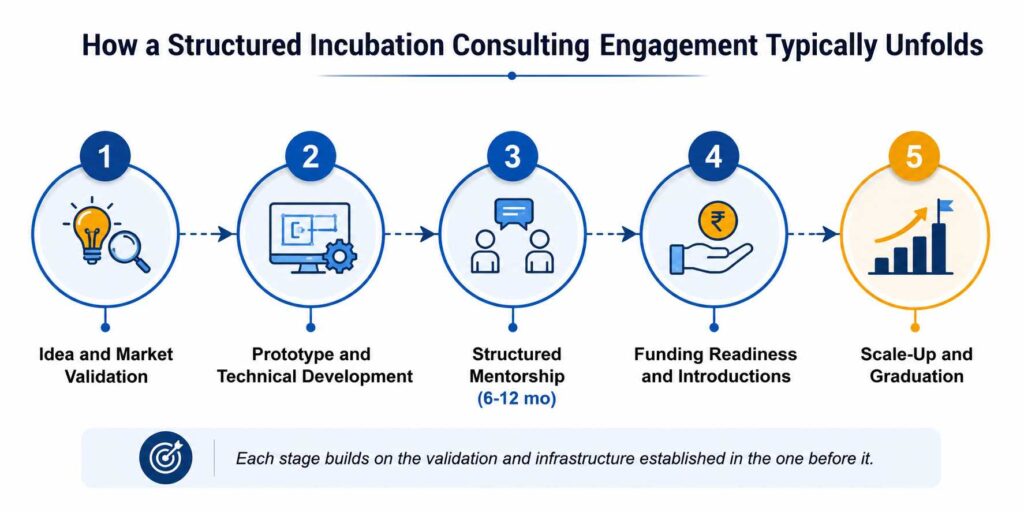
Around 61% of incubators run structured mentorship tracks lasting 6 to 12 months during the middle of this sequence, giving founders consistent guidance rather than occasional, informal advice, and it is this stage that most often determines whether a venture reaches the funding-readiness step with a business a serious investor will actually engage with.
Where This Matters Most for Manufacturing and Hardware Founders
Most of India’s incubation infrastructure has historically been built around software-first ventures, leaving a real gap for founders building physical products or industrial equipment:
- These founders need engineering validation before reaching a customer, something generalist, software-oriented incubators are rarely equipped to provide.
- Close to 39% of hardware and electronics-focused startups secure manufacturing partnerships during incubation specifically because their programme included engineering-level support, not just business mentorship.
- For these founders, the value of incubation consulting is measured less in office space or introductions and more in whether a working prototype can actually become a manufacturable, production-ready product.
IMARC Engineering works with founders at exactly this stage, so if you are building a hardware or manufacturing venture, this is worth a closer look.
Get Expert Incubation Support: https://www.imarcengineering.com/contact?service=incubation
Conclusion
The data on incubation consulting is consistent across every dimension that matters to a new venture, survival, cost, funding access, and intellectual property protection. With India adding startups faster than its incubation infrastructure is expanding to support them, founders who engage structured consulting early are working with materially better odds than those who try to build alone. For manufacturing and hardware ventures especially, where the gap between prototype and production is where most founders stall, the right incubation partner remains one of the highest-leverage decisions available at the start of the journey, often shaping outcomes years before revenue or fundraising numbers ever reflect it.
Contact Us:
IMARC Engineering
Phone: +91-120-433-0800
Email: sales@imarcengineering.com
India: C-130, Sector 2, Noida, Uttar Pradesh 201301
LinkedIn: https://www.linkedin.com/showcase/imarc-engineering/
About the Author