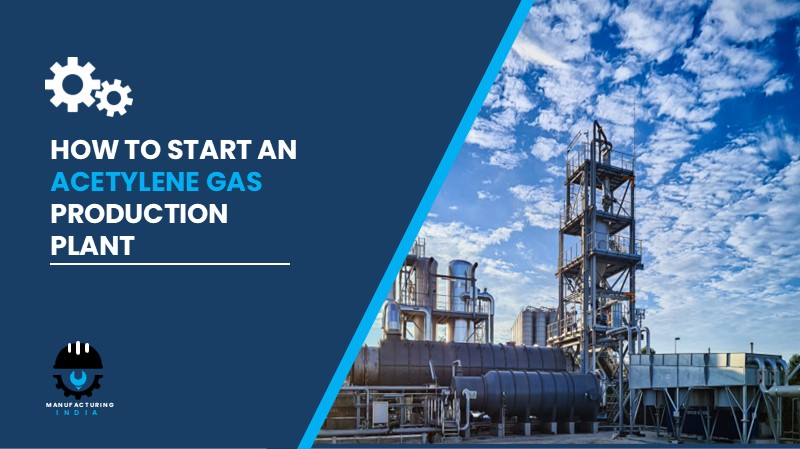
Setting up an acetylene gas production plant in India presents a compelling investment case driven by the ongoing demand for high-temperature, precision cutting and joining solutions in industrial operations, the rising demand from metal fabrication and welding activities, the expansion of construction and infrastructure projects, and the growth of the automotive and shipbuilding industries. Acetylene gas – a colourless, highly combustible hydrocarbon gas produced primarily through the reaction of calcium carbide with water – generates an exceptionally high flame temperature when combined with oxygen, making it the fuel gas of choice for oxy-acetylene welding, cutting, brazing, and heating across India’s most capital-intensive and technically demanding industrial sectors. As India’s infrastructure pipeline, automotive production base, and industrial engineering sectors continue their rapid expansion, the demand for reliable, high-performance acetylene gas is structurally positioned for sustained long-term growth.
India’s structural advantages make this a strategically sound investment. According to reports, the US construction industry is expected to grow by 4.5% in real terms in 2024 and 4% in 2025 – a global construction growth trajectory that is mirrored and exceeded by India’s own infrastructure build-out, with capital expenditure on roads, railways, bridges, and urban development creating a large and government-backed institutional demand base for welding and cutting gases. Rising investments in infrastructure refurbishment and industrial maintenance are supporting continued consumption of oxy-acetylene systems across India’s metalworking sector. The global acetylene gas market was valued at USD 6.34 billion in 2025 and is expected to reach USD 7.80 billion by 2034 at a CAGR of 2.3% from 2026 to 2034 according to IMARC Group estimates – positioning a domestic acetylene gas production plant in India to serve one of the most consistent and institutionally deep industrial demand categories in the country’s chemicals and industrial gases landscape.
India’s rapidly expanding construction, automotive, and shipbuilding industries, the global acetylene gas market growing from USD 6.34 billion in 2025 to USD 7.80 billion by 2034, and the product’s unmatched thermal performance in precision metalworking make an acetylene gas production plant a financially sound and demand-backed industrial investment. With gross margins of 30–40% and net margins of 12–18% across a capacity of 5,000–10,000 MT annually, the project delivers consistent returns aligned with India’s long-term industrial growth trajectory.
What is Acetylene Gas?
Acetylene gas is a colourless and very combustible hydrocarbon gas, produced primarily through hydrocarbon cracking processes or by the interaction between calcium carbide and water. When combined with oxygen, it produces an exceptionally high flame temperature, which is highly prized for oxy-acetylene welding, cutting, brazing, and heating. Acetylene gas provides clean cutting performance, accurate heat management, and stable combustion, assuring consistent results in industrial and commercial applications.
To guarantee safe storage and transportation, the gas is often delivered in solution within specially made cylinders containing a porous mass and acetone or dimethylformamide. Acetylene can be used with both manual and automated welding systems and is appropriate for use in large-scale industrial operations as well as smaller shops. Because of its reliability, adaptability, and efficiency, it is the fuel gas of choice for demanding metalworking applications – a positioning that is reinforced by the fact that alternative gases cannot match acetylene’s thermal performance in applications requiring the highest flame temperatures for precision cutting, heat treatment, and flame hardening.
The primary production method is calcium carbide production or hydrocarbon cracking, controlled gas generation, purification and drying, compression and dissolution in solvent, cylinder filling, safety inspection, and labelling – a multi-stage industrial gas production process. End-use industries served include the metal fabrication and welding industry, construction and infrastructure sector, automotive and transportation industry, shipbuilding and repair yards, and maintenance and repair operations.
Cost of Setting Up an Acetylene Gas Production Plant in India
The cost of establishing this facility depends on capacity, technology selection, plant location, degree of automation, and regulatory compliance requirements.
1. Capital Expenditure (CapEx)
Total capital investment for an acetylene gas production plant in India covers land acquisition, site preparation, civil construction, process machinery, and pre-operative expenses. The cost of land and site development – including charges for land registration, boundary development, and other related expenses – forms a substantial part of the overall investment. This allocation ensures a solid foundation for safe and efficient plant operations. Investors can reduce land acquisition costs by locating the unit in a chemical zone, industrial estate, or Special Economic Zone (SEZ), which also provide shared utility infrastructure and potential state-level fiscal incentives aligned with India’s industrial chemicals production development agenda.
Civil works and construction encompass the main calcium carbide handling, gas generation, and purification production building, raw material storage areas for calcium carbide and water, a cylinder filling and storage area, a quality control laboratory, and an administrative block. Given that acetylene gas is highly flammable and explosive at concentrations above 2.5%, civil and structural infrastructure must incorporate explosion-proof construction, appropriate ventilation, secondary containment provisions, and fire safety systems throughout the facility.
Machinery costs account for the largest portion of total capital expenditure. Key machinery required includes:
- Calcium carbide handling or gas generation units
- Gas purification and drying systems
- Compressors
- Solvent filling systems
- Acetylene cylinders with porous mass
- Safety valves and flashback arrestors
- Leak detection systems
- Quality testing equipment
- Cylinder filling and sealing machinery
All machinery must be high-quality and corrosion-resistant, tailored for acetylene gas production, and must comply with industry standards for safety, efficiency, and reliability. Other capital costs include the effluent treatment plant (ETP), advanced process monitoring systems, pre-operative expenses, trial production costs, and commissioning charges.
Request a Sample Report for In-Depth Market Insights: https://www.imarcgroup.com/acetylene-gas-production-plant-project-report/requestsample
2. Operational Expenditure (OpEx)
The operating cost structure of an acetylene gas production plant is primarily driven by raw material consumption, particularly calcium carbide, which accounts for approximately 60–70% of total operating expenses (OpEx). Water is the secondary raw material input – in this reaction, water is added to calcium carbide (CaC₂) to produce acetylene gas (C₂H₂) and calcium hydroxide (Ca(OH)₂). Securing long-term supply agreements with reliable calcium carbide producers and minimising transportation costs by selecting nearby suppliers is essential for production cost stability and continuity. Sustainability and supply chain risks must be assessed, and long-term contracts should be negotiated to stabilise pricing and ensure a steady supply.
Utility costs – comprising electricity for gas generation units, compressors, purification and drying systems, and cylinder filling and sealing machinery, as well as water – account for 15–20% of total OpEx, reflecting the energy-intensive nature of calcium carbide-based acetylene generation and gas compression operations. Other ongoing operating costs include transportation, packaging, salaries and wages, depreciation, taxes, equipment repairs and maintenance, and other miscellaneous expenses.
In the first year of operations, the operating cost for the acetylene gas production plant is projected to be significant, covering raw materials, utilities, depreciation, taxes, packing, transportation, and repairs and maintenance. By the fifth year, the total operational cost is expected to increase substantially due to factors such as inflation, market fluctuations, and potential rises in the cost of key materials. Additional factors, including supply chain disruptions, rising consumer demand, and shifts in the global economy, are expected to contribute to this increase.
3. Plant Capacity
The proposed production facility is designed with an annual production capacity ranging between 5,000 and 10,000 MT, enabling economies of scale while maintaining operational flexibility. Acetylene gas production and cylinder filling operations can be efficiently scaled with moderate capital investment – a scalable production model that allows investors to progress from initial capacity to full-scale operation in line with market penetration timelines. Capacity can be customised per investor requirements based on target industrial, construction, or automotive market segments, available capital, and chosen production technology. Profitability improves materially with higher capacity utilisation, making domestic supply agreements with metal fabrication workshops, construction contractors, automotive manufacturers, and shipyards a commercial priority from the commissioning stage.
4. Profit Margins and Financial Projections
The project demonstrates healthy profitability potential under normal operating conditions. Gross profit margins typically range between 30–40%, supported by stable demand and value-added applications. Net profit margins range between 12–18%. Break-even in an acetylene gas production business typically ranges from 3 to 6 years, depending on scale, regulatory compliance costs, raw material pricing, and market demand – with efficient production and export opportunities able to help accelerate returns. A comprehensive financial model covering NPV (net present value), IRR (internal rate of return), payback period, liquidity analysis, uncertainty analysis, sensitivity analysis, and a full five-year profit and loss account provides investors with a rigorous analytical framework for assessing financial viability and long-term sustainability across different capacity and pricing scenarios.
Why Set Up an Acetylene Gas Plant in India?
Strong and Consistent Industrial Demand Across Multiple Sectors. Ongoing infrastructure development and industrial growth continue to support steady demand for acetylene gas across multiple sectors in India. The need for precise and high-quality welding and cutting solutions remains strong, particularly in applications where alternative gases cannot match acetylene’s performance – ensuring a structurally durable and multi-sector demand base that is largely insulated from single-industry cyclical downturns.
High Thermal Efficiency Maintaining Gas Preference. The very high flame temperature of acetylene ensures superior cutting speed and welding quality compared to alternative fuel gases. Industrial users continue to prioritise reliability, efficiency, and consistent output – which positions acetylene gas as a critical input for metalworking operations across developed and emerging markets. This performance differentiation protects acetylene’s market share against lower-cost alternative fuel gas substitutes in precision metalworking applications.
Expanding Construction and Infrastructure Activity Creating Direct Demand. Acetylene gas is used for cutting and joining steel structures, pipelines, and reinforcement bars in large-scale construction projects. According to reports, the US construction industry is expected to grow by 4.5% in real terms in 2024 and 4% in 2025, following an annual growth rate of 2% in 2023 – a global growth rate that is directionally consistent with India’s own infrastructure spending trajectory, where government capital expenditure on roads, railways, and urban infrastructure is creating sustained and growing procurement demand for industrial cutting gases.
Versatility Across Applications Ensuring Multi-Channel Revenue. Acetylene gas supports a wide range of operations, from heavy industrial fabrication to small-scale repair work. Its use in oxy-acetylene welding and cutting, metal brazing and soldering, heat treatment processes, flame hardening, and precision fabrication tasks means that domestic producers can serve diverse end-use customer categories – from large automotive OEM suppliers and shipyards to local fabrication units and service garages – across both organised and unorganised market channels.
Organised Distribution Networks Enhancing Market Accessibility. Organised distribution networks and improved cylinder safety technologies are enhancing market accessibility for acetylene gas across India’s industrial geography. The gas is delivered in solution within specially made cylinders containing a porous mass and acetone or dimethylformamide – a proven and well-standardised distribution format that allows efficient cylinder logistics management and creates recurring cylinder exchange revenue streams for domestic acetylene producers.
Active Global Industry Developments Confirming Production Innovation. In September 2025, the Irkutsk Institute of Chemistry, in collaboration with En+ Group, announced progress toward developing a technology to produce acetylene from hard coal, with plans to launch pilot production by 2028. The project supports replacing petroleum-based feedstocks, strengthens chemical import independence, and positions acetylene gas production as a platform for joint product development and export growth, including cooperation with China. In March 2025, South Africa Calcium Carbide opened an 8 MW cogeneration plant in Newcastle, KwaZulu-Natal, with support from the Industrial Development Corporation to reduce electricity costs and environmental impact – a development that supports energy-intensive calcium carbide production used to generate acetylene gas (C₂H₂) while lowering grid demand and cutting carbon dioxide emissions by over 45,000 tons annually. These investments confirm that the global acetylene gas production industry is actively innovating to reduce input costs, improve energy efficiency, and diversify feedstock sources.
Production Process – Step by Step
The acetylene gas production process uses calcium carbide production or hydrocarbon cracking, controlled gas generation, purification and drying, compression and dissolution in solvent, cylinder filling, safety inspection, and labelling as the primary production method. Each stage is precision-controlled to ensure gas purity, operational safety, and compliance with the storage, transportation, and quality standards required by industrial, construction, automotive, and shipbuilding customers.
- Raw Material Receipt and Inspection: Calcium carbide and water are received at the facility and subjected to incoming quality checks for calcium carbide grade specification, purity, and moisture content before entering the production process.
- Calcium Carbide Production or Procurement: Calcium carbide (CaC₂) is either produced in-house by heating lime and coke in a calcium carbide furnace at high temperatures, or procured from reliable external suppliers meeting the required grade specification for acetylene generation.
- Acetylene Gas Generation: Water is fed in controlled amounts into calcium carbide handling or gas generation units, reacting with calcium carbide to produce raw acetylene gas (C₂H₂) and calcium hydroxide (Ca(OH)₂) as a by-product. The reaction is exothermic and carefully controlled to manage gas evolution rate, temperature, and pressure within safe operating parameters.
- Acetylene Gas Separation: Crude acetylene gas is separated from by-products – including calcium hydroxide slurry and process water – in separation stages that produce a clean acetylene gas stream ready for downstream purification.
- Purification: Acetylene gas passes through gas purification and drying systems to remove impurities including hydrogen sulphide, phosphine, and moisture – contaminants that could impair welding and cutting performance and affect the long-term integrity of cylinder solvent and porous mass.
- Cooling and Drying: Purified acetylene is cooled and further dried to achieve the moisture specification required for safe dissolution in acetone or dimethylformamide within the cylinder.
- Compression and Dissolution in Solvent: Dried acetylene is compressed using compressors and dissolved under controlled pressure into the solvent – acetone or dimethylformamide – contained within the porous mass inside the acetylene cylinder, producing a stable and safe pressurised gas product for storage and transportation.
- Cylinder Filling and Sealing: Charged cylinders are sealed and fitted with safety valves and flashback arrestors using cylinder filling and sealing machinery, ensuring safe containment and reliable gas delivery to end-user welding and cutting equipment.
- Safety Inspection and Quality Testing: Filled cylinders are evaluated on quality testing equipment for gas purity, cylinder pressure, valve integrity, and safety compliance before release for labelling and dispatch.
- Labelling and Dispatch: Approved cylinders are labelled with gas specification, safety information, and traceability data and dispatched to end-use customers across the metal fabrication and welding industry, construction and infrastructure sector, automotive and transportation industry, shipbuilding and repair yards, and maintenance and repair operations.
Key Applications
The acetylene gas production plant serves a diverse and industrially critical range of end-use sectors across India’s metalworking and construction economy.
- Construction and Infrastructure Sector: Acetylene gas is used for cutting and joining steel structures, pipelines, and reinforcement bars in large-scale construction projects – the largest volume application segment driven by India’s government infrastructure spending.
- Automotive and Transportation Industry: Vehicle production and repair workshops use acetylene gas for chassis fabrication, exhaust systems, and body repairs – a consistent and geographically dispersed procurement channel across India’s automotive OEM facilities and vehicle repair service network.
- Shipbuilding and Marine Industry: Shipyards rely on acetylene gas for heavy plate cutting, hull repairs, and structural welding operations – a premium-grade application segment where acetylene’s high flame temperature performance is a non-negotiable specification requirement.
- Production and Engineering Units: Industrial plants use acetylene gas for precision metalworking, tool fabrication, and maintenance activities – a broad and diversified institutional demand channel across India’s production sector.
- Small Workshops and Repair Services: Local fabrication units and service garages depend on acetylene gas for efficient and reliable welding and cutting solutions – the largest number of procurement accounts for domestic acetylene producers, providing volume distribution reach across India’s dispersed small industry base.
- Heat Treatment and Flame Hardening: Acetylene gas is used in heat treatment processes and flame hardening applications where precise and localised high-temperature heating is required for surface hardening, stress relieving, and component forming operations across precision engineering and toolmaking sectors.
Leading Manufacturers
The global acetylene gas industry is served by several established multinational producers with extensive production capacities and diverse application portfolios. Key players operating in this market include:
- Airgas, Inc.
- BASF SE
- China Petroleum and Chemical Corporation
- Gulf Cyro
- Hebei Xingyu Chemical Co. Ltd.
Additional top acetylene gas producers in the global market include Air Liquide, Linde PLC, Air Products, and Praxair – all of which serve end-use sectors including metal fabrication and welding, construction and infrastructure, automotive and transportation, shipbuilding and repair yards, and maintenance and repair operations.
Timeline to Start the Plant
Investors should plan for a structured pre-production and commissioning phase covering the following key stages:
- Feasibility study and project report preparation
- Land acquisition and site development
- Regulatory approvals and environmental clearances
- Factory licence and fire safety compliance
- Machinery procurement and installation
- Raw material supplier agreements and supply chain setup
- Trial production and quality testing
- Commercial production launch
The timeline to start an acetylene gas production plant usually ranges from 12 to 24 months, depending on factors such as site development, machinery installation, environmental clearances, safety measures, and trial runs.
Licences and Regulatory Requirements
Starting an acetylene gas production unit in India requires several approvals:
- Business registration (Proprietorship, LLP, or Private Limited Company)
- Factory Licence under the Factories Act
- Environmental Clearance from the State Pollution Control Board
- GST Registration
- Fire Safety NOC
- Hazardous chemical compliance for storage and handling of calcium carbide, acetylene gas, and acetone or dimethylformamide under the Manufacture, Storage and Import of Hazardous Chemical Rules
- Effluent Treatment Plant (ETP) operational clearance
- Occupational Health and Safety compliance
Key Challenges to Consider
High Capital Requirements. Establishing a fully equipped acetylene gas production plant – with calcium carbide handling or gas generation units, gas purification and drying systems, compressors, solvent filling systems, acetylene cylinders with porous mass, safety valves and flashback arrestors, leak detection systems, quality testing equipment, and cylinder filling and sealing machinery – at the 5,000–10,000 MT annual capacity range requires significant upfront capital investment. Access to MSME credit-linked subsidy schemes, chemical production cluster support, and state government investment promotion grants can help bridge funding requirements.
Raw Material Price Volatility. Calcium carbide – accounting for 60–70% of total OpEx – is produced from lime and coke in energy-intensive electric arc furnaces, making its price sensitive to electricity tariff movements and coke price cycles. Long-term procurement contracts with reliable domestic calcium carbide producers and diversified sourcing strategies are the primary risk mitigation measures for managing this dominant cost driver. The March 2025 South Africa Calcium Carbide cogeneration plant development – reducing electricity costs and CO₂ emissions by over 45,000 tons annually – confirms that energy efficiency is the central competitive lever in calcium carbide and acetylene production globally.
High Utility Cost Intensity. Utilities – at 15–20% of total OpEx – represent a materially elevated cost component driven by the electricity demands of calcium carbide furnace operations (where in-house production is pursued) and the energy demands of gas compression. Securing reliable and cost-competitive electricity supply, ideally through industrial estate grid infrastructure or open access renewable arrangements, is a key site selection criterion for managing operating cost efficiency.
Regulatory Compliance. Acetylene gas is highly flammable and can form explosive mixtures with air at concentrations of 2.5–81%, making it one of the most hazard-classified industrial gases under India’s regulatory framework. Compliance obligations under the Hazardous Chemicals Rules are extensive, covering gas generation safety, cylinder inspection, storage separation requirements, emergency response plans, and ongoing ETP monitoring. Advanced monitoring systems and leak detection systems must be installed and maintained throughout operations. Dedicated safety management resources are a non-negotiable operational requirement.
Competition from Global and Domestic Players. Established multinational industrial gas producers – including Air Liquide, Linde PLC, Air Products, BASF SE, and Airgas Inc. – alongside existing domestic acetylene producers hold strong market positions across India’s organised industrial and construction customer segments. New entrants must compete through geographic proximity to key demand centres, competitive cylinder lease pricing, reliable supply continuity, and the ability to serve both large institutional accounts and the dispersed small workshop segment.
Skilled Manpower. Operating gas generation units, compressors, purification systems, and cylinder filling and sealing machinery in a highly hazardous industrial environment requires trained industrial gas process operators and certified safety personnel. Recruiting, training, and retaining qualified technical staff – particularly for calcium carbide handling safety, gas purity testing, and cylinder maintenance – is a recurring operational challenge in India’s industrial chemicals production sector.
Frequently Asked Questions
1. How much does it cost to set up an acetylene gas production plant in India?
Capital requirements generally include land acquisition, construction, equipment procurement – including calcium carbide handling or gas generation units, gas purification and drying systems, compressors, solvent filling systems, acetylene cylinders with porous mass, safety valves and flashback arrestors, leak detection systems, quality testing equipment, and cylinder filling and sealing machinery – installation, pre-operative expenses, and initial working capital. The total amount varies with capacity, technology, and location. A detailed feasibility study is recommended to generate accurate project-specific cost estimates.
2. Is acetylene gas production profitable in India in 2026?
Yes. The project delivers healthy financial performance, with gross margins of 30–40% and net profit margins of 12–18% under normal operating conditions. The global acetylene gas market was valued at USD 6.34 billion in 2025 and is projected to reach USD 7.80 billion by 2034 at a CAGR of 2.3% according to IMARC Group, with India’s expanding construction, automotive, shipbuilding, and metal fabrication sectors providing a large and structurally consistent domestic demand base.
3. What machinery is required for an acetylene gas plant in India?
Essential equipment includes calcium carbide handling or gas generation units, gas purification and drying systems, compressors, solvent filling systems, acetylene cylinders with porous mass, safety valves and flashback arrestors, leak detection systems, quality testing equipment, and cylinder filling and sealing machinery.
4. What licences and approvals are required to start an acetylene gas plant in India?
Required approvals include business registration, factory licence, environmental clearances, fire safety certifications, and industry-specific permits applicable under local, state, and national regulations. Hazardous chemical compliance for calcium carbide and acetylene handling under the Manufacture, Storage and Import of Hazardous Chemical Rules, ETP operational clearance, and Occupational Health and Safety compliance are mandatory.
5. What raw materials are needed for acetylene gas production?
Primary raw materials are calcium carbide and water. In the core production reaction, water is added to calcium carbide (CaC₂) to produce acetylene gas (C₂H₂) and calcium hydroxide (Ca(OH)₂). Calcium carbide is the dominant cost driver, accounting for 60–70% of total operating expenses.
6. What are the environmental compliance requirements for an acetylene gas plant in India?
The facility must obtain Environmental Clearance from the State Pollution Control Board, operate an approved ETP for calcium hydroxide slurry and process water management, and comply with the Hazardous Chemicals Rules for calcium carbide, acetylene, and acetone/dimethylformamide storage and handling. Advanced monitoring systems must be installed to detect leaks or process deviations, and regular effluent monitoring and safety audit documentation are mandatory throughout operations.
7. What is the best location to set up an acetylene gas plant in India?
The location must offer easy access to key raw materials such as calcium carbide and water, while proximity to target markets minimises distribution costs. The site must have robust infrastructure including reliable transportation, utilities, and waste management systems. Industrial clusters in Maharashtra, Gujarat, Andhra Pradesh, Tamil Nadu, and Uttar Pradesh – which combine calcium carbide supply chain access with dense metalworking, construction, and automotive production demand – are strong candidates for plant location.
8. What is the break-even period for this type of plant in India?
Break-even in an acetylene gas production business typically ranges from 3 to 6 years, depending on scale, regulatory compliance costs, raw material pricing, and market demand. Efficient production and export opportunities can help accelerate returns.
9. What government incentives are available for manufacturers in India?
Governments may offer incentives such as capital subsidies, tax exemptions, reduced utility tariffs, export benefits, or interest subsidies to promote production under various national or regional industrial policies. Financing can be arranged through term loans, government-backed schemes, private equity, equipment leasing, or strategic partnerships. Financial viability assessments help identify optimal funding routes for acetylene gas production investment.
Key Takeaways for Investors
An acetylene gas production plant in India offers a consistent and financially well-grounded investment opportunity anchored by growing demand across the metal fabrication and welding industry, construction and infrastructure sector, automotive and transportation industry, shipbuilding and repair yards, and maintenance and repair operations – all of which depend on acetylene gas as the critical high-performance cutting and joining fuel that alternative gases cannot fully replace in precision metalworking applications. The project is financially viable across the 5,000–10,000 MT annual capacity range, with gross margins of 30–40% and net margins of 12–18% providing a strong return framework supported by a break-even horizon of 3 to 6 years at efficient capacity utilisation. According to IMARC Group estimates, the global acetylene gas market is set to grow from USD 6.34 billion in 2025 to USD 7.80 billion by 2034 at a CAGR of 2.3%, with India’s government-driven infrastructure spending and expanding industrial production base creating a structurally growing and institutionally deep domestic demand pool. With active global technology investment – including the Irkutsk Institute of Chemistry and En+ Group’s September 2025 coal-to-acetylene development programme and South Africa Calcium Carbide’s March 2025 cogeneration plant reducing electricity costs and carbon emissions – the long-term demand sustainability for domestically produced acetylene gas in India is structurally sound across all investment planning horizons.
About the Author