Setting up a high-efficiency power supply manufacturing plant in India presents a compelling investment case, driven by surging demand from information technology (IT), data centers, industrial automation, automotive and electric vehicles, renewable energy, and consumer electronics sectors. These advanced electrical conversion systems are critical enablers of India’s digital economy, powering everything from server racks in hyperscale data warehouses to onboard chargers in electric vehicles. As the country’s digital infrastructure and industrial base expand rapidly, domestic production of these units offers a significant commercial opportunity for first movers.
India’s manufacturing advantages align closely with what this sector demands. The country’s urbanisation trajectory, large-scale infrastructure investment, and the Make in India initiative create a supportive environment for electronics production. States such as Maharashtra, Karnataka, Tamil Nadu, and Telangana offer established electronics clusters, skilled engineering talent, and well-developed logistics corridors. Cost-competitive labour and proximity to component suppliers further strengthen the business case, making India strategically sound for this type of production.
This investment is supported by strong policy momentum, cost-competitive operations, and a growing base of end-use industries spanning data centers, EV charging, and renewable energy. With gross margins of 20–35% and annual capacity scalable between 50,000 and 2,00,000 units, the unit economics are attractive and break-even viability is well within reach for disciplined investors.
What is High-Efficiency Power Supply?
High-efficiency power supplies are advanced electrical conversion systems designed to transform input electrical energy into usable output power with minimal energy loss. These systems achieve superior efficiency levels through optimised circuit topologies, advanced semiconductor materials, and intelligent power management controls. They comply with stringent international standards such as 80 PLUS, DOE Level VI, and IEC norms, and are engineered to reduce heat generation, enhance reliability, and support stable voltage regulation across energy-intensive applications.
The production method encompasses circuit design and simulation, semiconductor assembly, and firmware programming and testing. Finished units serve information technology (IT), data centers, industrial automation, automotive and electric vehicles, renewable energy, and consumer electronics, with applications spanning AC-DC and DC-DC power conversion, server and networking equipment, EV charging systems, and industrial control systems.
Cost of Setting Up a High-Efficiency Power Supply Plant in India
The total investment for this facility depends on capacity, technology, location, automation level, and regulatory compliance requirements.
1. Capital Expenditure (CapEx)
Land and site development form a substantial component of total capital investment. Investors may consider locating within a Special Economic Zone (SEZ) or an established electronics industrial estate to benefit from infrastructure support and potential tax concessions. Land registration, boundary development, and related charges must be planned carefully.
Civil works cover the manufacturing shed, quality control laboratory, raw material storage, finished goods warehouse, and administrative block, with adequate space for smooth material flow.
Key machinery required includes:
- SMT (Surface Mount Technology) pick-and-place machines
- Reflow soldering ovens
- Automated optical inspection systems
- Power testing and efficiency analyzers
- Environmental and burn-in testing chambers
Other capital costs include effluent treatment plant (ETP) installation, pre-operative expenses, commissioning charges, and import duties on specialised equipment.
Request a Sample Report for In-Depth Market Insights: https://www.imarcgroup.com/high-efficiency-power-supply-manufacturing-plant-project-report/requestsample
2. Operational Expenditure (OpEx)
Raw material cost is the dominant driver of operating expenditure, accounting for approximately 60–70% of total OpEx. The primary raw materials include semiconductors and ICs, magnetics, capacitors, PCBs, and mechanicals and enclosures. Long-term supply contracts with reliable vendors are recommended to stabilise pricing and ensure consistent quality.
Utility costs — electricity, water, and steam — account for 3–7% of total OpEx. Other operating costs include transportation, packaging, salaries and wages, repairs and maintenance, depreciation, and taxes. By the fifth year, total operational costs are projected to increase substantially due to inflation, market fluctuations, and potential rises in material costs.
3. Plant Capacity
The unit is designed with an annual production capacity ranging between 50,000 and 2,00,000 units per year, enabling economies of scale while maintaining flexibility. Capacity can be customised per investor requirements, and profitability improves significantly at higher utilisation rates.
4. Profit Margins and Financial Projections
Gross profit margins typically range between 20–35%, with net profit margins between 5–15%, reflecting stable demand and value-added applications. A comprehensive financial analysis encompassing NPV, IRR, payback period, and sensitivity analysis is essential before committing capital.
Why Set Up a High-Efficiency Power Supply Plant in India?
Compliance with Energy Conservation Regulations. Manufacturers must increasingly comply with international energy conservation standards. Domestically produced units directly reduce energy loss and carbon emissions from industrial processes, creating regulatory-driven demand for Indian-made power supplies.
Increased Demand for Digital Infrastructure. As more data centers and cloud-computing facilities are built across India, the demand for efficient and reliable power conversion has grown exponentially. Hyperscale cloud expansion intensifies the need for systems with lower energy loss and superior thermal performance.
Support for Electrification Trends. Growing adoption of electric vehicles, renewable energy systems, and smart grids has increased reliance on efficient power conversion technologies. A domestic production base is well-positioned to supply India’s fast-growing green energy and EV charging infrastructure.
Thermal Management Advantages. Higher-efficiency units emit less heat, resulting in extended equipment life, reduced cooling requirements, and improved operational reliability — benefits that are driving adoption in Indian data centers and industrial automation facilities.
Active Industry Investment. In June 2025, Innoscience unveiled a 2kW four-phase interleaved step-down power supply built on gallium nitride (GaN) technology delivering up to 98% efficiency, targeting data centers and AI servers. In October 2025, GigaDevice partnered with Navitas Semiconductor to establish a Digital Power Joint Lab combining GaN and SiC technologies, developing 4.5 kW and 12 kW server platforms and a 500 W PV micro-inverter exceeding 97% efficiency.
Manufacturer’s Opportunity for Value-Added Products. Advanced design and testing requirements allow manufacturers to command substantially higher prices than standard alternatives, resulting in a structurally superior margin profile.
Manufacturing Process – Step by Step
The high-efficiency power supply manufacturing process uses circuit design and simulation, semiconductor assembly, and firmware programming and testing as the primary production method.
- Circuit Design and Simulation: Engineers design and validate optimised circuit topologies before physical production begins.
- PCB Fabrication and Preparation: Printed circuit boards are sourced and inspected for board integrity and surface finish.
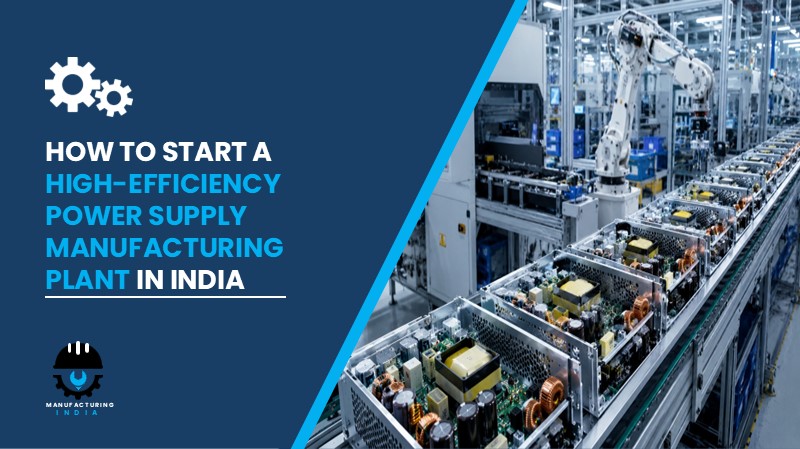
- SMT Pick-and-Place Assembly: SMT pick-and-place machines position semiconductors, ICs, capacitors, and magnetics onto PCBs at high speed.
- Reflow Soldering: Reflow soldering ovens bond surface-mount components to the PCB using controlled heat profiles.
- Automated Optical Inspection: Automated optical inspection systems scan for solder defects and component misalignment.
- Firmware Programming: Firmware is loaded into microcontrollers to enable intelligent power regulation and efficiency optimisation.
- Power Testing and Efficiency Analysis: Power testing and efficiency analyzers verify voltage regulation, efficiency ratings, and electromagnetic compliance.
- Environmental and Burn-In Testing: Environmental and burn-in testing chambers subject units to thermal stress and extended load cycles to confirm reliability.
- Packaging and Dispatch: Finished units are dispatched to IT, data center, industrial automation, automotive and EV, renewable energy, and consumer electronics customers.
Key Applications
The facility serves a broad spectrum of industries requiring stable, energy-efficient power conversion:
- Information Technology and Data Centers: Deployed in servers, storage systems, and networking equipment to reduce energy consumption and thermal load.
- Industrial Automation: Supports programmable logic controllers, robotics, and factory automation systems requiring stable power delivery.
- Automotive and Electric Vehicles: Applied in onboard chargers, power control units, and battery management systems.
- Renewable Energy: Integrated into solar inverters, wind power controllers, and energy storage systems.
- Consumer Electronics: Utilised in adapters, gaming consoles, and home automation devices.
Leading Manufacturers
The global market is served by established multinational companies with extensive production capacities. Key players include:
- ABB Ltd.
- TDK Lambda
- Siemens AG
- Delta Electronics
- Schneider Electric
- Texas Instruments
- Infineon Technologies AG
- Mean Well Enterprises
- Murata Manufacturing Co., Ltd.
Timeline to Start the Plant
- Feasibility study and project report preparation
- Land acquisition and site development
- Regulatory approvals and environmental clearances
- Factory licence and fire safety compliance
- Machinery procurement and installation
- Raw material supplier agreements and supply chain setup
- Trial production and quality testing
- Commercial production launch
Licences and Regulatory Requirements
Starting a high-efficiency power supply manufacturing unit in India requires several approvals:
- Business registration (Proprietorship, LLP, or Pvt Ltd)
- Factory Licence under the Factories Act
- Environmental Clearance from State Pollution Control Board
- GST Registration
- Fire Safety NOC
- Hazardous/Chemical compliance (for soldering flux and chemical cleaning agents used in PCB assembly)
- Effluent Treatment Plant (ETP) operational clearance
- Occupational Health and Safety compliance
Key Challenges to Consider
High Capital Requirements. Initial investment in SMT pick-and-place machines, reflow soldering ovens, automated optical inspection systems, and burn-in testing chambers is significant and requires careful project financing planning.
Raw Material Price Volatility. Semiconductors and ICs, magnetics, capacitors, PCBs, and mechanicals and enclosures are subject to global supply chain disruptions. Long-term contracts and multi-supplier strategies are essential risk mitigants.
Regulatory Compliance. Meeting standards such as 80 PLUS, DOE Level VI, and IEC norms alongside domestic BIS requirements demands continuous investment in testing and quality management systems.
Technology and Innovation Pressure. Rapid adoption of wide-bandgap materials such as silicon carbide (SiC) and gallium nitride (GaN) is raising performance benchmarks. Producers must monitor and selectively adopt these developments.
Competition. Established global players including ABB Ltd., Siemens AG, Delta Electronics, Schneider Electric, and Murata Manufacturing Co., Ltd. serve the market, requiring new entrants to differentiate through application focus and localisation.
Skilled Manpower. Circuit design, firmware programming, and automated optical inspection demand trained electronics engineers and technicians, making structured recruitment and training programmes essential.
Frequently Asked Questions
1. How much does it cost to set up this type of manufacturing plant in India?
Total investment depends on capacity (50,000 to 2,00,000 units per year), technology, location, and automation level, covering land, civil works, machinery, raw materials, and regulatory compliance.
2. Is high-efficiency power supply manufacturing profitable in India in 2026?
Yes. Gross margins of 20–35% and net margins of 5–15% are achievable, supported by stable demand from data centers, EV, and renewable energy sectors.
3. What machinery is required for this type of manufacturing unit in India?
Key equipment includes SMT pick-and-place machines, reflow soldering ovens, automated optical inspection systems, power testing and efficiency analyzers, and environmental and burn-in testing chambers.
4. What licences and approvals are required to start this manufacturing unit in India?
Required approvals include business registration, Factory Licence, Environmental Clearance, GST Registration, Fire Safety NOC, ETP clearance, and Occupational Health and Safety compliance.
5. What raw materials are needed for high-efficiency power supply manufacturing?
Primary raw materials are semiconductors and ICs, magnetics, capacitors, PCBs, and mechanicals and enclosures, accounting for 60–70% of total OpEx.
6. What are the environmental compliance requirements for this plant in India?
The unit must obtain Environmental Clearance from the State Pollution Control Board, operate an approved ETP, comply with hazardous waste rules for solder materials, and maintain Occupational Health and Safety standards.
7. What is the best location to set up the production facility in India?
States with established electronics ecosystems — Maharashtra, Karnataka, Tamil Nadu, and Telangana — offer skilled labour, reliable utilities, logistics infrastructure, and proximity to end-use industries. SEZs offer additional incentives.
8. What is the break-even period for this type of plant in India?
Break-even depends on capacity utilisation, pricing, and financing structure. A detailed financial analysis covering NPV, IRR, and payback period provides investor-specific estimates.
9. What government incentives are available for manufacturers in India?
The Make in India initiative, Production Linked Incentive (PLI) schemes for electronics, SEZ tax exemptions, and state-level capital subsidy schemes are among the frameworks potentially available. Investors should verify current eligibility with relevant authorities.
Key Takeaways for Investors
A high-efficiency power supply manufacturing plant in India represents a robust opportunity, underpinned by structural demand from IT, data centers, industrial automation, automotive and electric vehicles, renewable energy, and consumer electronics. The financial profile is compelling across production scales, with gross margins of 20–35% and net margins of 5–15% achievable under normal conditions. The global market was valued at USD 30.51 Billion in 2025 and is projected to reach USD 54.69 Billion by 2034 at a CAGR of 6.70% from 2026 to 2034, reflecting the sustained trajectory that supports domestic investment. With India’s digital infrastructure expansion, electrification drive, and cost-competitive manufacturing environment, demand fundamentals for the production of these units are durable and well-aligned with the country’s long-term industrial policy direction.
About the Author