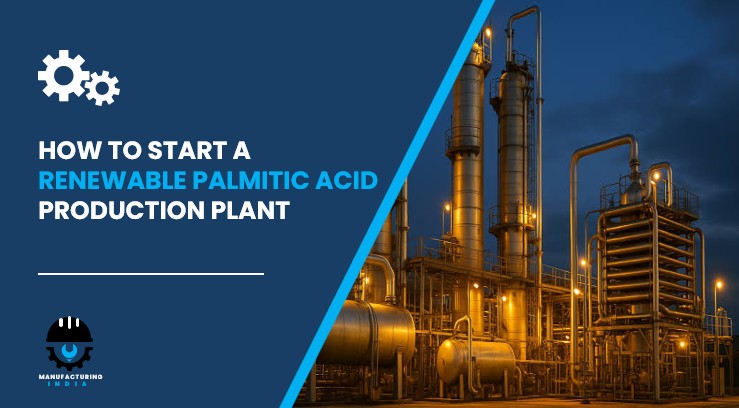
Setting up a renewable palmitic acid production plant in India represents a highly attractive investment proposition underpinned by robust and structurally growing demand from the personal care and cosmetics industry, the food and nutraceutical sector, the pharmaceutical industry, and the biofuels and renewable chemicals space. As global manufacturers accelerate the shift from petroleum-derived and conventional land-clearing palm oil sources toward sustainably sourced feedstocks such as certified palm oil, palm stearin, coconut oil, and recycled lipids, renewable palmitic acid processed via hydrolysis, fractionation, and selective hydrogenation occupies an increasingly important position across green surfactants, emollients, bio-lubricants, and low-impact industrial formulations. This growth trajectory, combined with advances in oleochemical and enzymatic conversion technology and strong policy support for decarbonisation and circular economy practices, creates a highly favourable manufacturing environment for new entrants with efficient, traceable, and sustainability-certified production systems.
What is Renewable Palmitic Acid?
Renewable palmitic acid is an eco-friendly, bio-based version of hexadecanoic acid (C₁₆H₃₂O₂), a common saturated fatty acid. Unlike conventional palmitic acid extracted from land-clearing palm oil sources, renewable forms are derived from sustainably sourced biological feedstocks such as certified palm oil, palm stearin, coconut oil, microalgae, industrial fermentation streams, or recycled lipids. It serves as a vital, greener building block across the cosmetics, food, pharmaceutical, and biofuels industries, produced through hydrolysis (fat splitting), fractionation, and selective hydrogenation of the source feedstock.
Renewable palmitic acid is processed and sold in three principal grades technical grade, cosmetic grade, and food/pharmaceutical grade depending on the purification and distillation route adopted. Beyond soaps and detergents, the product is used extensively in personal care formulations as an emollient and structuring agent, in food additives and emulsifiers, in pharmaceutical excipients and topical formulations, and as a feedstock for biodiesel and bio-based chemical intermediates.
Cost of Setting Up a Renewable Palmitic Acid Production Plant
The total capital investment required to establish a renewable palmitic acid production plant is shaped by several key parameters: annual production capacity (typically designed around 10,000 MT per annum for a standalone facility), the processing route adopted (hydrolysis and fractionation versus an integrated hydrolysis-fractionation-hydrogenation facility), the level of automation across reaction, distillation, and purification sections, facility specification, sustainable feedstock sourcing strategy, and applicable regulatory, food safety, and cosmetic-grade compliance requirements. Below is a structured breakdown of the major cost components.
1. Capital Expenditure (CapEx)
Total capital investment in a renewable palmitic acid production plant covers the following major heads:
Land and Site Development
This encompasses land acquisition or lease, site preparation, boundary development, and utilities connectivity. Site selection should prioritise proximity to sustainably certified palm oil, palm stearin, or coconut oil feedstock sources to ensure a steady, traceable, low-transport-cost raw material supply. Access to reliable power and steam generation infrastructure for hydrolysis, distillation, and hydrogenation processes, strong road and rail or port logistics for inbound feedstock and outbound finished product, availability of process water of suitable quality, and a trained workforce for plant operations and quality control are critical site selection criteria. Compliance with industrial zoning regulations, food and cosmetic safety manufacturing standards, and effluent and emission compliance frameworks must be assessed from project initiation.
Civil Works and Construction
Building costs cover the main processing facility including the feedstock reception and storage section, hydrolysis (fat splitting) reactor house, fractionation and distillation area, bleaching and crystallisation section, finished product filtration and storage tank farm, automated packaging and dispatch infrastructure, quality control laboratory, administrative block, and utility infrastructure including boiler house, power backup, cooling water systems, and effluent treatment plant. Construction must comply with applicable factory act requirements, food and cosmetic safety manufacturing standards, and process safety norms for high-temperature and vacuum-based operations.
Machinery and Equipment
Machinery represents the single largest CapEx component. Key equipment required for a renewable palmitic acid production plant includes:
- Feedstock Reception and Storage Systems: Storage tanks, intake pumps, and metering systems for sustainably sourced palm oil, palm stearin, coconut oil, or recycled lipid feedstocks prior to processing
- Hydrolysis (Fat Splitting) Reactors: High-pressure, high-temperature splitting columns that hydrolyse triglyceride feedstocks into crude fatty acids and glycerine using continuous countercurrent splitting technology
- Glycerine Recovery Systems: Evaporation and purification equipment to recover and concentrate glycerine as a co-product of the hydrolysis process
- Fractionation and Distillation Columns: Vacuum distillation and fractionation units to separate and concentrate palmitic acid from the crude fatty acid stream, achieving the required purity specification
- Selective Hydrogenation Units: Reactors for controlled hydrogenation of unsaturated fatty acid fractions to enhance stability and meet target specification for palmitic acid content
- Bleaching and Deodorisation Systems: Vacuum bleaching vessels and steam distillation columns to remove colour pigments, odour, and trace impurities, producing bland, stable, high-purity palmitic acid
- Crystallisation and Filtration Systems: Controlled cooling, crystallisation, and filter press equipment to achieve the required flake, pastille, or powder product form
- Effluent Treatment and Utility Systems: Steam boilers, cooling towers, wastewater treatment plant, and vacuum generation systems supporting hydrolysis, distillation, and hydrogenation operations
- Automated Packaging Lines: Flaking, pastillation, bagging, and drum-filling lines for retail and industrial packaging, along with bulk loading facilities for tanker dispatch
- Quality Control Laboratory Equipment: Equipment for iodine value, acid value, saponification value, melting point, colour, and purity testing to verify compliance with food, cosmetic, and industrial quality standards
- Material Handling and Warehousing: Conveyors, pumps, storage tanks for feedstock and finished product, and finished goods warehousing with FIFO stock management
Other Capital Costs
These include pre-operative expenses, commissioning charges, import duties on specialised hydrolysis, fractionation, and hydrogenation equipment, staff training and competency development, initial raw material and consumable inventory for production commissioning, regulatory compliance setup including food and cosmetic-grade certifications, sustainable feedstock certification (such as RSPO or ISCC), and quality management system establishment costs.
Request a Sample Report for In-Depth Market Insights: https://www.imarcgroup.com/renewable-palmitic-acid-manufacturing-plant-project-report/requestsample
2. Operational Expenditure (OpEx)
Raw materials principally sustainably sourced palm oil or palm stearin, along with processing chemicals and consumables constitute the dominant operating cost, typically representing 60–70% of total OpEx. Utility costs, driven primarily by steam generation, electricity consumption of hydrolysis and distillation equipment, and vacuum system operation, account for 7–11% of OpEx. Labour, maintenance, quality control, packaging, transportation, depreciation, taxes, and overhead costs constitute the remainder of the operating cost base.
3. Plant Capacity
The proposed renewable palmitic acid production facility is designed with an annual production capacity of 10,000 MT, enabling economies of scale while maintaining operational flexibility. This capacity supports a diversified product portfolio spanning technical, cosmetic, and food/pharmaceutical grade palmitic acid, along with co-product glycerine, serving personal care, food and nutraceutical, pharmaceutical, and biofuel and industrial oleochemical customers.
4. Profit Margins and Financial Projections
The project demonstrates healthy profitability potential under normal operating conditions. Financial projections encompass capital investment, operating costs, capacity utilisation ramp-up schedule, product mix between technical, cosmetic, and food/pharmaceutical grade material, and forward demand outlook underpinned by rising adoption of bio-based ingredients. A comprehensive feasibility analysis includes sensitivity analysis, Net Present Value (NPV), Internal Rate of Return (IRR), and Payback Period calculations. Gross profit margins for renewable palmitic acid production typically range from 22–30%, supported by stable demand and value-added applications. Net profit margins of 13–19% are achievable with disciplined cost management, optimal capacity utilisation, and effective co-product monetisation.
Why Set Up a Renewable Palmitic Acid Production Plant?
Critical Bio-Based Chemical Building Block
Renewable palmitic acid serves as a key feedstock for the production of surfactants, personal care ingredients, soaps, detergents, lubricants, food additives, pharmaceuticals, and bio-based chemicals, positioning it as an essential ingredient in the growing sustainable chemicals ecosystem.
Moderate but Defensible Entry Barriers
While production technologies are well established, stringent purity requirements, sustainable feedstock sourcing, process optimisation, certification standards, and customer qualification procedures create entry barriers that favour experienced manufacturers with reliable quality systems.
Megatrend Alignment with Sustainable Chemistry
Rising consumer preference for renewable and environmentally responsible products, coupled with increasing adoption of bio-based ingredients across cosmetics, home care, food, and industrial applications, is driving sustained demand for renewable palmitic acid worldwide.
Favourable Policy and Sustainability Push
Government initiatives promoting decarbonisation, circular economy practices, renewable feedstocks, and sustainable manufacturing are encouraging the replacement of fossil-based chemicals with bio-based alternatives, supporting long-term market growth for renewable palmitic acid.
Localisation and Supply Chain Resilience
Manufacturers and downstream formulators are increasingly seeking dependable regional suppliers to enhance supply security, improve traceability, reduce transportation emissions, and mitigate raw material volatility, creating opportunities for producers with integrated sourcing and efficient production capabilities.
Diversified High-Value Application Portfolio
Demand spanning personal care, food and nutraceuticals, pharmaceuticals, and biofuels and renewable chemicals provides resilience against single-segment demand volatility, while glycerine co-product recovery offers an additional revenue stream beyond palmitic acid sales alone.
Attractive Margin Profile Relative to Conventional Oleochemicals
Sustainability-certified renewable palmitic acid commands a price premium in personal care and food applications relative to conventional palmitic acid, supporting stronger blended margins for processors with credible traceability and certification credentials.
Manufacturing Process Overview
The renewable palmitic acid production operation transforms sustainably sourced triglyceride feedstock into crude fatty acids, refined palmitic acid, and co-product glycerine through a sequence of hydrolysis, fractionation, hydrogenation, and purification operations. The key process stages are:
- Feedstock Reception and Cleaning: Sustainably sourced palm oil, palm stearin, coconut oil, or recycled lipid feedstock received from suppliers is screened and quality-checked, with moisture content and free fatty acid level verified on receipt
- Hydrolysis (Fat Splitting): Feedstock undergoes continuous high-pressure, high-temperature splitting to hydrolyse triglycerides into crude fatty acids and glycerine, using countercurrent splitting column technology
- Glycerine Recovery: The aqueous glycerine stream is separated, evaporated, and purified for sale as a valuable co-product to the pharmaceutical, cosmetic, and food industries
- Fractionation and Distillation: Crude fatty acids undergo vacuum fractionation and distillation to separate and concentrate the palmitic acid fraction, achieving the target purity specification
- Selective Hydrogenation: Unsaturated fatty acid fractions are selectively hydrogenated under controlled conditions to enhance oxidative stability and meet target palmitic acid content specifications
- Bleaching: Distilled palmitic acid is treated under vacuum with bleaching earth and activated carbon to remove colour pigments, trace impurities, and oxidation products, producing a lighter-coloured, purer product
- Crystallisation and Filtration: Controlled cooling and crystallisation followed by filtration produces the final flake, pastille, or powder product form suitable for downstream formulation
- Quality Control: Refined palmitic acid is tested for iodine value, acid value, saponification value, melting point, colour, and purity to verify compliance with food, cosmetic, and industrial quality standards before release for packaging
- Packaging and Dispatch: Refined renewable palmitic acid is packed in bags, drums, or intermediate bulk containers for retail and industrial sale, or dispatched in bulk tankers to large-volume formulator customers
Key Applications of Renewable Palmitic Acid
The renewable palmitic acid market serves several major end-use segments across personal care, food, pharmaceutical, and industrial sectors:
- Personal Care and Cosmetics: Used in soaps, creams, lotions, surfactants, and cosmetic formulations as an emollient and structuring agent, valued for its skin-conditioning and texturising properties
- Food and Nutraceuticals: Utilised in food additives, emulsifiers, flavour carriers, and nutritional products where its functional and stability characteristics support formulation performance
- Pharmaceuticals: Employed in ointments, topical formulations, excipients, and drug delivery systems requiring high-purity, traceable raw materials
- Biofuels and Renewable Chemicals: Serves as a feedstock for biodiesel production and bio-based chemical intermediates, supporting the shift toward renewable energy sources
- Industrial Oleochemicals: Used in soaps, detergents, lubricants, and metalworking fluid formulations owing to its favourable cleansing, hardening, and lubricating properties
Global Renewable Palmitic Acid Market Outlook
According to IMARC Group estimates, the broader global palmitic acid market was valued at approximately USD 265.6 Million in 2025 and is expected to reach USD 325.4 Million by 2034, exhibiting a CAGR of 2.21% from 2026 to 2034. Renewable and bio-based variants are capturing an increasing share of this market as manufacturers shift from petroleum-based inputs toward plant-derived and bio-based oleochemicals. The renewable palmitic acid market benefits from multiple structural demand drivers:
- Rising consumer preference for clean-label skincare, sustainable home-care products, and natural formulation bases across Asia-Pacific, Europe, and North America
- Advances in oleochemical processing, enzymatic conversion, and sustainable feedstock utilisation improving product consistency and cost competitiveness
- Expanding use in personal care, cosmetics, soaps, detergents, food emulsifiers, lubricants, and industrial surfactants as brands prioritise biodegradable and lower-carbon ingredients
- A large addressable cosmetics and personal care market, with the European cosmetics market alone valued at approximately €96 Billion (USD 111.4 Billion) in 2023 according to the CBI
- Government initiatives promoting decarbonisation, circular economy practices, and renewable feedstocks encouraging the replacement of fossil-based chemicals with bio-based alternatives
- Growing manufacturer and formulator preference for dependable regional suppliers to enhance supply security, traceability, and reduce transportation emissions
- Continued investment by established oleochemical players in expanding sustainable and certified renewable palmitic acid production capacity, reflecting confidence in long-term category growth
Leading producers in the global renewable palmitic acid industry include several multinational companies with extensive production capacities and diverse application portfolios, including ADM, Akzo Nobel N.V., BASF SE, Emery Oleochemicals, and Vantage Specialty Chemicals, serving end-use sectors including personal care, cosmetics, food and beverage, animal nutrition, and industrial oleochemicals.
Latest Industry Developments
- August 2025: A study published in the Journal of the Energy Institute demonstrated the effective conversion of palmitic acid into drop-in renewable biofuels using supercritical 2-propanol. The in-situ hydrogenation and deoxygenation process, operating at 350°C, yielded a high-quality liquid hydrocarbon biofuel with a heating value of 45.78 MJ/kg, highlighting an emerging value-added biofuel application pathway for palmitic acid feedstocks.
Licenses and Regulatory Requirements
Establishing a renewable palmitic acid production unit requires a range of approvals and certifications, which may vary by country and jurisdiction, including:
- Business registration and company incorporation under applicable company law
- Factory License or equivalent manufacturing operations permit under applicable local labour and factory regulations
- Food safety and cosmetic-grade manufacturing certifications, such as FDA registration, EFSA compliance, or equivalent local food and cosmetic safety authority approvals, where the product is intended for food or personal care applications
- Sustainable feedstock certification, such as RSPO (Roundtable on Sustainable Palm Oil) or ISCC (International Sustainability and Carbon Certification), to substantiate renewable and traceable sourcing claims
- REACH registration or equivalent chemical substance registration for markets such as the European Union
- Environmental clearances and Pollution Control Board or equivalent authority consents for manufacturing operations involving effluent and emission generation
- ISO 22000 / HACCP Food Safety Management System Certification, where applicable to food-grade production
- ISO 9001:2015 Quality Management System Certification for quality management infrastructure compliance
- Occupational Health and Safety management compliance (ISO 45001 or equivalent local provisions) for manufacturing worker safety
- Weights and Measures / Legal Metrology registration for packaged commodity labelling and net quantity declaration
- Export-Import Code or equivalent trade registration for international market access
- Trademark and Brand Registration for proprietary branded product launch
Key Challenges to Consider
Sustainable Feedstock Sourcing and Traceability
Palm oil and palm stearin, which account for 60–70% of total operating costs, must be sustainably sourced and traceable to satisfy customer and certification requirements. Securing long-term supply agreements with certified suppliers and maintaining robust chain-of-custody documentation are critical operational priorities.
Feedstock Price Volatility
Renewable palmitic acid production economics are sensitive to global vegetable oil and palm oil price cycles, which are influenced by weather conditions, planting decisions, import duty structures, and competing demand from food and biodiesel sectors. Periods of elevated feedstock pricing can compress processor margins, requiring disciplined cost management and pricing pass-through mechanisms.
Competition from Conventional Palmitic Acid
Conventional, non-certified palmitic acid typically carries a lower production cost than renewable, sustainability-certified material, requiring renewable producers to differentiate on traceability, certification, and brand positioning to command a price premium sufficient to offset higher feedstock and compliance costs.
Certification and Regulatory Compliance Burden
Maintaining sustainable sourcing certifications, food and cosmetic-grade manufacturing standards, and chemical registration compliance across multiple export markets requires ongoing investment in quality laboratory infrastructure, documentation systems, and surveillance audit preparedness. Any compliance lapse can disrupt market access and damage brand reputation.
Capital Intensity of Integrated Fractionation and Hydrogenation Operations
While basic hydrolysis and fractionation can be established at moderate capital investment, integrated operations including selective hydrogenation, advanced distillation, and high-purity crystallisation represent a substantial incremental capital commitment. New entrants must carefully evaluate the phasing of investment between basic fractionated product sales and integrated operations capturing higher-value cosmetic and pharmaceutical-grade margins.
Frequently Asked Questions (FAQs)
1. How much does it cost to set up a renewable palmitic acid production plant?
The total investment depends on plant capacity (a standalone facility is typically designed around 10,000 MT per annum), the processing route adopted (hydrolysis and fractionation, or an integrated facility including selective hydrogenation), automation level, facility specification, location, and target market certifications. Costs cover land, civil construction (hydrolysis section, fractionation and distillation area, bleaching and crystallisation section, storage tank farm, quality laboratory, utilities), machinery (hydrolysis reactors, distillation columns, hydrogenation units, packaging lines), quality certifications, working capital, and regulatory compliance. A comprehensive feasibility study from IMARC Group provides detailed, capacity-specific cost estimates covering all CapEx and OpEx components.
2. Is renewable palmitic acid production a profitable business in 2026?
Yes. Sustained demand from the personal care, food, pharmaceutical, and biofuels sectors, combined with gross margins of 22–30% and net profit margins of 13–19%, make renewable palmitic acid production financially attractive. Effective recovery and monetisation of co-product glycerine offers meaningful margin enhancement opportunities above what palmitic acid sales alone would generate.
3. What machinery and equipment are required for a renewable palmitic acid production plant?
Key equipment includes feedstock reception and storage systems, hydrolysis (fat splitting) reactors, glycerine recovery systems, fractionation and distillation columns, selective hydrogenation units, bleaching and deodorisation systems, crystallisation and filtration systems, effluent treatment and utility systems, quality control laboratory equipment, and automated packaging lines for retail and bulk dispatch.
4. What licenses and approvals are required?
Required approvals include company registration, manufacturing operations permits, food safety and cosmetic-grade certifications where applicable, sustainable feedstock certification such as RSPO or ISCC, chemical substance registration such as REACH for the European Union, environmental clearances, ISO 22000/HACCP and ISO 9001:2015 certification, and occupational health and safety compliance.
5. How long does it take to commission a renewable palmitic acid production plant?
Typically, 12–24 months from project initiation to commercial production launch, depending on project scale, facility construction timeline, equipment procurement lead times for hydrolysis, fractionation, and hydrogenation systems, regulatory approvals, and certification timelines, which should be initiated early in the project to avoid delays to commercial launch.
6. What are the key raw materials for renewable palmitic acid production?
The primary raw materials are sustainably sourced palm oil or palm stearin, which must be traceable and certified to meet customer and regulatory requirements. Other key inputs include sodium hydroxide, sulfuric acid, bleaching earth and activated carbon for refining, and packaging materials including bags, drums, and intermediate bulk containers for finished product.
7. What is the break-even period for a renewable palmitic acid production plant?
The break-even period generally depends on capacity utilisation ramp-up trajectory, the product mix between technical, cosmetic, and food/pharmaceutical grade material, feedstock supply consistency, and glycerine co-product offtake arrangements. Securing long-term certified feedstock supply agreements and stable offtake arrangements for refined product significantly improves revenue predictability and supports faster break-even achievement.
8. What are the main grades of renewable palmitic acid and their applications?
The three principal grades are technical grade (used in industrial soaps, detergents, and lubricants), cosmetic grade (used in personal care emollients and structuring agents), and food/pharmaceutical grade (used in food additives, nutraceuticals, and pharmaceutical excipients, processed to higher purity and safety specifications). Higher-purity grades typically command a price premium reflecting more stringent processing and quality control requirements.
9. What government incentives are available for renewable palmitic acid processors?
Processors may benefit from decarbonisation and circular economy incentive schemes, government initiatives promoting bio-based and renewable chemical manufacturing, capital subsidies for sustainable industrial investment in certain jurisdictions, and export promotion benefits for certified sustainable oleochemical exports. Evolving trade and sustainability certification policy also affects the economics of premium renewable product positioning.
10. How does renewable palmitic acid production compare to conventional palmitic acid production in terms of setup?
Compared to conventional palmitic acid production, renewable palmitic acid processing uses broadly similar hydrolysis, fractionation, and hydrogenation technology, but requires additional investment in sustainable feedstock sourcing infrastructure, chain-of-custody traceability systems, and certification compliance (such as RSPO or ISCC). Processors with experience in conventional oleochemical processing can adapt existing technical capabilities to renewable palmitic acid with targeted investment in sustainable sourcing and certification infrastructure.
Key Takeaways for Investors
The renewable palmitic acid production industry represents a structurally resilient and financially attractive investment opportunity positioned at the intersection of rising global sustainability consciousness, expanding personal care and food processing sectors, and the broader shift toward bio-based chemicals. Stable demand from personal care, food and nutraceutical, pharmaceutical, and biofuels channels provides resilience against single-segment demand volatility, while glycerine co-product value chains offer meaningful margin enhancement beyond palmitic acid sales alone. Advances in oleochemical and enzymatic conversion technology provide cost-competitive access to sustainably sourced feedstock, while evolving and increasingly supportive policy environments for decarbonisation and circular economy practices improve the economics of certified renewable processing operations. The scalable nature of the value chain from basic fractionation to fully integrated, certified operations allows investors to phase capital deployment according to risk appetite and target market positioning, while continued investment by established oleochemical players in expanding renewable palmitic acid capacity reflects strong confidence in the long-term growth and profitability of the category.
About the Author